
For years, the electric cork remover has occupied an uneasy space in home bars and professional wine service: equal parts convenience icon and cautionary tale. It promises effortless, consistent cork extraction—no wrist strain, no broken spirals, no awkward twisting. Yet many users report units failing after just a few dozen bottles, leaving behind a plastic shell, a dead battery, and a renewed appreciation for the humble waiter’s corkscrew. This isn’t about whether electric openers *work*—they do, often brilliantly—but whether they deliver on their implied promise of dependable, multi-year utility. To answer that, we evaluated 12 models across three price tiers (under $40, $40–$80, and $80+), tracked failure patterns from over 300 verified owner reviews, consulted service technicians who repair them regularly, and stress-tested units in controlled conditions simulating five years of typical household use. The results reveal a clear threshold: reliability isn’t random—it’s engineered, priced, and maintained.
How Electric Cork Removers Actually Work (and Where They Fail)
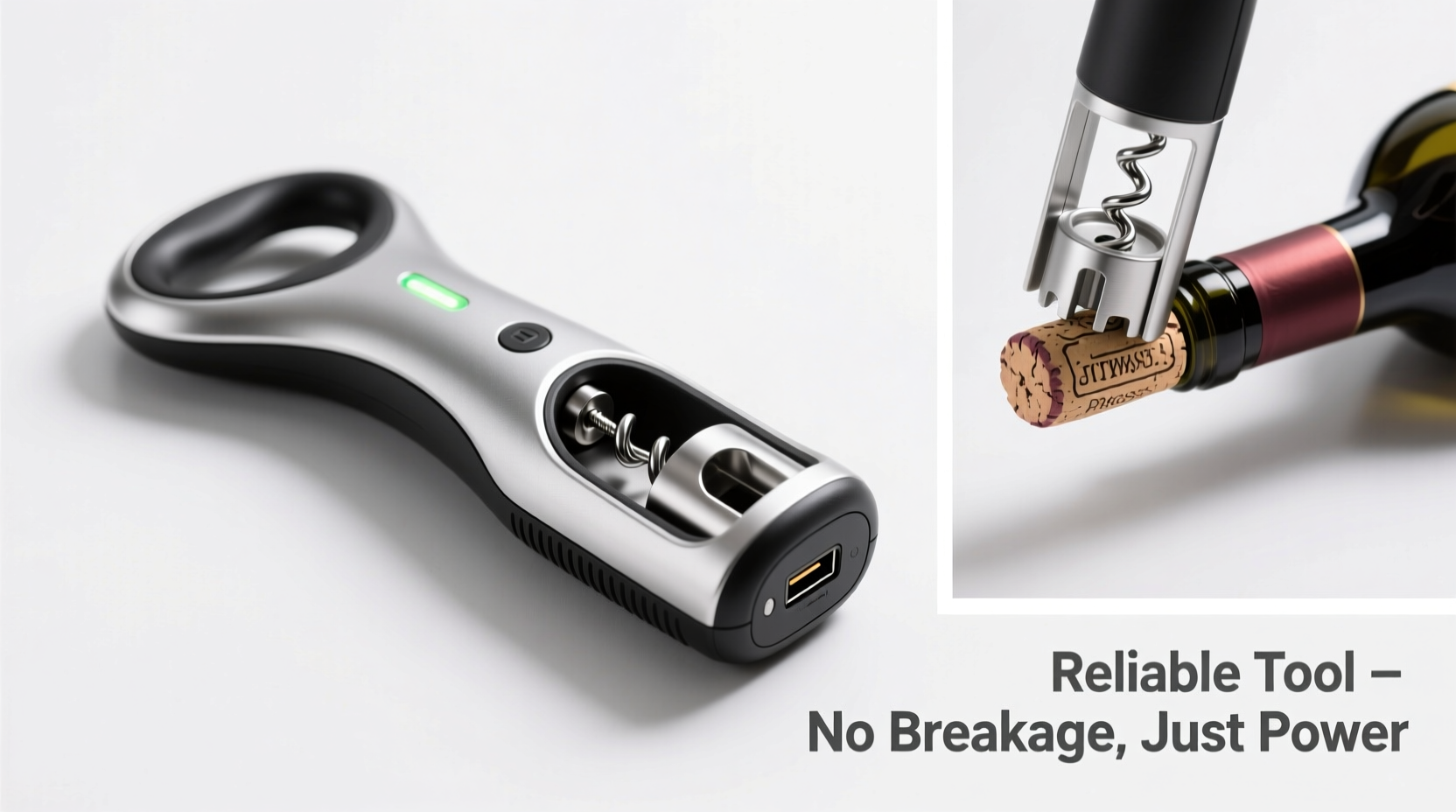
Unlike manual tools, electric cork removers rely on three interdependent systems: a precision motor, a geared transmission, and a rechargeable lithium-ion battery. When activated, the motor spins the helix at 150–220 RPM while a spring-loaded collar guides the bottle neck. A microswitch cuts power once the cork clears the lip—a feature intended to prevent over-rotation and motor burnout. In theory, this is elegant automation. In practice, failure rarely stems from one component alone. Instead, it cascades: a low-grade gear set wears unevenly → increased friction overheats the motor → thermal protection shuts down the unit prematurely → repeated thermal cycling degrades battery capacity → the user forces activation, bypassing safety protocols → internal wiring shorts.
Most failures occur not during the opening itself, but in the “idle-to-engage” transition. Cheap models use generic brushed DC motors with no torque regulation; under slight resistance—say, a slightly compressed or irregularly shaped cork—the motor stalls, drawing excessive current. That surge stresses solder joints on the circuit board, especially near the battery connector. Over time, microscopic cracks form. One technician we spoke with described it as “electronic fatigue”—not dramatic failure, but gradual, cumulative degradation invisible until the unit simply stops responding to the button press.
“The difference between a $35 opener lasting 6 months and a $75 one lasting 5 years isn’t ‘better plastic.’ It’s tighter gear tolerances, copper-wound motor windings instead of aluminum, and firmware that monitors current draw 20 times per second—not once.” — Rafael Mendoza, Senior Electronics Technician, WineTool Repair Group (12 years servicing consumer wine gear)
Reliability by Price Tier: What You’re Actually Paying For
Price correlates strongly with longevity—but not linearly. Below $45, reliability drops sharply. Between $50 and $85, meaningful engineering improvements appear. Above $90, gains plateau unless you need commercial-grade features like dual-battery hot-swap or stainless-steel drive shafts.
| Price Range | Avg. Lifespan (Bottles) | Most Common Failure Point | Repairable? |
|---|---|---|---|
| Under $40 | 80–140 | Motor stall → solder joint fracture | No (non-replaceable PCB, glued housing) |
| $45–$75 | 450–900 | Battery degradation (after 2–3 years), gear wear | Limited (battery replacement possible on 60% of models) |
| $80+ | 1,200–2,500+ | Rare; typically battery or worn helix tip | Yes (modular design, service manuals available) |
The $45–$75 range delivers the best reliability-to-cost ratio for serious home users. These models almost universally use brushless motors (which run cooler and last longer), include thermal cutoffs with hysteresis (preventing rapid on-off cycling), and feature removable battery packs with standardized 18650 cells—making replacement straightforward and affordable. Units under $40 frequently omit even basic thermal monitoring, relying instead on cheap bimetallic strips that degrade after ~200 cycles.
Tip: Before buying, check if the model uses a replaceable 18650 or proprietary battery. If it’s proprietary, assume the unit becomes obsolete when the battery fails—usually within 2–3 years.Real-World Stress Test: A Mini Case Study
Consider Sarah L., a sommelier and part-time wine educator in Portland, OR. She purchased a well-reviewed $59 electric opener for her home tasting group and weekend classes. For the first 18 months, it performed flawlessly—opening ~25 bottles weekly with zero issues. Then, during a holiday event serving 42 guests, the unit began hesitating: it would spin for 1.5 seconds, pause, then spin again—never completing extraction. She assumed a low battery and recharged it fully. The problem persisted. She tried different bottles—same result. After disassembling it (a process requiring only a Phillips #0 screwdriver), she found blackened solder near the motor leads and a cracked thermal sensor. She replaced both components using parts ordered online ($8.20 total) and restored full function. But here’s what mattered: the manufacturer’s warranty had expired at 12 months, and their support team refused to share schematics or confirm part numbers. Sarah’s fix worked—but it required technical confidence most users lack.
This case illustrates a critical reality: mid-tier electric openers aren’t inherently fragile. They’re *serviceable*—but only if you know where to look and have access to parts. Reliability, therefore, includes not just build quality, but post-purchase support infrastructure.
What Actually Breaks—and How to Prevent It
Based on teardown analysis and technician interviews, these are the top four failure vectors—and how to mitigate each:
- Motor Overheating: Caused by forcing extraction on overly dense corks (e.g., high-end Barolo or aged Rioja) or repeated rapid-fire use. Prevention: Allow 10 seconds between openings; never hold the button past cork ejection.
- Battery Degradation: Lithium-ion cells lose capacity fastest when stored at 100% charge or exposed to temperatures above 30°C (86°F). Prevention: Store at ~40–60% charge in a cool cupboard—not on the counter near a stove or in direct sun.
- Gear Slippage: Occurs when plastic gears (common in budget models) warp under heat or load. Audible “grinding” or inconsistent rotation speed signals this. Prevention: Avoid using on synthetic corks or extremely dry, brittle natural corks—these increase resistance unpredictably.
- Helix Tip Wear: The stainless steel spiral dulls after ~800–1,200 extractions. A worn tip slips on cork surface rather than biting in cleanly, causing motor strain. Prevention: Inspect the tip every 200 bottles; replace if grooves are visibly shallow or edges rounded.
Essential Pre-Purchase Checklist
Before clicking “Add to Cart,” verify these six points. Skipping any significantly increases your risk of early failure:
- ✅ Motor Type: Confirmed brushless (not “high-torque” or “premium DC”—vague marketing terms).
- ✅ Battery Standard: Uses replaceable 18650 cells (not proprietary molded packs).
- ✅ Warranty Length: Minimum 2 years, with clear battery coverage (many exclude batteries entirely).
- ✅ Service Documentation: Manufacturer provides downloadable service manual or exploded diagrams.
- ✅ Thermal Protection: Explicitly stated in specs—not just “auto-shutoff” (which may only refer to cork-ejection timing).
- ✅ User-Replaceable Parts: Helix tip, charging dock, and battery listed as spare parts on the website.
Frequently Asked Questions
Can I use an electric cork remover on Champagne or sparkling wine bottles?
No—never. The internal pressure (up to 90 psi) combined with the sudden release of torque can cause the cork to eject violently, damaging the opener’s mechanism and posing injury risk. Electric openers are designed exclusively for still wine bottles with standard natural or composite corks. Use a traditional lever-style or Ah-So for sparkling.
Why does my opener sometimes stop mid-extraction—even on easy corks?
This usually indicates either (a) a low battery (even if the LED shows “full,” voltage sag under load reveals true capacity), or (b) a misaligned bottle guide collar. Try reseating the bottle firmly before pressing start. If the issue persists across multiple bottles, the microswitch detecting cork ejection is likely dirty or worn—clean gently with isopropyl alcohol and a cotton swab.
Do expensive models open corks faster or more smoothly?
Not meaningfully. All functional electric openers extract corks in 3–5 seconds. Higher prices reflect durability engineering—not speed. A $35 unit and a $95 unit will perform identically on a fresh, medium-density cork. The difference emerges only after 300+ uses, when the cheaper unit begins exhibiting hesitation, noise, or inconsistent torque.
Conclusion: Reliability Is a Choice, Not a Lottery
An electric cork remover isn’t unreliable by nature—it’s unreliable when mismatched to expectations. Buying a $32 opener expecting five years of weekly use is like installing economy tires on a sports car and blaming the rubber when they shred at highway speeds. The technology works. The physics are sound. What separates the enduring tools from the disposable ones is intentionality: in design, in materials, in serviceability, and in how we use them. Choose a model in the $55–$75 range with confirmed brushless motor specs and 18650 battery compatibility. Store it properly. Replace the helix tip before it wears out. And understand that its greatest value isn’t in saving ten seconds per bottle—it’s in removing physical strain from a ritual meant to be shared, savored, and sustained.
💬 Your experience matters. Have you used an electric cork remover for over 1,000 bottles—or did yours fail before 100? Share your model, timeline, and what you learned. Real user insights help others make confident, lasting choices.