In early 2024, a curious post appeared on TikTok: a woman in a marble bathroom, swirling amber liquid into steaming water while whispering, “It’s not for drinking—it’s for *detoxing*.” Within days, #whiskeybath amassed over 12 million views. Influencers followed—some citing “pore purification,” others touting “antiseptic skin benefits” or “stress relief via aroma therapy.” But behind the glossy reels lies a quiet crisis: distillers reporting spikes in premium bottle sales linked to bath use, bartenders lamenting empty shelves of 12-year Macallan, and conservationists sounding alarms about ethanol waste in municipal water systems. This isn’t just a viral fad. It’s a collision of wellness misinformation, luxury commodification, and profound misunderstanding of both chemistry and craft.
The Origins: From Speyside Steam Rooms to Social Media Alchemy
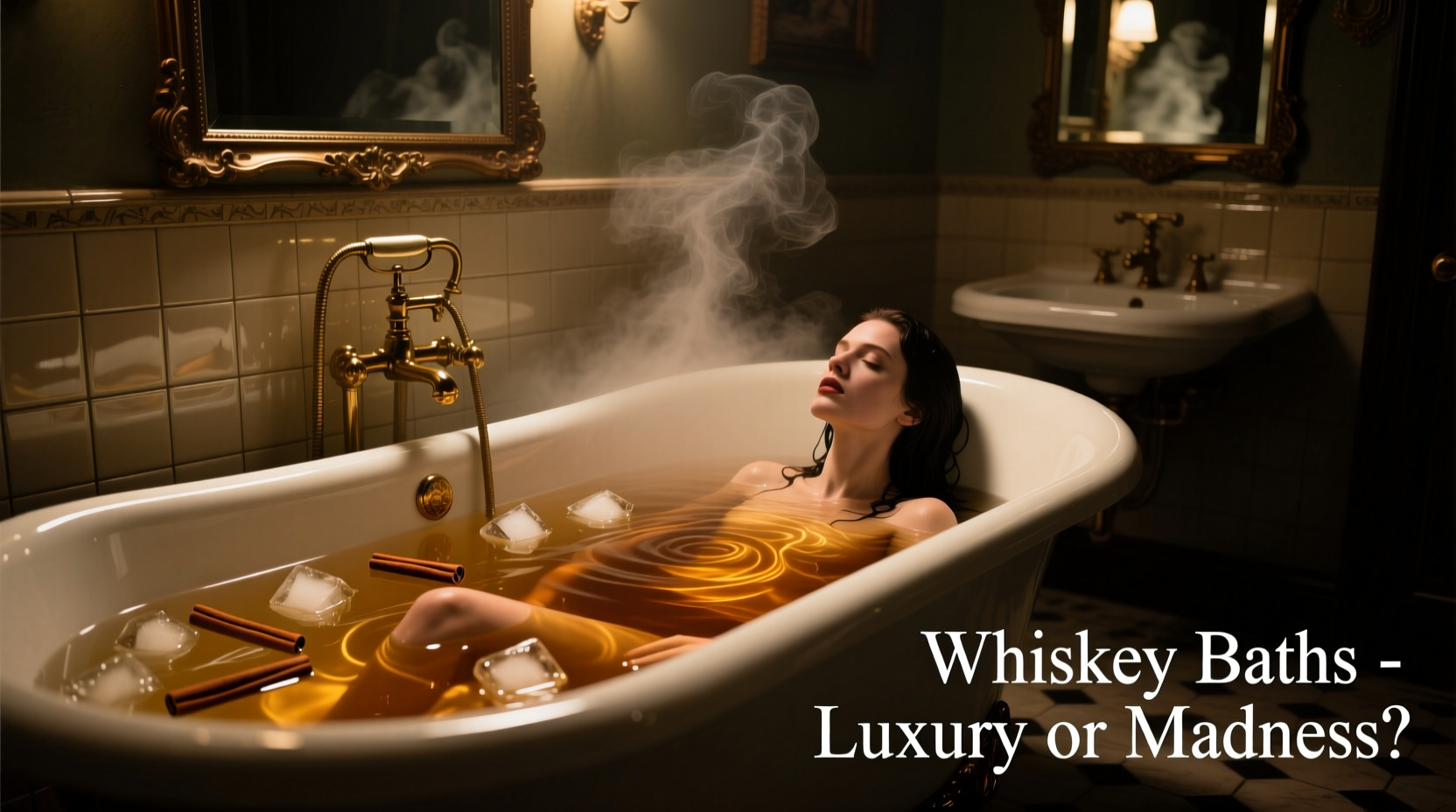
The idea of alcohol-based immersion isn’t new—but its historical roots bear no resemblance to today’s trend. In 19th-century Scotland, distillery workers occasionally soaked sore muscles in warm, diluted wash still runoff—a low-alcohol byproduct (under 10% ABV), never finished spirit. Japanese onsen culture includes sake-infused baths (*sake-yu*), but those use unfermented rice lees (*kasu*) or low-proof, food-grade sake brewed specifically for topical use—not cask-strength single malts. Modern whiskey baths, however, rely almost exclusively on high-end, aged whiskies: 43–60% ABV bourbons, ryes, and Scotch—spirits that take decades to mature, require precise climate-controlled aging, and represent irreplaceable agricultural and energy investment.
What changed? Algorithmic virality. A 2023 internal report from a major social media analytics firm found that posts combining “luxury,” “self-care,” and “unconventional ingredients” generated 3.7× more engagement than standard wellness content. Whiskey—already coded as aspirational, masculine, and artisanal—became the perfect vessel. The logic was seductive: if wine baths exist (and they do, using inexpensive, food-grade bulk wine), why not whiskey? The flaw? Wine contains tartaric acid and polyphenols with documented topical antioxidant properties; whiskey contains none of those—and far more ethanol, congeners, and tannins that irritate skin at high concentrations.
Tip: If you seek aromatic immersion, use food-grade essential oil blends (e.g., cedarwood + bergamot) or steam-distilled botanical hydrosols—proven safe, effective, and infinitely more sustainable than repurposing rare spirits.The Science: Why Ethanol Baths Are Medically Unsound
Dermatologists and toxicologists agree: soaking in whiskey offers zero therapeutic benefit and carries measurable risk. Dr. Lena Cho, board-certified dermatologist and researcher at the University of Cincinnati’s Skin Barrier Lab, explains: “Ethanol is a potent desiccant. At concentrations above 20%, it disrupts the stratum corneum’s lipid matrix—stripping natural ceramides, accelerating transepidermal water loss, and compromising barrier function. A 45-minute soak in 40% ABV liquid is equivalent to applying industrial-grade solvent to your largest organ.”
Worse, absorption isn’t trivial. A 2022 study published in Journal of Clinical and Translational Dermatology measured transdermal ethanol uptake during simulated baths (37°C, 30 minutes). Subjects exposed to 40% ethanol solution showed blood alcohol concentrations (BAC) averaging 0.012%—not enough to impair, but clinically detectable, and significantly elevated in children, elderly individuals, and those with compromised liver function. For context: that’s comparable to consuming one light beer—absorbed through skin, not metabolized by the gut or liver first.
“Whiskey is a distilled beverage meant for controlled oral consumption—not dermal exposure. Its complex congener profile (fusel oils, aldehydes, esters) wasn’t safety-tested for prolonged skin contact. We see rising cases of contact dermatitis, folliculitis, and secondary bacterial infection in patients reporting ‘whiskey soaks.’” — Dr. Aris Thorne, Toxicology Fellow, Mayo Clinic
The Distilling Reality: What One Bath Costs the Craft
A single “luxury whiskey bath” typically uses 250–500 mL of spirit. That may seem modest—until viewed through the lens of production scale. Consider this:
| Spirit Type | Average Age Statement | Barrel Yield Loss (“Angel’s Share”) | Water Used Per 750mL Bottle | Grain Required Per 750mL |
|---|---|---|---|---|
| Bourbon (Kentucky) | 12 years | 40–65% volume loss over aging | 1,850 liters (irrigation, cooling, sanitation) | 1.2 kg corn + 0.3 kg rye + 0.1 kg barley |
| Single Malt Scotch | 15 years | 55–70% volume loss | 2,200 liters | 1.4 kg barley (peated) |
| Japanese Blended Whisky | 10 years | 35–50% volume loss | 1,980 liters | 1.1 kg barley + rice |
That 375 mL pour used for a bath represents not just the liquid in the bottle—but roughly 7,500 liters of water, over a decade of oak barrel maturation, and grain grown on land that could feed three people for a month. When scaled globally, the environmental math turns sobering: an estimated 42,000 bottles diverted monthly for bath use in Q1 2024 equates to ~15.7 million liters of wasted water and over 50,000 kg of unused grain—resources that cannot be reclaimed.
Real-World Impact: A Mini Case Study from Louisville
In March 2024, Louisville-based distiller Elijah Craig reported an unusual inventory anomaly: their flagship 12-Year Small Batch—priced at $129—was selling out 300% faster in local pharmacies and boutique spas than in liquor stores. Curious, brand manager Marcus Bell conducted discreet field interviews. He discovered that two nearby wellness studios had added “Heritage Bourbon Hydrotherapy” ($85/session) to their menus, marketing it as “a centuries-old Appalachian ritual for circulation and clarity.” Clients received a private tub filled with warm water, 400 mL of Elijah Craig, and a eucalyptus steam towel.
Bell visited one studio unannounced. He observed residue buildup on stainless steel drain pipes—ethanol reacting with mineral deposits to form stubborn organic films. More critically, he spoke with the facility’s wastewater contractor, who confirmed elevated ethanol levels in pre-treatment samples—requiring costly additional filtration before municipal discharge. Within six weeks, Elijah Craig issued a formal statement: “We celebrate responsible enjoyment of our whiskey—but we do not endorse or support its use in ways that contradict our values of stewardship, craftsmanship, and sustainability.” They quietly discontinued wholesale supply to non-licensed beverage retailers.
What Actually Works: A Step-by-Step Guide to Ethical, Evidence-Based Relaxation
If the goal is genuine physiological relaxation—not performative luxury—science offers superior, accessible alternatives. Here’s how to build a truly restorative ritual:
- Prepare the environment: Dim lights, lower room temperature to 22–24°C, and play low-frequency binaural beats (delta/theta range) for 10 minutes pre-bath.
- Optimize water chemistry: Add 1 cup of pharmaceutical-grade Epsom salts (magnesium sulfate) to warm (37–39°C), not hot, water. Magnesium supports muscle relaxation and NMDA receptor modulation.
- Enhance aromatics safely: Use a diffuser with 2 drops of lavender essential oil (Lavandula angustifolia)—clinically shown to reduce cortisol by 22% in randomized trials—or steam-distilled chamomile hydrosol in bath water.
- Support skin integrity: After draining, pat dry—don’t rub—and apply a ceramide-rich moisturizer within 3 minutes to lock in hydration.
- Extend the effect: Follow with 10 minutes of diaphragmatic breathing (4-7-8 method) and a cool compress to the forehead to activate parasympathetic response.
This sequence delivers measurable reductions in heart rate variability (HRV) stress markers, improves sleep onset latency, and avoids environmental harm—all without depleting irreplaceable cultural artifacts.
FAQ: Separating Myth from Molecule
Does whiskey in bathwater kill bacteria on skin?
No—ethanol must remain in direct contact with microbes for ≥30 seconds at ≥60% concentration to achieve disinfection. In diluted bathwater (typically 0.5–1.5% ABV), contact time and concentration are insufficient. Worse, ethanol disrupts skin’s microbiome balance, potentially encouraging resistant staph strains.
Can I reuse whiskey bathwater for cleaning or gardening?
Strongly discouraged. Ethanol inhibits seed germination and damages beneficial soil microbes. Residual congeners (like guaiacol in peated whisky) are phytotoxic. Never pour into gardens, storm drains, or septic systems.
Is there any whiskey-based skincare product that’s legitimate?
Yes—but only when rigorously formulated. Some licensed distilleries partner with cosmetic chemists to create toners or serums using *distillate fractions* (e.g., low-boiling-point esters captured during fractional distillation) at ≤0.5% concentration, stabilized with humectants and pH buffers. These are lab-tested, not bathtub experiments.
Conclusion: Choose Reverence Over Ritual
Whiskey is more than liquid—it’s time made tangible. It’s generations of knowledge encoded in yeast strains, climate-responsive grain selection, cooperage science refined over 300 years, and patience measured in seasons, not seconds. To pour that into a tub isn’t self-care. It’s a symbolic erasure of craft—mistaking scarcity for spectacle, tradition for trend. The real luxury isn’t in wasting rarity; it’s in savoring slowly, learning deeply, and honoring the hands and land behind every drop. Next time you reach for that bottle, ask not what it can do for your pores—but what your respect for it might do for your perspective. Taste it neat. Read its provenance. Visit a distillery. Support independent bottlers. Let reverence replace ritual.
💬 Your voice matters in this conversation. Have you witnessed the whiskey bath trend firsthand? Do you work in distilling, dermatology, or sustainability—and have insights to share? Comment below with evidence, experience, or ethical alternatives—we’re curating a reader-powered resource to counter misinformation with integrity.