Dog owners often find themselves pausing mid-sentence, captivated by a sudden, unmistakable movement: their dog tilting its head to the side as if trying to decipher every syllable. This endearing gesture has charmed millions on social media and warmed hearts in homes across the world. But beyond its cuteness, what’s really going on? Is your dog truly listening more intently, or is the head tilt just a clever trick to win extra treats and affection? The answer lies at the intersection of canine anatomy, cognitive processing, and emotional intelligence.
Understanding why dogs tilt their heads involves exploring how they hear, process language, and respond to human cues. While it may seem like a simple quirk, this behavior reveals much about the depth of the bond between humans and dogs—and how finely tuned our pets are to our voices, expressions, and routines.
The Anatomy Behind the Tilt
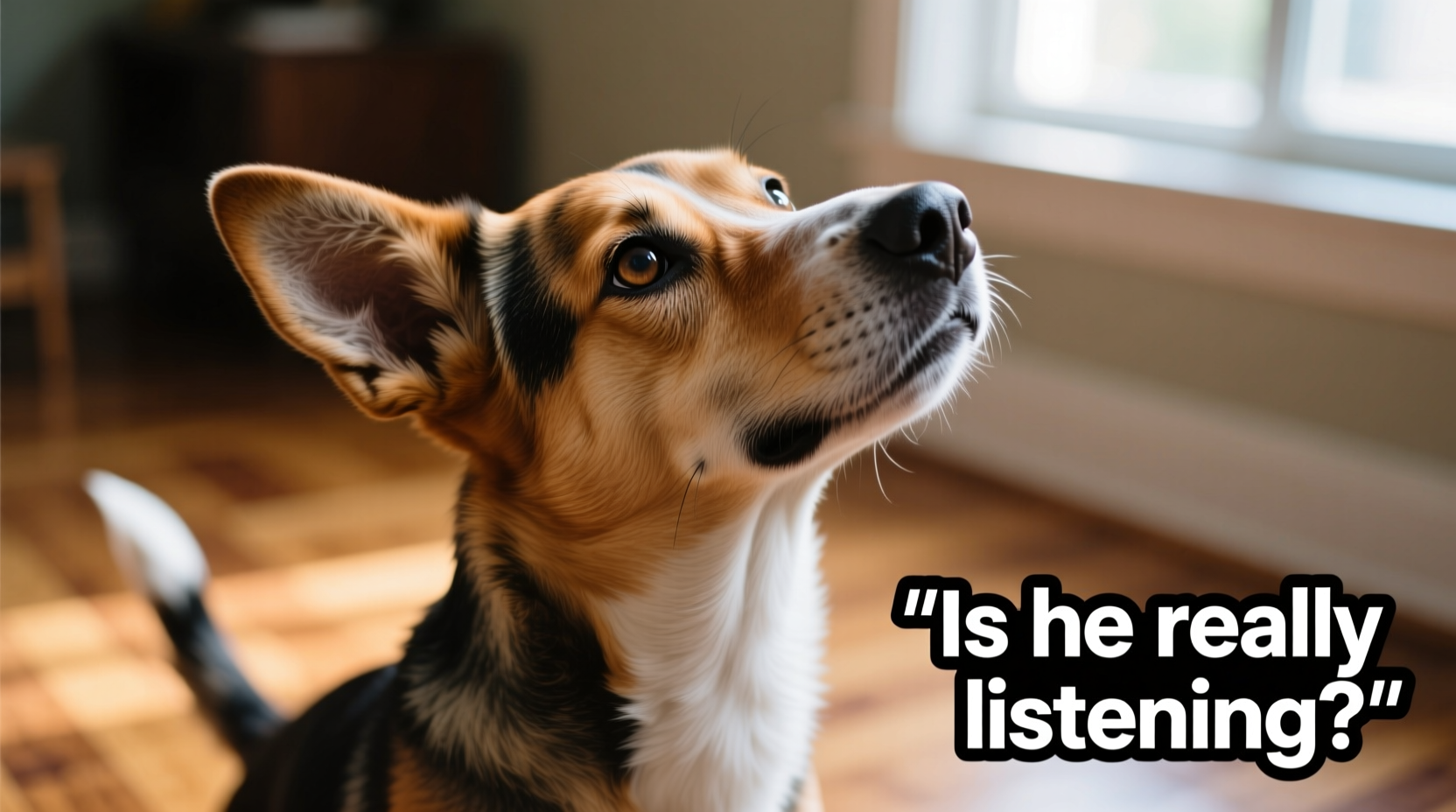
A dog’s skull structure and ear placement play a crucial role in how they perceive sound. Unlike humans, many dog breeds have long, floppy ears that can partially obstruct auditory input. When a dog hears an unfamiliar or high-pitched sound—such as a new word, a change in tone, or a squeaky toy—they may tilt their head to adjust the position of their ears and improve sound localization.
This physical adjustment helps them pinpoint where a sound is coming from and enhances their ability to distinguish subtle nuances in speech. Breeds with longer muzzles, like Collies or Greyhounds, may tilt more frequently than brachycephalic (short-nosed) breeds such as Pugs or Bulldogs, whose facial structure already allows for better forward hearing alignment.
Moreover, the tilt may help reduce visual obstruction. A dog’s muzzle can block part of their lower field of vision. By cocking their head, they gain a clearer view of your facial expressions—especially around the mouth—which aids in interpreting emotional context and understanding commands.
Tip: If your dog tilts their head frequently in quiet environments, consider scheduling a hearing check—excessive tilting without stimulus could indicate ear discomfort or infection.Cognitive Processing and Word Recognition
Research suggests that some dogs possess a surprising capacity for understanding human language. A landmark study published in *Science* magazine highlighted Rico, a Border Collie who could recognize over 200 words—demonstrating fast-mapping abilities similar to those seen in young children.
When you speak, your dog isn’t just reacting to tone; they’re actively parsing familiar words. The head tilt may occur when they encounter a novel word, a changed inflection, or a command delivered in an unusual context. It's a sign of mental engagement—a moment of “Wait, what did you say?”—as they search their mental database for a match.
Dogs rely heavily on associative learning. Over time, they link specific sounds with actions: “walk” means leash time, “sit” means treat opportunity. When a word triggers uncertainty, the tilt may reflect cognitive effort—an attempt to resolve ambiguity by gathering more auditory and visual data.
“Dogs don’t understand grammar, but they excel at pattern recognition. The head tilt often coincides with moments of heightened attention and information processing.” — Dr. Alexandra Horowitz, Canine Cognition Researcher, Barnard College
Emotional Connection and Social Reinforcement
Beyond biology and cognition, the head tilt is deeply rooted in social communication. Dogs are exceptionally attuned to human emotions and expressions. They watch our faces closely, seeking cues about our mood and intentions. A tilted head softens their appearance, making their eyes more visible and their expression appear curious or empathetic.
This look often elicits positive responses from humans—smiles, laughter, petting, or verbal praise. Over time, dogs learn that tilting their head brings rewards. Even if the behavior began as a natural reaction to sound, it can become reinforced through conditioning. Your dog may not only be listening but also performing—offering the tilt because it works.
In households where owners consistently respond warmly to the head tilt, the behavior becomes more frequent. It’s not deception; it’s adaptation. Just as we modify our tone when speaking to babies (known as “parentese”), dogs adapt their body language to strengthen connection and communication.
Real Example: Max the Rescue Terrier
Consider Max, a mixed-breed rescue adopted by a family in Portland. Initially shy and hesitant, Max rarely made eye contact or responded to verbal cues. Over months of consistent training and gentle interaction, his confidence grew. One day, his owner said, “Do you want to go to the park?” in an exaggerated, upbeat tone. Max froze, ears perked, then slowly tilted his head to the left. Within seconds, he dashed to the door.
His foster mom noticed the head tilt only occurred with certain phrases—never during neutral conversation. She began tracking which words triggered it: “treat,” “ball,” “vet,” and “bath.” The tilt was selective, appearing most often with emotionally charged or action-linked vocabulary. It became clear Max wasn’t just reacting to sound—he was associating words with outcomes, and the head tilt signaled active comprehension.
Do All Dogs Tilt Their Heads? Breed and Individual Differences
No single explanation fits all dogs. Head tilting varies significantly by breed, age, hearing ability, and personality. Some dogs never tilt their heads, while others do so at the slightest whisper.
Below is a comparison of factors influencing head-tilting frequency:
| Factor | Promotes Tilting | Reduces Tilting |
|---|---|---|
| Hearing Sensitivity | High-frequency hearing, responsive to tonal shifts | Hearing loss or deafness |
| Breed Type | Long-muzzled breeds (e.g., Shelties, Shepherds) | Brachycephalic breeds (e.g., Boxers, Boston Terriers) |
| Training Level | Highly trained dogs attentive to verbal cues | Minimally trained dogs less focused on speech |
| Age | Younger dogs more curious and reactive | Older dogs with reduced hearing or mobility |
| Socialization | Dogs raised with strong human interaction | Shy or under-socialized dogs |
It’s important to note that absence of head tilting doesn’t indicate disinterest or poor listening skills. Many attentive dogs express focus through stillness, eye contact, or ear positioning rather than dramatic physical gestures.
When Listening Goes Beyond Words: The Role of Tone and Rhythm
Dogs may not grasp syntax, but they are remarkably skilled at interpreting prosody—the rhythm, pitch, and emotional tone of speech. A 2016 study conducted at Eötvös Loránd University in Hungary used fMRI scans to show that dogs process emotional tones in a brain region analogous to the human auditory cortex.
This means your dog can tell the difference between a happy “Good boy!” and an angry “What did you do?”, even if the words are the same. The head tilt often follows changes in vocal pitch—particularly rising intonation associated with questions or excitement. In these moments, the dog is not just hearing words but analyzing emotional intent.
Additionally, dogs respond to rhythmic patterns. Commands delivered in a consistent cadence—like “Sit. Stay. Come.”—are easier to recognize than casual, run-on sentences. When you break routine and speak in a sing-song or unpredictable way, your dog may tilt their head to recalibrate their expectations.
Tip: Use clear, consistent tone and phrasing when training. Avoid overly emotional inflections that might confuse your dog during learning phases.Is My Dog Actually Listening? Signs Beyond the Tilt
The head tilt is one of many indicators of canine attention. To determine whether your dog is truly listening, observe the full spectrum of behavioral cues:
- Ears forward or swiveling: Indicates active sound collection.
- Stilled body posture: A sudden freeze suggests focus.
- Eye contact: Sustained gaze shows engagement.
- Tail position: Relaxed or gently wagging tail signals attentiveness; stiff tail may indicate alertness or tension.
- Movement toward you or a related object: Action confirms understanding (e.g., heading to the door when you say “leash”).
If your dog tilts their head but then walks away, they may have been momentarily intrigued but not fully engaged. Conversely, a dog that doesn’t tilt but immediately obeys a command is clearly listening—even without the theatrical flair.
Checklist: Is Your Dog Understanding You?
Use this checklist to assess your dog’s listening and comprehension skills:
- ✅ Responds consistently to basic commands (sit, stay, come).
- ✅ Reacts differently to praise vs. correction tones.
- ✅ Associates words with actions (e.g., runs to grab leash at “walk”).
- ✅ Pays attention when spoken to, even with distractions.
- ✅ Shows curiosity (head tilt, ear movement) when hearing new words.
- ✅ Ignores irrelevant speech (proving selectivity, not indifference).
Frequently Asked Questions
Does head tilting mean my dog is confused?
Not necessarily. While confusion can trigger a head tilt, it’s more often a sign of focused listening. Dogs tilt their heads when processing new or ambiguous stimuli—not just when they’re lost. Context matters: if they follow up with correct action, they likely understood.
Can excessive head tilting be a sign of illness?
Yes. Occasional tilting is normal, but persistent head tilting—especially if accompanied by balance issues, circling, or ear scratching—may indicate an ear infection, vestibular disease, or neurological problem. Consult your veterinarian if the behavior is constant or one-sided.
Can I train my dog to tilt his head on command?
Yes, using positive reinforcement. Hold a treat slightly above and to the side of their head, prompting a natural upward gaze and tilt. Say a cue like “listen” and reward immediately. With repetition, the behavior can become cued—though it’s best used sparingly to avoid encouraging strain.
Conclusion: More Than Just Cute—A Window Into Canine Mindfulness
The head tilt is far more than a photogenic reflex. It’s a complex behavior shaped by evolution, anatomy, and emotional intelligence. When your dog tilts their head as you speak, they are likely doing exactly what it appears: listening with intention, seeking clarity, and connecting with you on a deeper level.
Recognizing this behavior for what it is—a blend of curiosity, cognition, and companionship—enhances our appreciation of dogs not just as pets, but as sentient beings finely attuned to our world. Whether they tilt daily or never at all, every dog listens in their own way.
💬 Does your dog tilt their head when you talk? Share your story or observations in the comments—let’s celebrate the unique ways our dogs choose to listen.








