
Fireworks can transform a festive night into a terrifying ordeal for dogs. The sudden booms, bright flashes, and unpredictable rhythms trigger intense fear in many canines, leading to trembling, pacing, panting, or even destructive behavior. As a pet owner, seeing your dog suffer is distressing. Two popular solutions—calming collars and ThunderShirts—promise relief, but which one actually works better for firework anxiety? This article dives deep into the mechanisms, scientific backing, user experiences, and practical considerations of both options to help you make an informed decision.
Understanding Canine Firework Anxiety
Dogs have significantly more sensitive hearing than humans, capable of detecting frequencies up to 65,000 Hz (compared to our 20,000 Hz limit). Fireworks produce sharp, high-decibel sounds that not only startle but can cause physical discomfort. Unlike predictable noises, fireworks are erratic—no pattern, no warning—which amplifies stress. This triggers the dog’s fight-or-flight response, releasing cortisol and adrenaline. Chronic exposure without intervention can lead to long-term anxiety disorders.
Effective management requires more than just comfort; it demands tools that address the physiological and psychological roots of fear. That’s where calming collars and ThunderShirts come in—each operating on different principles but aiming for the same goal: reducing your dog’s panic during fireworks.
How Calming Collars Work: Pheromones and Science
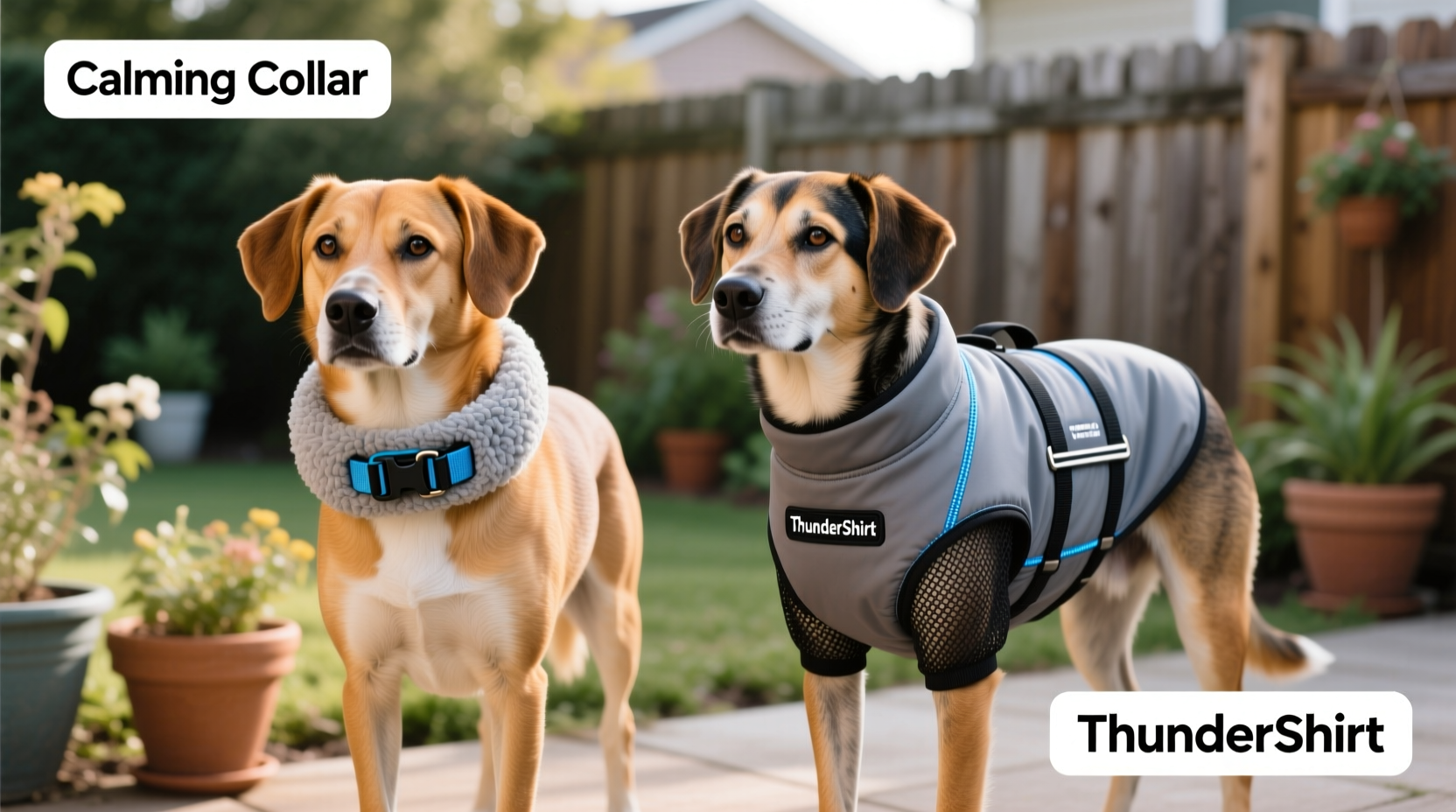
Calming collars, such as Adaptil, release synthetic versions of dog-appeasing pheromones (DAP). These are chemical signals naturally produced by mother dogs to reassure their puppies. When released into the environment, they signal safety and comfort to adult dogs as well, helping to modulate emotional responses.
The collar continuously diffuses these pheromones around the dog’s head and neck, where they’re inhaled through the vomeronasal organ—a specialized scent receptor linked directly to the brain’s limbic system, which governs emotions and memory.
According to veterinary behaviorist Dr. Karen Overall, “Pheromone therapy doesn’t sedate, but it can lower baseline anxiety levels, making other interventions like training or environmental modification more effective.”
“Pheromones provide a subtle but consistent background signal of safety. They won’t stop a panic attack, but they can reduce the intensity over time.” — Dr. Nicholas Dodman, Veterinary Behaviorist
Calming collars typically last 30 days and are waterproof, making them low-maintenance. However, they work best when used preventively—starting a few days before expected fireworks—and may take 1–2 weeks to show noticeable effects in chronic cases.
ThunderShirt: Pressure-Based Calming Technology
The ThunderShirt operates on the principle of gentle, constant pressure applied across the dog’s torso. Inspired by Temple Grandin’s squeeze machine for cattle, the idea is that deep touch pressure can have a calming effect on the nervous system by stimulating the parasympathetic response—the body’s natural relaxation mechanism.
When a dog wears a ThunderShirt correctly, it applies snug but non-restrictive compression around the chest and back. This mimics the feeling of being held or swaddled, which many dogs find comforting during stressful events.
Unlike pheromone collars, ThunderShirts offer immediate tactile feedback. In a 2014 study published in *Applied Animal Behaviour Science*, 89% of dog owners reported improvement in anxiety symptoms when using a pressure wrap during storms and fireworks.
However, proper fit is critical. If too loose, it won’t be effective; if too tight, it can increase stress. Dogs should be able to breathe easily and move normally. Most manufacturers recommend limiting continuous wear to 1–2 hours at a time with breaks to prevent skin irritation or overheating.
Tip: Introduce the ThunderShirt during calm moments first. Let your dog wear it briefly while playing or eating to create positive associations before fireworks season.Comparative Analysis: Calming Collar vs ThunderShirt
To determine which solution performs better, we evaluated both products across key criteria relevant to firework anxiety.
| Feature | Calming Collar | ThunderShirt |
|---|---|---|
| Mechanism | Synthetic pheromones (DAP) | Gentle pressure on torso |
| Onset of Action | 1–7 days (preventive use recommended) | Immediate (within minutes) |
| Duration of Use | Up to 30 days per collar | 1–2 hours per session (with breaks) |
| Scientific Support | Moderate (studies show reduced cortisol in stressed dogs) | Strong owner-reported efficacy; limited peer-reviewed trials |
| Breed/Size Suitability | All sizes (collar adjusts) | Must be sized correctly; less effective on very large or short-haired breeds |
| Weather Considerations | Works in all conditions | Risk of overheating in warm weather |
| Cost (Initial) | $20–$30 per collar | $40–$60 per shirt |
| Long-Term Value | Monthly replacement needed | Reusable; lasts years with care |
The table reveals a trade-off: calming collars offer sustained, passive support ideal for prolonged firework seasons (e.g., July 4th week or New Year’s Eve), while ThunderShirts deliver rapid, targeted relief during peak noise events.
Real-World Case: Max, the German Shepherd During Firework Season
Max, a 4-year-old German Shepherd in Colorado, had a severe reaction to fireworks every summer. His owner, Sarah, tried several methods before settling on a combination approach.
In previous years, Max would bark incessantly, scratch at doors, and hide under beds. One year, Sarah tried only the ThunderShirt. While Max was calmer initially, he became agitated after about 90 minutes—likely due to discomfort from prolonged wear.
The following year, she started using an Adaptil collar five days before Independence Day. She noticed Max seemed less reactive overall in the days leading up to the event. On the night of the fireworks, she added the ThunderShirt. This time, Max paced briefly but then lay down and eventually fell asleep.
“It wasn’t magic,” Sarah said, “but it was the first year I didn’t have to hold him the whole night. He still flinched at loud booms, but he recovered faster.”
This case illustrates a growing trend among veterinarians and trainers: combining modalities often yields better results than relying on a single product.
Step-by-Step Plan for Managing Firework Anxiety
Whether you choose a calming collar, ThunderShirt, or both, a structured plan increases success. Follow this timeline in the days leading up to and during fireworks:
- 2 Weeks Before: Begin using the calming collar daily. This allows pheromone levels to build and reduce baseline anxiety.
- 1 Week Before: Introduce the ThunderShirt during quiet times. Pair it with treats and play to create positive reinforcement.
- 3 Days Before: Start desensitization training. Play low-volume firework recordings while your dog eats or plays. Gradually increase volume over days if tolerated.
- On Event Night: Put on the ThunderShirt 30 minutes before expected fireworks. Close windows and curtains to muffle sound and light. Turn on white noise or calming music.
- During the Event: Stay calm. Avoid overly comforting fearful behavior, but remain present. Offer puzzle toys or chew treats to redirect focus.
- After the Event: Remove the ThunderShirt after 1–2 hours. Continue using the calming collar for ongoing support.
When to Combine Both Methods
For dogs with moderate to severe firework anxiety, using both a calming collar and ThunderShirt together can be highly effective. The collar provides a continuous sense of security, lowering overall arousal, while the ThunderShirt offers acute, physical reassurance during the most intense moments.
Veterinary behavior clinics increasingly recommend multimodal approaches. As Dr. Sophia Yin noted, “Anxiety is complex. Relying on one tool is like using only a bandage for a deep wound. You need layers of intervention.”
If your dog has never responded to either method alone, consider pairing them. Monitor your dog closely the first few times to ensure they don’t show signs of increased stress (e.g., excessive panting, whining, or attempts to escape).
Frequently Asked Questions
Can I use a calming collar and ThunderShirt at the same time?
Yes, and it’s often recommended for dogs with severe anxiety. The mechanisms are complementary—one works chemically, the other physically—and there are no known interactions between the two.
Are calming collars safe for puppies?
Yes, calming collars like Adaptil are safe for puppies as young as 8 weeks. In fact, they were originally developed to support puppies during transitions like adoption or training.
How do I know if the ThunderShirt fits properly?
The ThunderShirt should be snug but allow room for two fingers between the fabric and your dog’s body. It should cover the chest and go behind the front legs without restricting movement or breathing.
Final Recommendation: Which Works Better?
There is no universal answer. For mild anxiety or preventive care, a calming collar is cost-effective, easy to use, and provides round-the-clock support. For acute episodes where immediate calming is needed, the ThunderShirt often delivers faster, more noticeable results.
However, the most effective strategy for severe firework anxiety is combining both. Use the calming collar consistently throughout firework season to maintain lower stress levels, and deploy the ThunderShirt during actual events for targeted relief.
Ultimately, every dog is different. Some respond strongly to pheromones; others thrive under pressure. The best approach is patient experimentation, careful observation, and, when necessary, consultation with a veterinarian or certified animal behaviorist.
Take Action Today for a Calmer Fourth
Your dog doesn’t have to suffer through another firework season in fear. Start early, combine tools wisely, and build a supportive environment. Whether you choose a calming collar, ThunderShirt, or both, taking proactive steps now can transform nights of panic into moments of peace. Share your experience, explore what works for your dog, and give them the gift of calm.
💬 Have a tip or story about managing your dog’s firework anxiety? We’d love to hear how calming collars, ThunderShirts, or other methods helped your pet. Leave a comment and support fellow dog owners!








