
Maintaining crystal-clear aquarium water isn’t just about aesthetics—it’s essential for the health of your fish, plants, and beneficial bacteria. While regular water changes and proper feeding habits play a role, the heart of water clarity lies in your filtration system. Not all filters are created equal. Each type—mechanical, biological, and chemical—works differently, and some excel at keeping water clear longer than others.
Understanding how each filter functions, their strengths, limitations, and maintenance demands can help you make an informed decision. This guide compares the most common fish tank filter types, evaluates their ability to maintain long-term water clarity, and provides actionable advice based on real-world performance and expert recommendations.
How Filtration Works: The Three Pillars of Clean Water
Fish tank filters rely on three core processes to keep water clean: mechanical, biological, and chemical filtration. A high-performing system integrates all three, but the balance and efficiency vary by filter type.
- Mechanical filtration physically removes debris like uneaten food, fish waste, and plant matter using sponges, floss, or foam. This is critical for immediate clarity.
- Biological filtration uses beneficial bacteria (like Nitrosomonas and Nitrobacter) to break down toxic ammonia into nitrite, then into less harmful nitrate. This process stabilizes water chemistry and prevents algae blooms that cloud water.
- Chemical filtration involves media such as activated carbon, phosphate removers, or resins that absorb dissolved pollutants, tannins, odors, and discoloration.
The best filters combine these methods effectively, but some prioritize one over others. The key to lasting clarity is sustained biological stability and consistent mechanical trapping, supported by periodic chemical polishing.
Tip: Rinse mechanical media in old tank water (never tap water) during water changes to preserve beneficial bacteria colonies.Common Fish Tank Filter Types: Pros, Cons, and Clarity Performance
Five main filter types dominate the aquarium market: sponge, hang-on-back (HOB), canister, internal power, and undergravel filters. Each has distinct advantages and drawbacks when it comes to maintaining clear water over time.
Sponge Filters
Simple and effective for small tanks or breeding setups, sponge filters use air-driven suction to pull water through a porous sponge. They’re excellent for biological filtration due to large surface area for bacterial colonization.
However, they offer minimal mechanical filtration for fine particles and no chemical filtration unless modified. While reliable and gentle, they don’t produce strong enough flow for larger tanks and often leave water slightly hazy over time if not paired with additional filtration.
Hang-On-Back (HOB) Filters
Popular among beginners and mid-level hobbyists, HOB filters attach to the back rim of the tank and draw water up through intake tubes. They typically include multiple media chambers for mechanical, biological, and chemical filtration.
Modern models feature adjustable flow rates and customizable trays. Their continuous water movement helps prevent dead spots and promotes oxygen exchange. With regular maintenance, HOB filters can keep water visibly clear for weeks. However, they lose efficiency as mechanical media clogs, requiring frequent rinsing or replacement.
Canister Filters
Often considered the gold standard for clarity and performance, canister filters sit beneath the tank and use powerful pumps to push water through multiple stages of filtration media. They support deep mechanical filtration (via filter floss), robust biological media (ceramic rings, bio-balls), and optional chemical resins.
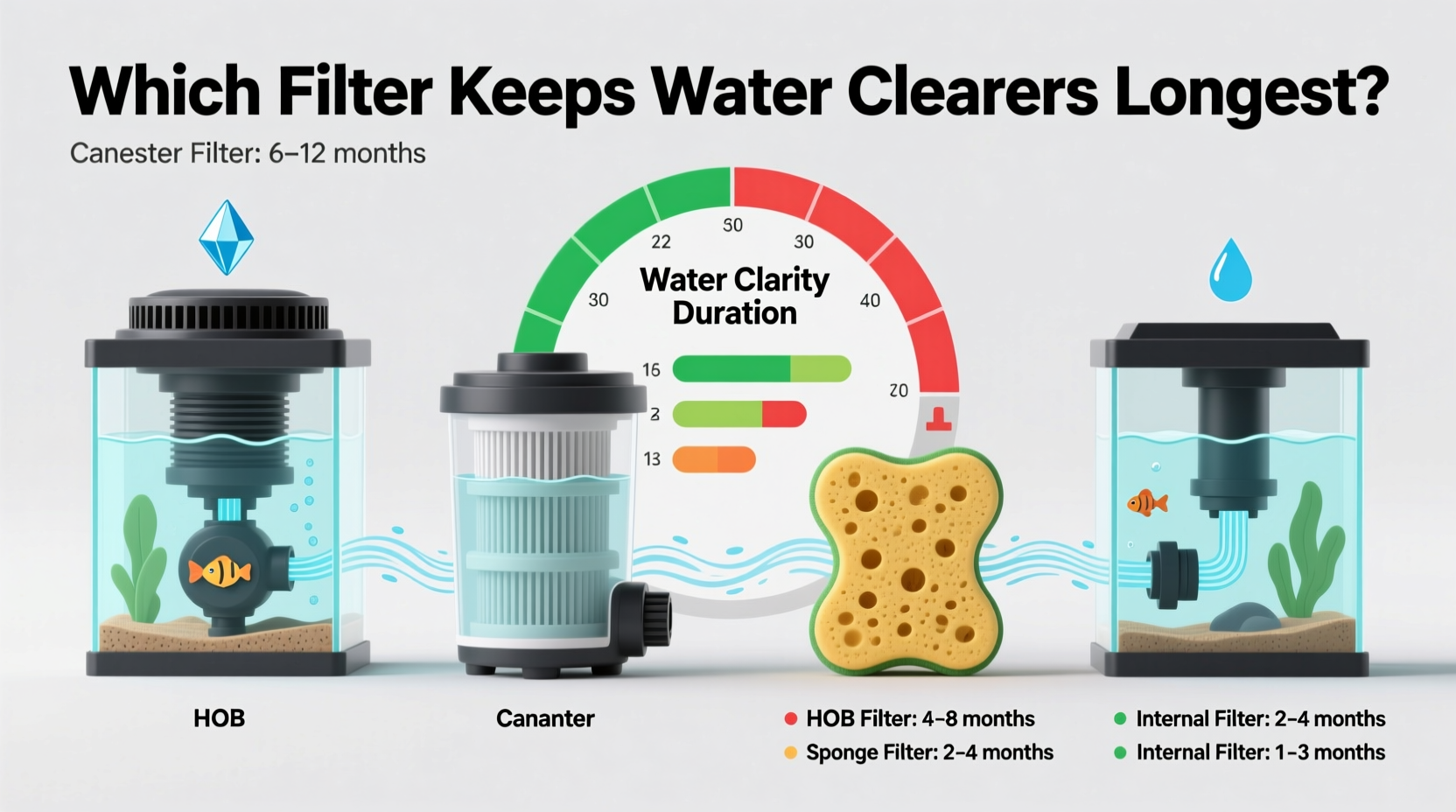
Because of their high flow rate and large media capacity, canister filters trap fine particles more efficiently and sustain biological balance longer than other types. Many aquarists report water staying “glass-like” for 4–6 weeks between major maintenance sessions—longer than any other filter category.
“Canister filters provide superior turnover and multi-stage filtration, making them ideal for achieving and maintaining pristine water conditions.” — Dr. Mark Reynolds, Aquatic Systems Biologist
Internal Power Filters
Submerged inside the tank, these compact units are suitable for smaller aquariums (up to 30 gallons). They combine sponge and cartridge-based filtration in a single unit. While convenient and quiet, their limited space restricts media diversity and capacity.
They perform adequately for short-term clarity but require frequent cleaning—often weekly—to avoid clogging and reduced flow. Without upgrades, they struggle to maintain long-term clarity in heavily stocked tanks.
Undergravel Filters
Once mainstream, undergravel filters use uplift tubes and an air pump or powerhead to pull water down through the substrate, where gravel acts as both mechanical and biological media. Though low-cost and invisible, they have significant downsides.
They trap debris deep in the substrate, which can decay and release nutrients that fuel algae. Over time, they become less efficient and may contribute to cloudy water if not vacuumed thoroughly during every water change. Most modern aquarists consider them outdated for clarity-focused setups.
Comparison Table: Filter Types and Long-Term Clarity Performance
| Filter Type | Mechanical Efficiency | Biological Capacity | Chemical Media Support | Clarity Duration | Maintenance Frequency |
|---|---|---|---|---|---|
| Sponge | Low-Moderate | High | Low (add-on only) | 1–2 weeks | Every 2–3 weeks |
| Hang-On-Back (HOB) | Moderate-High | Moderate | High (customizable) | 2–4 weeks | Every 2–3 weeks |
| Canister | Very High | Very High | Very High | 4–6+ weeks | Every 4–6 weeks |
| Internal Power | Moderate | Moderate | Low-Moderate | 1–2 weeks | Weekly |
| Undergravel | Low (deep trapping) | Moderate | None | 1–2 weeks (with vacuuming) | Weekly (substrate cleaning) |
The table shows that while several filters offer decent clarity, **canister filters consistently outperform others in sustaining long-term water clarity** due to superior flow, media volume, and balanced filtration stages.
Step-by-Step Guide: Maximizing Water Clarity Based on Your Filter Type
No filter performs optimally without proper setup and maintenance. Follow this timeline to get the clearest water possible from your current system:
- Week 1: Install and Prime
Set up your filter according to manufacturer instructions. For new tanks, ensure all media is properly seated. Run the system continuously. Avoid adding fish until the nitrogen cycle is established (typically 4–6 weeks). - Week 2–4: Monitor and Adjust Flow
Check for dead zones where debris accumulates. Adjust intake/output direction to improve circulation. Test water for ammonia, nitrite, and nitrate levels weekly. - Month 1: First Maintenance
Rinse mechanical media in dechlorinated tank water. Replace chemical media (e.g., activated carbon) if used. Do not clean biological media aggressively—gentle swishing is enough. - Every 4 Weeks (Ongoing): Scheduled Upkeep
For HOB and internal filters: replace cartridges or rinse sponges. For canister filters: clean impeller, check hoses, and rotate media layers. Perform 25% water change simultaneously. - Every 3 Months: Deep Evaluation
Inspect pump performance, check for leaks (canisters), and assess media degradation. Consider upgrading media types—for example, using fine filter floss for polishing or specialized resins for phosphate control.
Mini Case Study: From Murky to Mirror-Like in 6 Weeks
James, a beginner aquarist with a 55-gallon community tank, struggled with persistently cloudy water despite weekly water changes. He was using a basic HOB filter and feeding flake food twice daily. Algae coated the glass within days, and visibility dropped after weekends.
After consulting a local fish store, he upgraded to a mid-range canister filter and added a layer of fine filter floss behind the ceramic rings. He also began using a phosphate remover pad monthly and reduced feeding to once per day.
Within two weeks, the water noticeably brightened. By week six, it remained crystal clear even after feeding. Ammonia and nitrite stayed at zero, and nitrate levels rose more slowly, indicating better overall system stability. James now cleans his filter only once a month and reports the tank looks “better than it ever has.”
Expert Tips for Sustained Clarity Beyond the Filter
A filter is only one part of the equation. Supporting practices significantly impact how long water stays clear.
- Control Feeding: Overfeeding is the leading cause of excess waste. Feed only what fish consume in 2 minutes, once or twice daily.
- Vacuum Substrate Weekly: Use a gravel vacuum during water changes to remove detritus before it breaks down.
- Limit Light Exposure: Excessive light fuels algae. Use timers to limit lighting to 8–10 hours per day.
- Add Live Plants: Fast-growing plants like hornwort or java moss compete with algae for nutrients and improve biological balance.
- Use Filter Media Strategically: Layer coarse sponge first, then fine floss, followed by biological media, and finally chemical media (if needed) for optimal flow and efficiency.
FAQ: Common Questions About Filter Performance and Clarity
Why does my water get cloudy shortly after cleaning the filter?
This is usually due to disturbing the biological balance. When you clean all media at once—especially with tap water—you kill beneficial bacteria. Instead, stagger cleaning: rinse mechanical media one week, and handle biological media lightly the next. Cloudiness should clear within 24–48 hours as bacteria rebound.
Do I need chemical filtration to keep water clear?
Not always. In well-balanced tanks, mechanical and biological filtration suffice. However, chemical media like activated carbon can remove yellow tints from tannins or medications, and phosphate removers prevent algae-causing nutrient buildup. Use them periodically, not continuously, to avoid stripping trace elements.
Which filter is best for a planted tank?
Canister filters are ideal for planted tanks because they support high flow without disturbing substrate, allow custom media packing (e.g., nitrate-reducing resins), and maintain stable water parameters crucial for plant health. Their quiet operation and hidden design also complement aesthetic layouts.
Final Checklist: Choosing and Maintaining a Clarity-Optimized Filter
- Assess tank size and bioload (number and type of fish).
- Select a filter with a flow rate of at least 4–6 times the tank volume per hour (e.g., 300 GPH for a 50-gallon tank).
- Prioritize customizable media chambers for layered filtration.
- Install fine mechanical media (filter floss) for polishing.
- Rinse mechanical media in tank water every 2–3 weeks.
- Replace chemical media monthly or as directed.
- Never clean all media at once—preserve biological colonies.
- Perform monthly inspections of pumps, hoses, and seals.
- Combine filtration with routine water changes and substrate cleaning.
- Monitor water parameters weekly to catch issues early.
Conclusion: Achieving Lasting Water Clarity Starts Here
While all filters contribute to cleaner water, the choice you make directly impacts how long that clarity lasts. Canister filters stand out for their ability to deliver consistently clear water over extended periods, thanks to powerful flow, extensive media capacity, and balanced filtration stages. However, even the best filter requires smart maintenance and supportive husbandry practices.
By understanding how each filter type works, optimizing your setup, and following a disciplined care routine, you can enjoy a stunning, healthy aquarium where every fish and plant shines through pristine water. Don’t settle for temporary fixes—invest in a system that delivers lasting results.
💬 Have experience with a filter that kept your tank crystal clear for weeks? Share your story or tips in the comments—your insight could help fellow aquarists achieve the same results!








