Creativity doesn’t follow a single path. For artists, designers, and hobbyists alike, the tools used to express ideas can shape not only the final outcome but also the entire creative journey. In recent decades, digital art has surged in popularity, offering powerful software, undo buttons, and limitless layers. Yet, the traditional sketchbook—ink-stained, tactile, and unfiltered—remains a beloved staple for many creators. The real question isn’t about superiority, but rather: which medium fosters deeper, more authentic inspiration? The answer depends on context, personality, and process—but understanding the strengths and limitations of each is essential for making informed choices.
The Sensory Experience of Traditional Sketching
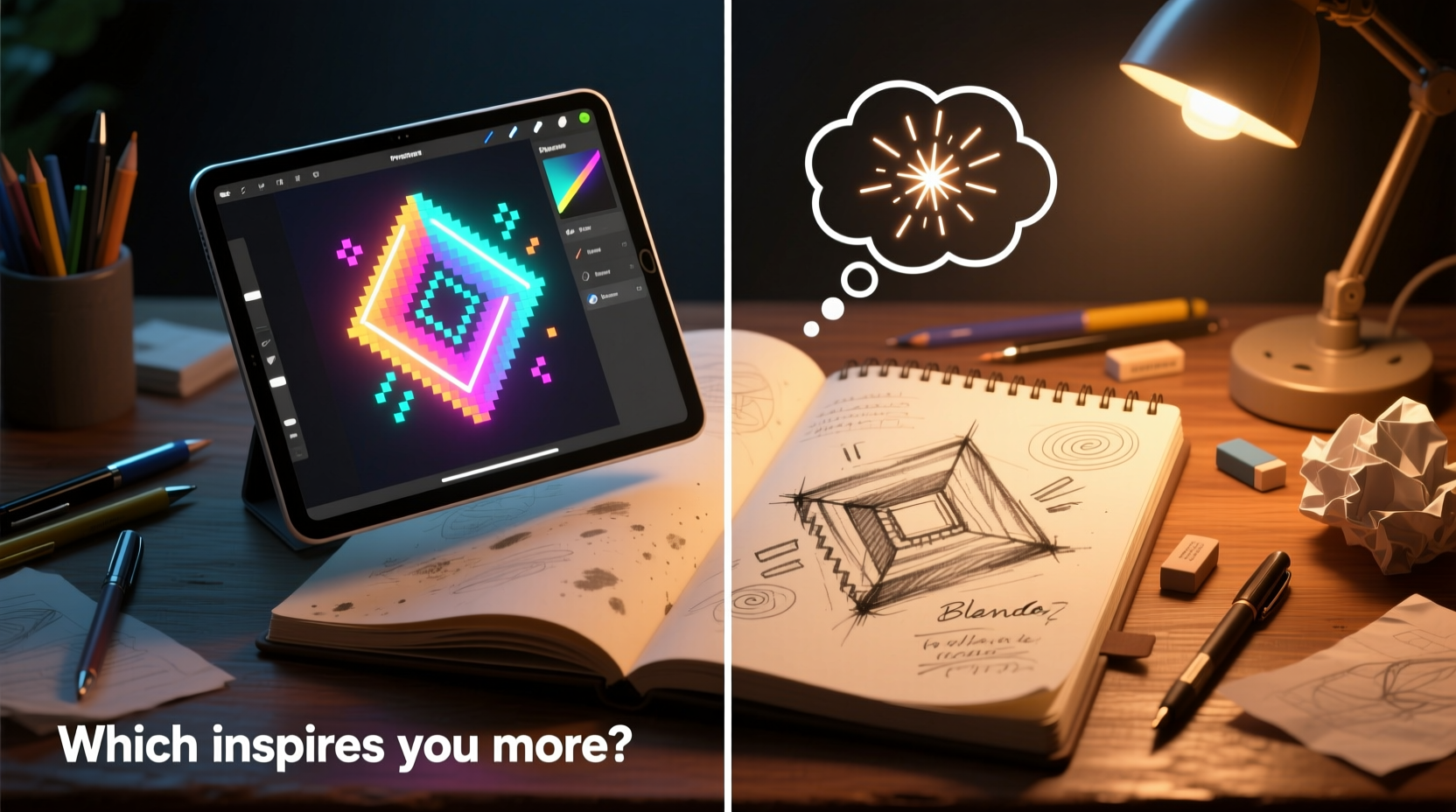
Working with pencil, pen, or charcoal on paper engages multiple senses. The resistance of the nib against textured paper, the faint sound of graphite gliding across a page, the subtle smell of ink or eraser shavings—all contribute to a grounded, immersive experience. This physicality creates a direct feedback loop between hand and mind, often leading to spontaneous marks, happy accidents, and organic flow.
Many artists report that sketchbooks feel less intimidating than blank digital canvases. There’s no startup time, no software updates, no pressure to “save” or “export.” A notebook fits in a coat pocket; a tablet requires charging, stylus calibration, and app selection. The immediacy of traditional tools lowers the barrier to entry, encouraging frequent, low-stakes experimentation.
“Drawing by hand forces you to commit. There’s beauty in imperfection—and that’s where real creativity begins.” — Lin Zhang, illustrator and educator at Rhode Island School of DesignTip: Carry a small sketchbook daily. Even five minutes of observational drawing can spark new ideas and strengthen creative intuition.
Digital Art: Precision, Flexibility, and Infinite Possibilities
Digital platforms like Adobe Fresco, Procreate, or Clip Studio Paint offer capabilities unmatched by physical media. Layers allow non-destructive editing. Undo functions eliminate fear of mistakes. Custom brushes simulate watercolor, oil, or airbrush effects with astonishing realism. Color adjustments, resizing, and exporting are seamless. For professionals working under deadlines, these efficiencies are invaluable.
Beyond practicality, digital tools open doors to hybrid workflows. Artists can scan hand-drawn sketches and enhance them digitally, blending the spontaneity of analog with the polish of digital refinement. Animation, 3D integration, and interactive design are also far more accessible in digital environments.
However, this flexibility comes at a cost. The very features designed to reduce friction—undo, copy-paste, auto-align—can sometimes stifle risk-taking. When every mistake is easily erased, there’s less incentive to explore boldly. Some creatives find themselves over-editing, chasing perfection instead of progress.
A Real Creative Dilemma: Maya’s Journey
Maya, a concept artist based in Toronto, spent years developing her style through daily sketchbook practice. Her lines were expressive, her compositions intuitive. When she transitioned to digital work for game design jobs, she found herself paralyzed by options. “I’d spend 20 minutes picking the perfect brush,” she recalls. “I missed the urgency of paper—the feeling that once the mark was down, it stayed.” After months of frustration, she returned to her sketchbook each morning before touching her tablet. Within weeks, her digital work regained its vitality. “The sketchbook reminded me how to trust my hand,” she says.
Comparative Breakdown: Key Factors Influencing Creativity
| Factor | Traditional Sketchbook | Digital Art |
|---|---|---|
| Accessibility | High – requires only paper and a writing tool | Moderate – needs device, software, stylus, power |
| Learning Curve | Low – intuitive, immediate | High – mastering tools takes time |
| Freedom to Experiment | High – low stakes, no file management | Moderate – fear of clutter or losing files |
| Error Correction | Low – limited erasing, permanent marks | Very High – unlimited undos, layers |
| Tactile Feedback | High – direct hand-to-medium connection | Low – mediated by screen and stylus |
| Portability | Very High – fits in bag, usable anywhere | Moderate – devices need protection and charging |
| Sharing & Collaboration | Low – requires scanning or photography | Very High – instant sharing, cloud sync |
This comparison reveals a fundamental truth: neither medium universally inspires creativity more. Instead, they serve different roles in the creative ecosystem. The sketchbook excels at nurturing raw, instinctive expression. Digital tools thrive in refinement, iteration, and production.
When Each Medium Shines: Practical Scenarios
- Idea Generation: Traditional wins. Quick thumbnails, gesture drawings, and mind-mapping benefit from speed and lack of distraction.
- Client Work: Digital dominates. Revisions, color adjustments, and file delivery are streamlined.
- Emotional Expression: Often favors traditional. The physical act of drawing can be therapeutic and meditative.
- Complex Compositions: Digital offers precision rulers, symmetry tools, and layer organization that simplify intricate designs.
- Learning Fundamentals: Experts recommend starting traditionally. Building hand-eye coordination and observational skills without digital crutches leads to stronger foundational abilities.
Hybrid Approaches: Best of Both Worlds
Increasingly, artists are embracing a dual workflow. They begin with rapid sketches in a Moleskine or Field Notes, then digitize promising concepts using a scanner or smartphone app. Once in the digital space, they enhance colors, add textures, or animate elements. This method combines the spontaneity of analog with the scalability of digital.
Some tools now bridge the gap. Tablets with palm rejection and natural-feeling screens (like iPad with Apple Pencil) mimic paper response. Certain apps simulate paper grain and ink bleed, creating a more tactile digital experience. Still, the psychological difference remains: knowing you can undo everything changes behavior.
Step-by-Step: Building a Balanced Creative Routine
- Start each day with 10 minutes of sketching in a physical notebook. No goals—just observation or freeform doodling.
- Carry the sketchbook everywhere. Capture street scenes, facial expressions, or abstract shapes during downtime.
- Select 1–2 weekly sketches to develop further. Scan or photograph them clearly.
- Import into digital software and experiment with color, composition, or additional layers.
- Share one piece publicly each week—online or with peers—to build accountability and receive feedback.
- Reflect monthly: Which medium led to your most original ideas? Adjust your balance accordingly.
“The best tool is the one that gets out of your way. If you’re thinking about brushes instead of ideas, switch mediums.” — Diego Mendez, concept artist at Blizzard Entertainment
FAQ: Common Questions About Creativity and Medium Choice
Can digital art be as authentic as traditional drawing?
Authenticity isn’t tied to medium but to intent. A digital piece infused with personal voice and emotional honesty is just as valid as a charcoal portrait. However, authenticity often emerges from constraint and limitation—qualities more naturally present in traditional formats.
Should beginners start with digital tools?
Most instructors advise starting traditionally. Learning to draw without relying on undo or zoom builds discipline and observational skill. Once fundamentals are solid, transitioning to digital becomes easier and more effective.
Does using a sketchbook improve creativity over time?
Yes—especially when used consistently. Regular sketching trains the brain to see creatively, notice details, and generate ideas rapidly. It builds a visual vocabulary that benefits all forms of artistic expression, including digital work.
Checklist: Optimizing Your Creative Flow
- ✅ Keep a sketchbook always accessible
- ✅ Limit digital sessions to defined tasks (e.g., coloring, finalizing)
- ✅ Schedule regular analog-only drawing time
- ✅ Digitize only your strongest sketches—avoid over-polishing early ideas
- ✅ Use digital tools for collaboration and presentation, not initial ideation
- ✅ Reflect weekly on which medium sparked your most inspired work
Conclusion: Let Inspiration Guide the Tool, Not the Other Way Around
The debate between digital art and traditional sketchbooks isn’t about declaring a winner. It’s about recognizing that creativity flourishes under different conditions for different people. For some, the quiet intimacy of pencil on paper unlocks imagination. For others, the infinite canvas of a tablet removes barriers to bold experimentation. The most inspired artists aren’t those who swear by one medium, but those who understand when to use each.
Ultimately, the sketchbook teaches presence. It asks you to engage fully, to accept imperfection, and to move forward. Digital art teaches possibility. It invites exploration, precision, and reach. Together, they form a dynamic partnership—one rooted in craft, the other in innovation.
🚀 Challenge yourself this week: Create one piece entirely in a sketchbook with no edits. Then, make another entirely digitally with no physical input. Compare which felt more liberating. Share your experience with someone—it might inspire their next breakthrough.