
The choice between the PS5 Digital Edition and the standard PS5 with a disc drive isn’t just about physical media preferences—it’s a financial decision that can ripple through years of gaming. While both consoles offer identical performance, graphics, and online features, the presence or absence of a disc drive shapes how you access and pay for games. For many players, especially those who buy new titles at full price, the difference may seem negligible. But when it comes to long-term savings—particularly through used games—the equation shifts. The question isn't just whether the disc drive \"pays for itself,\" but whether it unlocks ongoing financial flexibility that the Digital Edition simply cannot match.
Understanding the Core Differences
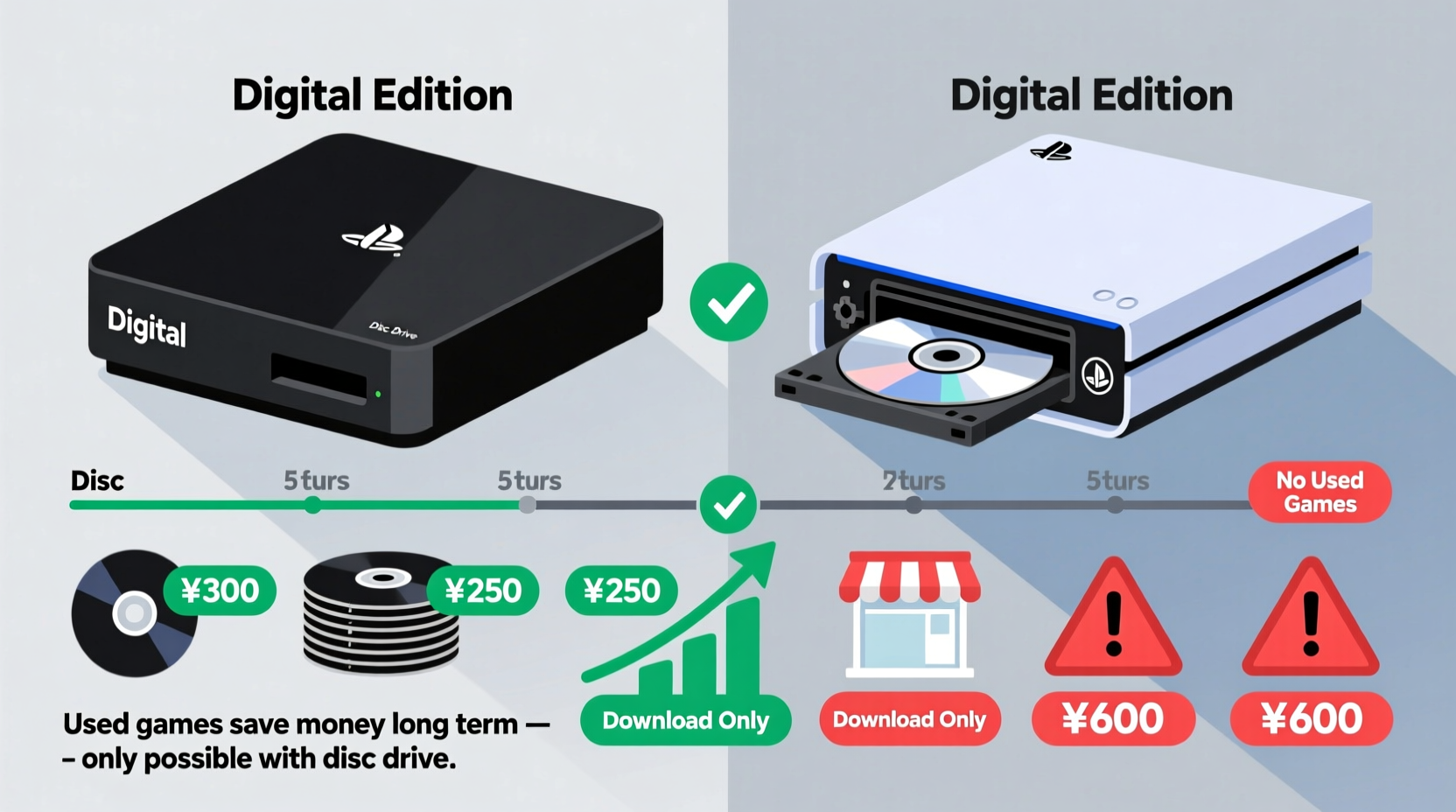
The primary distinction between the two PS5 models is straightforward: the standard edition includes an Ultra HD Blu-ray disc drive; the Digital Edition does not. This means the latter relies entirely on digital downloads from the PlayStation Store. Both versions support the same game library, user interface, and hardware capabilities—including 4K gaming, ray tracing, and fast load times via the SSD. However, the method of acquisition creates divergent ownership models and spending patterns.
The Digital Edition typically retails for $100 less than the standard model. At launch, this meant a $499 price for the disc version versus $399 for the digital-only console. That upfront discount is tempting, especially for budget-conscious buyers. But reducing the decision to a one-time price difference overlooks long-term usage habits. Gamers who frequently trade in, borrow, or purchase secondhand titles stand to benefit significantly from physical media access.
Tip: If you plan to resell games after finishing them, the disc edition pays for its premium quickly through trade-in value recovery.The Hidden Value of Used and Pre-Owned Games
Used games are where the disc edition begins to demonstrate tangible economic advantages. Retailers like GameStop, Best Buy, and independent shops routinely sell pre-owned PS5 titles at 20–40% below retail price. A new AAA release priced at $70 might be available used for $40–$50 just weeks after launch. For players who consume multiple games per year, these savings accumulate rapidly.
Moreover, buying used isn’t just about lower sticker prices. It also reduces financial guilt when playing through a game once. With digital purchases, even if you resell the console later, unused licenses don’t transfer. Physical discs, however, retain resale or gifting potential. This liquidity gives disc owners greater control over their entertainment budget.
Consider a gamer who buys eight full-priced games annually. Over five years, that’s 40 titles. At a conservative $15 average savings per used copy, the total savings reach $600—more than six times the initial price gap between the two consoles. Even factoring in inflation and fluctuating trade-in values, the math favors physical media for high-volume players.
“Physical games act like reusable vouchers. You can play, sell, lend, or buy them secondhand—options completely absent in digital-only ecosystems.” — Marcus Tran, Gaming Industry Analyst at NPD Group
Cost Comparison: Five-Year Ownership Scenario
To illustrate the long-term impact, let’s compare two hypothetical users over five years:
- User A: Owns the PS5 Digital Edition ($399). Buys all games digitally, mostly at full price.
- User B: Owns the standard PS5 ($499). Buys most games used or trades them in after use.
Assume both play the same 8 games per year (40 total), and each game has a base MSRP of $70. User A pays full price on 70% of purchases (new releases) and gets sales discounts on the rest (averaging 20% off). User B buys 60% of games used (average $45) and 40% new (often on sale for $55).
| User A (Digital) | User B (Disc + Used) | |
|---|---|---|
| Console Cost | $399 | $499 |
| New Games (28 @ $70) | $1,960 | $1,540 (on sale avg.) |
| Discounted Games (12 @ $56 avg.) | $672 | — |
| Used Games (24 @ $45 avg.) | — | $1,080 |
| Total Game Spending | $2,632 | $2,620 |
| Trade-In Earnings (20 games @ $15) | $0 | $300 |
| Net Game Cost | $2,632 | $2,320 |
| Total Ownership Cost (Console + Net Games) | $3,031 | $2,819 |
Despite paying $100 more upfront, User B ends up spending **$212 less** over five years. And this calculation doesn’t include additional benefits like borrowing games from friends, receiving gifts, or accessing older titles that may no longer be available digitally.
Real-World Example: The Budget-Conscious Family Gamer
Jamal, a father of two in Austin, Texas, bought the standard PS5 at launch. His household plays a mix of single-player adventures and multiplayer titles. He estimates spending $400–$500 annually on games. Instead of buying everything new, he visits local game stores monthly, picks up used copies, and trades in completed games. Last year, he acquired *Spider-Man 2* for $48 used, traded in *God of War Ragnarök* for $22 credit, and borrowed *Astro Bot* from a neighbor.
“I probably saved $200 last year just by not going digital,” he said. “Plus, my kids can take games to their grandparents’ house. Try doing that with a download code.”
Jamal’s approach reflects a broader trend among mid-tier gamers who value flexibility over convenience. For him, the disc drive isn’t a relic—it’s a tool for stretching his entertainment budget without sacrificing access.
Limitations of the Digital Model
The Digital Edition locks users into Sony’s ecosystem. Every game must be downloaded, tied to your account, and stored on limited internal storage (or an external SSD). There’s no way to loan a game to a friend, no opportunity to recoup costs through resale, and no offline backup if your console fails and your account faces issues.
Digital storefronts do offer sales, bundles, and subscription services like PlayStation Plus Extra, which includes a catalog of downloadable games. These can reduce costs—but only for patient shoppers willing to wait months for discounts. Meanwhile, physical retailers often price-match digital sales while still offering trade-in value.
Another overlooked factor is internet dependency. Downloading a 100GB game requires significant bandwidth and time, especially on slower connections. In rural areas or households with data caps, this becomes a real barrier. Discs bypass these constraints entirely.
Tip: Always check local game store trade-in policies—some offer bonus credit during promotional periods, boosting long-term savings.Step-by-Step: Maximizing Savings with the Disc Edition
If you choose the standard PS5, follow this strategy to maximize long-term value:
- Buy New Releases Used When Possible: Wait 4–6 weeks after launch. Many players trade in immediately, increasing supply and lowering prices.
- Use Price Tracking Tools: Websites like CamelCamelCamel (for Amazon) or GG.deals monitor price history across retailers.
- Trade In Promptly: Game value depreciates fastest in the first few months. Trade in within 2–3 months of completion for best returns.
- Stack Promotions: Combine trade-in credit with store sales or holiday events (e.g., Black Friday) for deeper discounts.
- Borrow or Lend: Share games with trusted friends or join local gaming swaps to expand your library at no cost.
When the Digital Edition Makes Sense
The Digital Edition isn’t inherently wasteful. It suits specific lifestyles:
- Low-Volume Gamers: If you play 2–3 major titles per year and keep them indefinitely, digital convenience outweighs savings.
- Sale Hunters: Players who wait for deep discounts (e.g., 70% off during seasonal sales) may spend less overall, even without trade-ins.
- Subscribers: Those using PlayStation Plus Premium gain access to hundreds of games without purchasing individual titles.
- Space-Conscious Users: Without discs, there’s no need for physical storage, ideal for small apartments or minimalist setups.
However, these advantages hinge on discipline and patience. Impulse buyers or those eager to play day-one will find digital prices steep and inflexible.
FAQ
Can I add an external disc drive to the PS5 Digital Edition?
No. Sony does not manufacture or support external optical drives for the PS5. The hardware lacks the necessary firmware and USB protocols to enable one. Once you choose digital, you’re permanently locked out of physical media.
Do used PS5 games work exactly like new ones?
Yes. Used discs function identically to new ones. The only difference is that any included digital bonuses (e.g., season passes) may already be redeemed. Always check the listing details before purchase.
Is the disc drive worth it if I mostly play PS Plus games?
Possibly not. If you rarely buy standalone titles and rely on the subscription library, the Digital Edition’s lower price makes sense. However, note that PS Plus doesn’t include all games—many third-party releases remain outside the catalog, where physical savings still apply.
Conclusion
The PS5 disc drive isn’t just a playback mechanism—it’s a financial lever. While the Digital Edition offers a lower entry point, its long-term cost efficiency depends heavily on disciplined shopping and reliance on subscriptions. For gamers who value ownership, flexibility, and incremental savings through used markets, the standard PS5 delivers measurable returns. Over five years, the ability to buy, trade, borrow, and resell games can easily offset the $100 premium—and then some.
The real cost of a console isn’t just what you pay at checkout. It’s how much freedom and value it gives you over time. In a market where game prices remain stubbornly high and digital rights are increasingly restrictive, the disc drive isn’t outdated. It’s a hedge against rising entertainment costs.
🚀 Ready to rethink your next console purchase? Calculate your annual game spending and ask: Can I save more with physical flexibility? Share your experience or trade-in tips in the comments below.