
Traveling solo offers unmatched freedom—exploring at your own pace, making spontaneous decisions, and immersing yourself in new cultures. But one question lingers for many independent travelers: where should you stay? The rise of short-term rental platforms like Airbnb has disrupted traditional lodging, but it also raises important questions about safety, especially when you're alone.
Hotels have long been considered the default choice for safe, predictable accommodations. With 24/7 front desks, security staff, and standardized procedures, they offer peace of mind. On the other hand, Airbnb provides unique, often more affordable stays in residential neighborhoods—but with greater variability in host quality, property standards, and location safety.
For solo travelers, particularly women, LGBTQ+ individuals, or those visiting unfamiliar destinations, safety isn’t just a preference—it’s a necessity. So, is staying in an Airbnb inherently riskier than booking a hotel? The answer isn’t black and white. It depends on preparation, destination, and how well you vet your options.
Safety Infrastructure: Hotels vs Airbnb
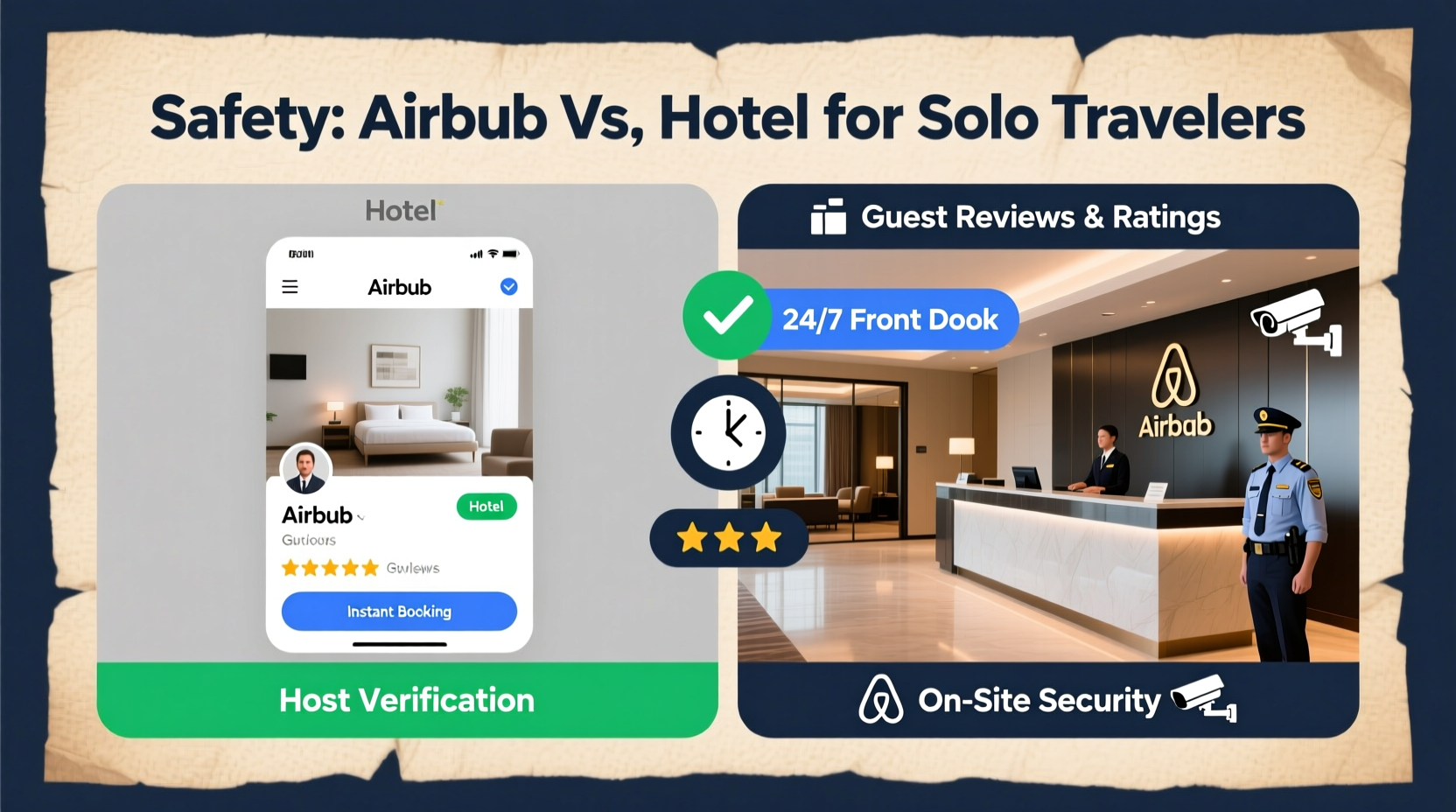
Hotels operate under regulated environments with established safety protocols. Most major chains invest heavily in guest security, including surveillance systems, electronic key cards, on-site personnel, and emergency response plans. Even budget hotels typically maintain basic security measures such as locked entrances, staffed front desks during peak hours, and standardized room layouts designed for visibility and access control.
In contrast, Airbnb properties are private homes managed by individuals. While some hosts go above and beyond—installing smart locks, security cameras (with proper disclosure), and fire suppression systems—others may overlook fundamentals like deadbolts or smoke detectors. There’s no universal standard enforced across listings, which means safety features vary dramatically from one rental to the next.
This lack of consistency is both Airbnb’s strength and its vulnerability. You might book a modern apartment with gated access and video intercoms—or unknowingly rent a basement unit in a high-crime area with flimsy doors and no lighting at the entrance.
“Solo travelers need predictability. Hotels provide that through institutional safeguards. With rentals, safety becomes a personal responsibility.” — Sarah Lin, Travel Safety Consultant and Founder of SafeWanderTip: Always verify lock types and entry points in Airbnb listings. Look for mentions of deadbolts, peepholes, and window locks in descriptions or photos.
Location and Neighborhood Awareness
One of the biggest advantages of Airbnb is access to local neighborhoods—staying in authentic districts away from tourist hubs. However, this benefit comes with trade-offs. Tourist-centric hotels are usually located in well-patrolled, central areas with visible police presence and easy access to public transport. They’re designed for transient guests who may not know the city well.
Airbnb listings, however, can be scattered throughout residential zones, industrial areas, or even remote suburbs. A listing might appear safe based on photos, but if it's in a poorly lit street with minimal foot traffic, returning late at night could feel isolating or risky.
Solo travelers must take extra care to research neighborhood safety. Relying solely on Airbnb’s map view isn’t enough. Cross-reference with local crime maps, read recent reviews mentioning walkability or nighttime safety, and use tools like Google Street View to virtually “walk” the route from the nearest transit stop to the property.
| Factor | Hotel | Airbnb |
|---|---|---|
| Neighborhood Predictability | High – typically in commercial/tourist zones | Variable – depends on host choice |
| Street Lighting & Foot Traffic | Generally good due to urban planning | Unpredictable; requires individual assessment |
| Access to Emergency Services | Quick response; known address and layout | Potential delays; complex building access |
| Nighttime Entry Security | Staffed entrances, keycard access | Depends on building type and host setup |
Verification and Trust: Who Is Hosting You?
Hotels employ trained staff. Front desk agents, housekeepers, and security personnel undergo background checks and professional training. Their identities are clear, their roles defined, and their behavior monitored.
Airbnb hosts, meanwhile, are private individuals. While Airbnb requires identity verification and encourages reviews, the system relies heavily on self-reporting. A host may have five-star ratings but still lack awareness of safety best practices. Worse, there have been rare but documented cases of fraudulent listings or unauthorized subletting, where guests arrive to find the property doesn’t match the description—or worse, someone else already occupying it.
To mitigate these risks, solo travelers should prioritize “Superhosts” (experienced, top-rated providers) and look for listings with verified government ID, multiple high-quality photos, and detailed house rules. Avoid last-minute bookings with sparse information or hosts who resist video calls before check-in.
Checklist: Evaluating Airbnb Host Credibility
- ✅ Host has complete profile with photo and verified ID
- ✅ At least 10 recent, detailed reviews mentioning safety or cleanliness
- ✅ Response rate above 90% and prompt communication
- ✅ Clear check-in instructions with no ambiguity
- ✅ Willingness to answer direct safety questions (e.g., “Is the door secure?”)
- ✅ No red flags: overly low prices, refusal to share address pre-booking, pressure to move conversation off-platform
Real-World Scenario: A Solo Traveler’s Close Call
Emily, a 29-year-old journalist from Canada, booked an Airbnb in Lisbon for a two-week work trip. The listing showed a charming studio in a historic district with glowing reviews. But upon arrival at 10 p.m., she found the building entrance unmarked, the stairwell dimly lit, and no intercom system. The door had only a basic latch, not a deadbolt.
She messaged the host, who apologized but said he lived across town and couldn’t come immediately. That night, Emily slept with a chair wedged under the doorknob. She moved to a hotel the next morning.
“I assumed the reviews meant it was safe,” she said. “But no one mentioned the sketchy entryway. I felt vulnerable and regretted not asking more specific questions.”
Her experience highlights a common gap: positive reviews often focus on aesthetics and value, not safety infrastructure. Travelers must ask what isn’t being said.
Emergency Preparedness: What Happens When Things Go Wrong?
If a fire alarm goes off at 3 a.m., a hotel guest can call the front desk and expect immediate assistance. Staff know your room number, can dispatch help quickly, and guide evacuations. In an Airbnb, you may be entirely on your own—especially if the host lives elsewhere.
Some hosts leave emergency contact sheets, but others assume guests will figure things out. Fire extinguishers, first aid kits, and working carbon monoxide detectors aren’t always present, despite Airbnb’s safety recommendations.
Solo travelers should treat every rental like a potential isolation scenario. Before settling in, locate the nearest exit, test smoke alarms, and save the host’s phone number—and local emergency services—in your phone. Consider bringing a portable door alarm or mini flashlight for added reassurance.
Step-by-Step: Securing Your Airbnb Upon Arrival
- Inspect all entry points: Test door locks, windows, and any secondary exits. Ensure deadbolts engage fully.
- Check lighting: Walk around the apartment and building common areas. Are hallways and stairwells well-lit?
- Verify emergency equipment: Look for smoke detectors, fire extinguishers, and first aid supplies.
- Photograph the space: Take pictures of the interior, locks, and any concerns. This creates a record if disputes arise.
- Share your location: Send your exact address to a trusted contact, even if it wasn’t shared publicly during booking.
- Test communication: Message the host to confirm responsiveness in case of issues.
When Airbnb Makes Sense for Solo Travelers
Despite the risks, Airbnb isn’t inherently unsafe—and in many cases, it can be the better option. For example:
- Longer stays: Monthly rentals often include deeper cleaning, better furnishings, and kitchen access, reducing the need to go out late for meals.
- Residential safety: Some quiet neighborhoods are statistically safer than bustling tourist zones prone to pickpocketing.
- Host interaction: A responsive, local host can offer real-time safety advice, recommend safe routes, and even check in during your stay.
- Privacy: Having your own space reduces exposure to strangers compared to shared hostel dorms or crowded hotel lobbies.
The key is intentionality. Choosing Airbnb shouldn’t be about price alone—it should be a calculated decision based on verified safety features and informed research.
Frequently Asked Questions
Is Airbnb safe for solo female travelers?
Yes, but with caveats. Many women travel safely via Airbnb by choosing highly rated listings in safe neighborhoods, communicating clearly with hosts, and following personal safety protocols. Prioritize listings with female hosts, as they often anticipate safety concerns more directly. Always read reviews from other solo female travelers when available.
Do hotels have better privacy than Airbnb?
Not necessarily. While hotels offer anonymity, they also involve frequent interactions—with staff, other guests, and security cameras in common areas. Airbnb provides physical privacy (your own space), but may lack institutional oversight. Privacy and safety are different priorities; balance them based on your needs.
What should I do if I feel unsafe in an Airbnb?
Contact the host immediately. If unresolved, reach out to Airbnb’s 24/7 customer support and request relocation assistance. In emergencies, call local authorities. Airbnb offers a “Safety Line” feature in its app for urgent situations. Never hesitate to leave if your instincts say something is wrong.
Final Thoughts: Safety Is a Choice, Not Just a Feature
The debate between Airbnb and hotels for solo travel isn’t about which is universally safer—it’s about how much control you want over your environment. Hotels offer built-in security through structure and staffing. Airbnb gives you autonomy, but demands proactive evaluation.
Safety isn’t just about locks and locations; it’s about preparation, awareness, and assertiveness. Whether you choose a downtown hotel or a cozy apartment across town, your ability to assess risks, trust credible information, and advocate for your well-being matters most.
Instead of asking, “Is Airbnb safe?” ask, “Am I booking this intelligently?” Read between the lines of reviews, demand clarity from hosts, and never sacrifice critical safety factors for a lower price or Instagram-worthy decor.
🚀 Ready to travel smarter? Next time you book, run through a safety checklist before confirming. Share your tips or experiences in the comments—your insight could help another solo traveler stay secure.