It’s a near-universal experience: that first sip of beer left too long in the sun, forgotten on a patio table, or poured from a room-temperature bottle—immediately registers as flat, harsh, or even vaguely medicinal. Yet the same beer, chilled to 4–7°C (39–45°F), delivers crispness, balance, and aromatic lift. This isn’t just preference—it’s biochemistry, sensory physiology, and centuries of brewing tradition converging. The aversion to warm beer isn’t cultural bias or habit; it’s rooted in how human taste and smell receptors respond to temperature, how volatile compounds behave in solution, and how brewers formulate beer for specific thermal conditions. Understanding this reveals far more than a simple “cold is better” rule—it illuminates the delicate architecture of flavor itself.
The Science of Temperature and Taste Receptor Sensitivity
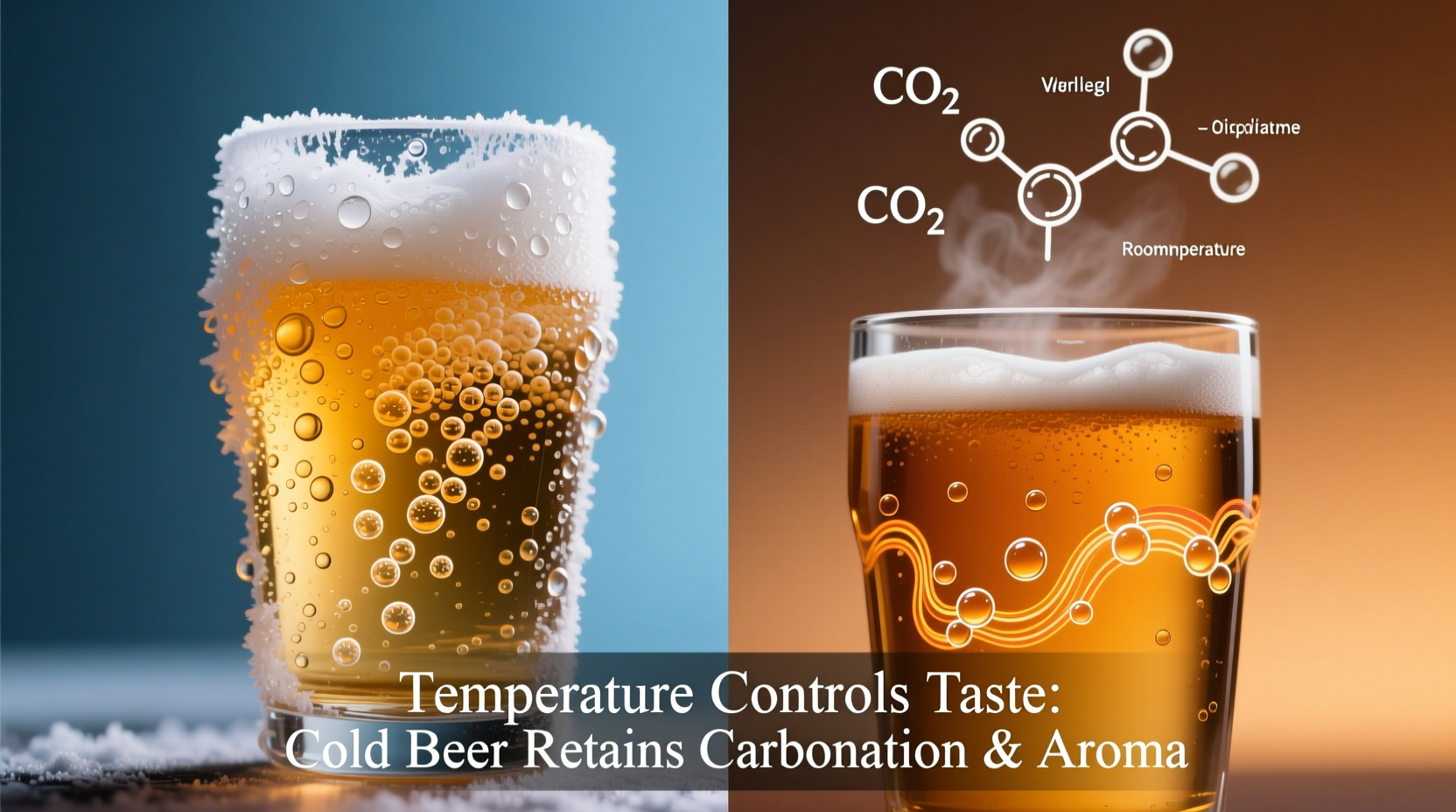
Human taste perception isn’t static. Our tongue’s taste receptor cells—those detecting sweetness, sourness, bitterness, saltiness, and umami—are profoundly temperature-dependent. Research published in Chemical Senses shows that bitterness perception peaks between 25–35°C (77–95°F), precisely the range where most “warm” beer lands. Meanwhile, sweetness perception declines sharply above 20°C. This creates an immediate imbalance: warmth doesn’t just make bitterness *more noticeable*—it actively suppresses the sweet malt notes that normally buffer hop-derived bitterness. The result? A disproportionately bitter, angular profile that feels aggressive rather than complex.
Equally critical is the role of trigeminal nerve stimulation—the “feel” component of flavor. Cold temperatures mildly suppress trigeminal activity, muting burn, astringency, and harsh alcohol heat. At warmer temperatures, ethanol becomes significantly more volatile and irritating. Even at moderate ABVs (4.5–5.5%), warm beer delivers a sharper, more solvent-like alcohol presence on the palate and in the sinuses—something cold beer masks through physical suppression and enhanced carbonation-driven mouthfeel.
Tip: Serve lagers and pilsners at 4–7°C (39–45°F); pale ales and IPAs at 6–10°C (43–50°F); stouts and barleywines at 10–13°C (50–55°F). Never serve any beer above 15°C (59°F) unless intentionally cellared for oxidative character (e.g., certain Belgian quads or imperial stouts aged years).Volatile Compounds: How Heat Unleashes Off-Flavors
Beer contains hundreds of volatile organic compounds—some desirable (citrus esters, floral terpenes), others undesirable (diacetyl, acetaldehyde, isovaleric acid, skunked MBT). Temperature governs their volatility: the warmer the liquid, the more readily these molecules escape into the headspace above the beer—and thus into your nose. This is where the real trouble begins.
Acetaldehyde—a green-apple or raw-pumpkin compound—is a natural fermentation intermediate. In healthy, fully conditioned beer, yeast reabsorbs most of it. But if beer warms significantly post-fermentation—or worse, undergoes temperature cycling—residual acetaldehyde becomes dramatically more perceptible. Similarly, diacetyl (buttery or butterscotch) thresholds drop by up to 50% at 25°C versus 5°C. And light-struck beer? That infamous “skunky” aroma from MBT (3-methyl-2-butene-1-thiol) intensifies exponentially with heat: studies show MBT perception increases 300% between 5°C and 25°C, even in brown bottles.
Crucially, warmth doesn’t just amplify flaws—it distorts harmony. Esters like isoamyl acetate (banana) and ethyl hexanoate (apple) are pleasant in moderation at cool temps but become cloying, solvent-like, or even nail-polish-remover-esque when heated. The delicate balance brewers spend weeks achieving collapses under thermal stress.
Carbonation: The Unsung Hero of Refreshment (and Why Warmth Defeats It)
Carbon dioxide solubility in liquid is inversely proportional to temperature. At 5°C, beer holds roughly 2.8 volumes of CO₂; at 20°C, it holds only ~1.7 volumes. That’s a 40% loss—not theoretical, but physically measurable and immediately perceptible. Reduced carbonation means diminished effervescence, weaker mouthfeel, and less mechanical cleansing of the palate between sips. Without that gentle prickle lifting aromas and scrubbing away residual bitterness, flavors stagnate.
More subtly, CO₂ dissolution affects pH. Colder, more carbonated beer is slightly more acidic (lower pH), which brightens perception of hop aroma and enhances perceived crispness. Warmer, flatter beer drifts toward neutral pH—muddying brightness and allowing bitterness to dominate without counterpoint. This is why a warm IPA doesn’t just taste “less hoppy”—it tastes *duller*, heavier, and more one-dimensionally bitter.
| Temperature | CO₂ Solubility (vols) | Perceived Bitterness | Aroma Intensity | Overall Palatability |
|---|---|---|---|---|
| 4°C (39°F) | 2.8–3.0 | Moderate, balanced | Bright, focused | High — crisp, refreshing |
| 10°C (50°F) | 2.4–2.6 | Noticeable, integrated | Rich, layered | High — ideal for complex styles |
| 15°C (59°F) | 2.0–2.2 | Pronounced, slightly sharp | Diffuse, alcoholic | Moderate — acceptable for strong dark beers |
| 22°C (72°F) | 1.5–1.7 | Harsh, dominant | Offensive, solvent-like | Low — widely perceived as “spoiled” |
| 28°C (82°F) | 1.2–1.4 | Overwhelming, astringent | Unpleasant, stale | Very low — triggers rejection response |
The Evolutionary Context: Why Humans Reject Warm Beer
This aversion isn’t arbitrary. From an evolutionary standpoint, warmth in fermented beverages was historically a red flag. Before refrigeration, beer stored at ambient temperatures risked microbial spoilage—Lactobacillus, Pediococcus, wild yeasts, or even pathogens thriving above 15°C. Humans developed a hardwired sensitivity to the sensory signatures of spoilage: increased acidity, buttery diacetyl, vinegar-like acetic acid, or cheesy isovaleric notes—all amplified by heat. Rejecting warm beer wasn’t snobbery; it was survival instinct.
Modern pasteurization and sterile filtration have largely eliminated pathogen risk, but our sensory systems haven’t caught up. We still register warmth-induced volatility shifts and bitterness spikes as warning signals—even when the beer is microbiologically sound. As Dr. Susan E. Ebeler, Director of the UC Davis Wine Spectral Database, explains:
“Temperature doesn’t change the chemical composition of beer—but it changes which molecules reach your olfactory epithelium, how intensely they bind to receptors, and how your brain interprets the resulting neural pattern. Warm beer doesn’t taste ‘wrong’ because it’s flawed; it tastes wrong because your neurobiology interprets its altered signal as a threat.”
Real-World Impact: A Brewery Quality Control Case Study
In 2022, a regional craft brewery in Vermont received consistent complaints about “stale, harsh” notes in their flagship hazy IPA—despite rigorous lab testing showing no microbial contamination or oxidation markers. Internal investigation revealed the issue wasn’t in production, but in distribution: cases shipped during summer months sat unrefrigerated in hot warehouses for up to 72 hours before retail placement. Samples held at 30°C for 48 hours showed no detectable increase in trans-isohumulones (oxidized hop compounds) but exhibited a 300% increase in free iso-alpha-acids leaching from hop particles—compounds known to deliver sharp, lingering bitterness when unbound. More critically, GC-MS analysis confirmed a 4.2x spike in volatile phenol release (4-vinyl guaiacol) at elevated temperatures, contributing clove-like spiciness that clashed with tropical esters.
The brewery implemented strict “cold chain” protocols: insulated shipping containers with phase-change gel packs, retailer education on refrigerated receiving, and QR-coded temperature logs on pallets. Within three months, customer complaints dropped 87%. The beer hadn’t changed—only its thermal history had. This case underscores a vital truth: beer is a dynamic, temperature-sensitive matrix, not a static product.
Practical Solutions: Preserving Flavor Through Thermal Discipline
Preventing warm-beer disappointment requires intentionality at every stage—from purchase to pour. Here’s how to maintain integrity:
- Buy cold, stay cold: Purchase beer from refrigerated sections only. Avoid cans/bottles sitting in sunlit bins or non-refrigerated displays.
- Transport wisely: Use insulated bags or coolers with ice packs for trips longer than 15 minutes—especially in summer.
- Store consistently: Keep beer at stable, cool temps (ideally 4–10°C / 39–50°F). Basements are better than garages; refrigerators beat pantries.
- Chill before serving: Even “cellar temperature” beers benefit from 20–30 minutes in the fridge before opening. Never serve straight from a warm room.
- Minimize thermal shock: Avoid rapid cooling (freezer dips) or repeated warming/cooling cycles—they accelerate staling reactions and destabilize foam.
FAQ: Addressing Common Misconceptions
Doesn’t some beer taste better warm?
Yes—but only specific, high-alcohol, barrel-aged styles intentionally designed for oxidative complexity: vintage barleywines, certain Belgian quads, or imperial stouts aged 3+ years. Even then, “warm” means 13–16°C (55–61°F), not room temperature. These beers rely on slow, controlled oxidation over years—not acute heat exposure. Serving a fresh IPA or lager warm offers no benefit and significant sensory cost.
Is “skunked” beer the same as warm beer?
No. Skunking (lightstruck flavor) results from UV light reacting with hop isohumulones to form MBT—a distinct, sulfur-based off-flavor. Warmth accelerates MBT perception but doesn’t create it. A beer can be perfectly protected from light yet still taste unappealing when warm due to heightened bitterness, lost carbonation, and volatile off-flavor release.
Why do Europeans often drink beer at “warmer” temperatures?
Many traditional European styles—like English bitters or German bocks—are brewed with lower hopping rates, higher malt complexity, and lower carbonation, making them more thermally forgiving. Their “cellar temperature” (10–13°C / 50–55°F) is still significantly cooler than typical room temperature (22–25°C / 72–77°F) and well below the bitterness amplification threshold. What’s marketed as “room temperature” abroad is often misinterpreted—true room temp is rarely ideal for any modern beer.
Conclusion: Respect the Physics, Elevate the Experience
Warm beer tastes unappealing not because we’ve been conditioned to dislike it, but because physics, chemistry, and neurobiology converge to degrade its intended sensory architecture. Heat doesn’t merely warm the liquid—it recalibrates bitterness thresholds, unleashes dormant off-flavors, drains effervescence, and hijacks our ancient threat-detection systems. Recognizing this transforms beer from casual beverage to a carefully orchestrated sensory event—one where temperature isn’t an afterthought, but the foundational variable upon which flavor, balance, and refreshment depend.
You don’t need specialized equipment to honor this principle. A refrigerator, a cooler bag, and 20 minutes of forethought are enough to restore the crisp snap of a pilsner, the juicy burst of an IPA, or the roasty depth of a stout. Next time you reach for a beer, pause—not just to appreciate its origin or ingredients, but to consider its thermal journey. Because the difference between a forgettable sip and a revelatory one often lies in a few degrees.
💬 Have you experienced a dramatic flavor shift when serving the same beer at different temperatures? Share your observations in the comments—your real-world insights help others decode the science behind their own tasting experiences.