Crystallization in homemade elderflower liqueur is one of the most common—and most misunderstood—issues among home infusers. You’ve spent hours gathering fragrant blossoms at dawn, carefully infused them in neutral spirit, sweetened with precision, and aged the batch with patience. Then, weeks later, you open the bottle to find a delicate snowfall of sugar crystals settled at the bottom—or worse, suspended like glitter throughout the liquid. Panic sets in: “Is it ruined? Did I contaminate it? Is it unsafe?” The answer is almost always no. What you’re seeing is not mold, fermentation gone wrong, or spoilage—it’s pure sucrose reasserting its natural tendency to return to solid form. Understanding *why* this happens—and how to reverse it *without* heat, dilution, or flavor loss—is essential for preserving both the integrity and elegance of your craft liqueur.
The Science Behind the Sparkle: Why Crystallization Occurs
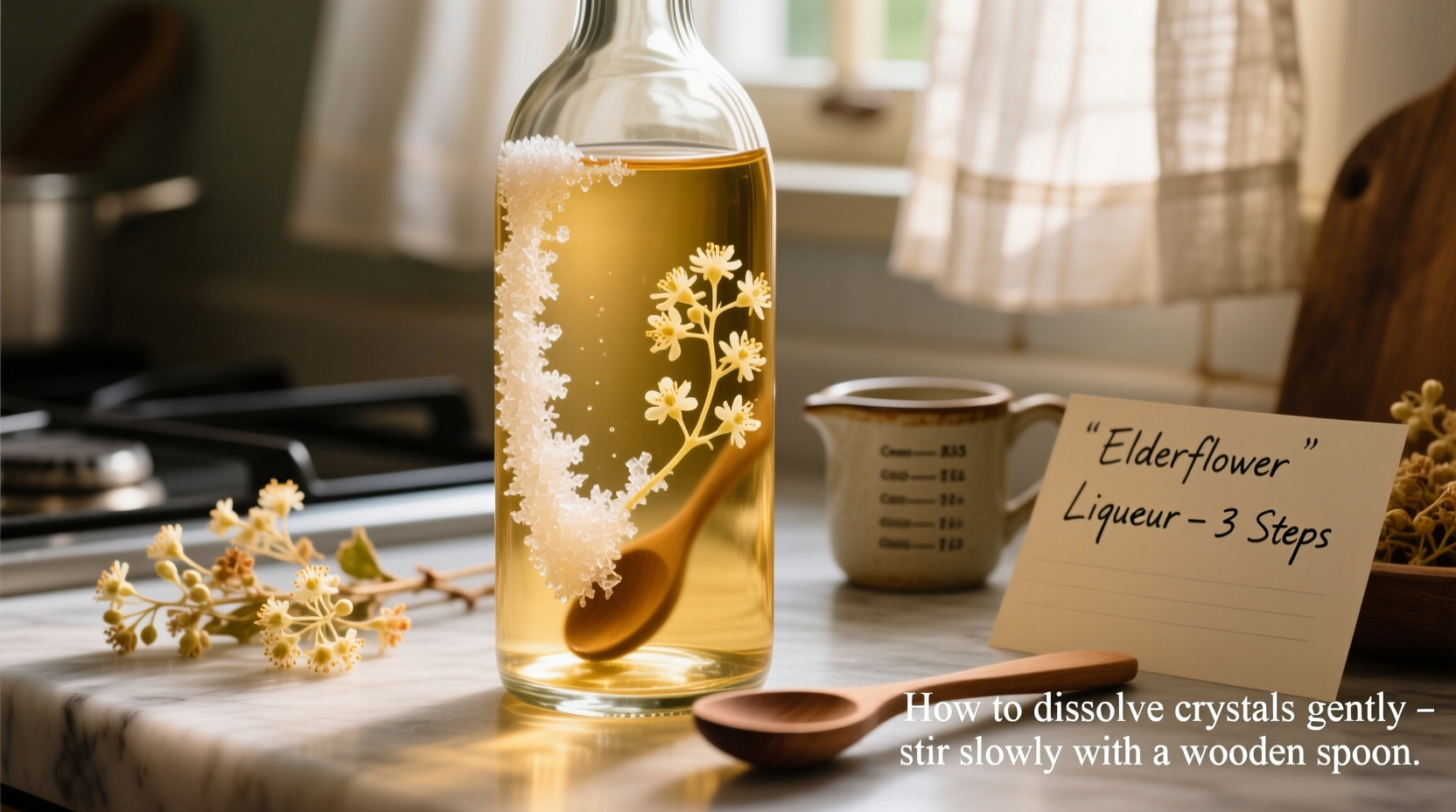
Elderflower liqueur is fundamentally a supersaturated sugar solution: ethanol (typically 35–45% ABV), water, floral aromatics, and a high concentration of dissolved sucrose—often 300–500 g/L. At room temperature, water can hold roughly 200 g of sugar per 100 mL; ethanol holds far less—only about 20–30 g per 100 mL. When you combine the two solvents, the total solubility drops significantly. Your liqueur sits in a delicate thermodynamic limbo: stable when freshly mixed and warm, but increasingly unstable as it cools, ages, or experiences minor temperature fluctuations.
Crystallization begins with nucleation—microscopic imperfections (a dust particle, a scratch on the glass, or even a stray pollen grain from the original infusion) act as anchor points. Once a crystal forms, it grows by attracting nearby sucrose molecules, pulling them out of solution. This process accelerates in cool environments (below 12°C), during prolonged storage (beyond 3–4 months), and especially when the liqueur contains unrefined sugars (like raw cane or demerara) or honey-based sweeteners, which introduce trace minerals and invert sugars that further destabilize the solution.
Importantly, crystallization does not indicate spoilage, bacterial growth, or chemical degradation. It’s a physical phase change—not a biochemical one. The alcohol content remains unchanged, the volatile terpenes (linalool, geraniol) responsible for elderflower’s signature perfume remain intact, and the pH stays well below levels supporting microbial activity (typically pH 3.2–3.8).
Prevention First: Building Stability Into Your Recipe
While dissolution is possible, prevention preserves clarity, mouthfeel, and shelf life. The most effective strategies target solubility limits and nucleation triggers:
- Use fully refined white sugar—not raw, turbinado, or brown sugar. Its purity minimizes mineral impurities that seed crystals.
- Dissolve sugar completely while warm—but never boil. Heat the sugar syrup to 60–65°C (140–150°F) and stir until fully transparent, then cool to room temperature before adding to the infused spirit. Boiling risks caramelization and volatile aromatic loss.
- Add a small amount of invert sugar (2–3% of total sugar weight). Invert sugar—made by gently heating sucrose with a pinch of citric acid or cream of tartar—resists crystallization because its glucose+fructose composition disrupts sucrose lattice formation.
- Fine-filter before bottling. Use sequential filtration: first through cheesecloth, then a 1.0-micron pad filter or coffee filter. This removes microscopic particles that serve as nucleation sites.
- Store upright in cool, stable conditions (12–18°C), away from windows or refrigerators. Avoid temperature swings greater than 3°C within 24 hours.
How to Dissolve Crystals Gently—Without Compromising Quality
When crystals appear, aggressive methods—boiling, vigorous shaking, or excessive dilution—damage the liqueur’s balance. Heat degrades delicate monoterpene esters; agitation introduces oxygen that accelerates oxidation; water dilutes ABV and shifts the solubility equilibrium further. Instead, use a low-energy, controlled approach focused on *re-saturation*, not force.
- Bring the bottle to a consistent 22–24°C (72–75°F) for 24 hours. Room temperature alone dissolves many early-stage crystals, especially if they’re fine and recently formed.
- Gently invert the bottle 5 times—no shaking. This encourages passive mixing without introducing air bubbles or shear stress.
- Let rest upright for another 12 hours at the same temperature. Observe whether crystals have begun to shrink or detach from the base.
- If crystals persist, apply mild, localized warmth: Fill a bowl with water at 35°C (95°F)—no hotter. Submerge only the bottom third of the bottle for 15 minutes. Remove, invert once, and rest upright for 6 hours.
- Repeat the warm bath once more if needed, but never exceed 35°C or submerge beyond the crystallized zone. Monitor closely: crystals should visibly diminish within 48 hours.
This method works because sucrose solubility increases predictably with temperature—even modest warming raises capacity enough to reabsorb fine crystals. Crucially, it avoids thermal shock, keeps volatile top notes intact, and preserves the liqueur’s natural viscosity.
What NOT to Do: A Critical Do’s and Don’ts Table
| Action | Why It’s Problematic | Better Alternative |
|---|---|---|
| Boiling the liqueur | Destroys linalool, nerol, and other heat-labile volatiles; caramelizes sugar; alters aroma profile irreversibly | Warm-water bath at ≤35°C, targeted to crystallized zone only |
| Vigorous shaking or stirring | Introduces oxygen, accelerating oxidative browning and aldehyde formation; may create stubborn microcrystal suspensions | Slow, gentle inversion—max 5 times—followed by still rest |
| Adding water to “dilute out” crystals | Lowers ABV, risking microbial stability; dilutes flavor concentration and changes mouthfeel permanently | Re-saturation via controlled warmth—not dilution |
| Filtering through paper filters post-crystallization | Removes crystals but also strips colloidal polyphenols and subtle waxy esters, flattening complexity | Dissolve first, then fine-filter only if cloudiness persists |
| Storing in the refrigerator long-term | Accelerates nucleation; cold temperatures reduce sucrose solubility by up to 40% in ethanol-water mixtures | Store at consistent 14–18°C in dark cupboard or wine fridge set to “cellar temp” |
A Real-World Example: Sophie’s Spring Batch Recovery
Sophie, a botanical distiller in Somerset, produced 12 liters of elderflower liqueur in late May using hand-foraged blossoms, 40% ABV wheat spirit, and organic caster sugar. She bottled after four weeks of maceration and three days of sugar dissolution at 60°C. By August—after moving bottles from a cool cellar to a sun-warmed pantry—the bottom third of six bottles had developed dense, sand-like crystals. Concerned about quality, she tried shaking one bottle vigorously. The crystals dispersed temporarily but reformed overnight, now finer and more uniformly suspended. She paused, consulted lab notes on sucrose solubility curves, and implemented the gentle warm-bath protocol: 35°C water, 15-minute submersion of bottle base, single inversion, 6-hour rest. Within 36 hours, all crystals had fully redissolved. She then adjusted her process: added 2.5% invert sugar to her next batch, installed a thermometer in her storage area, and began filtering through a 0.8-micron membrane pre-bottling. Her current batches—aged 10 months—remain brilliantly clear.
“Crystallization is nature reminding us that sugar wants to be solid. Our job isn’t to fight physics—it’s to work within its boundaries. Gentle warmth, not force, is the key to restoring equilibrium.” — Dr. Aris Thorne, Food Chemist & Fermentation Scientist, University of Reading
FAQ: Clarifying Common Concerns
Can I still drink crystallized elderflower liqueur?
Yes—absolutely. Crystals are pure sucrose and pose no safety risk. Texture may be gritty if consumed directly from the bottom of the bottle, but swirling gently before pouring usually suspends fine crystals temporarily. For best experience, dissolve first.
Will dissolving crystals change the alcohol percentage?
No. Dissolution is a physical process—no water or spirit is added or removed. ABV remains identical. Only the physical state of the sugar changes.
Does crystallization mean my liqueur is “old” or past its prime?
Not necessarily. Well-made liqueur can remain stable for 2+ years. Crystallization reflects storage conditions and formulation—not age alone. A 3-month-old batch stored at 5°C may crystallize faster than a 12-month-old batch held at steady 16°C.
Final Thoughts: Embrace the Process, Not Just the Product
Homemade elderflower liqueur is more than a beverage—it’s a seasonal ritual, a sensory archive of spring, and a quiet act of attention. Crystallization isn’t a failure; it’s feedback. It tells you something about your environment, your ingredients, and your technique. Responding with patience and precision—not haste or correction—deepens your understanding of the craft. Each time you gently coax those crystals back into solution, you reaffirm control over complexity, honoring both science and tradition. Don’t rush the warmth. Don’t fear the sparkle. And above all—don’t discard a bottle because it looks “imperfect.” Clarity is elegant, yes—but authenticity has texture, history, and resilience.
💬 Have you rescued a crystallized batch? Share your method, temperature log, or favorite elderflower tip in the comments. Let’s build a collective knowledge base—one thoughtful bottle at a time.