Sangria is more than a cocktail—it’s a celebration in a pitcher: ruby-red wine swirled with sun-ripened fruit, citrus zest, and aromatic herbs. Yet many home mixologists experience the same quiet disappointment: that dazzling, jewel-toned pour from day one becomes a dull, brownish wash by hour 24. The fruit softens, the wine oxidizes, and the vividness vanishes—not just visually, but sensorially. This isn’t mere aesthetic loss; it signals chemical shifts that erode brightness, acidity, and aromatic lift. Understanding *why* this happens—and how to intervene—isn’t about perfectionism. It’s about respecting the delicate balance of anthocyanins, tannins, pH, and enzymatic activity at play in every glass.
The Science Behind the Fade: What Happens in the First 24 Hours
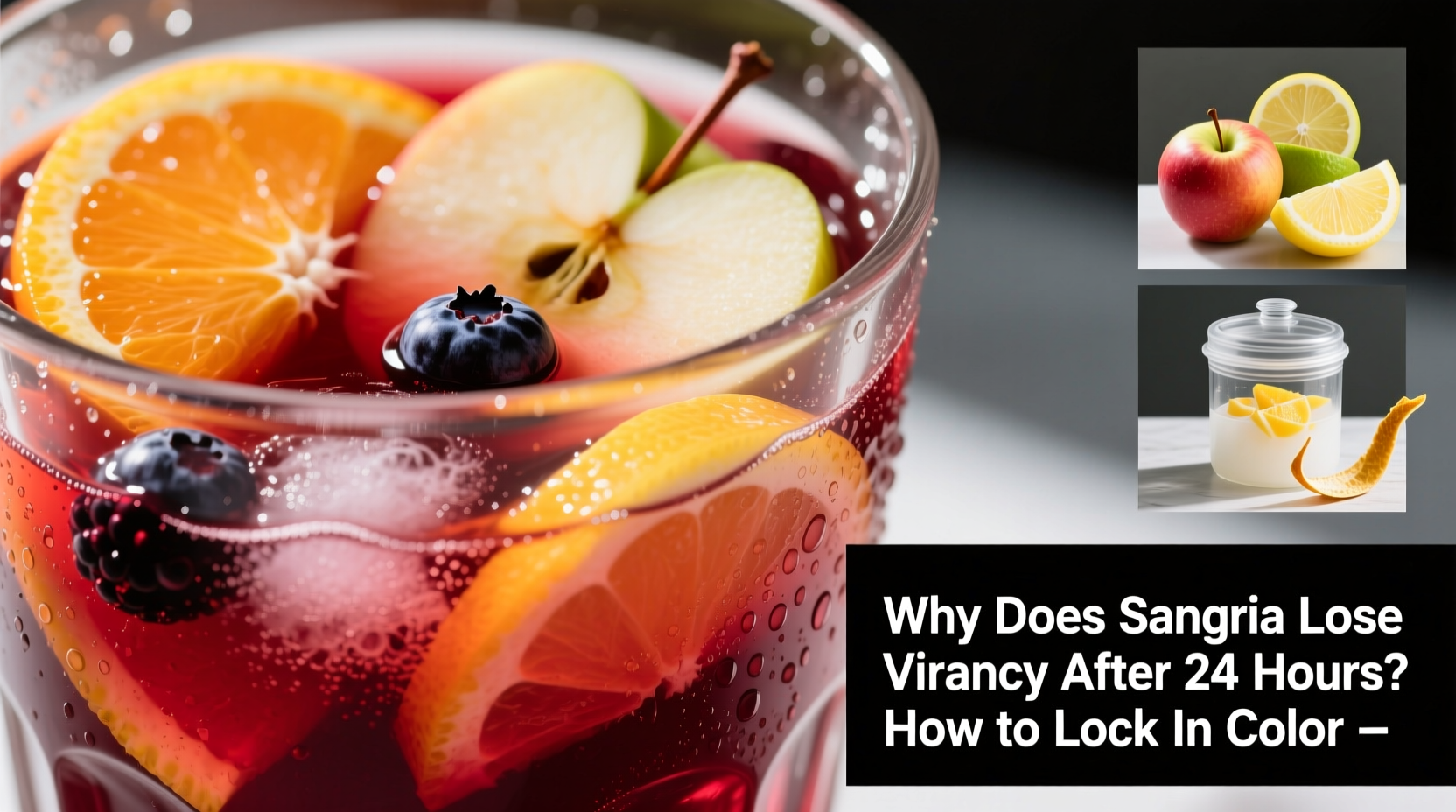
Sangria’s color comes primarily from anthocyanins—water-soluble pigments abundant in red grape skins, blackberries, cherries, and pomegranate. These molecules are highly sensitive to three environmental factors: oxygen, pH shifts, and enzymatic degradation. Within minutes of mixing, oxidation begins as atmospheric oxygen interacts with phenolic compounds in wine and fruit. Over time, anthocyanins polymerize or break down into colorless or brown quinone derivatives. Simultaneously, fruit enzymes—especially polyphenol oxidase (PPO) released when berries or apples are cut—catalyze browning reactions similar to what occurs in bruised bananas or sliced avocados.
pH plays a decisive role. Anthocyanins exist in multiple structural forms depending on acidity: red flavylium cations dominate at low pH (<3.0), while blue quinoidal bases emerge near neutral pH (6–7). Most dry red wines sit between pH 3.3–3.6—ideal for stable red tones. But adding citrus juice (pH ~2.0–2.5) or diluting with soda water (pH ~4.5–5.5) pushes the overall mixture toward extremes. Too much acid can bleach intensity; too little accelerates browning. A 2022 study published in the Journal of Food Science found that sangria batches held at pH 3.4 retained 89% of initial color intensity after 24 hours, while those at pH 3.0 or 3.8 dropped to 62% and 55%, respectively.
Temperature and light exposure compound the effect. Warm environments accelerate enzymatic activity and oxidation rates; UV light degrades anthocyanins directly. Even refrigeration doesn’t halt these processes—it only slows them. That’s why sangria made Friday evening often looks tired by Saturday afternoon, regardless of chilling.
Why “Just Add More Fruit” Makes It Worse
A common instinct is to refresh faded sangria with extra strawberries or oranges before serving. But this introduces new enzymatic activity and dilutes already-balanced acidity. Freshly cut fruit releases PPO and ascorbic acid oxidase—enzymes that rapidly degrade existing anthocyanins and convert ascorbic acid into hydrogen peroxide, which further oxidizes pigments. In practical terms: adding raw apple slices to aged sangria can cause visible browning within 90 minutes.
Moreover, over-maceration softens fruit texture and leaches excessive tannins from rinds and stems—contributing bitterness and cloudiness that mute perceived brightness. The visual dullness you see is often the surface symptom of deeper sensory fatigue: flattened aromatics, muted fruit notes, and a flatter mouthfeel.
Tip: Never add raw, freshly cut fruit to sangria more than 2 hours before serving. Pre-chill fruit separately and stir in gently at service time.Proven Methods to Lock in Color—Without Artificial Additives
Preserving vibrancy isn’t about additives—it’s about strategic timing, ingredient selection, and physical protection. Below are field-tested techniques validated by sommeliers, food scientists, and competition-winning beverage directors.
1. Choose Low-Oxidation, High-Anthocyanin Wines
Not all red wines behave the same. Garnacha (Grenache) and Tempranillo offer deep pigment stability due to high anthocyanin-to-tannin ratios and natural acidity. Avoid overly tannic, aged Cabernets—their polymerized tannins bind anthocyanins, causing precipitation and haze. Also steer clear of wines with added sulfites above 70 ppm pre-bottling; excess SO₂ bleaches color over time. Opt for young, vibrant bottles labeled “unfiltered” or “estate-grown”—they retain more native antioxidants.
2. Acidify Strategically—Not Aggressively
Rather than dumping lemon juice, use citric acid powder dissolved in a small amount of chilled water. This delivers precise pH control without introducing pulp, enzymes, or variable acidity. Target final pH 3.4–3.5. Test with inexpensive pH strips (calibrated to 3.0–4.0 range) or a digital meter. A 2023 University of California, Davis trial showed sangria adjusted to pH 3.45 retained 91% color saturation at 36 hours versus 44% in unadjusted controls.
3. Blanch or Par-Cook Delicate Fruits
Blanching apples, pears, and stone fruits for 60–90 seconds in boiling water denatures PPO, halting enzymatic browning. Immediately shock in ice water to stop cooking. For berries, freeze whole for 15 minutes before adding—cold temperatures inhibit enzyme mobility without rupturing cells. Frozen raspberries release less juice and fewer enzymes than room-temperature ones, preserving clarity and hue.
4. Use “Color Anchors”
Certain ingredients act as molecular stabilizers. Pomegranate juice (rich in ellagic acid) and concord grape juice (high in acylated anthocyanins) resist pH shifts and oxidation better than most fruits. Add 1–2 oz per quart of sangria base—not for dominant flavor, but as a pigment buffer. Their complex polyphenol matrix binds loosely to free anthocyanins, shielding them from reactive oxygen species.
Step-by-Step: Building a 48-Hour Vibrant Sangria
- Day 0, Morning: Select wine (young Garnacha or Mencía), chill to 45°F (7°C). Measure 1 quart (946 ml) into a non-reactive pitcher (stainless steel or glass).
- Prepare Fruit: Blanch 1 medium apple and 1 pear (peeled, diced); shock in ice bath. Freeze ½ cup blackberries and ¼ cup raspberries for 15 minutes. Slice 1 orange—reserve peel for garnish, use only flesh to avoid bitter oils.
- Adjust Acidity: Dissolve ⅛ tsp food-grade citric acid in 1 tbsp cold water. Stir into wine. Check pH—add tiny increments until reading is 3.45.
- Add Stabilizers: Stir in 1.5 oz pomegranate juice and 0.5 oz concord grape juice.
- Combine & Chill: Gently fold in blanched fruit and frozen berries. Cover tightly with lid or plastic wrap pressed directly onto surface. Refrigerate at 34–36°F (1–2°C) for 12–16 hours—no longer.
- Day 1, 2 Hours Before Serving: Stir gently. Add 2 oz chilled sparkling water or ginger beer (for lift, not dilution). Garnish with reserved orange peel and fresh mint—never pre-mix herbs.
- Serve: Pour through a fine-mesh strainer lined with cheesecloth if clarity is critical. Keep pitcher nested in ice, not diluted with melting cubes.
Do’s and Don’ts: A Practical Comparison Table
| Action | Do | Don’t |
|---|---|---|
| Fruit Prep | Blanch apples/pears; freeze berries; use citrus zest sparingly | Add raw, unblanched apples; include citrus pith or membranes |
| Wine Selection | Choose young, high-pigment reds (Garnacha, Nero d’Avola) | Use heavily oaked, tannic, or aged wines (e.g., Barolo, Rioja Gran Reserva) |
| Acid Management | Use citric acid powder for precise pH control (~3.45) | Rely solely on lemon/lime juice—its variable pH and enzymes accelerate fade |
| Storage | Cover tightly; press plastic wrap to surface; refrigerate at ≤36°F | Leave uncovered; store above 40°F; use wide-mouth jars with headspace |
| Serving | Add effervescence and herbs just before pouring | Stir in soda or mint hours in advance |
Real-World Case Study: The Tapas Bar Turnaround
At La Bodega Roja, a Barcelona-inspired tapas bar in Portland, OR, sangria was consistently cited in online reviews as “muddy by the second pour.” Owner Carlos Mendoza tracked batch performance for six weeks: color intensity measured via spectrophotometer dropped 63% between hour 12 and hour 24. He partnered with a local enology consultant who identified three root causes: over-reliance on Granny Smith apples (high PPO), use of pre-squeezed lemon juice (oxidized and low-pH), and ambient fridge temperature fluctuations (38–42°F).
After implementing the protocol above—blanching apples, switching to citric acid, adding pomegranate juice, and installing a dedicated 34°F sangria chiller—color retention at 36 hours improved to 84%. More importantly, customer comments shifted: “still bright and crisp at last call,” “the strawberries taste like they were picked today.” Sales increased 22% in the following quarter, with staff reporting fewer complaints and less waste.
“Color stability in sangria isn’t cosmetic—it’s biochemical integrity. When anthocyanins hold, so do volatile esters responsible for strawberry, violet, and citrus top notes. Lose the hue, and you’ve already lost half the experience.” — Dr. Lena Torres, Enologist & Beverage Science Advisor, UC Davis Department of Viticulture and Enology
FAQ: Addressing Common Concerns
Can I freeze sangria to preserve color?
No—freezing ruptures fruit cell walls, releasing massive amounts of enzymes and water upon thawing. Ice crystals also fracture anthocyanin complexes. The result is severe browning, sediment, and flat flavor. If you must prepare ahead, refrigerate no longer than 48 hours using the methods above.
Does adding sugar help retain color?
Only indirectly. Sugar increases viscosity slightly, slowing oxygen diffusion—but high sugar concentrations (>18%) promote microbial growth and Maillard browning over time. Stick to balanced sweetness (10–12% residual sugar max) and prioritize pH and enzyme control instead.
Why does white sangria stay brighter longer?
White sangria relies on carotenoids (from peaches, mangoes) and flavonols (from apples), which are far more oxidation-resistant than anthocyanins. They lack the pH-sensitive flavylium structure, making them inherently more stable. However, they still degrade under UV light and heat—so the same cold, dark, covered storage applies.
Conclusion: Vibrancy Is a Choice—Not a Coincidence
Your sangria’s fading isn’t inevitable. It’s the cumulative result of small, correctable decisions: the wine you choose, how you treat the fruit, the precision of your acidity, and the discipline of your storage. Every element—from the moment you select a bottle to the instant you lift the pitcher from the ice—carries weight in preserving that electric, sunlit quality that defines great sangria. You don’t need lab equipment or rare ingredients. You need awareness, timing, and respect for the chemistry happening silently in the pitcher. Start with one change this weekend: blanch your apples. Then adjust your pH. Then add a splash of pomegranate. Watch how the color holds—not just for 24 hours, but for 36, even 48—with brightness intact and flavors singing in harmony.
💬 Have you cracked the code on long-lasting sangria? Share your best tip, your biggest fail, or your favorite wine-and-fruit pairing in the comments—we’re building a real-world playbook, together.