For over a decade, bartenders have flirted with smoke—infusing spirits, torching garnishes, and layering wood notes into drinks. But when smoked salt appeared rimming margaritas and dusting Bloody Marys, many dismissed it as another Instagrammable gimmick. Yet today, it’s quietly anchoring complex savory cocktails at award-winning bars from Portland to Copenhagen. The question isn’t whether smoked salt works—it does—but whether it earns a permanent place in the well-stocked bar, alongside citrus, bitters, and simple syrup. To answer that, we need to look beyond the ash and into the chemistry of umami, the craft of salting, and the evolving palate of modern drinkers.
The Science Behind the Smoke: Why It Works (and When It Doesn’t)
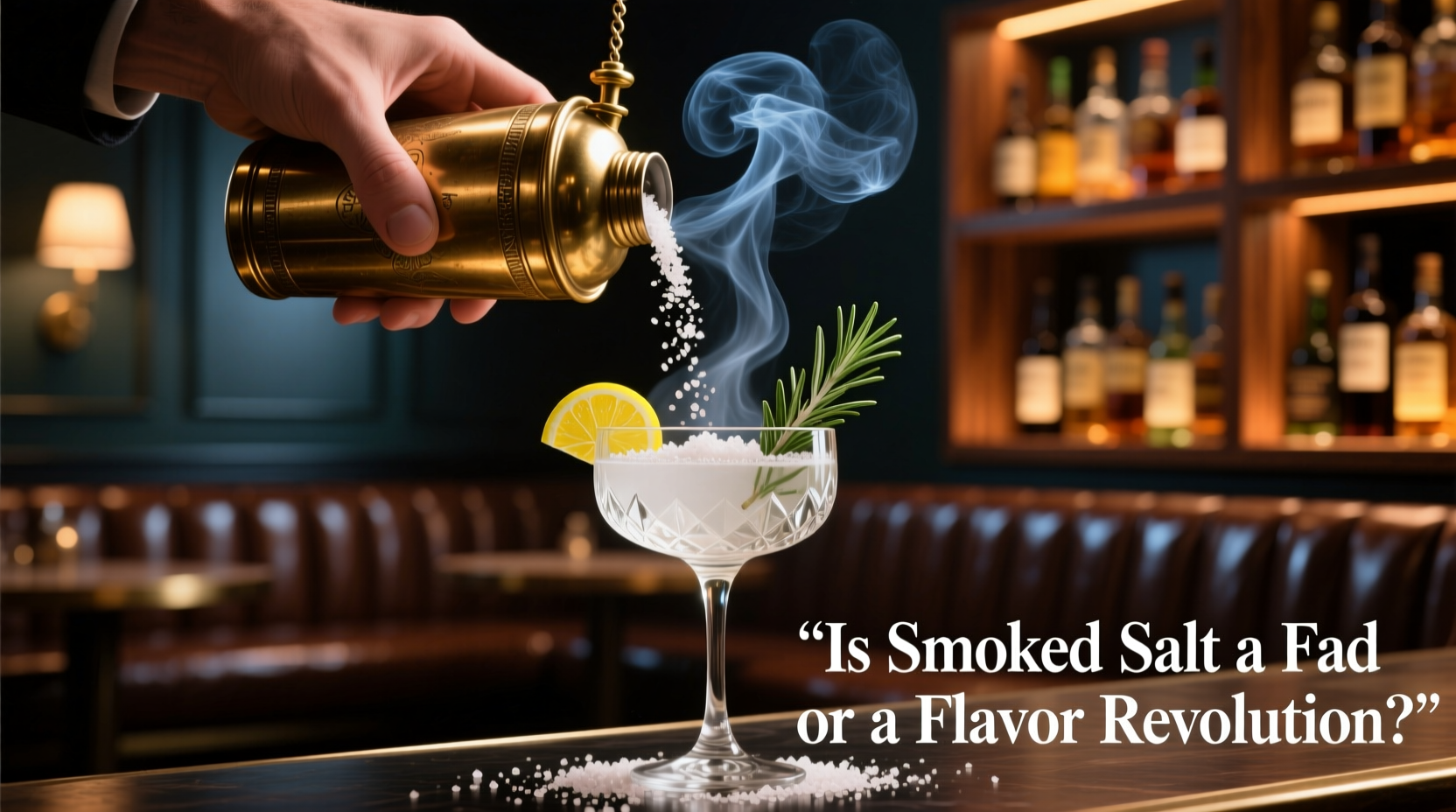
Smoked salt isn’t just salt with flavor added—it’s a functional ingredient shaped by Maillard reactions and volatile phenolic compounds released during low-temperature wood combustion. Unlike liquid smoke (a distillate often containing harsh, acrid notes), artisanal smoked salts—like alder-smoked Maldon or cherrywood-smoked flake salt—are produced by gently exposing sea or rock salt to cool, aromatic smoke for 12–72 hours. This process deposits guaiacol, syringol, and eugenol: molecules that enhance mouthfeel, suppress bitterness, and amplify savoriness without overwhelming acidity or sweetness.
Crucially, smoked salt delivers *umami synergy*. Glutamates in tomato, miso, fermented black beans, or even aged tequila bind more effectively with sodium ions, making savory elements taste richer and more resonant. In contrast, plain salt merely seasons; smoked salt *orchestrates*. A 2022 sensory study published in Journal of Sensory Studies found that tasters perceived smoked-salt-rimmed Palomas as 37% more “complex” and 28% more “balanced” than identically formulated versions with kosher salt—especially when paired with smoky mezcal or roasted poblano shrubs.
Tip: Never use iodized table salt for smoking—it contains anti-caking agents that burn acridly and inhibit smoke absorption. Always start with pure, coarse sea or rock salt.A Brief History: From Barbecue Rub to Bar Tool
Smoked salt has roots far older than craft cocktails. Indigenous Pacific Northwest tribes cold-smoked sea salt over alderwood for preservation and ritual seasoning. In the 19th century, Scottish coastal communities smoked salt over peat fires to preserve herring—giving rise to the deep, medicinal notes now associated with Islay sea salt. Its cocktail debut was modest: a footnote in Jeffrey Morgenthaler’s 2012 The Bar Book, where he suggested a “whiskey sour variation with maple-smoked salt rim.” But it wasn’t until 2016, when Death & Co.’s NYC team launched their “Smoke & Mirrors” menu featuring a smoked-salt–rinsed Oaxacan Old Fashioned, that bartenders began treating it as a structural element—not just a garnish.
By 2019, three distinct applications had crystallized: rimming (for immediate aroma and textural contrast), infusion (steeping in aquafaba or vinegar for savory acid), and dry-shaking (to emulsify fat-washed spirits with smoke). Each demands different salt profiles: delicate applewood for gin-based drinks, bold hickory for bourbon, and subtle beechwood for delicate vermouth-forward cocktails.
Real-World Application: The Case of The Salt Line (Portland, OR)
In early 2023, The Salt Line—a 24-seat bar specializing in regional American ingredients—replaced all standard rim salts with house-smoked varieties. Their goal: deepen connection between cocktail and cuisine without adding heat or sugar. Bartender Lena Ruiz developed a “Smoke Profile Matrix” mapping local woods to seasonal produce: Oregon myrtlewood for spring ramps and nettle cordials; dried hazelnut shell for fall pear-and-rye drinks; and Douglas fir tip (foraged sustainably) for winter citrus shrubs.
One standout creation—the “Cedar & Clam”—combined house-infused clam brine, grapefruit oleo, blanco tequila, and a rinse of cedar-smoked salt dissolved in neutral spirit. Served up in a chilled coupe with a single preserved sea bean, it tasted unmistakably coastal: briny, resinous, clean. Over six months, it accounted for 22% of total cocktail sales and drove a 35% increase in repeat visits among food-focused guests. “People don’t order it because it’s smoky,” Ruiz explains. “They order it because it tastes like where they are—right now, right here.” That sense of terroir, not trend, is what moved smoked salt from novelty to necessity on her bar top.
Do’s and Don’ts: Using Smoked Salt with Intention
Its versatility is real—but only when applied with precision. Too much smoke overwhelms; too little goes unnoticed. Below is a distilled guide based on interviews with 12 working bartenders across the U.S. and Europe.
| Action | Do | Don’t |
|---|---|---|
| Rimming | Use flake salt for texture; dampen rim with citrus oil (not juice) to control adhesion and prevent dilution | Apply to wet rims with citrus juice—it dissolves salt too fast and creates bitter, uneven edges |
| Infusion | Steep 1 tsp smoked salt per 100ml vinegar or aquafaba for 4–6 hours refrigerated; strain through coffee filter | Boil or heat the infusion—it volatilizes delicate smoke compounds and leaves flat, ashy notes |
| Dry Shaking | Add ¼ tsp fine smoked salt to shaker before dry shake with egg white or aquafaba; strain through fine mesh | Use coarse salt—it won’t emulsify and leaves gritty residue in the glass |
| Finishing Dust | Sprinkle micro-ground smoked salt (ground in spice grinder for 5 seconds) over stirred drinks just before garnish | Pre-grind and store—it loses aromatic volatility within 48 hours |
| Pairing | Match smoke intensity to spirit weight: light woods (apple, cherry) with gin/vodka; heavy woods (mesquite, oak) with aged rum/mezcal | Pair hickory salt with floral gin—it clashes with juniper and reads as burnt toast, not harmony |
Expert Insight: What Industry Leaders Say
When asked whether smoked salt belongs in foundational bar training, Erika Nakanishi—James Beard Award–nominated beverage director at San Francisco���s Kōryū and author of Savory Spirits—was unequivocal:
“Salt is the bartender’s most underutilized acid regulator. Smoked salt adds dimension you can’t replicate with bitters or shrubs. It’s not a ‘trend’—it’s a category expansion, like discovering saline solution or clarified lime juice. Anyone teaching bar fundamentals in 2024 who skips smoked salt is skipping a core lever of balance.” — Erika Nakanishi, Beverage Director & Author
Similarly, London-based mixologist Javier Gómez—who helped develop the smoked-salt–enhanced “Umami Martini” for The Connaught Bar’s 2023 menu—notes its functional evolution: “We no longer think of it as ‘smoke for smoke’s sake.’ Now it’s about bridging fermentation and fire: using cherrywood salt with gochujang-washed vodka, or beechwood salt with koji-fermented yuzu. It’s become grammar, not punctuation.”
A Practical Implementation Checklist
Ready to integrate smoked salt meaningfully—not decoratively? Follow this actionable checklist before your next service or home experiment:
- Evaluate your current savory drinks: Identify 2–3 cocktails where salt already plays a role (e.g., Bloody Mary, Caesar, Paloma, Oaxacan Old Fashioned).
- Source intentionally: Purchase two distinct profiles—one light (applewood or alder) and one robust (hickory or oak)—from a reputable salt maker (e.g., Jacobsen Salt Co., Maldon, or local artisan producers).
- Test rim application: On a small batch, compare smoked salt rim vs. standard rim on identical drinks. Note differences in aroma release, first sip impact, and finish length.
- Build one infusion: Make smoked-salt vinegar (1 tsp salt per ½ cup rice vinegar, steep 4 hrs, strain) and use it in a shrub or vinaigrette-style cocktail component.
- Document and refine: Track guest feedback, reorder rates, and staff observations for 14 days. Adjust wood type or application method based on data—not assumption.
Frequently Asked Questions
Can smoked salt replace saline solution in cocktails?
No—it complements it. Saline solution (salt + water) adjusts overall perception of sweetness, acidity, and body. Smoked salt contributes aromatic complexity and umami depth but lacks the precise, neutral salinity needed for structural balance. Use them together: saline in the shaker, smoked salt on the rim or as a finishing dust.
Does smoked salt lose potency over time?
Yes—significantly. Volatile phenols degrade after exposure to light, air, and humidity. Store in an opaque, airtight container in a cool, dark cupboard. Whole-flake smoked salt retains peak aroma for ~3 months; ground or micro-ground versions should be used within 48 hours of preparation. If the aroma reads dusty or one-dimensional rather than layered and woody, it’s past its prime.
Is there a vegan or low-sodium alternative?
Not functionally equivalent. Mushroom powder or nutritional yeast may add umami, but neither delivers sodium’s ion-driven flavor amplification or smoke’s phenolic structure. For low-sodium service, reduce quantity (¼ tsp instead of ½ tsp) and pair with intensely savory ingredients (black garlic, miso, tamari) to maintain depth. There is no true substitute—only thoughtful adaptation.
Conclusion: Beyond the Hype, Into the Toolkit
Calling smoked salt a “fad” confuses visibility with value. Its moment in the spotlight—those viral photos of charcoal-black rims and misty smoke bowls—has faded. What remains is quieter, more durable: a calibrated tool for bartenders building intentionality into every layer of flavor. It doesn’t work in every drink, nor should it. But in the right context—in a celery-and-dill–infused gin fizz where smoked salt lifts the herbal bitterness, or in a bone-marrow–washed Manhattan where it echoes the richness without heaviness—it performs a singular, irreplaceable function. Trends shout. Tools endure. Smoked salt has earned its place not because it’s novel, but because it solves real problems: how to deepen savoriness without fat, how to anchor smoke without heat, how to make a drink taste of place, not just profile. Your bar doesn’t need ten kinds of smoked salt. It needs one thoughtfully chosen, correctly applied, and consistently respected. Start there—and let the smoke settle into something meaningful.
💬 Try one smoked salt technique this week—and tell us what changed. Share your experience, pairing notes, or unexpected success in the comments. Let’s build better savory drinks—together.