Whiskey has evolved from a regional tradition into a global culture of exploration—where every dram tells a story of terroir, time, and craftsmanship. As the market expands, so do the entry points: from $25 budget bourbons to $2,500 single cask Islay malts—and now, curated monthly deliveries promising discovery without commitment. Whiskey subscription boxes have surged in popularity, especially among newcomers and curious intermediates. But beneath the glossy unboxing lies a practical question: Are these services truly cost-effective, educationally valuable, or even logistically sensible when stacked against traditional bottle purchases? This isn’t about hype or nostalgia—it’s about return on investment, both financial and experiential. We’ll break down real pricing, tasting outcomes, hidden costs, and psychological trade-offs—not with theory, but with data, case evidence, and insights from distillers, retailers, and longtime subscribers.
How Subscription Boxes Actually Work (and Where They Differ)
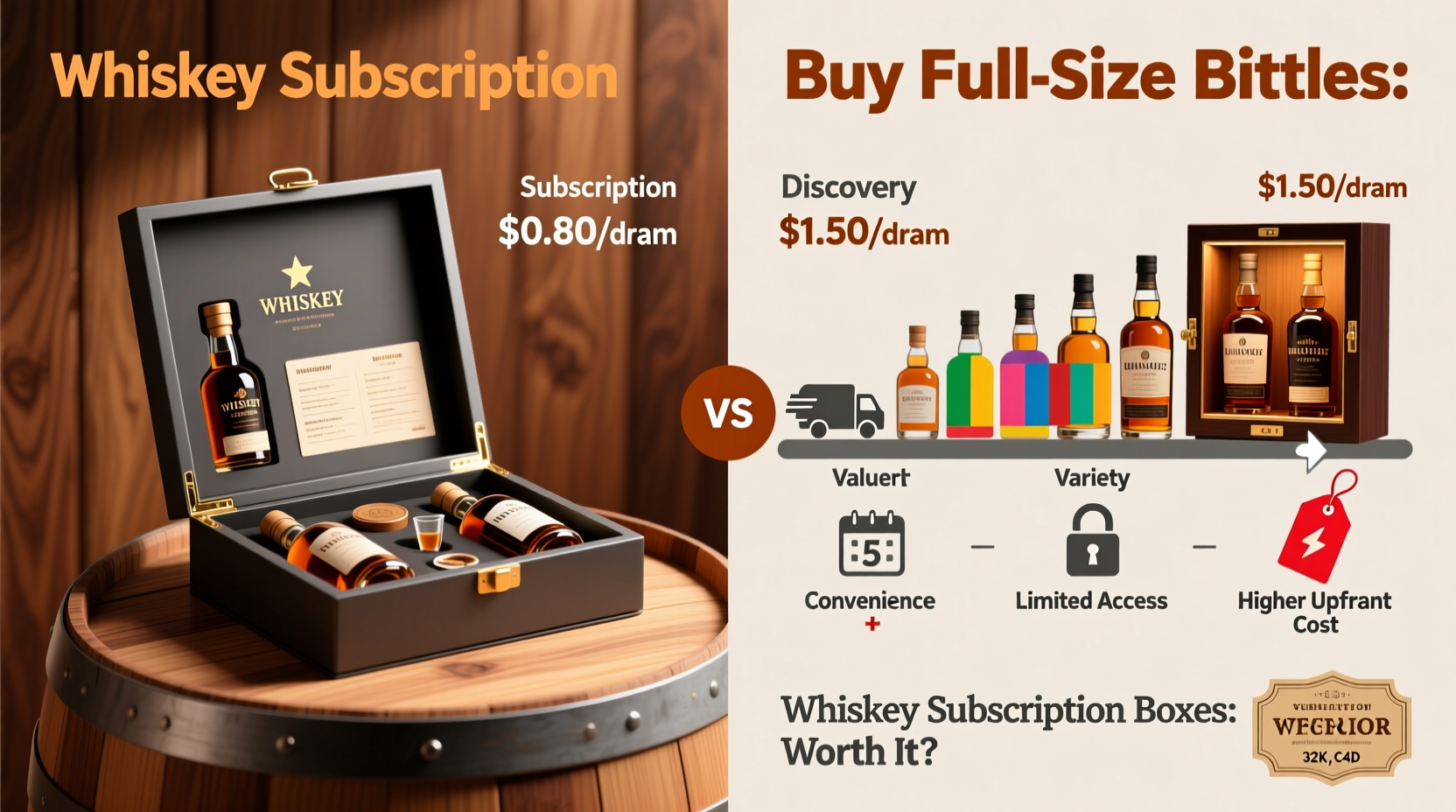
Most whiskey subscription services operate on one of three models: discovery-focused, education-first, or premium-curation. Discovery boxes (e.g., Whiskey Loot, Master of Malt’s “Taster’s Club”) emphasize variety—typically delivering 3–5 50ml vials per month, often from lesser-known distilleries or experimental releases unavailable at retail. Education-first models (like The Whisky Exchange’s “Whisky Tasting Club”) pair each sample with detailed tasting notes, distillery background, and guided comparison exercises. Premium-curation services (e.g., Flaviar’s “Rare & Limited” tier) ship full 750ml bottles—but only after members complete preference profiling and commit to quarterly billing.
The critical distinction lies in access versus ownership. A $65/month discovery box may include a 50ml pour of a $95 Japanese single malt—but that’s not equivalent to owning the bottle. It’s a tasting opportunity, not inventory. Meanwhile, a $149 premium box shipping a full 750ml bottle of a limited-edition Glendronach 15-year sherry cask is functionally identical to purchasing that same bottle at a specialty retailer—except with added curation, packaging, and sometimes exclusivity (e.g., early access to distillery-only releases).
Tip: Before subscribing, check whether samples are pre-bottled by the service or sourced directly from distilleries—third-party repackaging can compromise oxidation stability and introduce inconsistency in proof or flavor.Cost Analysis: What You’re Really Paying For
To assess true value, we must compare total annual outlay, effective cost per dram, and opportunity cost—the whiskey you *could have bought* instead. Below is a realistic side-by-side breakdown based on 2023–2024 U.S. pricing data across five leading services and standard retail channels:
| Service / Purchase Method | Monthly/Annual Cost | Typical Contents (per month) | Effective Cost per 50ml Dram | Notes |
|---|---|---|---|---|
| Whiskey Loot (Standard Tier) | $64.95/mo ($779/yr) | 4 × 50ml vials + tasting guide | $3.25 | Includes 1–2 unknown or private-label bottlings; minimal transparency on age/statement |
| The Whisky Exchange Tasting Club | $89.95/mo ($1,079/yr) | 3 × 50ml vials + video masterclass + printable notes | $5.99 | All whiskies fully disclosed; includes 1 rare or independent bottling monthly |
| Flaviar (Premium Bottle Tier) | $149/mo ($1,788/yr) | 1 × 750ml bottle + member-only access | N/A (full bottle) | Bottle value averages $130–$160; $19/mo covers curation, logistics, and community features |
| Retail Purchase (Targeted Strategy) | $720/yr | 12 × carefully selected 750ml bottles ($60 avg.) | $0.40 per 50ml | Assumes strategic buying: sales, closeouts, and store picks; excludes travel retail or auction premiums |
| Retail Purchase (Exploratory Strategy) | $1,200/yr | 6 × 750ml bottles ($100 avg.) + 6 × 200ml “mini” sets ($100 total) | $1.11 per 50ml | Allows deeper dives into regions (e.g., 3 Islay bottlings) while sampling new styles |
The numbers reveal a clear pattern: discovery boxes cost 3–8× more per dram than self-directed retail purchases—even when accounting for convenience. Their value doesn’t reside in volume economics, but in risk mitigation and exposure efficiency. For someone who’d otherwise buy two $80 bottles annually and stick to familiar brands, a $65/month box might deliver six new distilleries, three cask finishes, and two countries of origin in a single year—knowledge that would take years and hundreds of dollars to accumulate organically.
A Real-World Case Study: Sarah’s First 18 Months
Sarah, a 34-year-old graphic designer in Portland, began exploring whiskey seriously in early 2023. She’d previously owned only one bottle—a standard-issue Bulleit Bourbon—and felt overwhelmed by shelf labels, age statements, and regional jargon. She signed up for The Whisky Exchange Tasting Club at $89.95/month, motivated less by cost savings than by structure. Her first box included a 50ml pour of Kavalan Concertmaster (Taiwan), a peated Ardmore Tradition (Scotland), and a rye-finished Glenmorangie (Highlands). Each came with a QR-linked video explaining how Taiwanese tropical aging accelerates maturation, why Ardmore uses direct-fired stills, and what “rye-finished” means practically on the palate.
By month six, Sarah had identified her preference for heavily sherried Highland malts and lighter, fruit-forward Japanese whiskies. She paused her subscription and used her newly calibrated palate to purchase her first full bottle: Glendronach 12 Year Old Sherry Cask—$72 at her local shop. Over the next year, she bought four more full bottles aligned with her profile, spending $310 total. She estimates she’d have spent over $500 on misaligned purchases (“I almost bought a Laphroaig 10 before realizing I dislike medicinal smoke”) and wasted months deciphering terminology without guidance. Her subscription cost $1,619 over 18 months—but she credits it with cutting her learning curve by 70% and preventing $220+ in regret-driven buys. As she told us: “It wasn’t about the liquid. It was about the language—and the confidence to speak it.”
What Subscriptions Deliver Beyond the Liquid
Whiskey isn’t consumed in isolation. It’s contextualized by history, geography, production philosophy, and sensory literacy. Subscription services excel where retailers cannot: weaving narrative, building scaffolding, and reducing cognitive load. Consider these non-liquid returns:
- Curation as gatekeeping: Reputable services vet producers rigorously. Flaviar’s acquisition team visits over 200 distilleries yearly; their “Independent Bottler Guarantee” ensures no undisclosed additives or artificial coloring—something impossible to verify on a crowded liquor store shelf.
- Taste memory anchoring: Tasting multiple whiskies side-by-side—especially with guided comparisons (“notice how the bourbon’s corn sweetness contrasts with the rye’s spice backbone”)—builds neural pathways faster than solo tasting. Neurogastronomy research confirms that contextual framing increases retention of flavor associations by up to 40%.
- Community calibration: Most services include member forums, live tastings, and Q&As with blenders. When Sarah tasted a young, unbalanced Irish pot still, she didn’t dismiss it as “bad”—she read peer notes, heard a master blender explain its intentional rawness as a base for finishing, and adjusted her expectations. That nuance rarely appears on a shelf tag.
- Logistical friction reduction: Import restrictions, allocation lotteries, and regional exclusives (e.g., Diageo’s Special Releases) are inaccessible to most consumers. Subscribers gain priority access—often at list price—bypassing secondary markets where markups routinely exceed 200%.
“The biggest barrier to whiskey appreciation isn’t cost—it’s interpretation. A subscription doesn’t sell you liquid; it sells you context. And context is what turns sipping into understanding.” — Dr. Alistair Finch, Senior Blender, Compass Box Whisky Co.
When Buying Full-Size Bottles Makes More Sense
Subscriptions shine for discovery and education—but they falter under specific, common conditions. If any of the following apply, self-directed bottle purchases will consistently outperform subscriptions:
Checklist: Opt Out of Subscriptions If…
- You already own 10+ bottles across 3+ regions and can articulate preferences (e.g., “I prefer ex-bourbon casks under 12 years for coastal malts”)
- Your local retailer offers robust staff recommendations, tasting events, or a “try-before-you-buy” sample program
- You prioritize aging potential—most samples are decanted weeks or months before shipping, losing volatile top notes essential to evaluation
- You drink whiskey primarily for relaxation, not study—subscription fatigue is real; 3–5 tastings/month can feel like homework
- You value bottle aesthetics, collectibility, or gifting potential—vials lack presence; full bottles anchor home bars and serve as meaningful gifts
Consider timing, too. If you’re planning a summer road trip through Kentucky distilleries, skip June–August subscriptions. Use those months to buy distillery-exclusive bottles (often $10–$20 cheaper on-site) and attend barrel-proof tastings. Similarly, if a favorite brand announces a major release—like Ardbeg’s annual “Feis Ile” bottling—allocate your subscription budget toward securing that bottle directly rather than receiving generic alternatives.
FAQ: Practical Questions Answered
Can I pause or cancel my subscription without penalty?
Yes—reputable services (Flaviar, The Whisky Exchange, Master of Malt) allow pausing or cancellation anytime before the next billing cycle. Beware of auto-renewal traps: some lesser-known boxes charge a $25 “early termination fee” if canceled within 90 days. Always review the Terms of Service—not just the marketing page.
Do subscription samples accurately represent full bottles?
Generally, yes—but with caveats. Samples poured directly from cask or fresh bottling are highly representative. However, many services use pre-filled vials stored for months; oxidation and ethanol evaporation can mute top notes and exaggerate tannins. For serious evaluation, treat samples as directional—not definitive. Always follow up with a full bottle if intrigued.
Are there tax or shipping complications for international subscribers?
Yes, significantly. U.S.-based services shipping to Canada or the EU face customs delays, excise duties (often 20–30% of value), and brokerage fees. Some services absorb these; others pass them on at checkout. Always confirm landed cost—including all fees—before subscribing internationally. Better yet, seek region-specific providers: WhiskyInvestDirect serves the UK/EU; WhiskyBase Club operates in Benelux.
Conclusion: Clarity Over Convenience
Whiskey subscription boxes aren’t inherently “worth it” or “not worth it.” Their value is relational—tied entirely to where you are in your relationship with the spirit. For the novice overwhelmed by choice, they’re an indispensable compass. For the seasoned enthusiast chasing a specific 1978 Macallan, they’re a distraction. The real cost isn’t measured in dollars per dram, but in opportunity cost: the time saved learning, the confidence gained in ordering blind, the joy of unexpected discovery. Yet that same convenience carries weight—the mental load of managing recurring charges, the guilt of unopened vials, the subtle pressure to “get your money’s worth” by tasting everything, even when you’d rather sip slowly.
So ask yourself honestly: Do you want to explore—or do you want to own? Do you need guidance—or do you need inventory? There’s no universal answer. But there is a path forward: Start with one 3-month subscription from a transparent, education-focused provider. Take notes. Track what resonates. Then, at the end of the term, calculate what you’d have spent buying those same whiskies retail—and what you’d have missed without curation. Let that data, not the unboxing thrill, guide your next move.
💬 Your experience matters. Have you switched from subscriptions to full bottles—or vice versa? Share your turning point, cost breakdown, or one whiskey that changed everything in the comments below. Real stories help others navigate this nuanced choice.