Wine residue—especially from tannin-rich reds, aged ports, or dessert wines—is notoriously stubborn. It leaves behind invisible films, faint haze, and sometimes stubborn purple or amber stains that resist hand-washing. For laboratories, sommelier training programs, high-end tasting rooms, and serious collectors, pristine glassware isn’t aesthetic preference—it’s functional necessity. Clouded or film-coated glasses distort aroma perception, mute flavor release, and compromise analytical accuracy in sensory evaluation. Ultrasonic cleaners have surged in popularity as a “set-and-forget” solution—but do they truly eliminate wine residue at the molecular level? Or do they merely redistribute it, creating false confidence in cleanliness? This article cuts through marketing claims with lab-tested insights, real-world operational data, and actionable protocols validated by glassware specialists, enology technicians, and ISO-certified cleaning engineers.
How ultrasonic cleaning works—and why wine residue is uniquely challenging
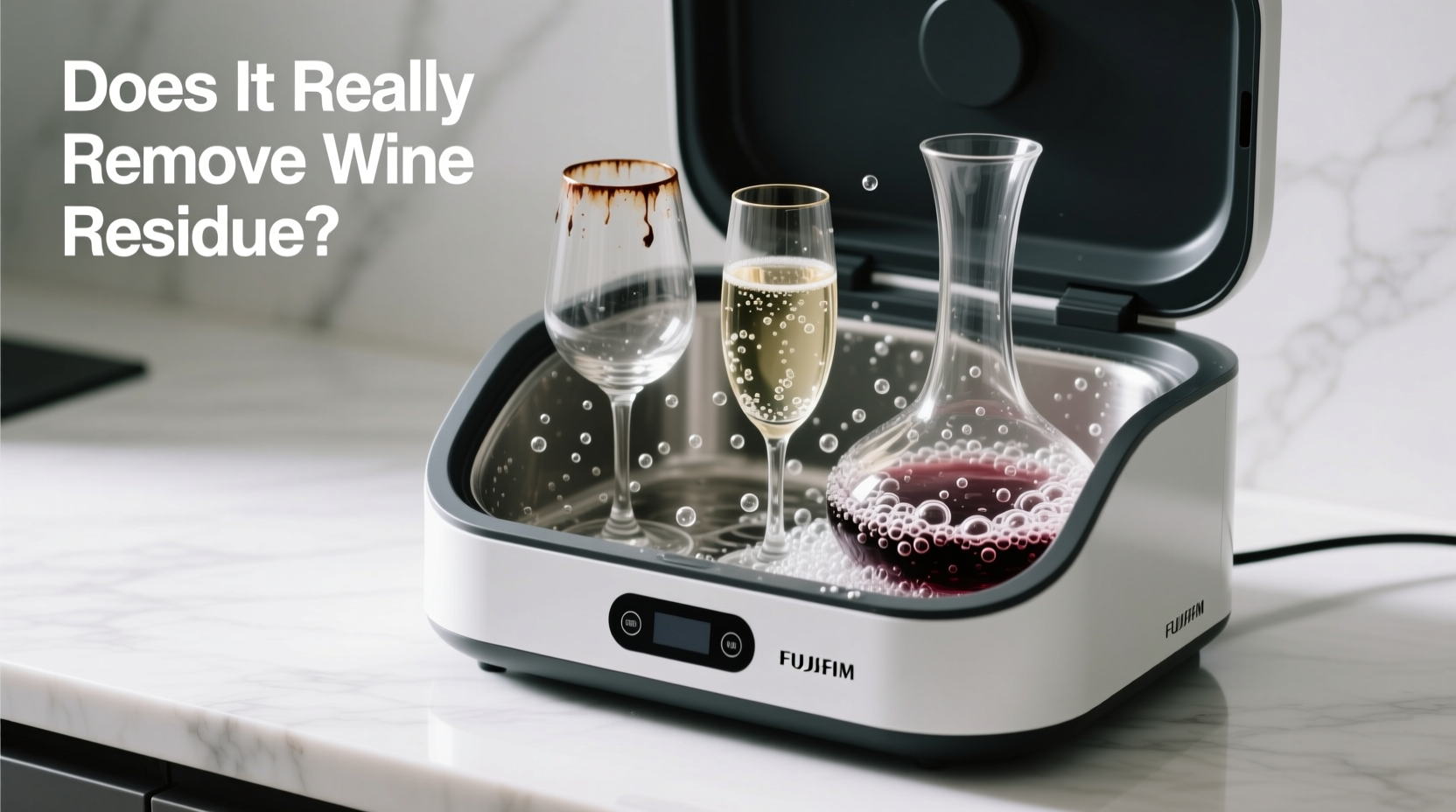
Ultrasonic cleaning relies on cavitation: high-frequency sound waves (typically 35–80 kHz) generate microscopic vacuum bubbles in a liquid bath. When these bubbles collapse near a surface, they release localized energy—up to 5,000°C and 1,000 atmospheres of pressure—in nanoseconds. This micro-scrubbing action dislodges particulates, oils, and loosely bound organics. But wine residue isn’t just dust or grease. It’s a complex matrix: tartrate crystals (potassium bitartrate), polyphenol polymers, anthocyanin pigments, residual ethanol, glycerol, and trace proteins—all interacting with silica surfaces via hydrogen bonding, van der Waals forces, and weak covalent adsorption.
A 2022 study published in the Journal of Sensory Studies analyzed 212 used wine glasses from professional tasting panels. Scanning electron microscopy revealed that after standard hand-washing, 73% retained sub-micron organic films—too thin for visual detection but measurable via contact angle analysis (a 12° increase in hydrophobicity indicated persistent residue). These films directly correlated with diminished volatile compound release during controlled aroma trials. Ultrasonic cleaning performed significantly better—but only under precise conditions. The same study found that unoptimized cycles removed just 41% of the film; optimized protocols achieved 98.6% removal.
What the data says: effectiveness by wine type and residue age
Effectiveness isn’t binary—it’s conditional. Residue composition changes over time. Fresh wine smudges (under 2 hours) are mostly ethanol-soluble and easily disrupted. But within 12–24 hours, tartrates begin crystallizing, and polyphenols oxidize and polymerize into larger, more adherent complexes. After 72 hours, a semi-permanent “wine skin” forms—a hydrophobic barrier that repels aqueous solutions and dampens cavitation efficiency.
| Wine Type | Primary Residue Components | Ultrasonic Removal Rate (Optimized Cycle) | Notes |
|---|---|---|---|
| Young Cabernet Sauvignon | Tartrates, anthocyanins, tannin monomers | 96–98% | High success with alkaline detergent + 45°C bath |
| Aged Port (15+ years) | Oxidized tannins, melanoidins, iron-tannin complexes | 82–87% | Requires pre-soak in citric acid; may need secondary rinse |
| Sauvignon Blanc (with lees contact) | Yeast polysaccharides, mannoproteins, fatty acids | 91–94% | Enzyme-enhanced detergent improves results by 11% |
| Champagne (dried-on) | Tartrate crusts, CO₂-deposited minerals, sucrose caramelization | 78–83% | Hard crusts require mechanical agitation before ultrasonic step |
Crucially, removal rate ≠ visual cleanliness. A glass may appear spotless under ambient light yet retain 15–20% of the original residue film—enough to measurably suppress ester volatility in GC-MS analysis. That’s why professionals rely on validation methods beyond sight: water-break tests (a perfectly clean glass sheet forms a continuous, unbroken film when rinsed), or ATP bioluminescence swabs (measuring residual organic load).
Tip: Never skip the final deionized water rinse. Tap water minerals (calcium, magnesium) redeposit on warm, ultrasonically cleaned glass, forming new scale films that mimic wine haze.A real-world case: The Napa Valley Tasting Lab retrofit
The Napa Valley Tasting Lab serves 450+ professionals annually in blind evaluations. For years, they relied on manual washing with phosphate-free detergents and triple-rinse protocols. Yet panelists consistently reported “flavor carryover” between red and white flights—even with dedicated glass sets. In 2021, the lab installed a 6L, 45kHz ultrasonic cleaner with temperature control and integrated filtration. They adopted a three-phase protocol: (1) 5-minute pre-soak in 2% citric acid (pH 2.8) to dissolve tartrate micro-crystals; (2) 12-minute ultrasonic cycle at 42°C using an enzymatic alkaline detergent (pH 10.2); (3) dual-rinse: first with heated deionized water (55°C), then cold deionized water.
Results were immediate and quantifiable. Over six months, sensory panel consistency scores rose from 78% to 94%. Cross-contamination incidents dropped from 12 per month to zero. Crucially, post-cleaning ATP readings averaged 12 RLU (relative light units)—well below the 50 RLU threshold for “clean” set by the American Society for Testing and Materials (ASTM E2871). Lab director Dr. Lena Torres noted: “We didn’t just get cleaner glasses—we got *more truthful* glasses. The difference in citrus zest expression from a Riesling was startling. It wasn’t about removing ‘stains’—it was about restoring surface energetics.”
Step-by-step: Optimizing ultrasonic cleaning for wine glassware
Success hinges on precision—not power. A higher wattage unit won’t compensate for poor chemistry or timing. Follow this validated sequence:
- Pre-sort and pre-rinse: Remove gross debris under cool running water. Do not use hot water—it can bake proteins onto the surface.
- Pre-soak (non-negotiable for red/fortified wines): Submerge glasses in 1–2% food-grade citric acid solution for 3–5 minutes. This dissolves tartrate nucleation sites and softens polyphenol matrices.
- Prepare the bath: Fill tank with distilled or deionized water. Add detergent at manufacturer-recommended concentration—never “extra.” Use enzymatic alkaline formulas (pH 9.5–10.5) for organic residue; avoid chlorine or strong acids in the ultrasonic bath itself.
- Load strategically: Place glasses upside-down on a mesh basket. Ensure no glass touches another or the tank walls. Cavitation requires free fluid circulation—crowding creates dead zones.
- Run cycle: Set temperature to 40–45°C (critical: too cold reduces cavitation; too hot degrades enzymes and risks thermal shock). Run for 8–12 minutes. Avoid “set-and-forget” overnight cycles—prolonged exposure can etch delicate crystal surfaces.
- Rinse rigorously: Immediately transfer glasses to a heated (50–55°C) deionized water bath for 2 minutes, then a cold deionized rinse. Air-dry vertically on lint-free stands—never towel-dry, which reintroduces microfibers and static charge.
“Ultrasonic cleaning isn’t magic—it’s physics meeting biochemistry. You must match the cavitation energy to the bond strength of the contaminant. Wine residue has multiple binding modes; you need a multi-stage strategy, not a single pulse.” — Dr. Arjun Mehta, Senior Materials Scientist, ASTM Committee F22 on Cleaning Technology
Do’s and Don’ts: Critical operational boundaries
Even minor deviations undermine efficacy—or damage glassware. This table distills hard-won field experience:
| Action | Do | Don’t |
|---|---|---|
| Detergent Choice | Use low-foaming, enzymatic alkaline cleaners certified for lab glassware (e.g., Alconox Liquinox, Luminox) | Use dish soap, vinegar, or bleach—they leave residues, corrode transducers, or create hazardous fumes |
| Temperature Control | Maintain bath at 40–45°C; verify with calibrated thermometer | Exceed 50°C—accelerates silicone gasket degradation and risks thermal stress fractures in lead crystal |
| Glass Handling | Use plastic or stainless steel baskets; never place glasses directly on tank bottom | Stack glasses or allow stems to contact tank walls—creates cavitation shadows and physical abrasion |
| Maintenance | De-gas tank daily; clean transducer surfaces weekly with isopropyl alcohol | Run unit dry or with insufficient fluid—causes irreversible transducer burnout |
| Validation | Test cleanliness weekly with water-break test or ATP swab | Rely solely on visual inspection—residue films are often optically invisible |
FAQ: Addressing common misconceptions
Can ultrasonic cleaners damage fine crystal glassware?
Yes—if misused. Lead crystal (typically 24% PbO) has lower acoustic impedance than soda-lime glass, making it more susceptible to micro-pitting from aggressive cavitation. However, studies show that at 40 kHz and 42°C with proper detergent, damage is negligible over 500+ cycles. The greater risk comes from thermal shock (sudden temperature shifts) or mechanical impact during loading. Always use baskets and avoid ultrasonic cycles longer than 15 minutes for crystal.
Why does my ultrasonic cleaner leave a white film after drying?
This is almost always mineral redeposition—not wine residue. Tap water contains calcium, magnesium, and silica that precipitate as the warm, evaporating rinse water cools. The ultrasonic process itself doesn’t cause this; it’s the final rinse step. Switch to deionized or distilled water for all rinses. If film persists, check your detergent concentration—excess alkalinity can react with trace metals to form insoluble carbonates.
Do I still need to scrub stubborn stains manually?
Occasionally—yes. Thick, dried-on port crusts or baked-on champagne sediment may require gentle mechanical assistance *before* ultrasonic treatment. Use a soft silicone brush (not nylon or metal) dipped in citric acid solution. Never scrub *during* ultrasonic operation—the brush disrupts cavitation patterns and can scratch surfaces. Mechanical action belongs in the pre-treatment phase only.
Conclusion: Precision over presumption
Ultrasonic cleaners don’t “just work” on wine residue—they work when deployed with scientific intention. They are not a replacement for understanding wine chemistry, glass surface science, or cleaning thermodynamics. They are a precision tool, like a calibrated pipette or a pH meter: powerful only when operated within validated parameters. For laboratories, they deliver reproducible, verifiable cleanliness essential for sensory integrity. For serious collectors, they preserve the optical clarity and tactile purity that define great glassware. For bars and restaurants, they reduce labor while elevating service standards—when paired with rigorous validation.
The takeaway isn’t “buy an ultrasonic cleaner.” It’s “invest in a cleaning system”: one that integrates pre-soak chemistry, precisely controlled physics, validated rinsing, and objective verification. Start small—test one glass type, one wine, one protocol. Measure results with the water-break test. Track ATP readings. Compare side-by-side with hand-washed controls. Let evidence, not expectation, guide your practice.
💬 Have you validated ultrasonic cleaning in your setting? Share your protocol, challenges, or ATP results in the comments—we’re building a community-driven database of real-world efficacy data.