Walk into a boutique candle shop and you’ll likely spot jars labeled “Old Fashioned,” “Espresso Martini,” or “Smoked Mezcal.” The promise is intoxicating: light it, and inhale the essence of your favorite cocktail—without the hangover. But does that amber-hued soy blend truly transport you to a dimly lit speakeasy, or does it just smell like warm paraffin with a hint of synthetic vanilla? The truth sits between marketing hype and aromatic science—and it hinges on formulation integrity, not fragrance naming.
Spirit-infused candles occupy a curious niche at the intersection of home fragrance, mixology culture, and olfactory psychology. They’re not scented with actual alcohol (ethanol evaporates instantly and destabilizes wax), nor do they contain distilled spirits. Instead, they rely on carefully engineered fragrance oils designed to mimic the volatile aromatic compounds found in real beverages—vanillin from aged bourbon barrels, limonene from citrus peels, guaiacol from smoked agave, or ethyl acetate from fermented fruit. Yet many consumers report disappointment: a flat, one-note “boozy” scent that fades fast—or worse, a cloying, chemical sweetness that bears no resemblance to the complexity of a well-crafted drink.
This article cuts through the aroma noise. Drawing on interviews with master perfumers, candle chemists, and bar owners who’ve collaborated on spirit-themed collections, we unpack why most spirit candles fall short—and how a select few succeed. You’ll learn what makes a true “drink-accurate” scent profile, how to read labels for authenticity, and why your nose might be tricked by memory more than molecules.
Why Spirit Candles Rarely Smell Like Real Drinks (and Why That’s Not Always a Flaw)
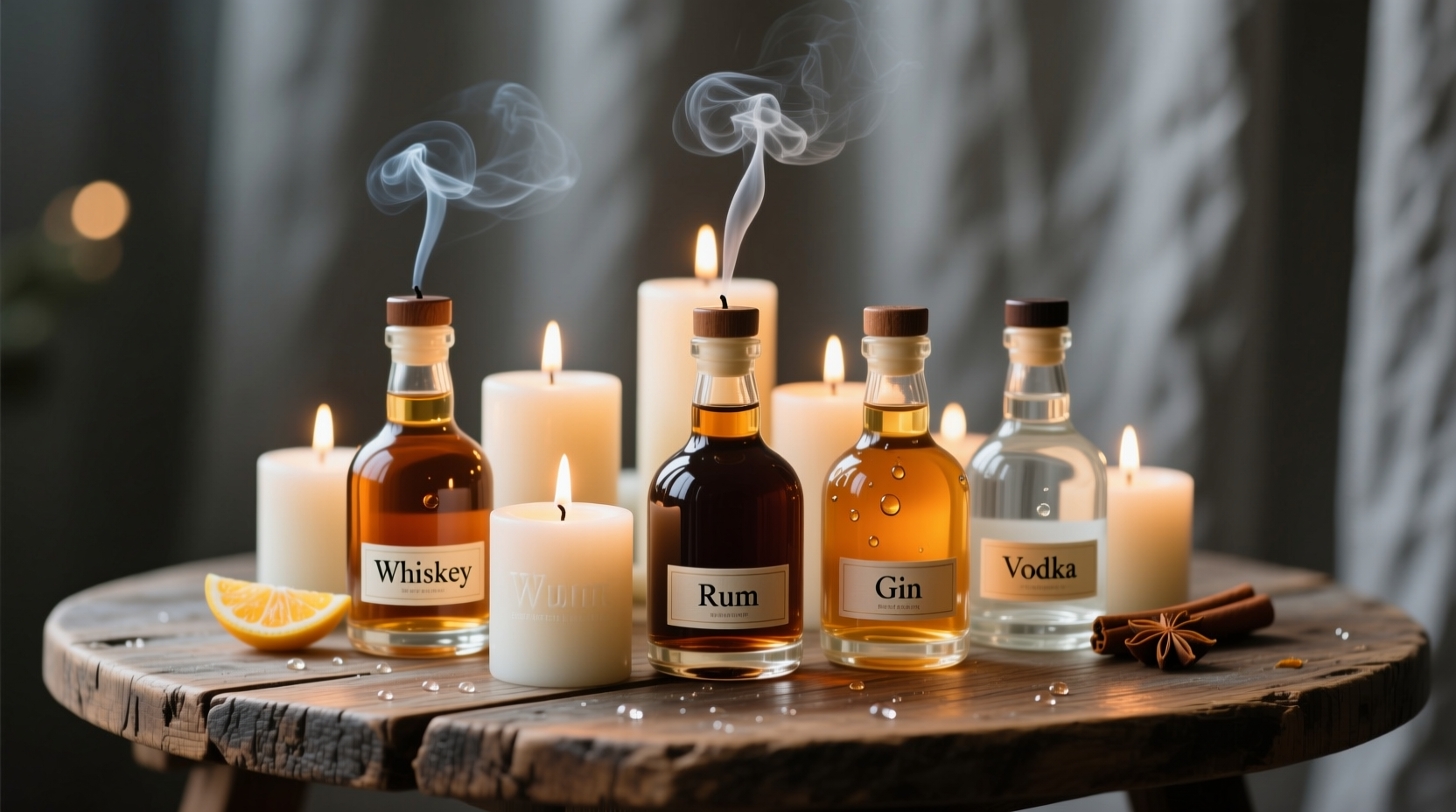
The fundamental disconnect begins with chemistry. Real spirits deliver scent through hundreds of volatile organic compounds (VOCs) released at specific temperatures and concentrations. Bourbon, for example, contains over 400 identifiable aroma molecules—including lactones (coconut, woody), furanals (caramel, roasted), and esters (fruity, floral)—each activated at different stages of nosing and sipping. A candle flame, however, operates at ~1,000°F at its core and ~300–400°F at the melt pool. That heat degrades delicate top notes (like fresh citrus zest or effervescent gin botanicals) while amplifying heavier base notes (amber, oak, smoke). What reaches your nose isn’t the full symphony—it’s a rearranged, thermally altered excerpt.
Compounding this is regulatory reality. The International Fragrance Association (IFRA) restricts or bans certain natural isolates and synthetics commonly used in high-end perfumery—especially those mimicking ethanol’s sharp, clean “alcohol note,” which is essential for drink authenticity but highly flammable and skin-sensitizing in concentrated form. Most commercial candle fragrances substitute safer, more stable alternatives—often sacrificing realism for safety and shelf life.
That said, “not smelling exactly like the drink” doesn’t equal failure. As perfumer Elena Ruiz explains: “A great spirit candle shouldn’t be a replica—it should be an evocation. Think of it like a jazz standard: same melody, new instrumentation. A well-made ‘Negroni’ candle won’t smell like Campari’s bitter orange peel hitting your tongue—it’ll conjure the mood of aperitivo hour: the waxy bitterness of orange rind, the herbal greenness of gin, the faint medicinal lift of vermouth—all balanced so none dominates.”
“The best spirit candles bypass literalism and aim for associative resonance—how the scent makes you *feel*, not how closely it matches a lab analysis.” — Elena Ruiz, Senior Perfumer, AromaLab NYC & former consultant for Bar Cart Collective
What Actually Makes a Spirit Candle Smell Authentic?
Authenticity in spirit candles emerges from three interlocking layers—not one. Each layer must be intentionally designed; skip any, and the illusion collapses.
1. Top Note Accuracy: The First Impression
This is the burst you smell within 10 seconds of lighting. For a “Whiskey Sour” candle, it should open with bright, tart lemon oil (not generic “citrus”), followed by a clean, slightly metallic lift—mimicking the sharpness of fresh-squeezed lemon juice cutting through whiskey’s richness. Many cheap versions use limonene-heavy lemon oil, which smells like cleaning product, not fruit. Authentic versions use cold-pressed lemon oil blended with trace amounts of aldehydes to recreate that mouth-puckering brightness.
2. Heart Note Complexity: The Body & Character
This is where the “spirit” lives. A true “Mezcal” candle avoids generic “smoke” (which reads as burnt tires or campfire). Instead, it layers: smoky guaiacol (from creosote bush or smoked wood distillates), earthy vetiver root, dried pineapple (for agave’s fruity ferment), and a whisper of black pepper (to echo roasted piña). Without this orchestration, you get “ashtray,” not “artisanal mezcal.”
3. Base Note Integration: The Lingering Memory
A real drink leaves a finish—oak tannins, caramelized sugar, or herbal bitterness. In candles, this translates to fixatives that anchor the scent without overwhelming: oakmoss absolute (for bourbon’s barrel character), tonka bean (for vanilla-coumarin depth), or immortelle (for the honeyed, slightly medicinal nuance of amaro). Poorly balanced bases drown out the top and heart, leaving only a heavy, waxy residue.
Tip: Test authenticity by smelling the unlit candle first. If you detect clear, recognizable notes (e.g., juniper berry, orange blossom, toasted oak), it’s likely built with quality naturals or sophisticated synthetics. If it smells only faintly sweet or vaguely “alcoholic,” the formula is probably generic.The Reality Check: A Comparison of Common Spirit Candles vs. Their Real-Drink Counterparts
| Spirit Candle Type | What It Often Smells Like (Mass Market) | What It *Can* Smell Like (Premium Craft) | Key Ingredient Difference |
|---|---|---|---|
| Bourbon | Vanilla + caramel + “woody” sawdust | Buttery diacetyl (buttered popcorn), toasted coconut (gamma-nonalactone), charred oak (guaiacol), faint leather (isobutyl quinoline) | Premium uses food-grade lactones and pyrazines; mass uses vanillin + synthetic “amber” base |
| Gin | Generic “clean” mint + pine cleaner | Fresh-cut juniper berries (not needles), coriander seed (citrus-pepper), angelica root (earthy bitterness), lime leaf (green zing) | Premium isolates juniper oil fractions; mass uses synthetic terpenes |
| Mojito | Artificial lime candy + fake mint gum | Crisp Key lime oil (cold-pressed), crushed mint stem (green, slightly pungent), cane sugar (ethyl maltol), faint soda fizz (trace ozonic molecule) | Premium avoids limonene overload; adds green leaf aldehyde for “crushed herb” effect |
| Smoked Old Fashioned | Charcoal briquette + vanilla extract | Maple-smoked cherry wood (phenolic compounds), orange oil (d-limonene + linalool), bittersweet gentian root, aged rum accord (ethyl acetate + ethyl butyrate) | Premium uses smoked wood distillates, not “smoke” fragrance oil |
A Mini Case Study: How “The Last Call” Bar Transformed Its Candle Line
When Brooklyn’s award-winning cocktail bar *The Last Call* launched its first candle collection in 2022, early batches flopped. Customers loved the branding—a sleek apothecary jar labeled “Penicillin” (a smoky, ginger-forward Scotch cocktail)—but reviews were damning: “Smells like burnt toast,” “Tastes like it smells… and I haven’t even lit it,” “Just smells like wax with regret.”
Owner Marcus Chen paused production and brought in perfumer Anya Petrova. Together, they deconstructed the real Penicillin: Islay Scotch (phenolic smoke, medicinal iodine), fresh ginger (zingy, spicy aldehydes), lemon (bright citral), and honey (warm, waxy sweetness). Petrova rejected off-the-shelf “smoky whiskey” oil. Instead, she built a custom accord using: • Fractionated oakwood smoke oil (low-temperature distillation to preserve delicate phenols) • Ginger CO2 extract (retains fresh rhizome sharpness, unlike steam-distilled ginger oil) • Lemon verbena absolute (adds green, herbal lift missing in lemon oil alone) • Beeswax absolute (for honeyed texture, not sweetness)
The result? A candle that opens with a startlingly accurate “ginger snap” bite, softens into smoky-sweet warmth, and finishes with a lingering, almost saline mineral note—echoing the Islay Scotch’s coastal character. Sales tripled. More tellingly, bartenders began using the candle’s scent profile as a training tool for staff to identify key aromatic markers in the actual drink.
Your Practical Guide: How to Choose (and Use) a Spirit Candle That Delivers
Not all spirit candles are created equal—but you don’t need a chemistry degree to spot the good ones. Follow this step-by-step evaluation process before you buy or burn:
- Read the ingredient list (if provided): Look for terms like “essential oil blend,” “natural isolates,” “CO2 extract,” or “fractionated oil.” Avoid vague terms like “fragrance oil,” “aroma compound,” or “proprietary blend” unless backed by transparency elsewhere.
- Check the wax type: Soy, coconut, or beeswax blends hold complex fragrances better than paraffin. Paraffin can mute subtle herbal or smoky notes and often carries its own petroleum-like undertone.
- Test the cold throw: Smell the unlit candle. Authentic spirit scents will have distinct, layered notes—not just “sweet” or “boozy.” If you can’t detect at least two recognizable elements (e.g., “juniper + citrus” for gin), move on.
- Observe the hot throw for 15 minutes: Light it, then wait. Does the scent evolve? A quality candle will shift: top notes fade, heart notes emerge, base notes anchor. If it smells identical at minute 1 and minute 15, the formula lacks sophistication.
- Assess longevity and diffusion: After 30 minutes, walk into another room. Can you still detect the scent? True spirit accords should project clearly but not overwhelm. If it disappears entirely or smells harsh/chemical, the load is too low or the fragrance is poorly balanced.
FAQ: Your Top Questions, Answered Honestly
Do spirit-infused candles contain real alcohol?
No—and they shouldn’t. Ethanol is highly volatile and flammable. Adding it to wax would create a fire hazard and destabilize the blend. All reputable spirit candles use non-alcoholic fragrance compounds designed to mimic the aromatic profile, not the liquid itself.
Why does my “Rum” candle smell like coconut or vanilla instead of molasses or spice?
Because coconut and vanilla are easy, stable, and inexpensive notes that broadly signal “tropical” or “sweet spirit.” True dark rum aroma comes from esters (fruity), phenols (smoky), and furfurals (caramelized sugar)—compounds that degrade faster in heat and cost significantly more to source and stabilize. Most brands prioritize shelf stability over fidelity.
Can I make my own spirit candle smell more authentic?
Yes—strategically. Place a small dish of real ingredients nearby while burning: a twist of orange peel for an “Old Fashioned” candle, a few crushed juniper berries for “Gin,” or a drop of real maple syrup on a ceramic dish near a “Smoked Maple Bourbon” candle. The ambient volatiles will layer with the candle’s scent, creating a richer, more convincing impression.
Conclusion: Smell Is Memory—And You Deserve Better Than Wax With Hype
Spirit-infused candles aren’t about deception. They’re about intention. When crafted with respect for both mixology and perfumery, they become olfactory heirlooms—small rituals that connect us to craft, memory, and place. That “Smoked Mezcal” candle isn’t meant to replace your next Oaxacan pour; it’s meant to pause your evening, summon the crackle of roasting agave, and remind you that complexity, even in scent, is worth seeking out.
Stop accepting “boozy” as a descriptor. Demand top notes that surprise, heart notes that intrigue, and bases that linger with purpose. Read labels. Trust your nose over the marketing copy. Support makers who collaborate with bartenders and perfumers—not just fragrance brokers. And next time you light one, don’t ask, “Does this smell like the drink?” Ask, “Does this make me feel like I’m exactly where I want to be?”
💬 Have you found a spirit candle that genuinely stunned you with its accuracy—or disappointed you deeply? Share your honest review, brand name, and what note surprised (or betrayed) you. Let’s build a real-world guide, one honest sniff at a time.