For those with thick, full hair, finding a hair clip that offers both style and staying power is more than a convenience—it’s a necessity. In recent years, two accessories have surged in popularity: the nostalgic Y2K butterfly clip and the ever-practical claw clip. Both are celebrated for their aesthetic appeal and functionality, but when it comes to holding thick hair securely throughout the day, one may outperform the other. This article dives deep into the mechanics, materials, design nuances, and real-world performance of these two staples to determine which truly lasts longer on dense, heavy strands.
The Anatomy of Hold: What Makes a Clip Stay Put?
The effectiveness of any hair clip depends on several key factors: grip strength, surface contact, weight distribution, and resistance to slippage. For thick hair—typically defined as having a high density of coarse or voluminous strands—these variables become even more critical. A clip must not only clamp down firmly but also distribute tension evenly to avoid pulling or sudden release.
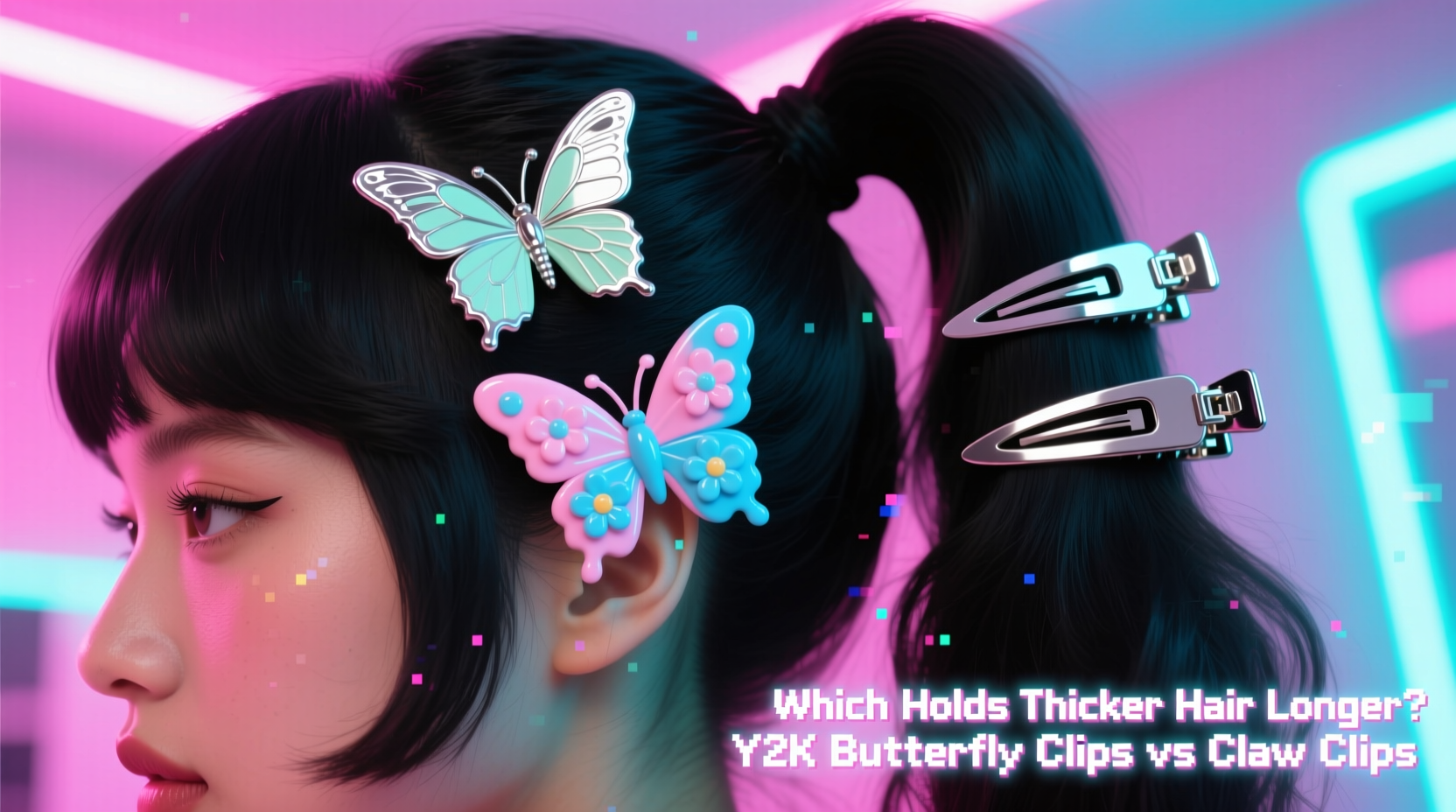
Butterfly clips and claw clips differ fundamentally in structure. Butterfly clips consist of two interlocking wire loops shaped like wings, often adorned with decorative elements such as rhinestones or enamel. Their spring mechanism relies on metal tension to close the loops around a gathered section of hair. Claw clips, by contrast, feature a hinged, multi-pronged jaw system made from plastic, metal, or resin, designed to open wide and snap shut over large volumes of hair.
The core distinction lies in how each applies pressure. Butterfly clips rely on pinching force concentrated at the center, while claw clips use distributed clamping across multiple points. This structural difference directly impacts longevity of hold, especially under movement, humidity, or extended wear.
Tip: Always gather thick hair slightly above the roots before securing—this reduces base weight and improves clip stability.Design Showdown: Butterfly Clips vs Claw Clips
To understand which clip performs better over time, let’s break down their design features side by side.
| Feature | Y2K Butterfly Clip | Claw Clip |
|---|---|---|
| Material | Metal wire (often coated), sometimes with plastic embellishments | Dense plastic, acetate, metal-reinforced resin, or stainless steel |
| Grip Mechanism | Spring-loaded wire tension | Hinged jaw with interlocking teeth |
| Surface Contact | Narrow, centralized pressure point | Broad, multi-point clamping area |
| Volume Capacity | Low to moderate (best for half-up styles) | High (can secure full ponytails or buns) |
| Weight Distribution | Poor—concentrated stress at clip center | Excellent—spread across prongs |
| Comfort Over Time | Fair—can dig into scalp after 2–3 hours | Good to excellent, depending on size and material |
| Aesthetic Appeal | High—nostalgic, decorative, fashion-forward | Moderate to high—minimalist or statement designs available |
While butterfly clips win in visual flair—particularly appealing to fans of early 2000s revival—their functional limitations become apparent with thick hair. The narrow grip struggles to contain dense sections, and the central spring often loosens gradually as hair shifts. Claw clips, especially larger matte-finish or textured variants, maintain consistent pressure due to their broader jaw span and superior friction against individual strands.
Real-World Performance: A Day-in-the-Life Test
To assess durability, consider a real-life scenario involving Maya, a graphic designer with shoulder-length, tightly coiled 4C hair averaging 180 grams in volume when gathered.
Morning Routine: At 8:00 AM, Maya secures her hair in a high puff using a medium-sized gold butterfly clip. By 10:30 AM, she notices slight sagging. At noon, after a walk outside in humid weather, the clip slips sideways and partially releases. She re-clips it, but by 2:00 PM, it falls out entirely during a client call.
The next day, she tries a large black acetate claw clip. She sections her hair into a loose top knot and fastens it securely. Despite similar activity levels—including coffee runs, screen time, and a midday gym session—the clip remains intact until she removes it at 7:00 PM.
This mini case study illustrates a common experience: butterfly clips, while charming, lack the mechanical resilience needed for prolonged wear on thick textures. Humidity, movement, and natural hair expansion all contribute to premature failure. Claw clips, particularly those labeled “jumbo” or “extra hold,” resist these forces more effectively due to their engineered jaw alignment and non-slip interior ridges.
“With thicker hair types, I always recommend claw clips over butterfly clips for all-day wear. The contact surface and leverage make a measurable difference in retention.” — Lila Nguyen, Professional Stylist & Texture Specialist
Maximizing Longevity: How to Use Each Clip Effectively
Neither clip is inherently flawed—but their success depends heavily on application technique. Below is a step-by-step guide to getting the most from each.
Using a Butterfly Clip for Longer Hold
- Start with slightly texturized hair—second-day waves or dry shampoo add grit and reduce slip.
- Gather a smaller section (e.g., half-up, not full-up) to minimize strain on the clip.
- Twist the section loosely before placing the clip at the base.
- Open the butterfly clip fully, position it horizontally, then press the wings together until they click into place.
- Secure with a hidden bobby pin through the base for backup support.
Using a Claw Clip for Maximum Security
- Divide thick hair into two sections if necessary—top and bottom—to avoid overloading.
- Twist or fold the top section into a compact roll before positioning at the crown.
- Hold the claw clip vertically, squeeze to open, and slide it over the folded hair from front to back.
- Release slowly to allow the teeth to lock; avoid snapping shut too quickly, which can misalign prongs.
- For extra security, insert a second small claw or U-pin at an angle beneath the main clip.
Expert-Backed Checklist: Choosing the Right Clip for Thick Hair
Use this checklist to evaluate any clip before purchase or daily use:
- ✅ Jaw width exceeds 2 inches for thick hair capacity
- ✅ Made from durable material (acetate, reinforced polymer, or metal)
- ✅ Features textured interior or grip-enhancing ridges
- ✅ Closes smoothly without excessive hand strain
- ✅ Distributes weight evenly—doesn’t tilt or pull when worn
- ✅ Tested for at least 6 hours of continuous wear in real conditions
- ❌ Avoid oversized butterfly clips marketed as “functional”—most are decorative only
While butterfly clips can work for short-term styling—such as photoshoots, brunches, or quick updos—they should not be relied upon for all-day utility. Claw clips, particularly jumbo sizes in 2.5” to 3” lengths, are structurally optimized for sustained hold.
Frequently Asked Questions
Can butterfly clips damage thick hair?
When used correctly and not left in for extended periods, butterfly clips are generally safe. However, their concentrated pressure can cause micro-breakage at the scalp if worn too tightly or reapplied repeatedly in the same spot. For protective styling, opt for claw clips or fabric-covered scrunchies instead.
Are there claw clips that look stylish enough for Y2K fashion?
Absolutely. Many brands now offer claw clips in retro colors (cherry red, translucent lavender), holographic finishes, or with embedded charms that blend function with nostalgia. These combine the grip of a modern tool with the aesthetic of early 2000s trends.
Do claw clips work for curly or coily hair?
Yes, and often better than other options. Curly textures benefit from the claw clip’s ability to compress volume without flattening curls. Just ensure the clip is large enough to accommodate shrinkage—many users find that their coils expand over time, so initial snugness should not be overly tight.
Final Verdict: Which Holds Thick Hair Longer?
The evidence is clear: **claw clips outperform Y2K butterfly clips in holding thick hair longer**. While butterfly clips capture the spirit of a bygone era and excel in editorial or momentary styling, they lack the structural integrity required for reliable, all-day wear on dense or heavy hair.
Claw clips, particularly those designed with ergonomics and texture-specific engineering in mind, offer superior grip, comfort, and durability. They adapt to hair movement, resist environmental factors like humidity, and maintain tension over extended periods. For anyone whose hair is both a personal expression and a practical concern, the claw clip is the smarter, longer-lasting choice.
That said, there’s room for both in a well-rounded styling arsenal. Use butterfly clips for accent pieces—adorning a braid, framing bangs, or adding sparkle to a half-up look. Reserve claw clips for situations where function meets fashion: workdays, travel, workouts, or events lasting more than three hours.
“The right clip isn’t just about trendiness—it’s about respecting your hair’s needs. With thick textures, longevity means minimizing manipulation and maximizing support.” — DeShawn Reed, Trichology Consultant
Take Action: Upgrade Your Hair Accessory Game
If you’ve been frustrated by clips that won’t stay put, it’s time to reassess your toolkit. Start by replacing flimsy butterfly clips with at least two high-quality claw clips—one standard size for everyday wear, one jumbo for maximum hold days. Experiment with placement techniques, and don’t hesitate to layer clips for added security.
Share your favorite claw clip brand or styling hack in the comments. Whether you’re team butterfly or team claw, your experience could help others find the perfect balance between nostalgia and necessity.
💬 Which clip has saved your hairstyle last-minute? Tell us your story below! Join the conversation and help thick-haired readers everywhere find their holy grail hold.