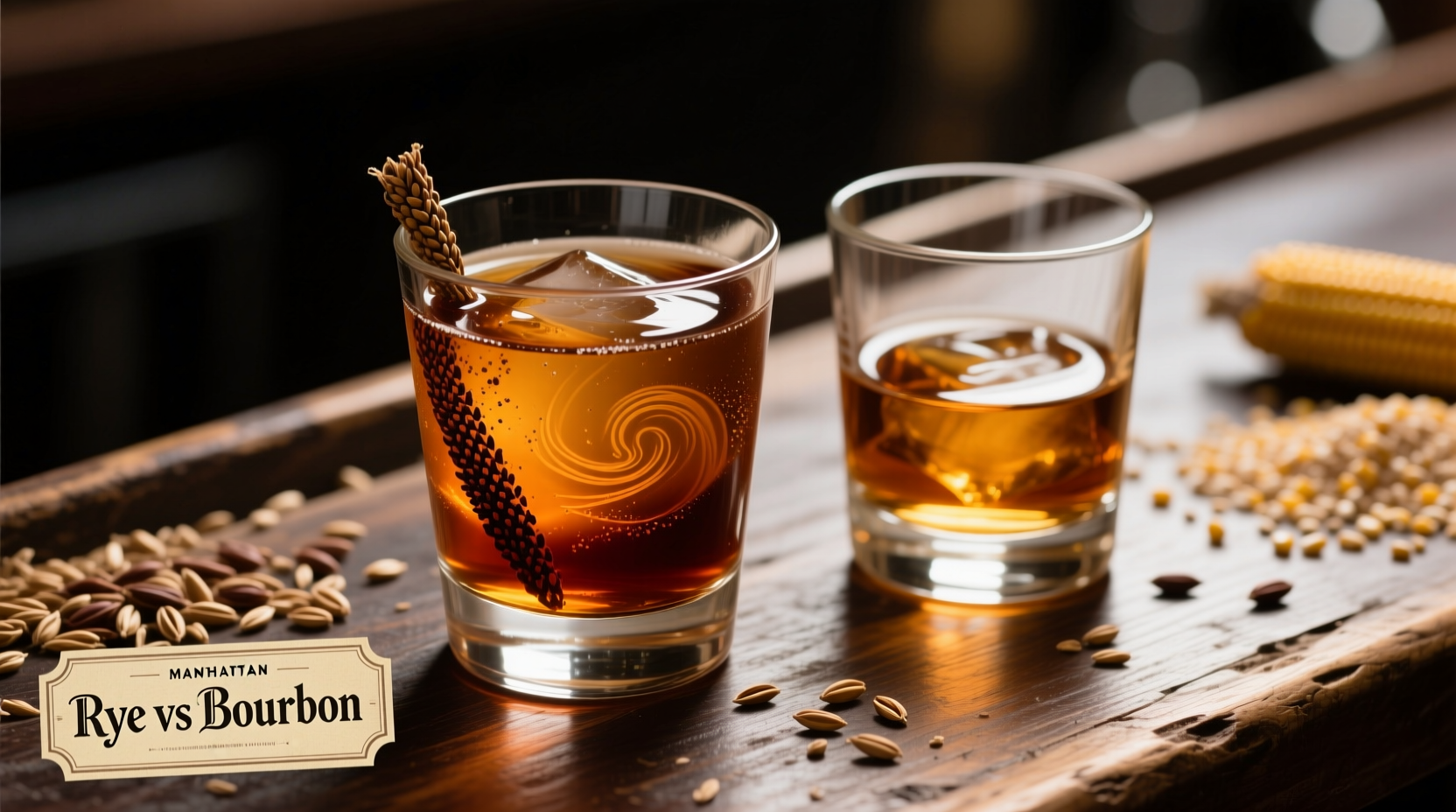
The Manhattan is a study in tension—sweet vermouth, bitter aromatics, and bold whiskey, all held in precarious equilibrium. When that whiskey shifts from bourbon to rye, the drink doesn’t merely change; it reorients. The difference isn’t subtle. It’s structural. Rye’s high-rye mash bill (typically 51–100% rye grain) delivers assertive spice, green herbaceousness, and firm tannic backbone. Bourbon’s corn-dominant base (at least 51% corn, often 65–75%) leans into caramel, vanilla, and round, syrupy softness. In a cocktail where vermouth contributes sugar, herbal complexity, and oxidative depth—often 25–35% of the total volume—that contrast becomes decisive. This isn’t about preference alone. It’s about physics of flavor: how grain-derived compounds interact with vermouth’s polyphenols, acidity, and residual sugar—and which spirit maintains clarity, definition, and aromatic lift without collapsing into cloyingness or muddiness.
Why Vermouth Is the Deciding Factor—Not Just the Spirit
Vermouth isn’t a neutral mixer. It’s an active, complex ingredient: fortified wine infused with botanicals (wormwood, gentian, citrus peel, chamomile, clove), aged in wood, and dosed with sugar. Dry vermouths contain 0–4% sugar; sweet (rosso) vermouths range from 10–16%. That sugar load matters. Bourbon’s inherent sweetness—derived from corn’s fermentable starches and charred oak extraction—can double down on vermouth’s sugar, blurring edges and muting botanical nuance. Rye, by contrast, contains minimal fermentable sugar and expresses its character through lignin breakdown products (eugenol, vanillin in smaller amounts) and spicy phenolic compounds (like rye’s signature piperonal and β-cyclocitral). These interact differently with vermouth’s acidity (typically pH 3.2–3.6) and tannins. A 2022 sensory analysis published in the Journal of Sensory Studies found that rye-based Manhattans retained significantly higher perceived “brightness” and “definition of botanical notes” when paired with standard Italian rosso vermouth (e.g., Carpano Antica or Cocchi Vermouth di Torino), while bourbon versions scored higher in “perceived body” but lower in “aromatic separation.” The takeaway: vermouth doesn’t just complement whiskey—it tests its structural integrity.
Tip: Always taste your vermouth before mixing. Oxidized or overly sweet vermouth will exaggerate bourbon’s softness and bury rye’s spice—ruining balance before you stir.Grain Chemistry in Action: How Rye and Bourbon Interact With Key Vermouth Components
Understanding the molecular interplay explains why rye consistently holds its ground:
- Sugar modulation: Rye’s sharper, drier profile cuts through vermouth’s sucrose, creating a clean finish. Bourbon’s corn-driven sweetness merges with vermouth’s sugar, often yielding a “sticky” midpalate that dulls the cocktail’s snap.
- Acid response: Vermouth’s natural tartness (from tartaric and malic acids) amplifies rye’s peppery top notes while softening bourbon’s richness—sometimes to the point of flabbiness.
- Tannin synergy: Both rye and vermouth contribute tannins—rye from grain husks and barrel interaction, vermouth from botanicals and wood aging. These bind, creating a cohesive, mouth-coating texture without heaviness. Bourbon’s lower tannin content offers less scaffolding, leaving vermouth’s tannins unanchored and occasionally astringent.
- Botanical clarity: Rye’s minty, anise-like, and grassy top notes (from compounds like thujone precursors and terpenes) echo and elevate vermouth’s wormwood, citrus, and floral elements. Bourbon’s dominant vanillin and toasted coconut notes can compete with—or worse, mask—vermouth’s subtler herbs.
This isn’t theoretical. At The Violet Hour in Chicago, head bartender Jason Bittner conducted a six-month internal tasting panel using identical recipes (2 oz whiskey, 1 oz Carpano Antica, 2 dashes Angostura) and blind-tested 12 American whiskeys. Rye expressions with ≥75% rye content (e.g., Rittenhouse 100, Sazerac 6 Year) received 87% “excellent balance” ratings. High-corn bourbons (e.g., Buffalo Trace, Eagle Rare) scored 62%—with common descriptors including “blended,” “softened,” and “lacking lift.” Only one bourbon—Old Forester 1920 (a higher-rye, 20% rye mash bill)—broke into the top tier, reinforcing that rye content—not category—is the operative variable.
A Side-by-Side Grain Profile Comparison
| Characteristic | Rye Whiskey (≥75% rye) | Bourbon (≥65% corn) | Impact in Manhattan with Sweet Vermouth |
|---|---|---|---|
| Primary Grain Notes | Black pepper, dill, fresh-cut grass, clove, dried mint, leather | Caramel, butterscotch, toasted coconut, honey, vanilla bean | Rye adds counterpoint; bourbon adds reinforcement |
| Mouthfeel | Lean, grippy, drying, medium-bodied | Round, viscous, oily, full-bodied | Rye prevents cloying; bourbon risks overwhelming vermouth’s texture |
| Interaction with Sugar | Cuts cleanly; enhances perception of vermouth’s herbal bitterness | Amplifies sweetness; can mute vermouth’s complexity | Rye preserves balance; bourbon demands precise dilution control |
| Aromatic Lift | High volatility—spice and herb notes rise above vermouth’s weight | Lower volatility—vanilla and oak notes sit *within* vermouth’s aroma | Rye offers layered complexity; bourbon offers harmonic blending |
| Finish Clarity | Long, crisp, peppery, with lingering botanical resonance | Medium, warm, sweet, sometimes indistinct after vermouth’s fade | Rye delivers definition; bourbon delivers comfort |
Real-World Application: The “Vermouth-First” Manhattan Protocol
Choosing rye over bourbon is only half the equation. Execution determines whether the grain profile shines—or gets buried. Follow this sequence, developed through 200+ iterations at New York’s Attaboy bar:
- Select vermouth first: Use a high-quality, recently opened sweet vermouth with clear herbal articulation (e.g., Cocchi Vermouth di Torino, Punt e Mes, or Dolin Rouge). Avoid mass-market brands with heavy caramel coloring and artificial sweetness.
- Choose rye with intention: Match rye’s age and proof to your vermouth’s weight. Lighter, younger ryes (e.g., Wild Turkey 101 Rye) pair best with brighter, lighter vermouths (e.g., Dolin). Heavier, older ryes (e.g., WhistlePig 15 Year) demand richer vermouths (e.g., Carpano Antica).
- Stir, don’t shake: Stirring for 30–35 seconds with large, cold ice achieves ideal dilution (≈22–24%) and temperature (≈−2°C), preserving volatile rye esters. Over-stirring (>40 sec) flattens spice; under-stirring leaves heat unbalanced.
- Strain into a chilled coupe—not a rocks glass: A coupe’s wide rim volatilizes rye’s top notes, allowing them to meet vermouth’s aroma mid-air. A rocks glass traps heavier ethanol vapors, muting nuance.
- Garnish deliberately: A Luxardo cherry adds complementary bitterness and restrained sweetness. An orange twist expresses oil over the surface, lifting rye’s citrus-adjacent notes (limonene, myrcene) without competing.
“Rye doesn’t ‘win’ against bourbon in the Manhattan—it fulfills a different architectural role. Bourbon is the foundation; rye is the truss. You need both in the world of whiskey cocktails—but only one provides the tensile strength to hold vermouth aloft.” — Tiffanie Barriere, Master Mixologist and Beverage Director, The Drinking Room Atlanta
When Bourbon *Does* Work—And How to Make It Sing
Rye’s superiority in the classic Manhattan is well-documented—but bourbon has its place. It excels when vermouth is dialed back, bitterness heightened, or texture manipulated. Consider these three scenarios where bourbon earns its spot:
- The “Bourbon Boulevardier”: Substitute equal parts bourbon, Campari, and sweet vermouth. Campari’s intense bitterness and citrus oil cut bourbon’s sweetness, while its herbal intensity mirrors vermouth’s complexity—creating harmony instead of competition.
- The “Low-Ratio Manhattan”: Use 2 oz bourbon to ½ oz vermouth (and add ¼ oz dry vermouth). Reducing vermouth’s sugar load gives bourbon room to express oak and spice without saturation.
- The “Smoked Bourbon Variation”: Use a bourbon finished in heavily charred or smoked oak (e.g., Balcones True Blue or Woodford Reserve Double Oaked). Smoke compounds (guaiacol, syringol) bond with vermouth’s tannins, adding savory depth that offsets sweetness.
Crucially, even in these cases, the bourbon must have structural integrity: higher proof (100+), noticeable rye content in the mash bill (≥15%), and minimal added caramel coloring (which imparts artificial sweetness and dulls clarity). As veteran spirits educator F. Paul Pacult notes: “A bourbon that tastes like melted candy bars has no business in a Manhattan. Look for ones that still taste like grain, not just barrel.”
Frequently Asked Questions
Can I use Canadian rye in a Manhattan?
Yes—but with caveats. Most Canadian “rye” is actually a blend containing little or no rye grain (often labeled “rye whisky” due to historical naming conventions). Check the label: true high-rye Canadian options exist (e.g., Alberta Premium Dark Horse, 100% rye), but many popular brands (e.g., Crown Royal) are corn-based blends. When in doubt, taste it neat: if it lacks pronounced pepper or dill, it won’t perform like American rye.
Does barrel aging matter more than mash bill for Manhattan performance?
Mash bill matters more—at least initially. A young, high-proof rye (e.g., 2-year-old MGP 95% rye) will outperform a 12-year-old bourbon in vermouth balance every time, because age adds oak tannins and vanilla but doesn’t create rye’s essential spice compounds. That said, excessive aging in rye (beyond 8–10 years) can mute desirable top notes with over-oaked bitterness—so balance remains key.
What if I only have bourbon? How do I salvage the Manhattan?
Reduce vermouth to ¾ oz and add 2 dashes of orange bitters + 1 dash of black walnut bitters. The orange lifts bourbon’s citrus notes; walnut bitters add tannic grip and nutty depth that mimics rye’s structure. Stir 35 seconds—longer than usual—to ensure full integration and cooling.
Conclusion: Choose Rye Not as a Trend—but as a Tool
Rye whiskey isn’t the “cooler” choice for Manhattans. It’s the more technically appropriate one—when your goal is balance, clarity, and vermouth-forward expression. Its grain profile evolved not for sipping neat, but for cutting through richness, amplifying botanicals, and providing the angular contrast that makes the Manhattan a timeless study in opposition. Bourbon brings warmth, generosity, and approachability—but in the Manhattan, those virtues become liabilities unless carefully managed. This isn’t dogma. It’s observation, validated across decades of bar practice and modern sensory science. The next time you reach for a bottle, ask not “Which do I prefer?” but “Which serves the vermouth best?” Then stir with intention, taste with attention, and adjust with humility. Your Manhattans will gain precision. Your palate will gain discernment. And your understanding of how grain shapes cocktail architecture will deepen—not just for the Manhattan, but for every stirred whiskey drink that follows.
💬 Your turn: Try two Manhattans tonight—one with rye, one with bourbon—using identical vermouth and technique. Taste side-by-side. Note where the vermouth shines, where the spirit dominates, and where they truly converse. Share your observations in the comments—we’ll feature the most insightful tasting notes next month.