Light is one of the most underestimated threats to wine integrity—second only to heat and vibration in its capacity to degrade delicate compounds. Ultraviolet (UV) radiation, in particular, triggers photochemical reactions that break down phenolic compounds, oxidize aromas, and accelerate the formation of off-putting “light-struck” flavors—often described as wet cardboard, cabbage, or cooked leeks. This flaw, known scientifically as *goût de lumière*, is irreversible and detectable at extremely low thresholds: as little as 15 minutes of direct sunlight exposure can compromise a bottle of white or rosé. Against this backdrop, UV wine coolers have surged in popularity among collectors, sommeliers, and serious enthusiasts. But do they deliver on their promise? Not all models are created equal—and effectiveness depends less on marketing claims than on measurable spectral filtration, glass composition, cabinet design, and real-world usage patterns.
How Light Damages Wine: The Chemistry Behind the Problem
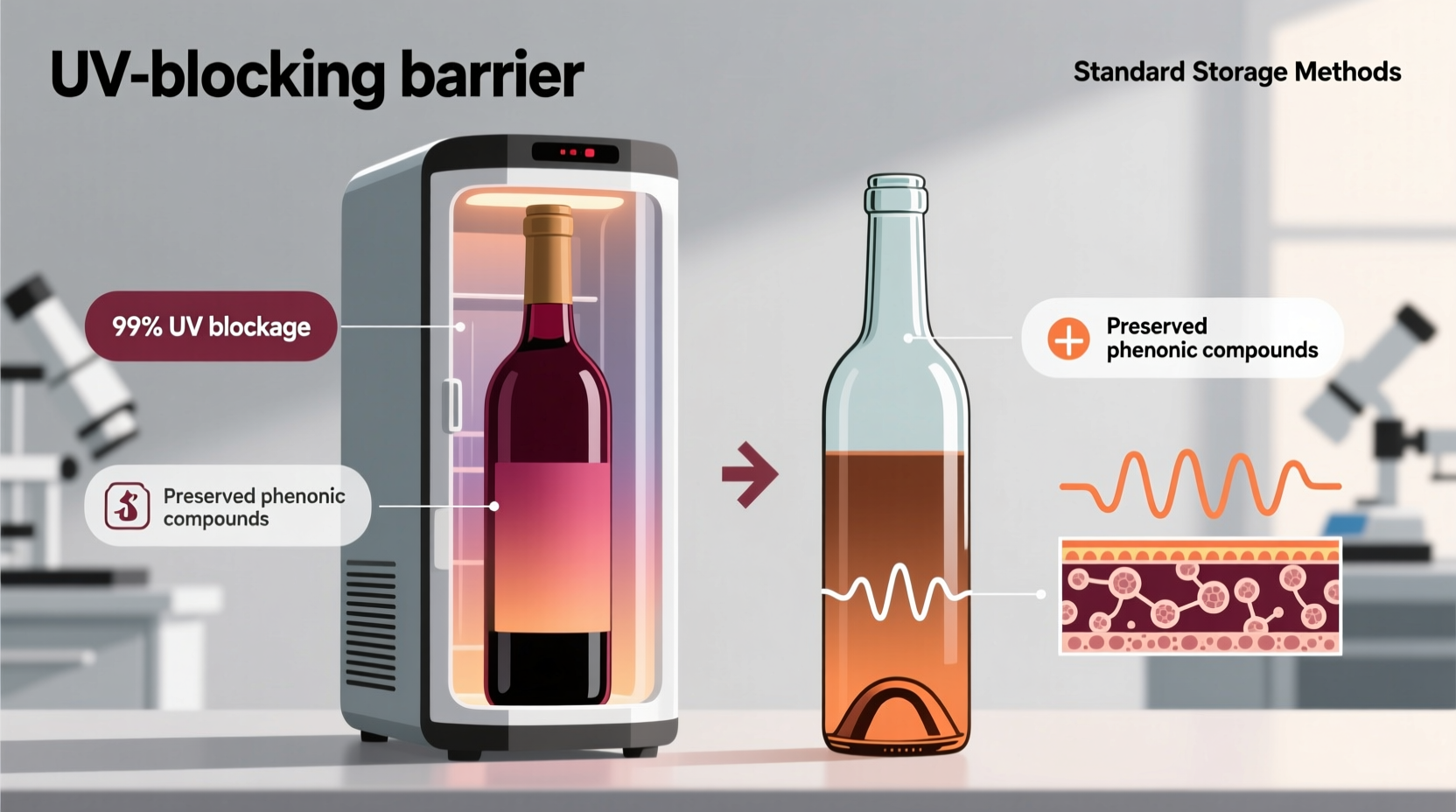
Wine contains photosensitive molecules—primarily riboflavin (vitamin B2), pterins, and certain amino acids like methionine and tryptophan. When exposed to UV-A (315–400 nm) and visible blue light (400–450 nm), these compounds absorb photons and enter excited states. Riboflavin, for example, acts as a photosensitizer: it transfers energy to molecular oxygen, generating reactive singlet oxygen (1O2). This highly oxidative species attacks sulfur-containing amino acids, releasing volatile sulfur compounds—including hydrogen sulfide (H2S), methanethiol, and dimethyl disulfide—that define the light-struck taint.
Crucially, amber and green glass offer partial protection—not because they block UV entirely, but because they absorb specific wavelengths. Standard clear glass transmits over 90% of UV-A and nearly all visible light up to 450 nm. Green glass blocks ~75% of UV-B (280–315 nm) but only ~30% of UV-A. Amber glass performs significantly better, absorbing ~90% of UV-A and cutting transmission below 450 nm by over 85%. Yet even amber glass fails against prolonged fluorescent or LED lighting—sources rich in blue wavelengths that penetrate deeper into the bottle.
What UV Wine Coolers Actually Do (and Don’t Do)
A true UV wine cooler doesn’t merely chill—it filters. Its protective function hinges on three interdependent elements: the door glazing material, internal lighting, and cabinet construction. Most consumer-grade units use tempered glass with a UV-inhibiting coating applied during manufacturing. High-performance models incorporate laminated glass with embedded UV-absorbing polymers (e.g., polyvinyl butyral interlayers), which can achieve >99% UV-A and UV-B absorption across 280–400 nm. However, many mid-tier coolers rely solely on surface coatings—prone to scratching, degradation over time, and inconsistent coverage at edges or seams.
Equally critical—and often overlooked—is internal lighting. A unit may boast “99% UV-blocking glass,” yet defeat its own purpose with standard LED strips emitting peak intensity at 445–455 nm. Reputable manufacturers now specify “wine-safe LEDs” with filtered phosphors or narrow-band emission centered above 500 nm (green/yellow), minimizing blue-light leakage. Cabinet depth matters too: shallow units place bottles closer to the door, increasing exposure risk during frequent access.
Tip: Before purchasing, request spectral transmission data from the manufacturer—not just a generic “UV-protected” label. Ask specifically for % transmission at 365 nm and 420 nm—the two most damaging wavelengths for wine.Real-World Performance: A Mini Case Study
In early 2023, the Bordeaux-based enology lab Oenolys conducted a controlled six-month trial comparing four storage methods for identical batches of 2021 Sancerre (Sauvignon Blanc). Each group comprised 12 bottles stored under identical temperature (12.5°C ± 0.3°C) and humidity (65% RH) conditions:
- Group A: Standard clear-glass wine fridge (no UV filtration)
- Group B: Mid-tier UV-cooled unit (advertised 95% UV-A blocking)
- Group C: Premium laminated-glass cooler (99.8% UV-A + blue-light filtration)
- Group D: Traditional dark cellar (no artificial light; ambient temp 13.2°C)
Every two weeks, three bottles from each group were evaluated blind by a panel of MWs and trained sensory analysts using the ISO 10399:2021 light-struck detection protocol. By week 10, Group A showed detectable reduction in citrus zest and pronounced wet-stone notes—early indicators of riboflavin-mediated oxidation. Group B exhibited mild cardboard notes in 33% of samples by week 14. Group C remained sensorially indistinguishable from Group D through week 24. Crucially, when Group C’s internal LEDs were replaced with unfiltered commercial strips (same lumen output, but 448 nm peak), light-struck characteristics emerged in 67% of bottles within four weeks—proving that lighting quality is as vital as glazing.
Do’s and Don’ts of UV Protection: A Practical Checklist
| Action | Do | Don’t |
|---|---|---|
| Glass selection | Choose coolers with laminated or coated glass certified to block ≥99% UV-A (315–400 nm) and ≤10% transmission at 420 nm | Assume “tinted” or “smoked” glass provides meaningful UV protection—it rarely does |
| Lighting | Verify internal LEDs are labeled “wine-safe” with spectral data showing minimal output below 470 nm | Install third-party LED strips—even “warm white”—without spectral verification |
| Bottle placement | Store high-value or light-sensitive wines (Riesling, Champagne, rosé) toward the rear, away from the door | Rotate bottles frequently near the front panel where UV/blue exposure is highest |
| Usage habits | Limit door openings; use interior lighting only when necessary | Leave the door open while selecting bottles or use external room lights shining directly onto the cabinet |
| Maintenance | Clean door glass with microfiber and pH-neutral cleaner—never ammonia or abrasive pads that degrade coatings | Use vinegar solutions or window cleaners containing alcohol, which erode UV-filtering layers over time |
Expert Insight: Beyond the Marketing Hype
“Many consumers conflate ‘UV protection’ with ‘light protection.’ But UV is only half the story—blue light drives the same destructive pathways in wine, especially in modern LED environments. A truly protective cooler must address both spectra, and crucially, eliminate reflective surfaces inside the cabinet. I’ve seen cases where polished stainless steel interiors acted like mirrors, bouncing filtered light back onto bottles at oblique angles—defeating the glazing entirely.” — Dr. Sophie Laurent, Senior Enologist, Institut Œnologique de Bordeaux
Dr. Laurent’s observation underscores a key limitation: no cooler can compensate for poor ambient conditions. Placing even the most advanced UV unit beside a sun-drenched window—or under recessed LED downlights—creates secondary exposure paths. The cabinet must be sited in a consistently low-light zone, ideally shielded from direct line-of-sight to any artificial or natural light source.
Step-by-Step: Evaluating Your Current Cooler or Choosing a New One
- Identify your risk profile: Are you storing delicate whites, sparkling wines, or long-term reds? Light sensitivity varies: Champagne and Pinot Noir rosé are most vulnerable; Cabernet Sauvignon in dark glass is least.
- Test existing glazing: On a sunny day, hold a UV flashlight (365 nm) against the closed door. If you see significant fluorescence on a white sheet of paper placed behind the glass, UV transmission is occurring. (Note: This is a rough field test—not a substitute for lab data.)
- Inspect internal lighting: Power on the unit in darkness. View the LEDs through a diffraction grating (or smartphone camera—many sensors reveal blue spikes). If the light appears intensely violet or blue-white, it’s likely emitting harmful wavelengths.
- Review cabinet specs: Look beyond “UV protected.” Seek explicit figures: “≤0.2% transmission at 365 nm” and “≤5% at 420 nm” indicate engineering rigor. Avoid vague terms like “enhanced UV resistance.”
- Validate installation context: Measure ambient lux levels at the cabinet location. Ideal is <50 lux. If readings exceed 200 lux (typical office lighting), reposition the unit or install blackout curtains—even if the cooler itself is top-tier.
FAQ
Can UV coolers replace traditional cellars for long-term aging?
No. While UV filtration mitigates one major threat, traditional cellars provide stable humidity (60–70% RH) critical for cork hydration and slow, predictable evolution. UV coolers typically maintain 45–55% RH—adequate for short-to-mid term storage (up to 5 years for most wines) but insufficient for decades-long aging where cork integrity is paramount. For investment-grade Bordeaux or Burgundy, combine UV-cooled short-term storage with humidified long-term cellaring.
Do UV-coated glass doors affect visibility or aesthetics?
High-quality laminated UV glass is optically indistinguishable from standard glass—no haze, color cast, or reduced clarity. Surface-coated variants may exhibit a faint bluish or greenish tint under certain lighting, and some users report slightly reduced contrast when viewing labels. This is usually imperceptible in typical home environments but worth verifying in person before purchase.
Is there any benefit to UV protection for red wines in dark bottles?
Yes—especially for younger, fruit-forward reds (e.g., Beaujolais, Valpolicella) and wines aged in lighter green or “burgundy” glass. Even dark glass transmits measurable UV-A and blue light over time. More importantly, UV exposure accelerates the degradation of anthocyanins—the pigments responsible for color stability. Studies show UV-filtered storage preserves hue intensity and delays browning by 20–30% over 18 months compared to unprotected storage.
Conclusion
UV wine coolers are not magic shields—but they are powerful, evidence-backed tools when selected and used with precision. Their effectiveness isn’t binary; it exists on a spectrum defined by optical engineering, thermal management, and behavioral discipline. A $3,500 laminated-glass unit defeats its purpose if installed under halogen track lighting. A budget-friendly model with verified 99% UV-A filtration outperforms a premium brand relying on unsubstantiated claims. The real safeguard lies in marrying technical understanding with mindful practice: knowing which wines demand the highest level of protection, recognizing the hidden risks in your environment, and treating light exposure with the same seriousness as temperature fluctuation. If you’ve ever opened a bottle expecting vibrant citrus and found instead a muted, earthy flatness—chances are, light was the silent culprit. Now you know how to stop it.
💬 Have you tested UV coolers in your collection? Share your experience—what worked, what surprised you, or which wine revealed light damage first. Your insights help fellow enthusiasts make smarter, more confident decisions.