
Sloe gin—once relegated to dusty back-bar shelves and grandmother’s Christmas cupboard—is now pouring confidently into award-winning cocktails, boutique distillery lineups, and Instagram feeds awash with hedgerow harvests. Its rise isn’t just seasonal; it’s structural. Over the past decade, UK sloe gin sales have grown 42% (IWSR 2023), while craft producers like Sacred Gin, Sipsmith, and The Oxford Artisan Distillery report triple-digit year-on-year growth in sloe expressions. But what catalysed this shift? Was it a quiet groundswell of urban foragers reclaiming wild foodways—or a deliberate, palate-driven campaign by bartenders and distillers who saw untapped potential in a tart, tannic berry long dismissed as “too fiddly”? The answer lies not in either/or, but in the fertile overlap where ecology meets expertise—and where tradition is rewritten, not revived.
The Sloe: A Berry With Baggage
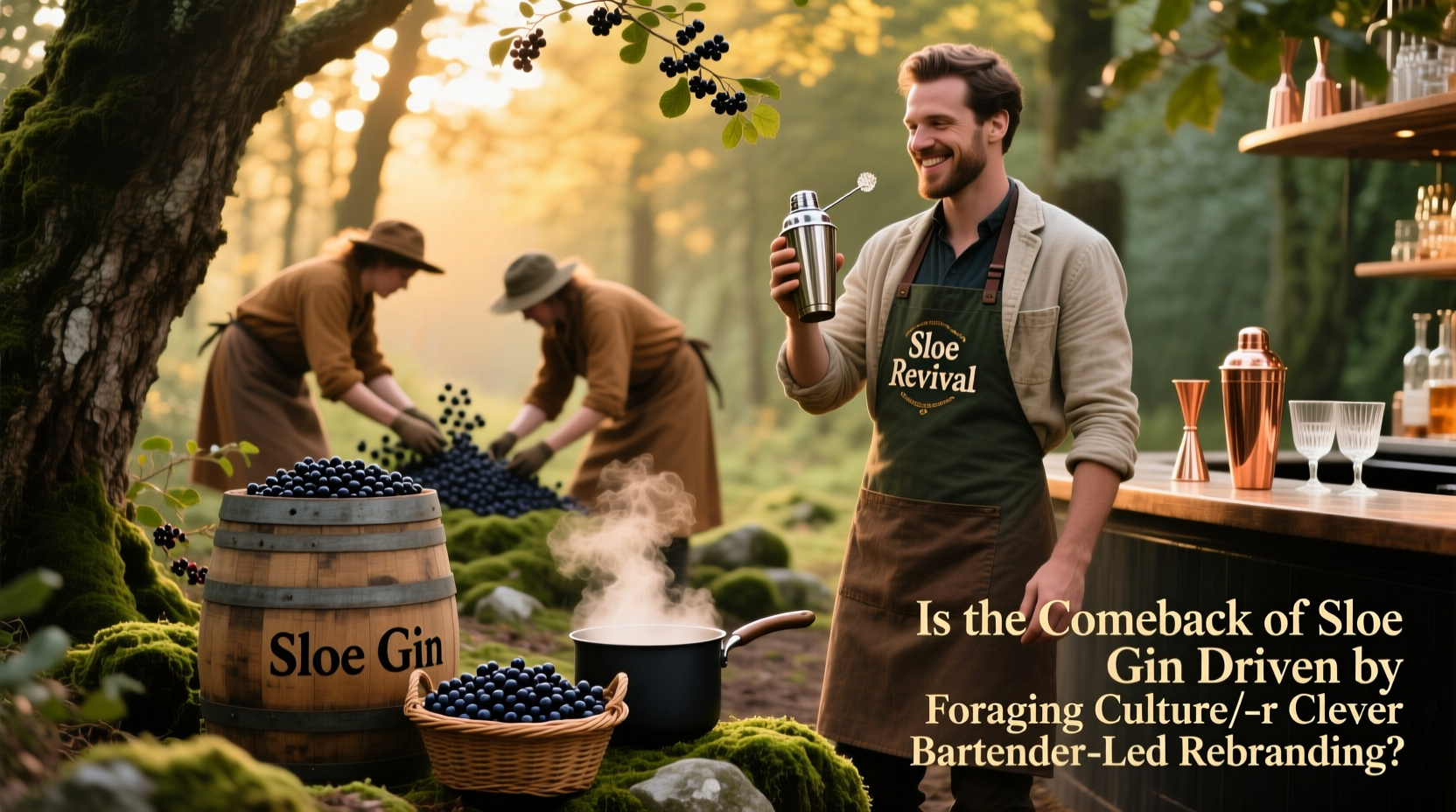
Prunus spinosa—the blackthorn—grows across Britain and much of Europe, its dense, thorny thickets lining country lanes and railway embankments. Its small, plum-like fruits ripen late—typically after the first frost—which softens their astringency and concentrates sugars. Historically, sloes were never drunk fresh. Their high tannin content delivers an immediate, mouth-puckering bitterness that makes them inedible raw. For centuries, they were preserved in vinegar or fermented into country wines. Sloe gin emerged in the 18th century as a practical solution: steeping the berries in cheap grain spirit with sugar, transforming a nuisance crop into a warming, medicinal winter tonic. By the mid-20th century, however, mass-produced, overly sweetened versions diluted its character. It became synonymous with cloying, purple-hued novelty—not nuance.
This legacy created a perceptual hurdle. Unlike gin’s botanical clarity or whisky’s terroir storytelling, sloe gin lacked a coherent identity. It was neither fully spirit nor liqueur; neither artisanal nor industrial. Its reputation rested on nostalgia, not quality—a liability in a market increasingly driven by provenance, transparency, and sensory precision.
Foraging Culture: From Survival Skill to Cultural Signal
The modern foraging revival didn’t begin with sloes—but it found in them a potent symbol. Starting in the early 2000s, figures like Roger Phillips and later Fergus Henderson reframed wild food not as poverty-era frugality, but as ecological literacy and culinary authenticity. Urban foraging groups multiplied; apps like iNaturalist gained traction; BBC’s *River Cottage* series normalised berry-picking as weekend ritual rather than rural relic.
Crucially, sloes offered low barriers to entry: no specialist knowledge required beyond frost timing and thorn awareness, abundant in even peri-urban areas, and legally harvestable from public land under the UK’s “right to roam” provisions (with landowner consent for private land). Foraging sloes became a tactile act of reconnection—part protest against hyper-processed food, part mindfulness practice. Social media amplified this: #sloeharvest posts spiked 210% between 2017–2022 (Instagram Data Lab), often featuring close-ups of gnarled hands holding glossy purple berries against misty hedgerows.
Tip: Never pick sloes before the first frost—they’ll be aggressively bitter and yield thin, unbalanced gin. Wait until late October or November, and test ripeness by gently squeezing: ripe sloes yield slightly and exude a faint, almond-like aroma from their pits.Yet foraging alone couldn’t sustain a category revival. Harvesting enough sloes for commercial production remains logistically impractical—most distilleries source berries from managed orchards or contracted growers. What foraging provided wasn’t volume, but legitimacy: a narrative of seasonality, locality, and intentionality that resonated with consumers increasingly sceptical of greenwashing. It shifted sloe gin from “grandma’s tipple” to “a taste of place.”
The Bartender’s Pivot: Reframing Technique, Not Just Taste
While foragers gathered berries, bartenders began reimagining what to do with them. Around 2012–2014, London bars like Nightjar and Swift started moving away from pre-bottled, syrupy sloe gins. Instead, they commissioned small-batch infusions—using neutral grain spirit rather than base gin, controlling maceration time (often 6–12 weeks, not months), and dialling back sugar to highlight acidity and floral notes. They treated sloes like vermouth ingredients: variable, expressive, and worthy of precise handling.
This technical recalibration had three key effects:
- Flavour liberation: Reducing sugar revealed the sloe’s natural complexity—violet petal, damson, bitter almond, and wet stone—making it compatible with dry cocktails rather than just dessert drinks.
- Category repositioning: Bars began listing sloe gin not under “liqueurs,” but alongside aged rums and amari—framing it as a complex, sipping spirit.
- Education as engagement: Bartenders started explaining the process: “We cold-infuse wild-harvested sloes for eight weeks, then fine-filter without adding colour or artificial flavour.” This transparency built trust and elevated perceived value.
“Sloe gin was always brilliant—it just needed better ambassadors. When we stopped hiding its tannins and started celebrating them as structure, everything changed. It’s not a ‘sweet’ spirit. It’s a structured one.” — Claire Smith, Head Distiller at The Oxford Artisan Distillery, 2023
Distillers Bridge the Gap: Craft, Consistency, and Story
By 2016, the convergence became undeniable. Distilleries responded not with imitation, but innovation. They invested in cold maceration tanks, experimented with secondary fermentation (like Sacred’s sloe gin fermented with wild yeast), and adopted regenerative farming partnerships with blackthorn growers. Crucially, they standardised what foragers and bartenders had pioneered informally: rigorous harvesting protocols, varietal selection (not all sloes are equal—Prunus spinosa var. insititia offers higher anthocyanins), and pH-balanced sugar additions.
The result is a new typology—distinct from both heritage sloe gin and generic fruit liqueurs. Modern iterations fall along a spectrum defined by three variables:
| Characteristic | Traditional Sloe Gin | Contemporary Craft Expression |
|---|---|---|
| Base Spirit | Pre-made gin (often low-quality) | Neutral grain spirit or house-distilled gin |
| Sugar Level | 25–35% by volume (cloying) | 12–18% (accentuating acidity) |
| Maceration Time | 3–6 months (oxidative, flat) | 6–12 weeks (cold, bright, aromatic) |
| Wild vs. Cultivated | Unspecified, often imported | Traceable origin (e.g., “Dorset hedgerow sloes, hand-picked Oct 2022”) |
| Alcohol by Volume | 15–20% ABV (liqueur strength) | 25–30% ABV (spirit strength) |
This consistency allowed bartenders to rely on specific brands for repeatable results—and enabled retailers to position sloe gin in premium spirits aisles, not just seasonal displays.
Mini Case Study: The Hedgerow Project, Yorkshire Dales
In 2019, five independent pubs across the Yorkshire Dales launched *The Hedgerow Project*: a collaborative initiative sourcing sloes exclusively from local, pesticide-free blackthorn stands. Each pub partnered with a different micro-distiller (all using identical base spirit and sugar ratios) to produce a unique batch reflecting terroir—soil pH, elevation, and microclimate subtly altering tannin expression. One batch from Malham Cove, grown on limestone scree, yielded pronounced mineral salinity and restrained fruit; another from wetter Wharfedale slopes showed deeper damson richness and softer tannins.
The project succeeded not because it sold more bottles, but because it created conversation. Locals debated regional differences at village halls. Food writers traced the journey from hedge to glass. Most importantly, it proved sloe gin could function as a vehicle for hyper-local storytelling—something no imported liqueur could replicate. Within two years, three participating distillers secured national distribution, citing the project as their “proof of concept.”
A Practical Rebranding Checklist for Producers & Enthusiasts
Whether you’re distilling at scale or making a batch for friends, these principles separate enduring quality from fleeting trend:
- Harvest ethically: Take no more than 30% of berries from any single bush; avoid protected sites or nesting seasons (March–July).
- Prioritise freshness over frost: While frost helps, fully ripe, deep-purple sloes picked on a dry, cool day often outperform frost-damaged fruit.
- Control extraction temperature: Macerate below 15°C to preserve volatile aromatics; avoid sunlight exposure during infusion.
- Balance, don’t mask: Add sugar only after tasting at multiple intervals—tannins soften over time, so initial bitterness may resolve naturally.
- Label transparently: State origin, harvest date, base spirit ABV, and sugar content. Consumers reward honesty with loyalty.
FAQ
Can I make authentic sloe gin without foraging?
Absolutely. Many respected producers use cultivated sloes grown specifically for distillation—offering greater consistency and food safety. What matters is traceability and respectful growing practices, not wilderness mythology.
Why do some modern sloe gins taste less sweet but more complex?
Reduced sugar allows the sloe’s natural acids, tannins, and floral esters to register clearly on the palate. High sugar doesn’t just add sweetness—it suppresses perception of bitterness and aroma. Lower sugar = higher fidelity.
Is sloe gin gluten-free?
Virtually all are, as base spirits (grain or grape-derived) are distilled to remove gluten proteins. However, always verify with the producer if you have coeliac disease—some may use gluten-containing fining agents or age in barrels previously holding beer.
Conclusion: A Resurgence Rooted in Reciprocity
The comeback of sloe gin isn’t the triumph of foraging or bartending—it’s the outcome of their sustained dialogue. Foragers reawakened cultural memory and ecological attention. Bartenders demanded rigour, precision, and sensory integrity. Distillers scaled those insights into reproducible craft. Together, they transformed a marginal product into a meaningful one: a spirit that speaks of season, soil, and skilled human intervention.
This isn’t nostalgia repackaged. It’s tradition reinterpreted—with the thorns left intact, the bitterness honoured, and the sweetness earned. Sloe gin’s revival reminds us that the most compelling rebrands aren’t invented in boardrooms, but coaxed from hedges, refined behind bars, and validated by palates that crave authenticity over ease.
💬 Your turn: Have you tasted a sloe gin that changed your mind? Did you forage your first batch—or discover it in a bar that made you pause mid-sip? Share your story in the comments. Let’s keep the conversation—and the hedgerows—thriving.