Whiskey has long occupied a paradoxical space in modern life: a symbol of celebration, contemplation, and camaraderie—and, at times, of isolation, avoidance, or emotional numbing. Meanwhile, therapy has evolved from a stigmatized last resort to a widely embraced pillar of proactive mental wellness. What happens when these two worlds intersect? Not as a prescription, not as a substitute, but as a deliberate, values-aligned practice? The emerging conversation around “mindful drinking” invites us to examine alcohol—not through the binary lens of abstinence versus excess—but through intention, awareness, and integration with evidence-based psychological care.
This isn’t about glamorizing alcohol or diluting clinical rigor. It’s about recognizing that for many adults who choose to drink, the ritual itself can become a site of presence—if approached with clarity, boundaries, and self-knowledge. When paired thoughtfully with therapeutic work, whiskey—like tea, journaling, or a quiet walk—can serve as an anchor for reflection, provided it remains subordinate to one’s mental health goals, not a detour from them.
The Science Behind Alcohol and Mood: What We Know (and Don’t)
Alcohol is a central nervous system depressant. Its acute effects—reduced inhibition, mild euphoria, muscle relaxation—are mediated primarily by enhanced GABA activity and suppressed glutamate signaling. These neurochemical shifts can temporarily ease social anxiety or quiet racing thoughts. But those same mechanisms also impair executive function, disrupt sleep architecture (especially REM), and blunt emotional regulation over time—even at moderate doses.
A 2023 meta-analysis published in JAMA Psychiatry confirmed that while low-dose alcohol (<1 standard drink/day) showed no statistically significant association with depression risk in longitudinal cohorts, any increase beyond that threshold correlated with measurable declines in emotional resilience and increased incidence of anxiety symptoms within six months. Crucially, the study emphasized context: participants who reported drinking *with intention*—e.g., during structured social rituals or reflective solo moments—exhibited slower symptom progression than those whose consumption was reactive or habitual.
This suggests that *how* we drink matters as much as *how much*. Neurobiology doesn’t operate in isolation from meaning-making. A single pour after a therapy session may function differently in the brain than the same pour after a stressful work call—because attention, narrative framing, and physiological state modulate neurochemical impact.
Tip: Track not just quantity, but context: note the time, your emotional state before pouring, who you’re with (if anyone), and what you do afterward. Patterns reveal more than numbers alone.Mindful Drinking vs. Mindless Consumption: A Practical Distinction
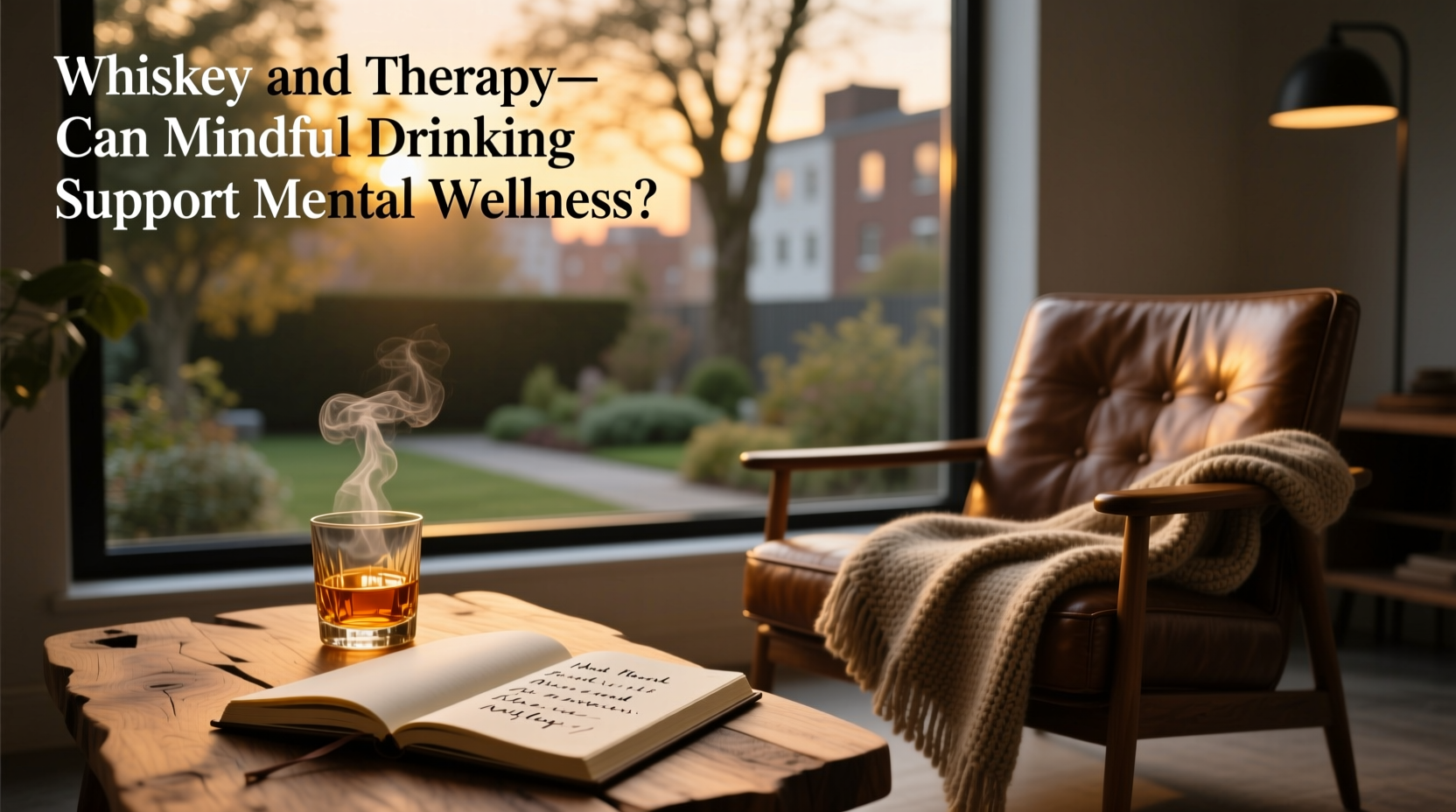
Mindful drinking is not abstinence. Nor is it moderation defined solely by unit counts. It is a practice rooted in Buddhist-informed mindfulness principles—observing experience without judgment, returning attention to the present, and acting from choice rather than impulse. Applied to whiskey, it means engaging all senses deliberately: noticing the amber hue against light, inhaling layered notes of oak, smoke, or dried fruit, feeling the warmth unfold—not rushing to the next sip, but pausing between them.
In contrast, mindless consumption often follows predictable cues: uncorking at 5:30 p.m. regardless of fatigue or mood; using whiskey to “take the edge off” before difficult conversations; or defaulting to a glass when bored or overwhelmed—without checking whether it serves your well-being or merely postpones discomfort.
The distinction becomes clinically relevant when clients bring drinking habits into therapy. A skilled therapist won’t assume every drink signals pathology—but will explore its function. Does this ritual foster connection—or reinforce withdrawal? Does it deepen reflection—or obscure insight? Is it aligned with stated values like authenticity, presence, or self-respect?
How Therapy Strengthens Mindful Drinking (and Vice Versa)
Therapy provides the scaffolding that makes mindful drinking sustainable. Cognitive Behavioral Therapy (CBT) helps identify automatic thoughts (“I need this to unwind”) and test their validity. Acceptance and Commitment Therapy (ACT) cultivates psychological flexibility—the ability to hold discomfort without needing to medicate it. Psychodynamic work uncovers unconscious drivers: Is this glass a stand-in for unmet needs? A reenactment of family patterns? A boundary against emotional overwhelm?
Conversely, the discipline of mindful drinking reinforces therapeutic gains. Sitting with the subtle burn of a well-aged bourbon—without reaching for distraction—builds tolerance for internal experience. Choosing *not* to pour, even when habit urges it, strengthens prefrontal cortex engagement and self-efficacy. Over time, these micro-choices accumulate into embodied confidence in one’s capacity to regulate emotion without external agents.
“Mindfulness doesn’t eliminate craving—it changes our relationship to it. When someone learns to taste whiskey with full attention, they often discover they don’t need as much to feel satisfied. That same skill transfers directly to managing anxiety, grief, or loneliness.” — Dr. Lena Torres, Clinical Psychologist and author of Substance and Self
Building Your Mindful Whiskey Practice: A 5-Step Framework
Integrating whiskey intentionally into a mental wellness routine requires structure—not rigidity, but gentle guardrails. This framework is designed for adults who already drink, wish to continue doing so consciously, and are engaged in or open to therapeutic support.
- Clarify Your ‘Why’: Before your next pour, write down three reasons you want to drink *this* whiskey *right now*. Is it curiosity about terroir? A desire to honor craft? A ritual marking transition? If “to relax” appears, ask: What does relaxation mean here—and is this the most effective path?
- Create Ritual Space: Designate a consistent, screen-free location and time (e.g., Saturday evenings, the armchair by the window). Light a candle or play ambient music—not to distract, but to signal intentionality.
- Engage All Senses Deliberately: Spend 60 seconds observing color and viscosity. Swirl gently and inhale three times—first shallow, then deeper, then slow. Sip, hold for 5 seconds, notice heat and texture, then swallow and track the finish. No multitasking.
- Pause Midway: After two sips, set the glass down. Breathe for 90 seconds. Ask: “What am I feeling *now*—physically, emotionally, mentally? Has my attention shifted? Is this still serving me?”
- Reflect & Record: Within 30 minutes of finishing, jot three observations: one sensory detail, one emotional shift, and one insight about your relationship to choice or control.
Do’s and Don’ts of Integrating Whiskey and Mental Wellness
| Do | Don’t |
|---|---|
| Pair tasting with journaling or gratitude practice | Use whiskey to suppress emotions you’re avoiding in therapy |
| Choose expressions with lower ABV (40–46%) for greater sensory nuance and less sedative effect | Drink on an empty stomach or while fatigued—both amplify neurological impact |
| Discuss your drinking patterns openly with your therapist—even if it feels vulnerable | Assume “moderation” means the same thing for everyone; individual thresholds vary widely |
| Explore non-alcoholic alternatives (e.g., barrel-aged shrubs, smoked teas) to preserve ritual without pharmacology | Ignore physical warning signs: disrupted sleep, morning anxiety, irritability, or memory gaps |
Real Example: Sarah’s Shift from Coping to Contemplation
Sarah, 38, began therapy after persistent low-grade anxiety and insomnia. She drank two glasses of bourbon nightly—a habit inherited from her father, framed as “unwinding.” Early sessions revealed she rarely tasted her whiskey; she drank quickly while scrolling, often falling asleep mid-glass. Her therapist didn’t pathologize the habit but invited curiosity: “What does ‘unwinding’ mean to you? And what happens in your body *before* you reach for the bottle?”
Through guided exploration, Sarah realized she associated stillness with dread—not peace. Her nightly pour wasn’t relaxation; it was anesthesia. With support, she began a modified mindful drinking experiment: one glass, poured slowly, sipped over 20 minutes, followed by 10 minutes of breathwork. Within three weeks, she noticed reduced nighttime awakenings and greater emotional clarity during therapy discussions. Six months later, she drinks whiskey only twice weekly—but now chooses cask-strength expressions she savors for 45 minutes, often alongside sketching or reading poetry. “It’s not about the alcohol anymore,” she shared. “It’s about claiming time where I’m fully here—without needing to fix, numb, or perform.”
FAQ: Addressing Common Concerns
Can mindful drinking help with anxiety or depression?
No—mindful drinking is not a treatment for clinical anxiety or depression. Evidence consistently shows alcohol worsens both conditions over time. However, for individuals managing subclinical stress or practicing wellness maintenance, intentional, low-dose rituals *may* support emotional regulation *when integrated with proven interventions* like therapy, movement, and sleep hygiene. Always consult a healthcare provider before making changes to mental health routines.
Isn’t promoting alcohol use contradictory to public health guidance?
Public health guidelines rightly emphasize population-level risk reduction—especially given alcohol’s links to cancer, liver disease, and addiction. This article addresses a specific, narrow demographic: adults with no history of substance use disorder, stable mental health, access to therapy, and the capacity for self-monitoring. It advocates for *increased awareness*, not increased consumption—and explicitly positions whiskey as optional, contextual, and secondary to clinical care.
How do I know if my drinking has crossed into problematic territory?
Ask yourself: Do I feel unable to skip a planned drink without irritability or guilt? Do I hide bottles or lie about consumption? Have loved ones expressed concern? Do I rely on whiskey to tolerate situations I’d otherwise avoid? If you answer “yes” to any, pause the ritual and speak with a mental health professional. Mindful drinking requires psychological safety—something only sustained through honesty and support.
Conclusion: Presence, Not Pour Size, Is the Measure
The question isn’t whether whiskey belongs in a life committed to mental wellness. It’s whether your relationship with whiskey reflects your deepest values—curiosity over compulsion, presence over escape, respect over reflex. Therapy offers the mirror; mindful drinking, the practice ground. Together, they cultivate something rare in our accelerated world: the ability to sit with complexity—to hold both the warmth of oak-aged spirit and the ache of unresolved grief, without needing either to disappear.
You don’t need to renounce tradition to honor your nervous system. You don’t need to chase euphoria to find peace. Start small: next time you pour, let the first sip wait. Watch the light catch the liquid. Breathe. Notice what arises—not to change it, but to know it. That moment of choice, repeated with kindness and consistency, is where true wellness begins.
💬 Your experience matters. Have you explored mindful drinking alongside therapy? What surprised you? Share one insight in the comments—your reflection could help someone else reclaim presence, one intentional pour at a time.