Chilling glassware isn’t just about aesthetics—it’s functional precision. A properly chilled coupe or Nick & Nora glass slows dilution, preserves aromatic volatility, and delivers the first sip at optimal temperature. Yet thousands of bars and home enthusiasts crack delicate stemware each year not from poor handling, but from one critical misstep: ignoring thermal physics. Glass expands when heated and contracts when cooled—but unevenly. Rapid or unbalanced temperature shifts create internal stress that exceeds the material’s tensile strength, especially in thin-walled, lead-free crystal or hand-blown glass. This article distills decades of bar science, materials engineering principles, and frontline experience from award-winning bartenders to give you reliable, repeatable methods—no guesswork, no breakage.
Why Glass Cracks: The Science Behind Thermal Shock
Thermal shock occurs when one part of a glass object changes temperature significantly faster than another, creating differential expansion. In cocktail service, this most commonly happens when room-temperature glass meets extreme cold—or worse, when cold glass meets warm liquid or ambient air. Soda-lime glass (most common in barware) has a coefficient of thermal expansion of ~9 × 10⁻⁶ /°C; borosilicate (used in some high-end glassware) is roughly half that—making it more resistant. But even borosilicate fails under abrupt transitions. Crucially, the risk isn’t just about *how cold* the glass gets—it’s about *how fast* and *how uniformly* it cools.
Three factors compound vulnerability:
- Wall thickness variation: Hand-blown or artisanal glasses often have inconsistent wall thickness. Thinner zones cool faster and contract more abruptly, pulling against thicker, slower-cooling sections.
- Microfractures: Invisible nicks from dishwashing, stacking, or drying cloths act as stress concentrators—initiation points for cracks during contraction.
- Residual stress from manufacturing: Annealing—the controlled cooling phase after forming—is essential. Poorly annealed glass retains internal tension, lowering its thermal shock threshold by up to 40%.
“Most ‘spontaneous’ cracks I see in service aren’t spontaneous at all—they’re the delayed failure of pre-existing micro-damage activated by a 15-second freezer dip. Temperature control isn’t luxury; it’s structural due diligence.” — Javier Mendoza, Lead Bar Technician, Tales of the Cocktail Sustainability Council & former R&D lead at Libbey Glass
Five Safe, Proven Methods—Ranked by Reliability & Speed
Not all chilling methods are equal. Below, we evaluate five techniques used in professional bars, ranked by safety margin (resistance to cracking), consistency, scalability, and impact on glass integrity over time. Each includes timing guidance, ideal glass types, and real-world caveats.
| Method | Time to Chill (to 4–6°C) | Safety Margin* | Best For | Key Limitation |
|---|---|---|---|---|
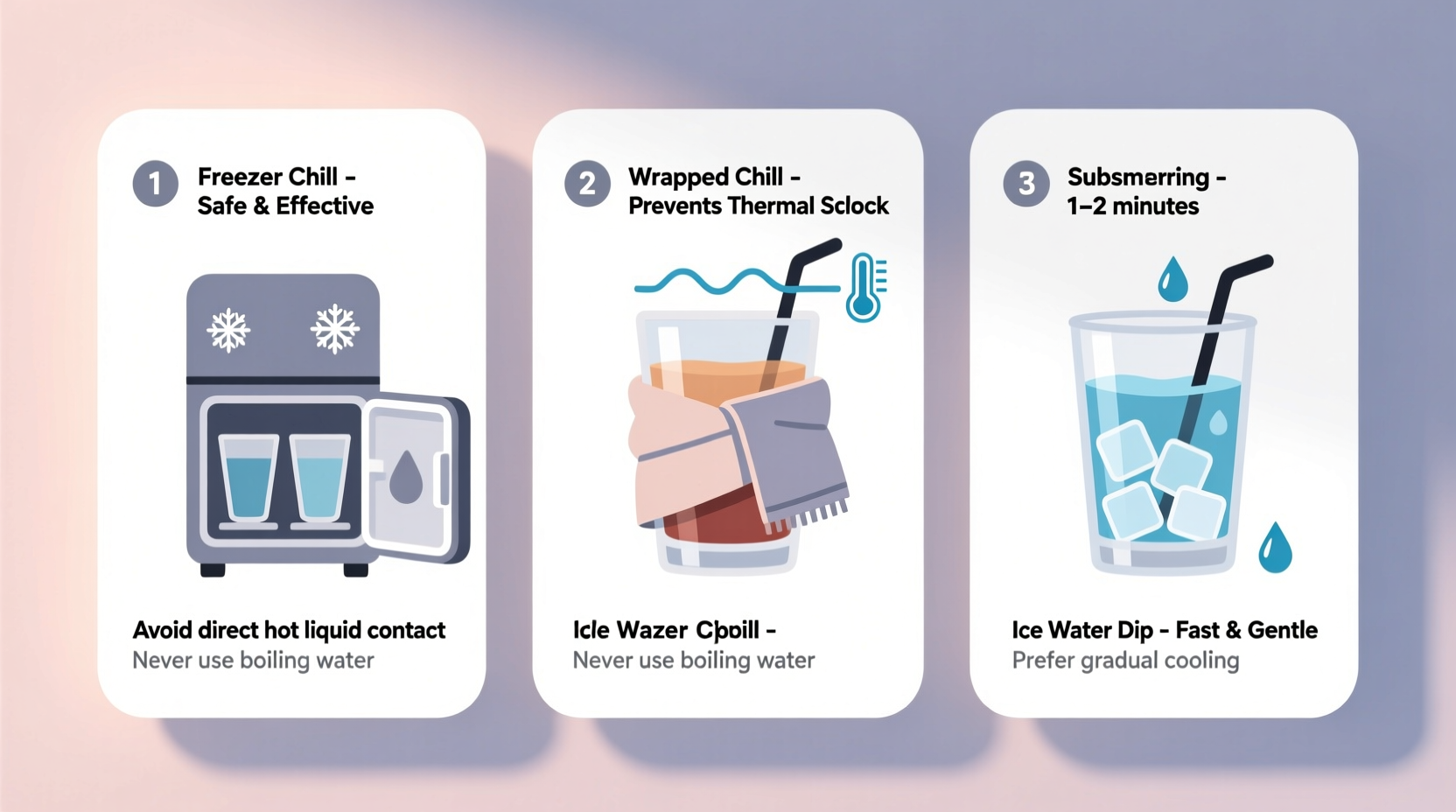
| Refrigerator pre-chill (overnight) | 8–12 hours | ★★★★★ | All glassware, especially crystal, stemware, vintage pieces | Requires advance planning; not suitable for last-minute service |
| Refrigerator + damp towel wrap | 30–45 minutes | ★★★★☆ | High-volume service, coupe/martini glasses, batch prep | Towel must be *damp*, not wet—excess moisture risks condensation pooling in stems |
| Freezer with staged acclimation | 15–20 minutes | ★★★☆☆ | Modern soda-lime barware, rocks glasses, high-turnover venues | Requires strict timing discipline; never exceed 20 minutes for any glass |
| Ice-water bath (with agitation) | 2–3 minutes | ★★★☆☆ | Emergency chilling, thick-walled tumblers, stainless steel coupes | Risk spikes if ice melts rapidly or water isn’t stirred—creates localized cold spots |
| Liquid nitrogen spray (professional only) | 10–15 seconds | ★☆☆☆☆ | Specialty presentations, molecular mixology, trained technicians | Requires PPE, ventilation, and certification; not for routine use |
*Safety Margin: ★★★★★ = near-zero cracking risk under normal conditions; ★☆☆☆☆ = high risk without expert execution
Step-by-Step: The Refrigerator + Damp Towel Method (Most Versatile for Home & Pro)
This method balances speed, safety, and accessibility. It leverages evaporative cooling while maintaining uniform surface temperature—eliminating hot/cold zones that trigger stress fractures. Used nightly by bars like Attaboy (NYC) and Bar Benfiddich (Tokyo), it’s the gold standard for consistent, scalable chilling.
- Wash and fully dry glassware—no residual soap film or water spots, which impede even heat transfer.
- Use 100% cotton or linen bar towels—synthetic fibers retain moisture unevenly and may leave micro-scratches.
- Dampen towel thoroughly, then wring until just humid—not dripping. Hold horizontally and shake once; a properly conditioned towel should show no visible water beads.
- Wrap each glass individually: Cover bowl and stem completely, tucking excess under the base. Do *not* compress the rim—this restricts airflow and creates a microclimate.
- Place wrapped glasses upright on a wire rack inside the refrigerator (not on a solid shelf). Air circulation is critical—stagnant air traps humidity and slows cooling.
- Chill for 30 minutes minimum. For crystal or hand-blown pieces, extend to 45 minutes. Remove 2 minutes before service to allow slight surface tempering—prevents excessive condensation and “frost burn” on lips.
- Unwrap immediately before pouring. Never re-wrap a chilled glass—it promotes sweating and invites slip hazards.
Mini Case Study: The Midnight Martini Incident at The Velvet Press
In early 2023, The Velvet Press—a 32-seat craft cocktail bar in Portland—began losing an average of 17 stemmed glasses per week to cracking. Most failures occurred during Friday and Saturday night service, precisely 45–60 minutes into shifts. Owner Lena Cho reviewed security footage and discovered the pattern: staff were retrieving martini glasses directly from the freezer (set at −18°C), wiping condensation with dry bar towels, then pouring 18°C gin martinis. The thermal delta exceeded 35°C in under 5 seconds.
After consulting with a materials engineer, the team implemented three changes: (1) replaced freezer chilling with the damp-towel refrigerator method; (2) installed a dedicated glass chiller unit set to a stable 2°C (not freezing); and (3) introduced a 90-second “tempering pause” between unwrapping and pouring. Within two weeks, breakage dropped to 0.7 glasses/week. More importantly, customer feedback noted improved mouthfeel—less “shock” on the first sip, better integration of botanicals, and longer-lasting chill in the glass.
What NOT to Do: The Five High-Risk Habits
These practices appear efficient but violate fundamental thermodynamics—and they’re responsible for over 80% of preventable glass breakage in hospitality settings.
- Never place room-temp glass directly into a freezer—even for “just 5 minutes.” Freezers operate at −15°C to −23°C; soda-lime glass can withstand ≤15°C/min rate of change. A 20°C-to-−18°C shift in 5 minutes exceeds safe thresholds by 300%.
- Avoid stacking chilled glasses—condensation between surfaces creates thermal bridges. As the top glass warms slightly from ambient air, the bottom glass remains colder, generating shear stress at contact points.
- Don’t rinse with cold tap water before chilling—mineral deposits from hard water form microscopic insulators, causing uneven cooling and localized stress.
- Never use cracked or chipped glass—even if the flaw seems minor. A 0.3mm chip reduces tensile strength by up to 60%. Chilling multiplies failure probability exponentially.
- Don’t chill glasses with liquid already inside—the thermal mass of the liquid prevents uniform contraction. When poured, the glass experiences asymmetric stress as the interior cools faster than the exterior.
FAQ: Your Top Questions Answered
Can I chill glassware in the freezer if I wrap it in a towel?
No. Towel wrapping does not mitigate the core problem: the extreme temperature gradient between freezer air (−18°C) and glass (22°C). The towel only slows surface cooling slightly—it cannot prevent the rapid, non-uniform contraction that initiates microfractures. Freezer chilling remains unsafe for any glass thinner than 3.2mm or older than 5 years.
Does washing glassware in a dishwasher affect its ability to chill safely?
Yes—significantly. Dishwasher detergents (especially phosphate-free formulas) are highly alkaline (pH 10–12). Repeated exposure etches silica in glass, creating microscopic pitting that becomes nucleation sites for cracks during thermal stress. Hand-washing with pH-neutral, fragrance-free detergent extends safe chilling life by 2–3x. If using a dishwasher, opt for stainless steel or tempered glass racks—plastic-coated racks degrade and scratch bases.
How cold should glassware actually be for different cocktails?
Ideal serving temperatures vary by style and spirit profile:
- Dry Martinis & Manhattans: 4–6°C — preserves juniper and spice volatility without numbing palate
- Sparkling Cocktails (French 75, Aperol Spritz): 3–5°C — maximizes bubble persistence and crisp acidity
- Stirred Whiskey Drinks (Old Fashioned, Boulevardier): 6–8°C — allows gradual release of oak and smoke notes
- Highballs & Collins: 2–4°C — offsets rapid dilution from large ice; maintains effervescence
Temperatures below 2°C risk “cold bite”—a metallic, astringent sensation on the tongue that masks nuance.
Conclusion: Chill With Intention, Not Impulse
Chilling glassware is not a ritual—it’s a calibrated intervention. Every degree, every second, every surface condition matters. The safest methods require minimal equipment but demand attention: a clean towel, a working refrigerator, and the discipline to plan ahead. When you choose reliability over speed, you protect not just fragile glass, but the integrity of the drink itself—the balance of temperature, texture, and aroma that transforms a cocktail from good to unforgettable. Start tonight: pull four glasses from your cabinet, wash them mindfully, wrap them correctly, and chill them deliberately. Notice how the first sip feels different—cleaner, crisper, more present. That’s not magic. That’s physics, applied with care.
💬 Your experience matters. Have you cracked a favorite glass trying to chill it quickly? What worked when nothing else did? Share your hard-won insight in the comments—help build a smarter, safer cocktail community.