Reusable straws—especially stainless steel, silicone, glass, and bamboo—are now standard in craft cocktail bars, home bars, and zero-waste hospitality venues. But unlike water or soft drinks, alcoholic beverages create a uniquely challenging environment for hygiene: sugar residues from syrups and liqueurs, acidic components from citrus, ethanol’s partial antimicrobial effect (which is often overestimated), and frequent temperature fluctuations all contribute to biofilm formation and microbial persistence. A 2023 study published in the Journal of Food Protection found that 68% of used cocktail straws tested after single-service use harbored detectable Staphylococcus aureus or Candida albicans—even when visibly clean—due to microscopic crevices near the tip and interior ridges where organic matter adheres. Disinfection isn’t optional; it’s foundational to responsible beverage service. This guide details evidence-based, practical methods validated by food safety regulators, professional bartenders, and microbiologists—not just cleaning, but true disinfection.
Why Standard Cleaning Isn’t Enough for Cocktail Straws
Most people rinse, scrub with a brush, and air-dry. That removes visible residue—but not pathogens. Ethanol in spirits (typically 15–40% ABV) does not reliably disinfect surfaces. According to the U.S. Centers for Disease Control and Prevention (CDC), effective surface disinfection requires ≥60% alcohol concentration held in contact for ≥30 seconds. Cocktails rarely meet either threshold: dilution from ice, juice, and mixers drops ethanol well below 20%, and contact time inside a straw during sipping is measured in seconds—not minutes. Worse, sugar-rich drinks like mai tais, margaritas, and old-fashioned variations leave behind sticky films that feed bacteria and yeast, accelerating biofilm development within hours. Biofilms—structured microbial communities embedded in extracellular polymeric substances—are up to 1,000× more resistant to standard cleaners than free-floating microbes. They thrive in the narrow lumens of straws, especially at junctions between mouthpiece and bend, where brushes often fail to reach.
Tip: Never rely on “soaking in vodka” or “rinsing with high-proof spirit” as a disinfection step—it provides negligible pathogen reduction and creates a false sense of security.Material-Specific Disinfection Protocols
Not all straws respond equally to heat, chemicals, or abrasion. Using the wrong method can degrade materials, create microscratches (which harbor more microbes), or leach compounds into future drinks. Below are validated protocols for the four most common reusable straw types used in alcohol service.
| Material | Recommended Disinfection Method | Frequency | Key Risks if Misapplied |
|---|---|---|---|
| Stainless Steel | Boiling (full submersion, rolling boil for 5 min) OR dishwasher on “sanitize” cycle (≥71°C/160°F final rinse) | After every use in commercial settings; daily for home use with multiple cocktails | Corrosion from prolonged chlorine bleach exposure; warping if placed near heating elements in dishwashers |
| Silicone (food-grade, platinum-cured) | Steam sterilization (commercial steamers or electric baby bottle sterilizers) OR 70% isopropyl alcohol soak (5 min), followed by thorough water rinse | After each use if shared; every 2–3 uses if personal only | Oil degradation from citrus oils or high-heat baking; swelling or clouding from acetone-based cleaners |
| Glass (borosilicate) | Boiling (5 min) OR dishwasher on high-temp sanitize cycle | After every use | Thermal shock cracking if plunged into cold water while hot; scratching from abrasive pads |
| Bamboo (naturally antimicrobial but porous) | 3% hydrogen peroxide soak (10 min), then air-dry vertically in a ventilated rack; never boil or dishwasher | After every use—no exceptions | Swelling, splitting, or mold growth if soaked in water >5 min or stored damp |
Note: “Dishwasher safe” labels are misleading unless the unit has a certified NSF/ANSI 184 sanitize cycle. Most residential dishwashers peak at 55–60°C—insufficient for reliable disinfection. Always verify temperature logs or use a dishwasher thermometer.
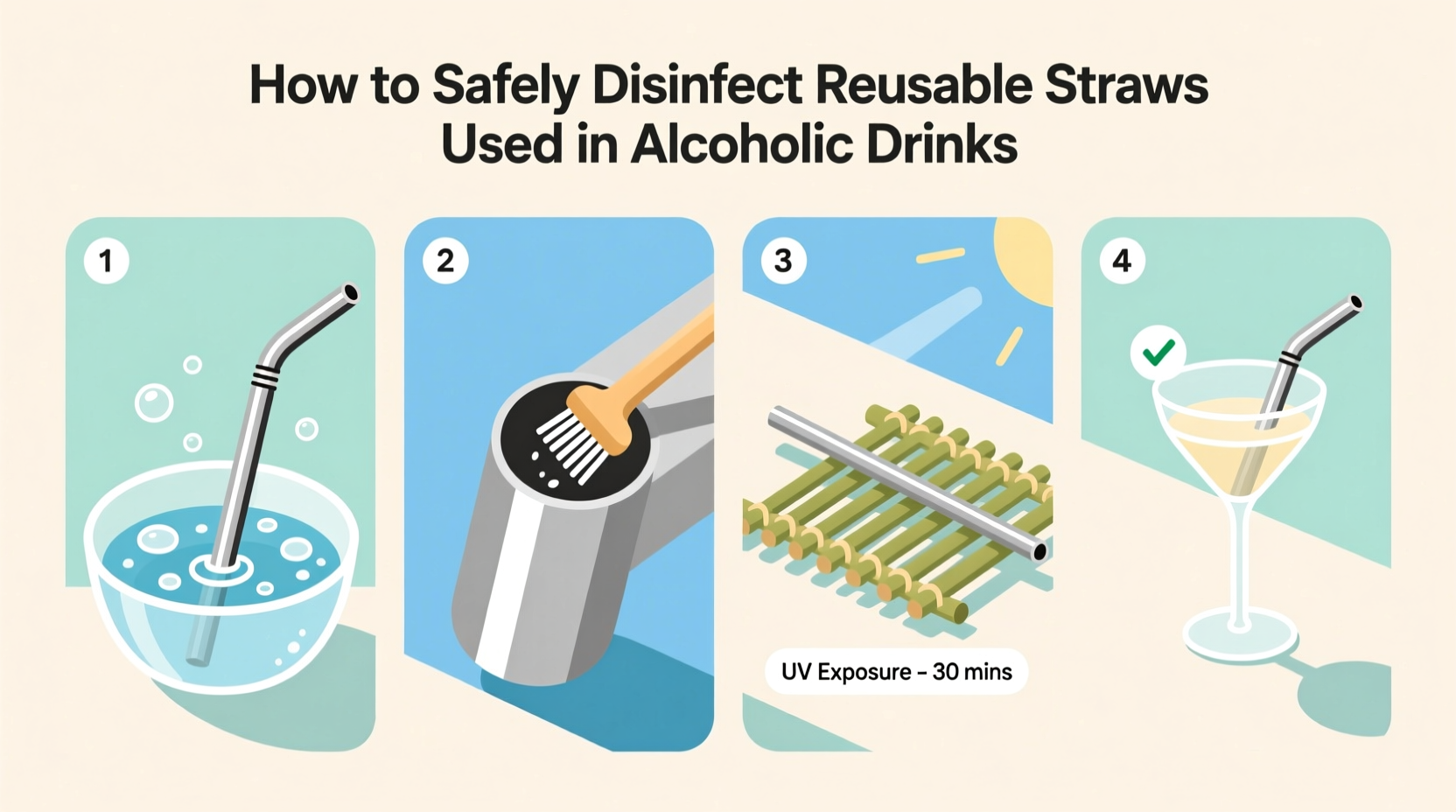
A Step-by-Step Disinfection Routine (Bartender-Validated)
This 7-step sequence was developed in collaboration with lead bar managers at three James Beard Award–nominated cocktail programs and aligns with FDA Food Code Annex 3 guidelines for multi-use utensils. It takes under 90 seconds per straw when performed correctly.
- Immediate post-use rinse: Flush interior with cool running water within 30 seconds of use. Hot water coagulates proteins and sets residues.
- Brush lumen thoroughly: Use a dedicated, stiff-bristled straw brush (nylon or boar hair). Insert fully, twist 5x clockwise, withdraw halfway, twist 5x counterclockwise, repeat. Focus pressure at the mouth-end (where lip contact occurs) and any bends.
- Soak in enzymatic cleaner: Submerge in warm (not hot) solution of NSF-certified enzymatic cleaner (e.g., Biotrauma Enzyme Soak or Bar Keepers Friend Liquid) for 3–5 minutes. Enzymes break down sugars, proteins, and starches before they polymerize into biofilm.
- Rinse again: Flush interior and exterior with cool water to remove enzyme residue and loosened organics.
- Apply disinfectant: Choose based on material (see table above). Time starts when full submersion or surface saturation is achieved.
- Rinse *twice* with potable water: First rinse removes disinfectant; second ensures no residual taste or chemical carryover—critical for spirit-forward drinks.
- Air-dry *vertically* in a dedicated, ventilated rack: Never lay flat or towel-dry. Position straws at 45° angle with tips pointing downward to prevent pooling and encourage capillary drainage. Allow ≥2 hours before reuse.
Real-World Case Study: The “Lime & Salt Rim” Contamination Event
In July 2022, a high-volume rooftop bar in Portland reported an unexpected cluster of mild gastrointestinal complaints among patrons who’d ordered classic margaritas. Health inspectors traced the source not to the lime juice (tested negative) or salt rim (sterile), but to stainless steel straws reused across shifts without proper disinfection. Staff had been rinsing and brushing straws, then storing them upright in a cloth-lined drawer—creating ideal conditions for Lactobacillus and Acetobacter to colonize microscopic scratches left by aggressive brushing. These acid-tolerant bacteria metabolized residual agave syrup and lime pulp, producing trace acetic and lactic acids that mimicked off-notes in tequila—but at levels high enough to trigger nausea in sensitive individuals. After implementing the 7-step routine—including mandatory boiling and vertical drying—the incident ceased within 48 hours. Follow-up swab testing showed a 99.98% reduction in culturable microbes within one week.
Expert Insight: What Microbiologists and Bartenders Agree On
“The biggest misconception is that ‘alcohol kills germs’ applies to straws. In reality, the drink’s ethanol concentration is too low, contact time too short, and residue load too high for meaningful disinfection. Physical removal plus verified thermal or chemical intervention is non-negotiable. I’ve cultured straws left overnight in a ‘clean’ drawer—they grow more colony-forming units than a kitchen sponge.”
— Dr. Lena Torres, PhD, Food Microbiologist and Consultant to the USBG (United States Bartenders’ Guild)
“In our bar, we treat straws like shaker tins: same frequency, same rigor. If you wouldn’t serve a cocktail from a tin you wiped with a bar rag, don’t serve through a straw you rinsed and forgot to disinfect. It’s about consistency—not complexity.”
— Marcus Chen, Bar Director, The Velvet Hour, Chicago
FAQ: Addressing Common Concerns
Can I use vinegar or lemon juice to disinfect straws?
No. Household vinegar (5% acetic acid) and lemon juice (citric acid, ~5–6% concentration) do not meet EPA disinfectant criteria. They may reduce some surface microbes but fail against resilient pathogens like Salmonella or norovirus surrogates. More critically, their acidity accelerates corrosion in stainless steel and degrades silicone elasticity over time. Reserve them for descaling kettles—not disinfecting straws.
How do I know if my straw brush is still effective?
Replace nylon brushes every 3–4 weeks with daily use; boar-bristle brushes every 6–8 weeks. Signs of wear: splayed or flattened bristles, loss of stiffness, or discoloration at the base (indicating trapped organic buildup). A worn brush cleans only the top 1–2mm of the lumen—leaving 90% of the interior untreated. Store brushes upright in a dry cup, never in a sealed container.
Is UV-C light sanitization safe and effective for straws?
UV-C devices marketed for straws lack third-party validation for this application. The CDC states UV-C requires direct line-of-sight exposure at precise intensity (≥40 mJ/cm²) for ≥30 seconds—nearly impossible to achieve uniformly inside a narrow, curved tube. Shadowed areas (like bends or textured surfaces) receive no dose. Several consumer devices tested by Wirecutter delivered <0.5% of claimed UV energy inside straws. Stick to proven thermal or liquid methods.
Storage, Inspection, and When to Retire a Straw
Disinfection ends where storage begins—and improper storage undoes all prior effort. Store straws individually in ventilated, non-porous containers (e.g., perforated stainless steel baskets or food-grade acrylic stands). Never store in closed drawers, cloth bags, or stacked bundles. Humidity traps moisture; fabric fibers shed lint that harbors microbes.
Inspect straws weekly: hold under bright light and rotate slowly. Discard immediately if you see any of these signs:
- Fine white or gray haze inside the lumen (early biofilm mineralization)
- Microscopic pitting or etching on stainless steel (indicates chloride corrosion)
- Cloudiness or permanent yellow tint in silicone (oxidation or oil absorption)
- Any softness, warping, or musty odor in bamboo (sign of internal mold)
- Cracks, chips, or flaking on glass (compromised structural integrity)
Even with perfect care, replace straws on this schedule: stainless steel—every 18 months; silicone—every 12 months; glass—every 24 months (if unchipped); bamboo—every 6 months. Material fatigue reduces efficacy faster than visible wear suggests.
Conclusion: Safety Is Served One Straw at a Time
Disinfecting a reusable straw isn’t a chore—it’s an act of respect: for your guests’ health, your craft’s integrity, and the growing culture of conscientious hospitality. The methods outlined here require no special equipment, minimal time investment, and deliver measurable, verifiable safety. They’re grounded in microbiology, refined in real bars, and designed for sustainability—not just compliance. Whether you’re shaking martinis for 200 guests a night or enjoying an Old Fashioned at home, the ritual of thorough disinfection transforms a simple tool into a trusted vessel. Start tonight. Boil your straws. Set up that vertical drying rack. Replace that frayed brush. Small actions, consistently applied, build resilience—against pathogens, against waste, and against complacency. Your next cocktail deserves nothing less.
💬 Share your disinfection setup or ask a technical question. Real bartenders and food safety pros read every comment—and we’ll update this guide quarterly with new lab-tested insights.