Aging whiskey isn’t reserved for distilleries with climate-controlled rickhouses and decades of tradition. With careful attention to wood science, food-grade sanitation, and realistic expectations, you can introduce authentic oak character—vanilla, caramel, spice, tannin, and subtle oxidation—to unaged or young spirit in your own kitchen or garage. But “home aging” isn’t a shortcut; it’s an accelerated, highly controllable extraction process that demands precision. Done well, it yields nuanced, drinkable results in weeks—not years. Done carelessly, it risks off-flavors, microbial contamination, or even unsafe ethanol oxidation byproducts. This guide distills real-world experience from home distillers, cooperage educators, and regulatory advisors into a rigorous, safety-centered methodology.
Why Small Oak Staves Work (and Why Barrels Don’t Belong in Most Homes)
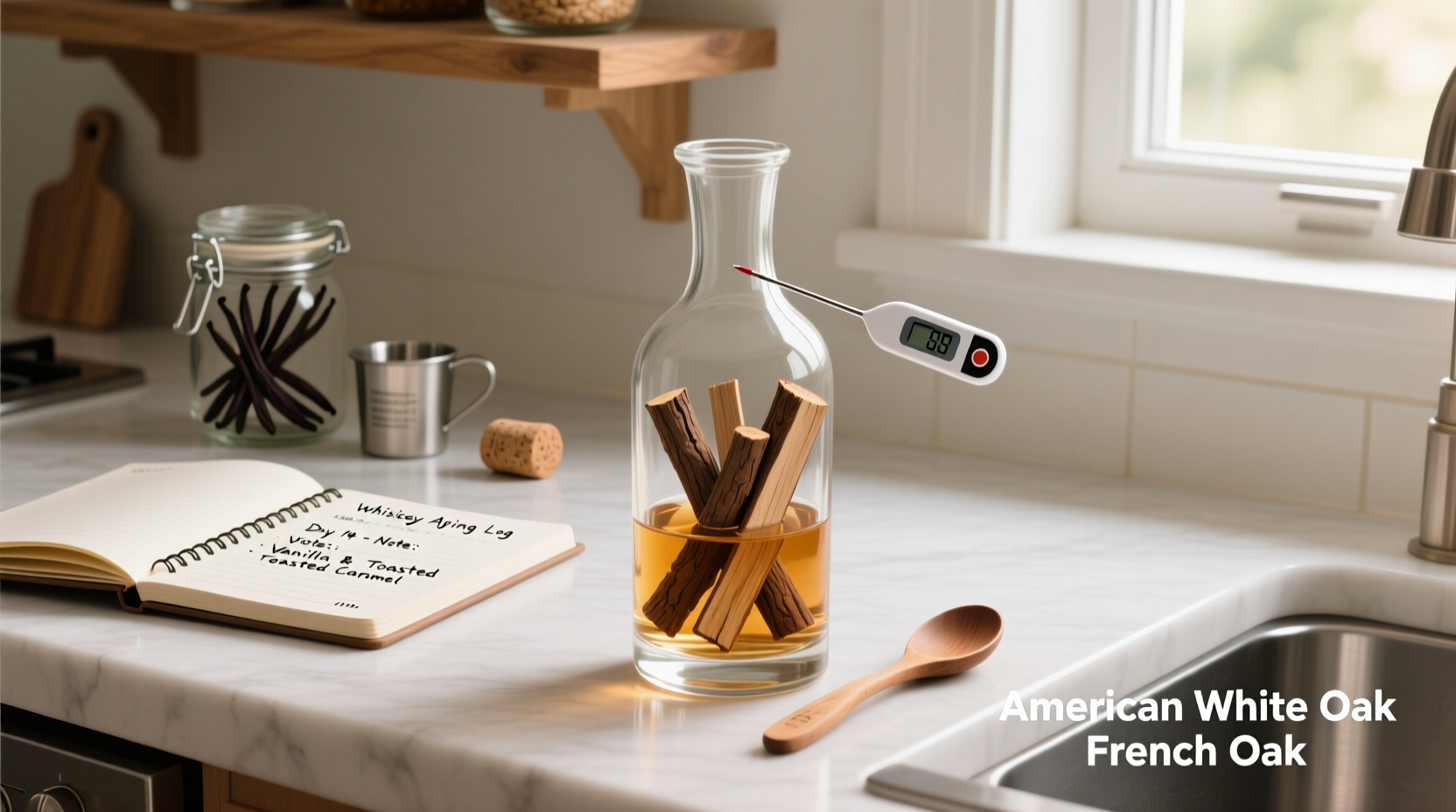
Traditional barrel aging relies on three interdependent factors: surface-area-to-volume ratio, micro-oxygenation through porous wood, and slow thermal cycling. A standard 53-gallon bourbon barrel has roughly 10–12 square feet of interior oak surface. In contrast, a 750 mL mason jar aged with 4–6 grams of properly prepared oak staves offers a surface-area-to-volume ratio up to 15× greater. That means faster extraction—but also faster saturation, over-extraction, and risk of bitterness if unmonitored.
Small staves bypass the logistical and safety hurdles of full barrels: no fire code concerns, no structural integrity risks from pressure buildup, no need for humidity control, and no long-term storage commitment. They also eliminate the biggest home-aging pitfall—leakage. A compromised seal on a repurposed barrel can create ethanol vapor accumulation, a serious fire hazard in enclosed spaces. Staves in sealed glass containers avoid this entirely.
Crucially, staves allow granular control. You can adjust toast level, species, cut geometry (planks vs. cubes vs. spirals), and contact time in precise increments—then remove them instantly when the desired profile emerges.
The Four Pillars of Safe Home Aging
Success hinges on four non-negotiable foundations:
- Wood Integrity: Only use food-grade, kiln-dried, untreated oak—never construction lumber, pallet wood, or reclaimed furniture. These often contain glues, pesticides, mold inhibitors, or heavy metals.
- Sanitation Protocol: Ethanol is not sterile. Unsanitized wood introduces lactic acid bacteria, wild yeast, or Acetobacter, which can convert ethanol into acetic acid (vinegar) or ethyl acetate (nail polish remover).
- Temperature Stability: Fluctuations above 85°F accelerate harsh tannin leaching and ester degradation. Below 55°F slows extraction to near-stasis. Ideal range: 65–75°F.
- Monitoring Discipline: Taste every 48–72 hours after Day 5. Extraction accelerates exponentially past two weeks—and bitterness can dominate in under 48 hours once saturation begins.
Step-by-Step: From Spirit to Sip (With Timing & Safety Checks)
- Select & Source Staves (Day 0): Choose American white oak (Quercus alba) for classic bourbon notes, or French oak (Quercus robur or petraea) for finer tannins and red-fruit nuance. Buy from reputable suppliers (e.g., Barrel Builders, Oak Solutions, or local cooperages) who certify food-grade, kiln-dried, and sulfite-free wood. Avoid “flavoring chips” sold in liquor stores—they’re often steam-treated with unknown additives.
- Sanitize Thoroughly (Day 0, Morning): Submerge staves in 190-proof neutral grain spirit (e.g., Everclear) for 24 hours. This extracts water-soluble contaminants and kills surface microbes. Discard the rinse spirit—do not consume it. Rinse staves once with distilled water, then air-dry on a sanitized rack for 2 hours.
- Prepare Vessel & Spirit (Day 0, Afternoon): Use only borosilicate glass (e.g., wide-mouth mason jars or Erlenmeyer flasks). Sterilize with boiling water or 70% isopropyl alcohol, then air-dry completely. Pour in 750 mL of unaged whiskey (white dog), high-proof corn whiskey (125–140 proof), or even a robust rye—avoid low-proof (<90) or heavily filtered spirits, which lack the ethanol strength to extract effectively.
- Add Staves & Seal (Day 0, Evening): Add 5–8 grams of staves per 750 mL (start low: 5 g for first batch). Seal tightly with airtight lid (not screw-top alone—use PTFE tape on threads if needed). Store upright in a dark, temperature-stable cabinet.
- Monitor & Taste (Days 3–21): Begin tasting on Day 3. Use a clean pipette to draw 1 mL sample; dilute with equal parts distilled water to assess balance. Record observations: “Day 5: noticeable vanilla, light oak sweetness, no bitterness.” “Day 12: strong clove, slight astringency.” If bitterness or sourness appears, remove staves immediately.
- Filter & Bottle (Day X): When optimal flavor is reached, decant spirit through a 0.45-micron syringe filter into a clean, sterilized bottle. Refrigerate post-filtering to halt enzymatic activity. Consume within 6 months.
Do’s and Don’ts: A Critical Comparison
| Action | Do | Don’t |
|---|---|---|
| Wood Selection | Use kiln-dried, food-grade American or French oak, medium toast (300–375°F) | Use pine, cedar, cherry, or any non-oak wood; accept “barrel fragments” without certification |
| Spirit Base | Start with unaged, high-proof (110+ proof), non-chill-filtered whiskey | Age vodka, rum, or low-proof whiskey—these lack congeners needed for balanced oak integration |
| Container | Borosilicate glass with silicone-sealed lid or inert stainless steel | Plastic (even PET), aluminum, or untempered glass—ethanol degrades plastics and leaches metals |
| Storage | Cool (65–75°F), dark, stable location—no attic, garage, or near HVAC vents | Direct sunlight, near stove/oven, or in fluctuating temperatures (e.g., unheated shed) |
| Legal Compliance | Age only purchased, taxpaid whiskey—never distill or redistill at home | Attempt to “distill” or “rectify” spirit—this violates federal law (27 CFR §19.51) and poses explosion risk |
Real-World Example: The Portland Batch Experiment
In early 2023, Sarah Lin, a Portland-based cocktail educator, began aging 750 mL batches of 125-proof unaged rye with 6 g American oak staves (medium toast, 1” x ¼” x ¼”). She maintained 68°F ambient temperature in a closet with a digital hygrometer/thermometer. On Day 7, she noted pronounced baking spice and toasted almond. By Day 11, tannins had built enough structure to balance the rye’s heat—but on Day 13, a sharp, green bitterness emerged. She filtered immediately. The resulting spirit was bottled at 112 proof and served in Manhattan variations for six months with consistent positive feedback on its “focused oak backbone and clean finish.” Crucially, Sarah kept a log: pH remained stable (4.8–5.1), and no cloudiness or vinegar aroma developed—key indicators of microbial stability.
“Home aging with staves isn’t about replicating a 12-year barrel—it’s about targeted, reversible extraction. The moment you taste bitterness, you’ve crossed the line from enhancement to degradation. Remove the wood. No exceptions.” — Dr. Robert Hayes, Senior Cooperage Scientist, Independent Spirits Research Group
FAQ: Addressing Common Concerns
Can I age whiskey in a reused wine or beer barrel at home?
No. Used barrels are microbiologically unstable. Even after cleaning, residual Lactobacillus or Pediococcus spores survive and thrive in ethanol-rich environments, producing diacetyl (butter), acetic acid (vinegar), or biogenic amines. Their porous structure also traps volatile compounds that off-gas unpredictably. Staves offer control; barrels invite variables you cannot measure or mitigate safely at home.
Does aging at home increase ABV or create new alcohol?
No. Aging does not produce ethanol. It only modifies existing compounds via extraction, oxidation, and esterification. ABV may *appear* to change slightly due to evaporation (angel’s share)—but in a sealed stave vessel, evaporation is negligible. Any perceived “strength” comes from flavor concentration, not increased alcohol.
Is it legal to sell or gift my home-aged whiskey?
No. Under U.S. federal law (27 CFR §19.51), aging taxpaid spirits for resale or distribution requires a DSP (Distilled Spirits Plant) permit. Gifting is legally ambiguous and strongly discouraged—liability for adverse reactions falls entirely on the maker. Home aging is strictly for personal consumption. Label your bottles clearly: “For Personal Use Only – Not for Sale or Distribution.”
Expert-Validated Wood Specifications
Not all oak is equal. Toast level, grain tightness, and seasoning method dictate extraction kinetics. Here’s what industry data confirms:
- Toasting: Medium toast (300–375°F for 20–30 minutes) maximizes vanillin and lactone release while minimizing harsh char-derived phenols. Light toast (<250°F) yields green wood notes; heavy toast (>400°F) adds ash and smoke but suppresses fruitiness.
- Grain: Tight-grain oak (≥12 growth rings per inch) releases compounds slower and more evenly than coarse grain—critical for avoiding spikes in tannin.
- Seasoning: Air-dried ≥12 months reduces harsh tannins and increases soluble lignin derivatives. Kiln-drying alone (without prior air-drying) risks “locked-in” astringency.
When to Stop—and Why Patience Is Overrated
Most home-aged batches peak between Day 7 and Day 18. Beyond Day 21, diminishing returns set in: tannins polymerize into insoluble complexes (causing haze), vanillin oxidizes into vanillic acid (sharp, medicinal), and ethanol begins slow auto-oxidation into acetaldehyde (green apple, then bruised fruit). Unlike barrel aging, where wood and spirit co-evolve over years, stave aging is extraction-limited—not time-limited. Your palate, not the calendar, is the true timer.
Track progress with three metrics: sweetness (vanilla, caramel), spice (clove, nutmeg), and mouthfeel (astringency, oiliness). When sweetness plateaus and astringency rises—even slightly—remove the staves. Filter immediately. Delaying filtration invites microbial bloom, especially if ambient humidity exceeds 60%.
Conclusion: Age Thoughtfully, Not Just Quickly
Home aging with oak staves is a craft rooted in observation, restraint, and respect for both wood chemistry and food safety. It rewards curiosity but punishes haste. You won’t replicate a 20-year Macallan—but you can transform a raw, fiery spirit into something layered, aromatic, and deeply personal in under three weeks. The most experienced home agers don’t chase longer timelines; they refine their ability to recognize the exact second extraction shifts from harmony to imbalance. Start small: one 750 mL batch, one variable (toast level), one consistent tasting schedule. Document everything. Taste mindfully. And remember—the safest, most flavorful whiskey is the one you stop aging just before it asks you to.
💬 Share your first batch notes with us. What did you taste on Day 5? Did you catch the bitterness early—or learn from it? Comment below and help build a smarter, safer home-aging community.