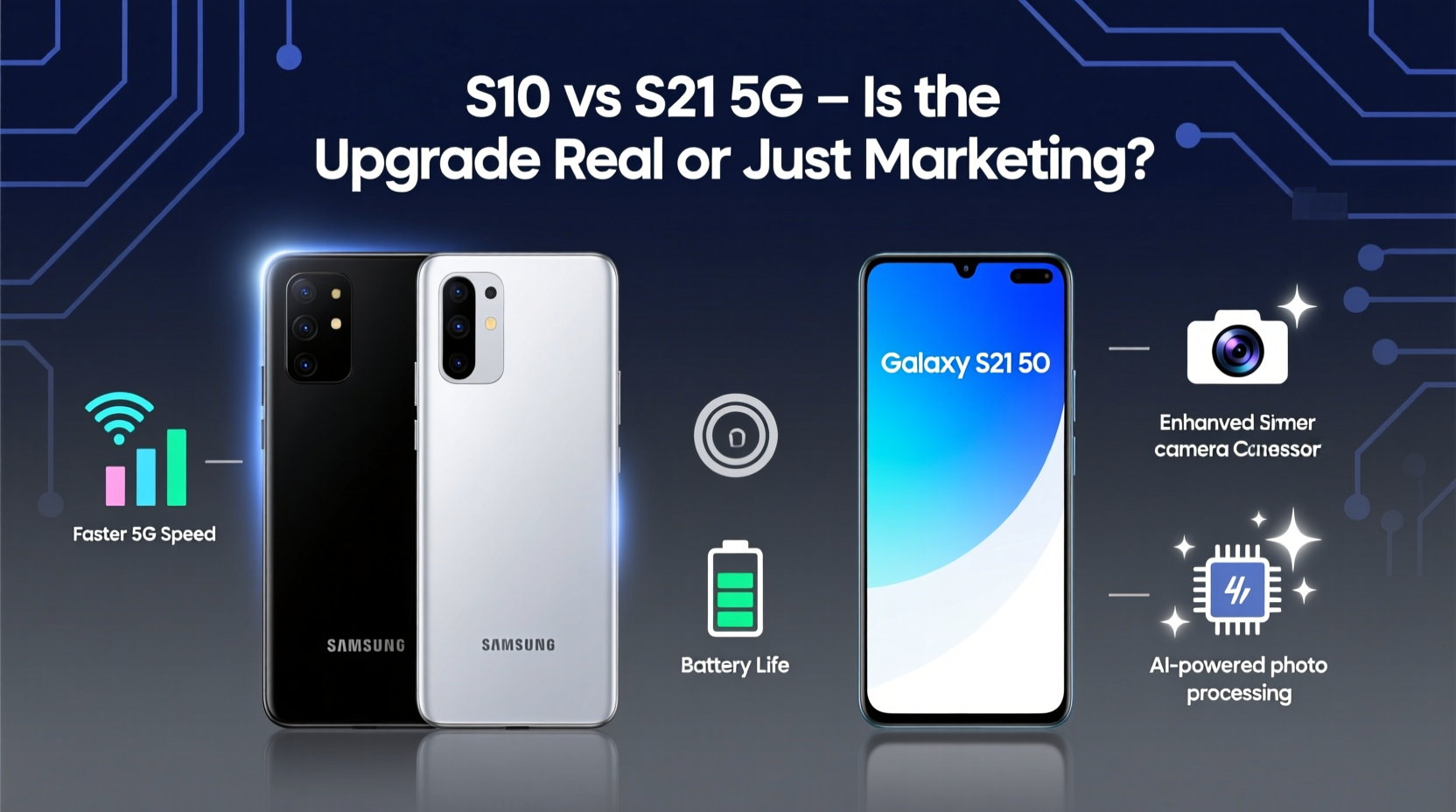
The Samsung Galaxy S10 was a landmark device—flagship power, elegant design, and a solid foundation for Android users. Now, nearly three years later, the S21 5G sits as its modern successor, boasting faster processors, improved cameras, and 5G connectivity. But for S10 owners wondering whether to upgrade, the question remains: are these upgrades transformative, or simply polished marketing?
This isn’t about chasing specs. It’s about understanding what actually improves your daily experience—speed, photo quality, longevity, and usability. Let’s dissect the reality behind the S21 5G’s claims and determine whether this upgrade delivers meaningful value or just incremental tweaks.
Performance Leap: From Good to Future-Proof
The S10 launched with the Exynos 9820 or Snapdragon 855 (depending on region), both of which were top-tier chips in 2019. By today’s standards, they’re still functional but beginning to show their age under heavy multitasking or newer gaming workloads.
The S21 5G, however, runs on the Exynos 2100 or Snapdragon 888 (again, region-dependent), offering roughly 30–40% better CPU performance and up to 60% faster GPU speeds. In practical terms, this means:
- Smaller app loading delays, especially after cold boots.
- Smoother transitions between apps, even with multiple high-demand apps open.
- Better handling of AR features, video editing, and high-refresh-rate gaming.
But here’s the catch: if you’re not a power user, the difference may feel subtle. Everyday tasks like browsing, messaging, and streaming won’t feel drastically faster. The real benefit lies in future-proofing. The S21 5G is built to handle software updates and heavier apps expected over the next 3–4 years, while the S10 may struggle sooner.
Tip: If you plan to keep your phone beyond two years, prioritize devices with current-gen chipsets—performance gaps widen over time.Camera Evolution: More Than Megapixels
Samsung marketed the S21 5G’s camera system as a major leap, but the changes aren’t just about higher resolution. The S10 featured a triple rear setup: 12MP main, 12MP telephoto, and 16MP ultra-wide. The S21 5G keeps a similar configuration but with key refinements:
| Feature | Samsung Galaxy S10 | Samsung Galaxy S21 5G |
|---|---|---|
| Main Sensor | 12MP, f/1.5-2.4 | 12MP, f/1.8, Dual Pixel AF |
| Telephoto | 12MP, 2x optical zoom | 64MP, 3x hybrid zoom |
| Ultra-Wide | 16MP, f/2.2 | 12MP, f/2.2, reduced distortion |
| Video Recording | 4K@30fps | 8K@24fps, 4K@60fps, improved stabilization |
| Front Camera | 10MP, f/1.9 | 10MP, f/2.2, AI-based focusing |
The most noticeable improvement comes in low-light photography. The S21 5G’s larger pixel binning and enhanced Night Mode produce cleaner, brighter images with less noise. Zoom performance has also improved—while the 64MP telephoto doesn’t deliver true optical clarity at 10x, the 3x hybrid zoom is more usable than the S10’s 2x.
“Smartphone photography isn’t just about hardware anymore—it’s computational. The S21’s processing engine makes a bigger difference than raw sensor size.” — Lena Park, Mobile Imaging Analyst at TechLens Review
Design and Display: Subtle Refinements
Aesthetically, the S21 5G marks a departure from the S10’s curved glass elegance. The new Contour Cut camera module blends into the metal frame, creating a more cohesive look. While some miss the premium feel of glass backs, the S21’s matte plastic back resists fingerprints and reduces accidental drops due to better grip.
The display remains excellent on both devices—Dynamic AMOLED with HDR10+ support—but the S21 5G ups the ante with a 48–120Hz adaptive refresh rate. This means smoother scrolling when needed and battery savings during static content. For S10 users accustomed to a fixed 60Hz screen, this change is immediately noticeable and genuinely enhances fluidity.
Real-World Example: Sarah’s Upgrade Journey
Sarah, a freelance photographer and long-time S10 user, upgraded to the S21 5G primarily for better low-light performance and 4K video capabilities. She shoots event highlights and shares quick edits on Instagram Stories.
At first, she didn’t notice a dramatic shift in daylight photos. But during a recent indoor wedding reception, the S21 captured sharp, well-exposed shots where her S10 produced grainy, blurry results. The improved stabilization also allowed her to record handheld videos without a gimbal.
She admitted the design took getting used to—the flat screen felt less immersive—but appreciated the reduced glare and longer battery life during full-day shoots. “It’s not flashy,” she said, “but it works better when I need reliability.”
5G: Ready for the Future or Premature Investment?
One of the biggest selling points of the S21 5G is, unsurprisingly, 5G connectivity. But how useful is it really in 2024?
In urban areas with mmWave or mid-band coverage, download speeds can exceed 300 Mbps—ideal for cloud gaming, instant large-file transfers, or streaming 4K video without buffering. However, outside major cities, many users still rely on LTE, and 5G coverage can be spotty or nonexistent.
More importantly, 5G impacts battery life. Continuous use drains the S21’s 4000mAh battery about 15–20% faster than LTE-only mode. Samsung includes an adaptive setting that switches to 5G only when needed, helping mitigate this issue.
If you live in a well-covered area and frequently transfer large media files or stream high-bitrate content, 5G adds tangible value. Otherwise, it’s a forward-looking feature rather than an immediate necessity.
Tip: Enable \"Smart 5G\" mode to balance speed and battery—lets the phone decide when to use 5G based on your activity.Should You Upgrade? A Practical Checklist
Before making the move, consider your actual needs. Use this checklist to evaluate whether the upgrade aligns with your lifestyle:
- Is your S10 slowing down? Frequent app crashes, laggy UI, or failed updates suggest it’s time.
- Do you shoot in low light often? The S21’s Night Mode and sensor improvements make a real difference.
- Are you using 5G networks regularly? Check your carrier’s coverage map before prioritizing this.
- Do you value smooth scrolling and animations? The 120Hz display is one of the most enjoyable upgrades.
- Can your S10 last a full day? Battery degradation on older devices is common; the S21 offers better endurance.
- Are you still satisfied with your current phone? If yes, wait—especially with newer models like the S23 and S24 already available.
Frequently Asked Questions
Will my S10 stop working if I don’t upgrade?
No. Samsung provided four years of major Android updates for the S10, meaning it received updates up to Android 13. Security patches may have ended or be limited now, but the phone remains functional for basic use.
Is the S21 5G significantly larger than the S10?
Not dramatically. The S21 5G measures 151.7 x 71.2 x 7.9 mm vs. the S10’s 149.9 x 69.9 x 7.8 mm. The weight is nearly identical (~172g). The flat edges may make it feel slightly bulkier, but it’s still pocket-friendly.
Can I expect better battery life despite the 120Hz screen?
Yes, but conditionally. The adaptive refresh rate helps conserve power, and the software is more efficient. In mixed usage, most users report similar or slightly better battery life than the S10, despite the newer screen tech.
Final Verdict: Hype Meets Real Value—With Caveats
The upgrade from the S10 to the S21 5G isn’t revolutionary, but it’s far from superficial. For users who rely on their phones for content creation, fast multitasking, or future-ready connectivity, the improvements in camera processing, display fluidity, and chipset performance add up to a noticeably better experience.
However, if your S10 still performs well and you don’t need advanced photography or 5G, the upgrade leans more toward “nice-to-have” than essential. Marketing emphasizes speed and innovation, but real-world value depends on how you use your device.
The truth? The S21 5G delivers genuine enhancements—not through one standout miracle feature, but through a cohesive package of refined hardware, smarter software, and better long-term support. It’s not hype-free, but for many, it’s a justified step forward.
🚀 Ready to decide? Assess your current pain points, check local 5G availability, and test the S21 5G in person if possible. Upgrades should solve real problems—not just follow trends.