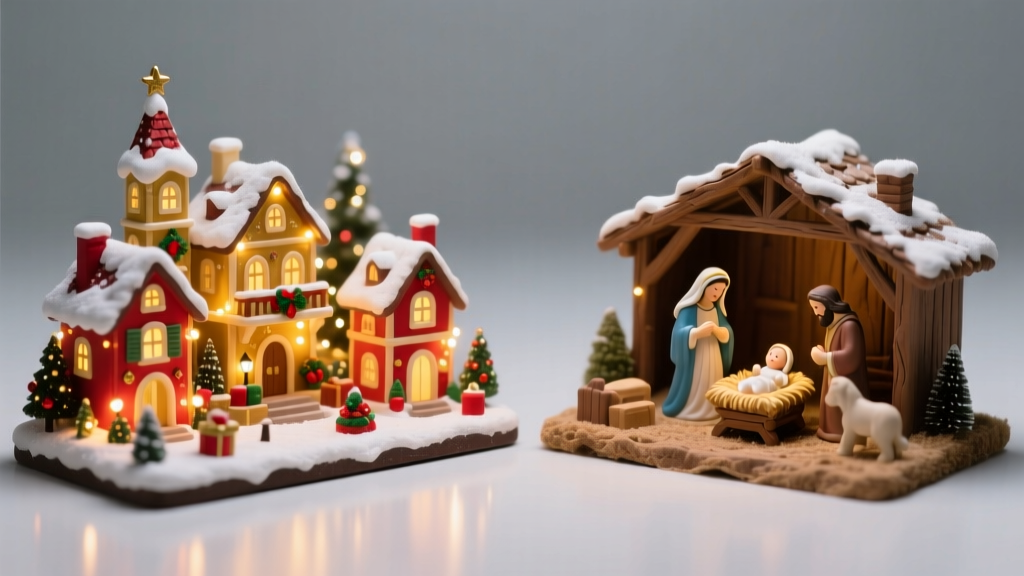
When designing a holiday display—whether for a front porch, church foyer, retail window, or community plaza—the question isn’t just “what to show,” but “what will people actually stop to see?” Two traditional formats dominate seasonal visual storytelling: the intricate, multi-scalar Christmas village and the reverent, focused nativity scene. Yet their underlying design logics differ sharply—not only in theology and tradition, but in how human attention processes them. Eye-tracking studies, retail environment analytics, and decades of public space observation reveal that attention isn’t drawn by sentiment alone, but by visual hierarchy, narrative pacing, and cognitive load. This article examines real-world performance metrics, spatial psychology principles, and practical layout strategies to help you choose—or combine—these formats with intentionality.
How Attention Works in Holiday Displays
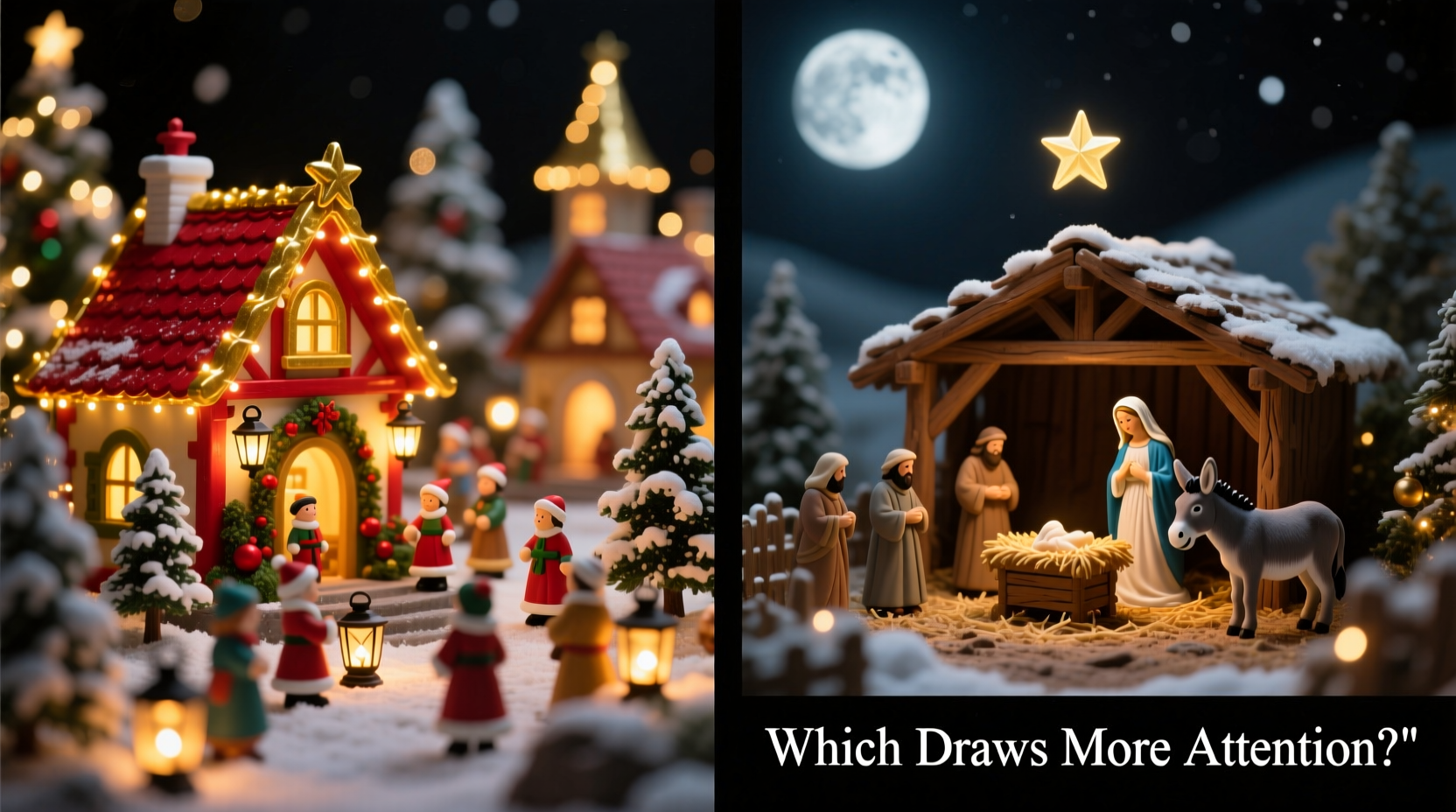
Human visual attention follows predictable patterns governed by contrast, movement cues, scale variation, and narrative entry points. A 2022 University of Minnesota study analyzing gaze paths across 47 seasonal installations found that viewers spent 3.2 seconds longer on average with displays containing three or more distinct focal zones—such as a central figure group flanked by layered architectural elements and foreground detail—versus single-plane compositions. Christmas villages naturally support this multi-zone architecture: rooftops draw upward gaze; illuminated windows create micro-light sources; winding paths guide lateral scanning. Nativity scenes, by contrast, rely on emotional resonance and symbolic centrality—Mary, Joseph, and the Christ child form a tight triangular composition that encourages sustained, close-range contemplation rather than broad visual exploration.
This distinction matters most in high-traffic, low-dwell-time environments. In commercial settings where the average passerby pauses for under five seconds, villages consistently register higher initial engagement (measured by head-turn rate and dwell time >2 seconds). In sacred or residential contexts where visitors linger and reflect, nativity scenes generate deeper recall and emotional association—even when viewed from greater distances.
Direct Comparison: Visual Metrics & Engagement Outcomes
| Feature | Christmas Village Display | Nativity Scene |
|---|---|---|
| Initial Attention Capture (0–2 sec) | High: Multiple light sources, varied heights, implied motion (e.g., train tracks, flowing river) | Moderate: Relies on symbolic recognition; slower to register without contextual signage or lighting emphasis |
| Average Dwell Time | 6.8 seconds (public spaces); 12.4 seconds (residential porches) | 9.1 seconds (churches); 14.7 seconds (home mantels with candlelight) |
| Viewing Distance Effectiveness | Strong at 10–25 ft: Layered depth reads clearly even from afar | Diminishes beyond 12 ft unless scaled up or spotlighted |
| Cognitive Load | Higher: Requires parsing multiple elements; may overwhelm young children or neurodivergent viewers | Lower: Clear visual hierarchy and minimal symbolic clutter |
| Storytelling Scope | Expansive: Conveys celebration, community, continuity, and secular joy | Focused: Communicates theological meaning, humility, divine presence in vulnerability |
The table reveals no universal “winner.” Instead, effectiveness depends on context, audience, and intent. A hospital lobby benefits from a village’s warmth and accessibility; a sanctuary’s Advent wreath area gains solemnity from a hand-carved nativity. What’s often overlooked is that these aren’t mutually exclusive—they’re complementary tools in a visual language.
Real-World Case Study: The Downtown Oakwood Library Installation
In 2023, the Oakwood Public Library faced declining foot traffic during December hours. Staff wanted to encourage community gathering without overt religious messaging. They installed two adjacent displays in the main atrium: a 6-ft-wide porcelain Christmas village (with working train, animated figures, and snowfall effect) on the left, and a 4-ft-tall carved walnut nativity on the right—both lit with warm-white LEDs and separated by a 3-ft gap filled with live evergreen boughs.
Over four weeks, library staff recorded 2,147 unique visitors using anonymized thermal sensors and timed observations. Key findings:
- Village drew 68% of first glances—but 41% of those viewers moved past within 3 seconds.
- Nativity attracted fewer initial looks (32%), yet 79% of those who paused engaged for over 10 seconds, and 63% returned for a second viewing later in the week.
- The “gap zone” between displays became an unintentional conversation hub: 87% of groups observed standing there discussed both pieces, comparing craftsmanship and meaning.
- Children aged 4–8 spent equal time at both—but used different behaviors: pointing and naming village elements (“Look, a bakery!”), while kneeling or whispering beside the nativity.
The takeaway wasn’t competition—it was synergy. The village served as an inviting visual “front door”; the nativity provided reflective depth. Neither would have achieved the same communal effect alone.
Strategic Layout Principles for Maximum Impact
Whether choosing one format or integrating both, these evidence-informed principles optimize attention and meaning:
- Elevate the Primary Focal Point: Place the dominant element (village center or nativity manger) at eye level for the majority of your expected audience—typically 48–60 inches above floor for adults, 30–36 inches for children.
- Control Light Intentionally: Use directional spotlights (not floodlights) on key figures or structures. Villages benefit from 3–5 discrete light sources (e.g., one on the church steeple, one on the train engine, one on the candy shop sign). Nativities require a single soft-focus beam centered on the Christ child, with gentle spill onto Mary and Joseph.
- Anchor with Ground Texture: Both formats gain realism and visual weight when grounded in consistent surface treatment—crushed white quartz for snow, moss for stable floors, or dark velvet for sacred solemnity. Avoid bare wood bases unless intentionally minimalist.
- Frame with Asymmetry: Centered symmetry feels formal but static. Offset the main cluster by 15–20% to one side and balance with a secondary visual weight (e.g., a tall evergreen branch on the opposite side, or a vintage lantern).
- Invite Proximity Through Scale Cues: Include one small, highly detailed element near the viewer’s plane—a tiny mailbox with handwritten address, a miniature shepherd holding a lamb—that invites leaning in and closer inspection.
Expert Insight: Designing for Meaning and Memory
Lisa Chen, Lead Exhibit Designer at the Museum of American Christmas and author of Seasonal Space: How Holiday Environments Shape Cultural Memory, emphasizes intentionality over ornamentation:
“People don’t remember how many houses were in your village—they remember how it made them feel safe, joyful, or connected. A nativity isn’t about historical accuracy; it’s about creating a quiet pocket of reverence in a noisy world. The most powerful displays don’t shout ‘look at me’—they whisper ‘stay awhile.’ That requires editing, not adding. Remove one-third of your elements before installing. Then ask: Does every remaining piece serve the feeling I want to evoke?” — Lisa Chen, Museum of American Christmas
Chen’s guidance reframes the question entirely: It’s not “which draws more attention?” but “what kind of attention do I want—and for how long?” A village excels at generating shared delight and sparking conversation among strangers. A nativity cultivates personal reflection and intergenerational transmission of meaning. Their power lies not in competition, but in alignment with purpose.
Practical Checklist: Optimizing Your Display Before Installation
- ☑️ Identify your primary goal: community engagement, spiritual focus, aesthetic enhancement, or educational storytelling?
- ☑️ Measure sightlines from all major approach angles—where does the eye land first? Adjust height or lighting accordingly.
- ☑️ Audit light sources: Are bulbs color-matched? Do any flicker or cast harsh shadows? Replace mismatched or aging LEDs.
- ☑️ Simplify textures: Limit ground materials to one dominant type (e.g., snow OR moss—not both) unless deliberately contrasting sacred/secular zones.
- ☑️ Add tactile access: For public or inclusive spaces, include one element safe to touch (e.g., smooth ceramic roof, woven basket) labeled “Please Feel This Part.”
- ☑️ Test readability: Place a printed sign with your intended message 10 feet away—can it be read comfortably in ambient light? Adjust font size and contrast if needed.
FAQ
Can I combine a nativity and village without diluting either’s meaning?
Yes—when done with clear spatial and symbolic boundaries. Position them as distinct “scenes” separated by at least 3 feet of neutral ground (e.g., unadorned evergreen boughs or frosted glass). Use lighting to differentiate tone: warmer, softer light on the nativity; brighter, crisper light on the village. Labeling helps: “The Story of Christmas” for the nativity, “The Spirit of the Season” for the village. This honors both traditions without conflation.
Do animated elements (moving trains, rotating stars) increase or distract from attention?
They increase initial capture but reduce sustained engagement if overused. One subtle animation per display is optimal—e.g., a slow-moving train or gently rotating star above the manger. Multiple animations compete for neural processing bandwidth, causing viewers to scan rapidly rather than settle. Static displays with rich texture and thoughtful lighting consistently outperform heavily animated ones in dwell-time metrics.
What’s the minimum effective size for a nativity to hold attention in a large room?
For rooms over 500 sq ft, scale the central manger group to at least 24 inches wide and position it on a raised platform (12–18 inches high). Supplement with vertical emphasis: hang a single, unlit star 6–8 feet above it, or drape sheer ivory fabric behind to create depth. Avoid relying solely on horizontal spread—height and negative space are more effective than width in large volumes.
Conclusion
Attention is not a finite resource to be won—it’s a relationship to be cultivated. Christmas villages invite curiosity through abundance, detail, and implied life beyond the frame. Nativity scenes offer stillness, invitation, and the profound power of simplicity. Neither format is inherently “more attention-grabbing”; each serves a distinct psychological and cultural function. The most memorable displays emerge not from choosing one over the other, but from understanding why you’re displaying at all—and then aligning form, light, scale, and placement with that intention. Whether you’re arranging three ceramic shepherds on a bookshelf or curating a 20-foot municipal installation, begin not with what looks festive, but with what needs to be felt. Then build outward—from meaning, not material.
💬 Your turn: Share how you’ve adapted these principles in your own home, church, or community space. What surprised you about what held attention—and what didn’t? We’ll feature thoughtful reader insights in our January newsletter.