The smartphone landscape is shifting. For over a decade, Samsung has dominated the Android flagship space with relentless innovation, premium hardware, and aggressive marketing. But Google’s Pixel line—once seen as niche developer devices—has matured into a serious contender. With the launch of the Pixel 9 Pro and the anticipated Galaxy S25, the question isn’t just about specs; it’s about momentum. Is Samsung, for the first time in years, facing real competition that challenges not just its hardware, but its entire value proposition?
This isn’t merely a battle of megapixels or processor speeds. It’s a clash of philosophies: Samsung’s all-in-one powerhouse approach versus Google’s AI-first, software-integrated vision. As users increasingly prioritize seamless experiences, long-term support, and intelligent features over raw power alone, the balance may be tipping.
Hardware Showdown: Power vs Precision
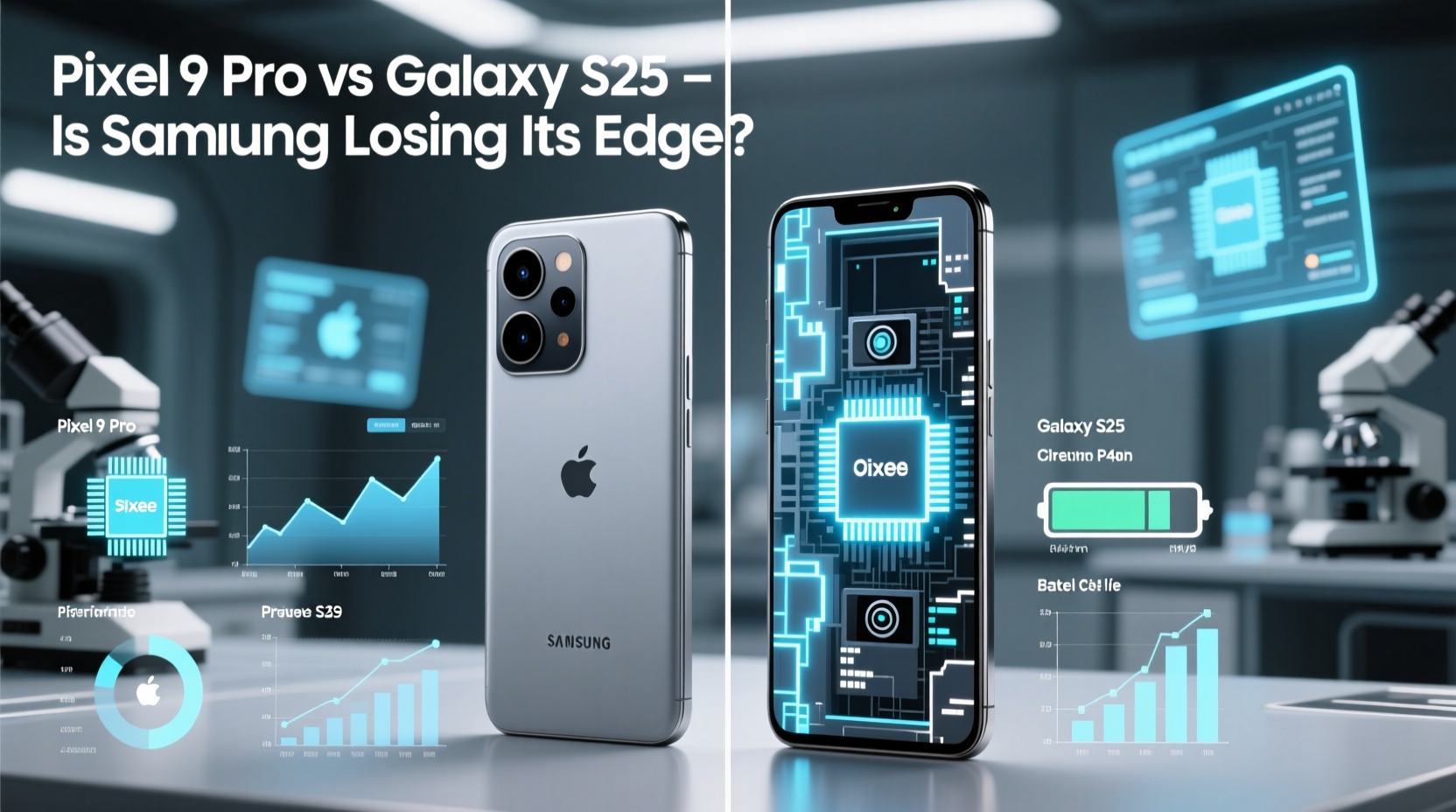
Samsung has long prided itself on delivering top-tier hardware across the board. The Galaxy S25 is expected to feature the next-generation Snapdragon 8 Gen 4 (or Exynos equivalent in select regions), 12GB+ of RAM, a 200MP main sensor, and an advanced QHD+ Dynamic AMOLED display with 144Hz refresh rate. These numbers are undeniably impressive and cater to users who demand maximum performance for gaming, multitasking, and media consumption.
In contrast, the Pixel 9 Pro takes a different route. It runs on Google’s custom Tensor G4 chip—a SoC not designed for benchmark dominance, but optimized for machine learning tasks. While its CPU and GPU performance lags slightly behind the Snapdragon 8 series, its NPU (Neural Processing Unit) outperforms in AI-driven functions like real-time translation, speech processing, and computational photography.
Where Samsung packs in every possible sensor and feature—ultrasonic fingerprint, S Pen support (in Ultra models), multiple telephoto lenses—Google focuses on refinement. The Pixel 9 Pro features a more modest triple-camera array, but leverages AI to deliver superior dynamic range, low-light clarity, and subject tracking. Its display, while limited to 120Hz LTPO OLED, is tuned for accuracy and battery efficiency rather than peak brightness arms races.
Tip: If you prioritize smooth photo processing and AI-enhanced video calls over gaming frame rates, the Tensor G4’s specialized architecture may serve you better than raw GHz.Software & Updates: The Long Game
One area where Google holds a decisive advantage is software longevity. The Pixel 9 Pro promises seven years of OS and security updates—a commitment unmatched in the industry. This means users can expect Android 20 and beyond on a device launched in 2024.
Samsung, while improving, currently offers seven years of security updates only for select Galaxy S24 and Z-series devices. Full OS updates are capped at four major versions. For consumers planning to keep phones longer—now averaging 4+ years—this difference is critical.
“Long-term software support is becoming a key differentiator. It’s no longer enough to launch strong; brands must sustain relevance.” — Dr. Lena Tran, Mobile Analyst at TechInsight Group
Google also controls the entire software stack. Pixel phones receive updates within days of release, often before other OEMs get beta access. Samsung, despite One UI’s maturity, still faces delays due to carrier approvals and extensive skin customization.
Camera Comparison: Computational Photography vs Hardware Flexibility
The camera war has evolved from hardware battles to algorithmic superiority. Samsung equips the S25 with a versatile quad-camera system: 200MP wide, dual telephotos (3x and 5x optical), and ultra-wide. This allows true lossless zoom and professional-grade manual control via Pro Mode.
Google counters with fewer lenses but smarter processing. The Pixel 9 Pro uses AI-powered Super Res Zoom, HDR+, and Magic Eraser to achieve results that rival or surpass higher-resolution sensors. Its Night Sight and Face Unblur technologies remain class-leading. Video stabilization, enhanced by Motion Sense radar (on Pro models), delivers cinematic smoothness even in motion.
| Feature | Pixel 9 Pro | Galaxy S25 |
|---|---|---|
| Main Sensor | 50MP (Dual Pixel AF) | 200MP (Adaptive Pixel) |
| Telephoto | 48MP (5x optical) | 10MP (3x), 10MP (5x) |
| Video Recording | 4K/60fps w/ AI stabilization | 8K/30fps, 4K/60fps w/ OIS |
| AI Features | Magic Editor, Audio Eraser, Best Take | Director’s View, Object Eraser, AI filters |
| Low-Light Performance | Best-in-class Night Sight | Strong, but less natural color tone |
In real-world use, the choice depends on intent. Photographers who shoot in RAW and edit manually may prefer Samsung’s flexibility. Casual users who want stunning point-and-shoot results will likely favor Pixel’s automation.
Mini Case Study: Travel Photographer’s Dilemma
Maya, a travel content creator, tested both phones during a two-week trip through Morocco. She needed reliable low-light shots in medinas, crisp zooms for distant architecture, and durable battery life.
She found the Galaxy S25 excelled in daylight zoom scenarios—capturing intricate tile patterns from afar without quality loss. However, in dimly lit markets, the Pixel 9 Pro produced cleaner images with accurate skin tones and minimal noise. The AI-powered “Best Take” feature saved her multiple group shots where someone blinked.
At the end of the trip, she preferred the Pixel for 80% of her social content, reserving the S25 for specific architectural close-ups. “The Pixel just works,” she said. “I spent less time editing and more time shooting.”
Ecosystem Integration: Google’s Quiet Advantage
Google has been quietly building a cohesive ecosystem. The Pixel 9 Pro integrates seamlessly with Wear OS smartwatches, Chromebooks, Nest devices, and Android Auto. Features like Quick Share (cross-device file transfer), Nearby Share, and Call Screen function flawlessly across Google services.
Samsung’s ecosystem—Galaxy Buds, Watches, Tablets, SmartThings—is broader and more established. However, integration with non-Samsung Android devices remains clunky. Its DeX desktop mode is powerful but underutilized outside enterprise settings.
Where Google leads is in AI continuity. With “Assistant Voice Typing,” “Circle to Search,” and “Now Playing,” the experience feels anticipatory. The Pixel doesn’t just respond—it predicts. For example, highlighting a phone number automatically suggests adding it to contacts. This subtle intelligence builds trust over time.
Tip: Enable “Hold for Me” and “Live Translate” on your Pixel—they save hours on customer service calls and language barriers.FAQ
Is the Galaxy S25 faster than the Pixel 9 Pro?
In raw benchmarks, yes—the Snapdragon 8 Gen 4 outperforms the Tensor G4 in CPU and GPU tasks. However, day-to-day responsiveness is comparable, and the Pixel often feels smoother due to lighter software overhead.
Which phone has better battery life?
The Galaxy S25 typically includes a larger battery (5000mAh+) and adaptive refresh rate, giving it an edge in heavy usage. The Pixel 9 Pro (~4700mAh) compensates with extreme battery saver mode and AI-driven background app management, making it highly efficient under moderate loads.
Should I switch from Samsung to Pixel?
If you value AI features, long-term updates, clean Android, and superior photo consistency, switching makes sense. But if you rely on S Pen, DeX, or Samsung Pay’s MST support (in some regions), staying within the Galaxy ecosystem may be better.
Checklist: Choosing Between Pixel 9 Pro and Galaxy S25
- ✅ Prioritize AI features and software smarts → Pixel 9 Pro
- ✅ Need maximum zoom and camera versatility → Galaxy S25
- ✅ Want 7 years of guaranteed updates → Pixel 9 Pro
- ✅ Use Samsung wearables or tablets daily → Galaxy S25
- ✅ Prefer stock Android with zero bloat → Pixel 9 Pro
- ✅ Play graphics-intensive games regularly → Galaxy S25
- ✅ Value fast, frequent OS updates → Pixel 9 Pro
Conclusion: A New Era of Competition
Samsung isn’t losing its edge because its phones are worse—they’re arguably more feature-rich than ever. But Google has redefined what “edge” means. It’s no longer about having the highest spec sheet; it’s about delivering intelligent, reliable, and future-proof experiences.
The Pixel 9 Pro proves that thoughtful software, vertical integration, and AI focus can compete with—and sometimes surpass—a hardware giant. Samsung must now innovate beyond specs, focusing on deeper software intelligence and update longevity to retain leadership.
The era of unquestioned Samsung dominance is over. We’re entering a new chapter—one where choice matters more than ever. Whether you lean toward Google’s minimalist intelligence or Samsung’s maximalist engineering, one thing is clear: the best time to upgrade is now.
🚀 Ready to choose your next flagship? Evaluate your priorities—longevity, AI, camera, or power—and make a decision that aligns with how you actually use your phone. Share your pick in the comments below!