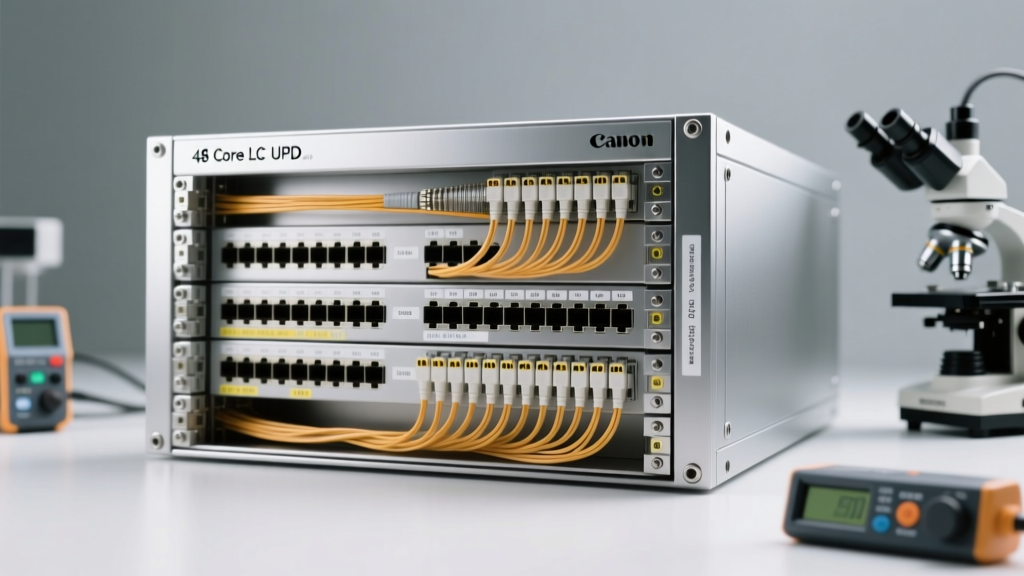
Types of 48-Core LC UPC Optical Distribution Frames (ODF)
A 48-core LC UPC Optical Distribution Frame (ODF) is a high-density fiber optic management system designed to organize, protect, and interconnect multiple fiber optic cables in structured cabling environments. These frames are essential in data centers, telecom hubs, and enterprise networks where efficient fiber routing, splicing, and connectivity are critical for maintaining signal integrity and scalability.
ODFs come in various configurations to meet diverse installation requirements, including space constraints, performance demands, and network topology. Below is a comprehensive overview of the most common types of 48-core LC UPC ODFs and their applications.
Standard ODFs
Standard Optical Distribution Frames are the foundational models used for general-purpose fiber management. Designed with modularity in mind, they typically come in 1U, 2U, or higher rack-mountable units, making them ideal for server rooms and data centers.
Advantages
- Modular design with adjustable splice trays
- Supports up to 48 LC UPC ports for high-density connectivity
- Easy cable routing and labeling for maintenance
- Compatible with standard 19-inch racks
Limitations
- Larger footprint compared to compact models
- May require additional patch panels for complex setups
- Less suitable for tight spaces
Best for: Data centers, central offices, and telecom rooms requiring reliable, scalable fiber management
LC UPC vs. LC APC Compatibility
Understanding the difference between LC UPC (Ultra Physical Contact) and LC APC (Angled Physical Contact) is crucial when selecting an ODF. While this guide focuses on LC UPC, many ODFs are designed to support both connector types.
LC UPC Features
- Flat ferrule polish reduces back reflection (~-50dB)
- Ideal for short to medium-distance transmissions
- Commonly used in LANs, data centers, and enterprise networks
- Blue-colored adapters for easy identification
APC Comparison
- Green-colored adapters indicate APC (angled polish)
- Better performance in long-haul and CATV applications (~-65dB reflection)
- Not interchangeable with UPC without signal loss
Best for: High-speed Ethernet, campus networks, and environments where cost-effective, reliable connections are prioritized
Patch Panel ODFs
Also known as patched ODFs, these frames are optimized for environments requiring frequent reconfiguration. They feature pre-terminated LC UPC ports and dedicated patch cord management zones.
Advantages
- Quick deployment with plug-and-play connectivity
- Supports high-density patching with organized cable trays
- Reduces downtime during network changes
- Integrated strain relief and bend radius protection
Limitations
- Higher initial cost due to pre-termination
- Less flexibility in custom splicing
- Requires careful inventory management of patch cables
Best for: Dynamic data centers, cloud infrastructure, and colocation facilities requiring rapid provisioning
Mini ODFs
Compact alternatives to standard frames, mini ODFs deliver full 48-core LC UPC functionality in a space-saving design. These are ideal for edge computing nodes, remote cabinets, or small server closets.
Advantages
- Space-efficient design (often sub-1U or wall-mountable)
- Maintains full 48-port capacity
- Integrated dust covers and labeling options
- Easy installation in confined areas
Limitations
- Limited room for cable slack storage
- Fewer options for future expansion
- Tighter working space during maintenance
Best for: Remote offices, telecom cabinets, and space-constrained installations needing full-density fiber termination
| Type | Density | Installation Space | Use Case | Connector Type |
|---|---|---|---|---|
| Standard ODF | High (48 LC ports) | 1U–2U Rack | Data Centers, Telecom Rooms | LC UPC (Blue) |
| LC UPC vs. APC | Same Physical Size | Depends on Frame | Network Segmentation | UPC (Blue) / APC (Green) |
| Patch Panel ODF | High + Patch Zones | 1U–2U Rack | Dynamic Networks | LC UPC (Pre-Terminated) |
| Mini ODF | Full 48-Core | <1U or Wall-Mount | Edge Locations, Remote Sites | LC UPC (Compact) |
Expert Tip: When installing LC UPC ODFs, always use dust caps on unused ports and ensure proper fiber bend radius (minimum 30mm) to prevent signal attenuation and long-term damage. For mixed environments, clearly label UPC (blue) and APC (green) ports to avoid mismatched connections.
Specifications & Maintenance of 48-Core LC UPC ODF
Optical Distribution Frames (ODFs) are essential components in modern fiber optic networks, serving as central connection points for routing, managing, and protecting fiber optic cables. The 48-core LC UPC ODF is a high-density solution widely used in data centers, telecommunications hubs, and enterprise networks. Understanding its technical specifications and implementing proper maintenance practices ensures reliable signal transmission, minimizes downtime, and extends equipment lifespan.
Technical Specifications of 48-Core LC UPC ODFs
The performance and reliability of a 48-core LC UPC ODF depend on several key design and engineering factors. Below is a detailed breakdown of the most important specifications that define its functionality and suitability for various applications.
Cable Capacity
The 48-core LC UPC ODF is designed to support up to 48 individual fiber optic strands, making it ideal for medium to high-density network environments. This capacity allows seamless integration with LC UPC connectors, which are known for their precision and low insertion loss.
To accommodate future network expansion, most ODFs include an additional 10%–20% cable management space. This buffer enables technicians to add new connections or reconfigure existing ones without requiring hardware upgrades, supporting scalability and reducing long-term operational costs.
Material and Build Quality
Constructed from high-quality aluminum or cold-rolled steel, the ODF housing provides excellent mechanical strength, corrosion resistance, and electromagnetic shielding. These materials ensure durability while maintaining a lightweight profile for easy installation and handling.
The robust enclosure protects delicate fiber splices and terminations from physical damage, dust, and environmental stress. Removable top and bottom panels allow full access during installation and maintenance, improving serviceability. Additionally, the frame features pre-drilled mounting holes and adjustable depth settings, enabling secure installation in standard 19-inch equipment racks regardless of rack depth or manufacturer.
Adapter Plate Configuration
The 48-core LC UPC ODF typically includes interchangeable adapter plates that support multiple connector types such as LC, SC, ST, and MTP/MPO. However, in its standard LC UPC configuration, the unit contains 12 modular slots, each accommodating 4 LC duplex connectors—totaling 48 ports.
Each adapter slot is precision-machined to ensure smooth fiber insertion and proper alignment, minimizing internal strain on the fiber and reducing the risk of micro-bending losses. Proper selection and installation of adapter plates are critical for maintaining optimal optical performance, including low insertion loss (<0.3 dB) and high return loss (>50 dB), especially in high-speed data transmission environments.
Port Layout and Fiber Management
The ODF is organized into 12 modular sections with 4 ports per module, enabling efficient routing and identification of incoming and outgoing fibers. This structured layout simplifies cable tracing, reduces clutter, and enhances overall network manageability.
Integrated vertical and horizontal fiber management systems—including cable guides, strain relief clamps, and bend radius controllers—help maintain proper fiber curvature and prevent signal degradation due to tight bends. These features also promote airflow within the rack, reducing the risk of overheating and ensuring stable operating conditions for connected equipment.
| Specification | Detail | Benefit |
|---|---|---|
| Fiber Count | 48 cores | Supports medium to high-density fiber networks |
| Connector Type | LC UPC (standard) | Low insertion loss, high repeatability |
| Material | Aluminum or cold-rolled steel | Durable, lightweight, EMI-resistant |
| Mounting | 19-inch rack-mountable | Compatible with standard telecom/data center racks |
| Fiber Protection | Splice trays, strain relief, bend limiters | Prevents breakage and signal loss |
Maintenance Tips for 48-Core LC UPC ODFs
Regular maintenance is crucial to preserving the performance and longevity of fiber optic distribution frames. Even minor issues like dust accumulation or loose connections can lead to significant signal degradation or network outages. The following best practices help ensure optimal operation and minimize service disruptions.
Important: Always follow manufacturer guidelines when installing, cleaning, or repairing fiber optic components. Using improper tools or non-compliant parts can result in permanent fiber damage, increased loss, or safety hazards. Never look directly into fiber ends—invisible laser light can cause eye injury. Regular preventive maintenance not only safeguards network performance but also reduces emergency repair costs and enhances overall system reliability.
Scenarios of 48-Core LC UPC ODF Applications
48-core LC UPC Optical Distribution Frames (ODFs) are essential components in modern fiber optic infrastructure, offering high-density connectivity, efficient cable management, and reliable signal transmission. Designed for scalability and performance, these ODFs support a wide range of applications across industries where fast, stable, and organized fiber networks are critical. Below is a detailed overview of the most common deployment scenarios for 48-core LC UPC ODFs.
Data Centers
Data centers demand high-density, scalable, and easily maintainable fiber infrastructure to support massive data flows from cloud computing, video streaming, AI processing, and enterprise applications. 48-core LC UPC ODFs are ideal in this environment due to their compact design and ability to manage up to 48 fiber connections per unit.
- Supports high-density cabling with minimal space consumption in server rooms and network cabinets
- Enables clean routing and segregation of patch cords, reducing signal interference and physical damage
- Facilitates rapid deployment, reconfiguration, and troubleshooting during upgrades or outages
- LC UPC connectors ensure low insertion loss and high return loss, critical for maintaining signal integrity
- Modular architecture allows seamless scalability as data demands grow
Key Benefit: Reduces downtime and improves network agility in mission-critical data environments.
Telecommunication Networks
Telecom providers rely on robust fiber distribution systems to interconnect central offices, cell towers, and customer premises. The 48-core LC UPC ODF serves as a backbone for splicing, terminating, and distributing fiber links across metropolitan and long-haul networks.
- Acts as a central termination point for feeder and distribution cables in FTTx (Fiber to the x) deployments
- Supports efficient splicing trays and slack storage for long-distance fiber runs
- Provides secure, labeled access points for service activation and maintenance
- High port density reduces rack space and simplifies cable tracing in complex networks
- UPC (Ultra Physical Contact) polish ensures minimal back reflection, enhancing voice and data transmission quality
Operational Advantage: Ensures reliable, high-bandwidth connectivity across expansive telecom infrastructures.
Commercial Buildings
In large office complexes, universities, hospitals, and multi-tenant buildings, structured cabling is vital for delivering internet, VoIP, security systems, and video conferencing. The 48-core LC UPC ODF streamlines fiber management in telecom closets and main distribution frames (MDFs).
- Centralizes fiber connections from different floors or departments into a single, organized unit
- Supports converged networks that carry data, voice, and video over a unified fiber backbone
- Compact design fits easily in tight spaces like communication closets without sacrificing accessibility
- Enables quick provisioning of new workspaces or services with pre-terminated patch panels
- Reduces clutter and accidental disconnections, improving network reliability
Ideal For: Buildings requiring future-proof, scalable, and professionally managed network infrastructure.
Enterprise Networks
Enterprises in finance, healthcare, manufacturing, and government require uninterrupted, secure, and high-speed internal communications. 48-core LC UPC ODFs provide the foundation for resilient enterprise fiber networks that support cloud access, real-time collaboration, and data-intensive operations.
- Manages high volumes of fiber links between servers, switches, and workstations
- Ensures consistent performance with low-loss UPC connectors suitable for sensitive applications
- Facilitates compliance with IT standards and audit requirements through organized cabling
- Supports redundancy and failover configurations for business continuity planning
- Simplifies upgrades and maintenance with labeled ports and easy access to individual fibers
Strategic Value: Enhances network uptime, security, and operational efficiency in mission-critical environments.
Pro Insight: When deploying 48-core LC UPC ODFs, always ensure proper labeling, use color-coded patch cords, and implement documentation protocols. This not only speeds up troubleshooting but also reduces human error during maintenance or expansion. Consider using ODFs with built-in cable management brackets and dust covers to further enhance longevity and performance.
| Application | Key Requirements | ODF Benefits | Typical Use Cases |
|---|---|---|---|
| Data Centers | High density, low latency, scalability | Space efficiency, modular design, low signal loss | Cloud hosting, big data, content delivery |
| Telecom Networks | Long-haul connectivity, splicing support, reliability | Centralized termination, FTTx compatibility, durability | ISP backbones, mobile backhaul, rural broadband |
| Commercial Buildings | Multi-service support, ease of access, space constraints | Compact size, organized routing, quick deployment | Office campuses, hospitals, schools |
| Enterprise Networks | Security, uptime, future expansion | Structured cabling, easy maintenance, high performance | Corporate HQs, financial institutions, government |
Additional Considerations for ODF Deployment
- Cable Management: Use integrated spools and strain relief features to prevent bending beyond the minimum radius and avoid signal degradation.
- Environmental Protection: In harsh environments, choose ODFs with dust and moisture resistance for long-term reliability.
- Polarity Management: Ensure proper fiber polarity (A-B or A-A) is maintained, especially in duplex LC configurations, to avoid connectivity issues.
- Future-Proofing: Select ODFs with extra ports or expansion slots to accommodate future network growth without hardware replacement.
- Standards Compliance: Verify that ODFs meet TIA/EIA-568 or ISO/IEC 11801 standards for structured cabling systems.
How to Choose the Right 48-Core LC UPC ODF for Your Network
Selecting the appropriate 48-core LC UPC Optical Distribution Frame (ODF) is a critical decision in building a reliable, scalable, and efficient fiber optic infrastructure. ODFs serve as central hubs for managing, protecting, and interconnecting fiber optic cables in data centers, telecommunications networks, enterprise campuses, and service provider environments. A well-chosen ODF ensures optimal signal integrity, simplifies maintenance, and supports future network growth. This guide outlines the key factors to consider when choosing a 48-core LC UPC ODF to meet your specific operational and technical requirements.
Technical Note: LC UPC (Lucent Connector with Ultra Physical Contact) connectors are widely used in high-performance networks due to their small form factor, low insertion loss, and excellent return loss characteristics. When selecting an ODF, ensure compatibility with LC UPC pigtails, patch cords, and splice trays to maintain signal quality across the network.
Key Factors in Selecting a 48-Core LC UPC ODF
- Application Requirements
The intended use of the ODF plays a decisive role in selection. Different environments demand different performance and design features:
- Data Centers: High-density 48-core ODFs are ideal for data centers where space efficiency and massive connectivity are priorities. Look for models with front-access splicing, rear cable routing, and support for high-speed protocols like 10G, 40G, or 100G Ethernet.
- Telecom Networks: In carrier or metro networks, ODFs must support extensive splicing, long-haul connections, and redundancy. Choose frames with robust splice tray capacity, grounding provisions, and compatibility with outside plant (OSP) cables.
- Enterprise Networks: For office buildings or campus environments, prioritize ease of installation and user-friendly cable management. Modular designs with labeled ports enhance troubleshooting and reduce downtime.
Understanding your network’s traffic load, connectivity needs, and environmental conditions ensures you select an ODF that delivers reliable performance over time.
- Space Limitations and Form Factor
Physical installation space directly impacts ODF selection. Standard rack-mounted ODFs come in various heights, typically measured in rack units (U):
- 1U ODFs: Ideal for compact installations where rack space is limited. These are commonly used in edge locations or small server rooms.
- 2U ODFs: Offer more room for splice trays, slack storage, and cable bends, making them suitable for high-fiber-count applications.
- Mini ODFs: Designed for tight spaces such as telecom closets or remote cabinets. While space-efficient, they may have reduced splice capacity or require careful cable routing.
Always measure available rack space and consider future expansion when choosing the form factor. Proper airflow and bend radius clearance should also be factored in to prevent fiber damage.
- Scalability and Future Expansion
Networks evolve, and your ODF should be able to grow with them. Consider the following for long-term scalability:
- Select ODFs with higher port density than currently needed to accommodate future connections.
- Choose modular frames that allow the addition of adapter panels, splice trays, or blanking plates as needed.
- Ensure compatibility with higher-core-count cables or MPO/MTP trunking for potential upgrades.
- Look for ODFs with labeling systems and color-coded ports to simplify future expansions and reduce configuration errors.
Investing in a scalable ODF reduces the need for costly replacements and minimizes service disruptions during network upgrades.
- Ease of Use and Maintenance
An ODF that is easy to access and maintain improves operational efficiency and reduces downtime. Key design features to look for include:
- Removable Panels: Allow full access to splice trays and terminations without disassembling the entire unit.
- Tool-less Design: Enables quick installation and reconfiguration of adapter modules or covers.
- Cable Management: Integrated strain relief, routing brackets, and slack storage prevent fiber stress and bending beyond minimum bend radius.
- Labeling Options: Clear, customizable port labels help technicians identify circuits quickly during troubleshooting or moves, adds, and changes (MACs).
A well-designed ODF reduces installation time and enhances long-term serviceability, especially in high-traffic environments.
- Budget Considerations
While cost is always a factor, it should be balanced against long-term value. Consider the following:
- Entry-Level ODFs: May offer basic functionality at a lower price but could lack durability, scalability, or advanced features.
- Premium ODFs: Often include superior materials, better cable management, enhanced protection, and longer warranties—justifying a higher upfront cost.
- Total Cost of Ownership (TCO): A higher-quality ODF may cost more initially but can save money over time through reduced maintenance, fewer failures, and easier upgrades.
Always evaluate the ODF within the context of your overall network lifecycle. Choosing a durable, well-supported product often proves more economical in the long run.
| Selection Factor | Recommended Features | Common Trade-offs | Ideal Use Cases |
|---|---|---|---|
| Application Requirements | High-density ports, splice tray support, LC UPC compatibility | Higher cost for advanced features | Data centers, telecom hubs |
| Space Limitations | 1U/2U form factor, mini ODF options, compact design | Limited splice capacity in smaller units | Server rooms, telecom closets |
| Scalability | Modular panels, extra adapter space, labeling system | Requires planning and potential over-provisioning | Growing enterprises, cloud providers |
| Ease of Maintenance | Removable covers, tool-less access, cable guides | Slightly larger footprint | High-availability networks |
| Budget | Durable materials, warranty, vendor support | Higher initial investment | Long-term deployments |
Expert Tip: Before finalizing your ODF selection, request a sample unit or installation demo from the vendor. This allows you to evaluate build quality, ease of splicing, and cable management in real-world conditions, ensuring compatibility with your team’s workflows and tools.
Additional Recommendations
- Verify that the ODF is compatible with your existing patch panels, enclosures, and fiber types (e.g., OM3/OM4 for multimode, OS2 for single-mode).
- Check for certifications such as RoHS, CE, or Telcordia GR-3120 to ensure compliance with industry standards.
- Consider environmental factors like dust, humidity, and temperature—especially in outdoor or industrial settings.
- Choose ODFs from reputable manufacturers with strong technical support and warranty policies.
- Document fiber assignments and maintain an updated patch panel map for efficient network management.
Selecting the right 48-core LC UPC ODF is more than just matching port counts—it’s about ensuring reliability, scalability, and ease of management in your fiber infrastructure. By carefully evaluating application needs, space constraints, future growth, usability, and budget, you can make an informed decision that supports both current operations and long-term network evolution. When in doubt, consult with a fiber optic specialist or system integrator to validate your choice based on your specific deployment scenario.
Frequently Asked Questions About Optical Distribution Frames (ODF)
Q1: What is the meaning of ODF in the telecommunications world?An ODF, or Optical Distribution Frame, is a critical infrastructure component used in fiber optic communication systems. It serves as a centralized termination point for managing, organizing, and interconnecting fiber optic cables in large-scale installations such as data centers, telecom exchanges, and enterprise networks.
Key functions of an ODF include:
- Cable Termination: Provides secure termination points for incoming and outgoing fiber optic cables.
- Splice Management: Houses fiber splicing trays to protect and organize fusion or mechanical splices.
- Connection Flexibility: Enables easy cross-connections using patch panels and adapters (e.g., LC, SC).
- Protection: Shields delicate optical fibers from environmental damage, bending, and physical stress.
- Maintenance Access: Facilitates quick identification, testing, and troubleshooting of individual fibers.
By ensuring structured cable management, ODFs significantly improve network reliability, reduce signal attenuation, and streamline upgrades—making them indispensable in modern high-speed optical networks.
Q2: What is the difference between ODF and MDF?While both the ODF (Optical Distribution Frame) and the MDF (Main Distribution Frame) serve as central connection hubs in telecommunications, they differ fundamentally in the type of cabling and technology they support:
| Feature | ODF (Optical Distribution Frame) | MDF (Main Distribution Frame) |
|---|---|---|
| Cable Type | Fiber optic cables (glass/plastic fibers) | Copper cables (twisted pair, coaxial) |
| Signal Type | Light-based (optical signals) | Electrical signals |
| Bandwidth Capacity | High (Gbps to Tbps range) | Limited (up to 10 Gbps with advanced copper) |
| Applications | Data centers, FTTH, 5G backhaul, long-haul networks | Traditional telephone systems, legacy LANs |
| Distance Efficiency | Long-distance with minimal loss | Shorter distances; signal degrades over length |
| Interference Resistance | Immune to EMI/RFI | Vulnerable to electromagnetic interference |
In modern infrastructure, ODFs are increasingly replacing MDFs in core networks due to the superior speed, scalability, and future-readiness of fiber optics. However, MDFs still play a role in maintaining older copper-based telephony systems and hybrid environments.
Q3: Why is an ODF important for a fiber optic network?The Optical Distribution Frame is a cornerstone of efficient and reliable fiber optic network design. Its importance stems from several key benefits:
- Structured Organization: Prevents cable tangling and ensures logical routing, making it easier to trace and manage hundreds or thousands of fiber strands.
- Signal Integrity: Proper bending radius control and strain relief minimize micro-bends and macro-bends, reducing insertion loss and back reflection.
- Scalability: Modular designs allow for incremental expansion without disrupting existing connections.
- Durability: Protects splices and terminations from dust, moisture, and accidental damage, extending the lifespan of the network.
- Operational Efficiency: Simplifies testing, reconfiguration, and fault isolation during maintenance or service changes.
- Space Optimization: High-density configurations save valuable rack or cabinet space in data centers and telecom rooms.
Without an ODF, fiber networks would be prone to disorganization, higher failure rates, longer downtime, and increased operational costs—making the ODF essential for professional-grade deployments.
Q4: Can the 48-core LC UPC ODF handle future expansions?Yes, a 48-core LC UPC ODF is specifically engineered to support both current demands and future network growth. Here’s how it ensures scalability:
- High-Density Design: Accommodates 48 individual fiber cores using LC connectors, which are half the size of SC connectors, maximizing port density in limited space.
- Modular Architecture: Most ODFs feature removable cassettes or trays that can be upgraded or replaced to support higher fiber counts or different connector types (e.g., APC instead of UPC).
- Expansion Slots: Many units include预留 (预留 means预留 space) for additional modules, allowing seamless integration of more fibers as needed.
- Backward and Forward Compatibility: UPC (Ultra Physical Contact) polish ensures low insertion loss and high return loss, compatible with most existing systems while supporting migration to next-gen technologies.
- Future-Proofing: Designed to integrate with wavelength division multiplexing (WDM), passive optical networks (PON), and 100G/400G Ethernet standards.
This makes the 48-core LC UPC ODF ideal for rapidly expanding environments such as cloud data centers, smart cities, and enterprise campuses where bandwidth demands grow continuously. With proper planning, a single ODF unit can evolve alongside your network for years to come.