When you're deep in the backcountry with no access to electricity, keeping your devices charged can mean the difference between staying connected and being stranded without navigation or emergency communication. Power banks are essential gear for modern campers, but choosing between a solar power bank and a standard model isn’t always straightforward. While solar models promise endless recharging under sunlight, real-world conditions often fall short of expectations. Understanding the trade-offs—capacity, weight, charging speed, reliability, and environmental factors—is critical for making an informed decision.
This article dives into the practical realities of using solar versus standard power banks while camping. We’ll explore how each performs in different scenarios, break down their strengths and limitations, and provide clear guidance on when a solar option makes sense—and when it’s better to stick with a conventional battery pack.
How Solar and Standard Power Banks Work
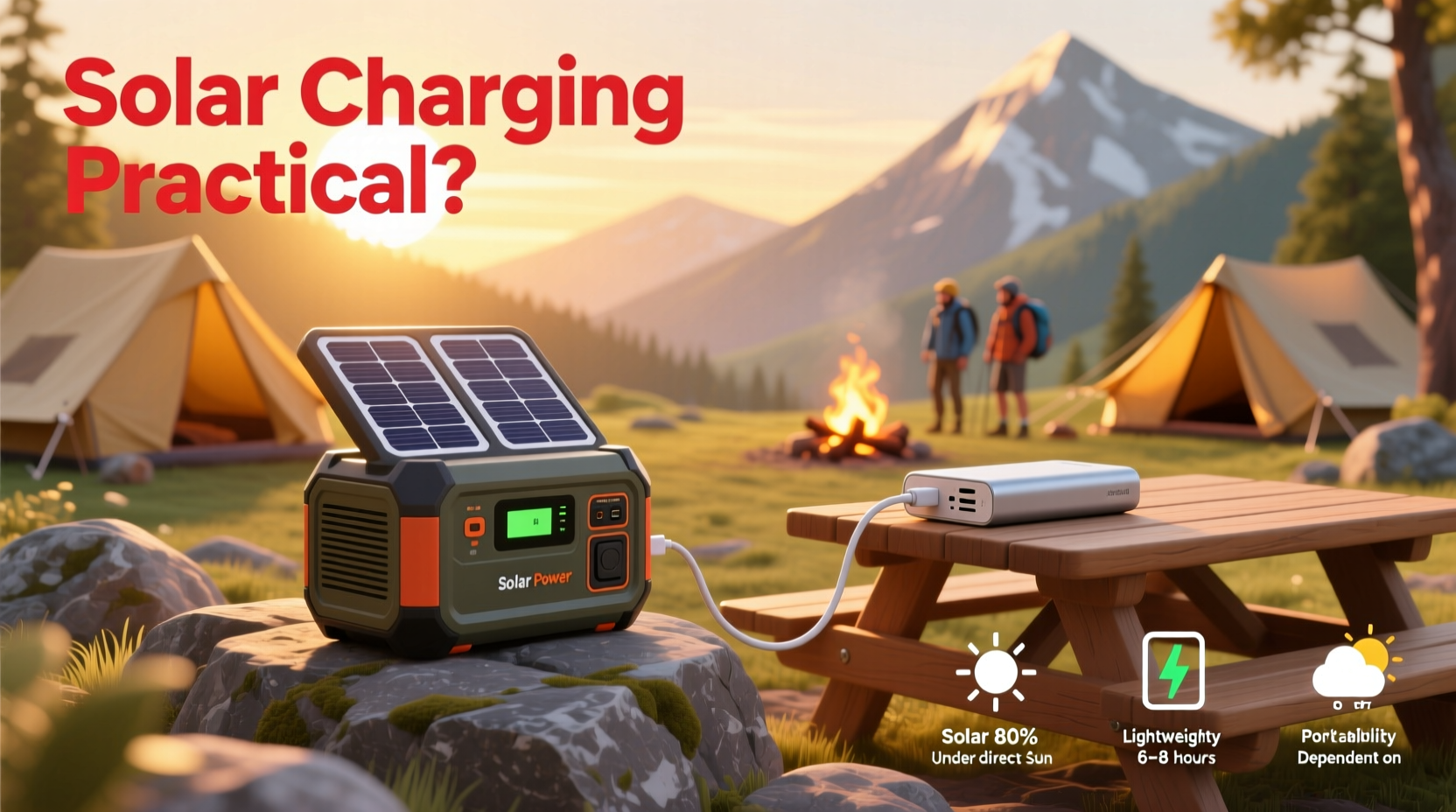
A standard power bank stores electrical energy in an internal lithium-ion or lithium-polymer battery. You charge it via a wall outlet, car USB port, or laptop before your trip, and then use that stored energy to recharge phones, GPS units, headlamps, or other small electronics in the field. Its capacity is measured in milliampere-hours (mAh) or watt-hours (Wh), and efficiency depends largely on build quality and circuitry.
Solar power banks integrate one or more photovoltaic panels directly into the device or attach them via a foldable panel system. These convert sunlight into electricity to either charge the internal battery or power devices directly. Most solar models still require some pre-charging before departure and rely heavily on ideal lighting conditions to generate meaningful power.
The key distinction lies in reusability during extended trips. A standard power bank offers predictable output but finite energy. Once drained, it stays dead until you return to civilization. A solar model, in theory, allows indefinite recharging—as long as the sun shines.
Performance Comparison: Real-World Charging Scenarios
To evaluate practicality, consider three common camping situations:
- Weekend car camping: Access to vehicle, moderate sun exposure.
- Backpacking over 5–7 days: Carrying all gear, limited space and weight tolerance.
- Remote expedition (10+ days): No resupply, unpredictable weather, off-grid travel.
In weekend scenarios, a high-capacity standard power bank (e.g., 20,000 mAh) fully charged at home typically suffices. Solar functionality adds little value unless multiple devices are used heavily. For multi-week treks through variable climates, however, even large-capacity batteries may run out. That’s where solar could theoretically shine—but only if conditions allow consistent sun exposure.
Tip: Always assume solar input will be 30–50% less than manufacturer claims due to angle, cloud cover, and temperature.Charging Speed: Sunlight vs Wall Outlet
Most solar power banks feature 5W to 10W solar panels. Under perfect laboratory conditions (direct midday sun, optimal panel angle), a 10W panel might deliver full recharge in 10–12 hours. In reality, moving shadows, indirect light, dust, and suboptimal positioning reduce actual output significantly.
Compare this to a standard power bank charged via a 18W USB-C PD wall charger: a full recharge takes 2–3 hours. Even with solar advantage, you’d need nearly two full sunny days to match one hour at home.
“Solar charging works best as a trickle top-up, not a primary source. Expecting it to fully recharge a depleted battery daily is unrealistic in most outdoor environments.” — Dr. Lena Torres, Renewable Energy Researcher at Mountain Ridge Institute
Key Differences: Solar vs Standard Power Banks
| Feature | Solar Power Bank | Standard Power Bank |
|---|---|---|
| Battery Capacity | Often lower (5,000–15,000 mAh) due to added solar components | Higher range available (up to 30,000+ mAh) |
| Recharge Method | Sunlight + USB | USB only |
| Recharge Time (Sun) | 8–20+ hours depending on conditions | N/A |
| Weight & Bulk | Heavier due to rigid/foldable panels | Compact and lightweight options widely available |
| Durability | Panels vulnerable to cracking, moisture, sand | Generally rugged; many waterproof models exist |
| Camping Use Case | Best for long trips with reliable sun | Ideal for short to medium trips |
| Cost | Typically 20–50% more expensive | Wider price range, including budget options |
When Solar Charging Is Practical: A Step-by-Step Guide
Solar power banks aren't universally impractical—they just require strategic planning. Follow this timeline to determine whether solar suits your next adventure:
- Assess Trip Duration: If camping longer than 5 days without access to electricity, solar becomes more viable.
- Evaluate Sun Exposure: Are you traveling in open terrain (desert, alpine zones) or dense forest? Clear skies increase solar potential.
- Calculate Device Needs: Estimate total daily power draw. Example: Phone (3,000 mAh), GPS (2,000 mAh), headlamp (1,000 mAh) = ~6,000 mAh/day.
- Select Appropriate Capacity: Choose a solar power bank with at least double your daily usage to account for inefficiency.
- Plan Charging Routine: Hang the unit in direct sun during hikes or set it outside the tent during rest breaks. Avoid placing inside backpacks or shaded areas.
- Carry Backup Option: Bring a secondary standard power bank or hand-crank charger for emergencies.
Even under favorable conditions, solar should be treated as a supplemental source—not a replacement for proper preparation.
Real Example: Backpacking Through the Sierra Nevada
Riley, an experienced hiker, planned a 9-day trek through California’s High Sierra. With spotty cell service and reliance on offline maps, maintaining phone charge was crucial. She brought a 12,000 mAh solar power bank with dual 8W panels, expecting full recharges each day.
Days 1–3 were sunny and productive. By hanging the unit from her pack during morning hikes, she gained about 40% charge per day—enough to offset half her phone’s drain. On day 4, clouds rolled in, reducing solar input to under 10%. By day 6, rain persisted, and the battery dropped below 15%. Fortunately, Riley had packed a compact 5,000 mAh backup bank, which allowed her to send an emergency check-in message when she lost trail markers.
Her takeaway: “Solar helped extend my power window, but I couldn’t have completed the trip without a traditional bank as insurance.”
Common Pitfalls and How to Avoid Them
Many campers overestimate solar performance based on marketing claims. Here are frequent mistakes and how to avoid them:
- Mistake: Relying solely on solar – Never depend on sunlight alone. Weather changes fast in wilderness areas.
- Mistake: Poor panel orientation – Panels must face the sun directly. Tilting or covering them cuts efficiency by up to 70%.
- Mistake: Using low-quality models – Cheap solar banks often have inefficient cells and poor battery management systems.
- Mistake: Ignoring temperature effects – Lithium batteries lose efficiency below 50°F (10°C). Cold nights reduce usable capacity.
Checklist: Choosing the Right Power Bank for Camping
Use this checklist to select the best option for your needs:
- ✅ Determine total device power requirements (sum of mAh used per day)
- ✅ Decide trip length: <5 days → standard bank; >5 days → consider solar
- ✅ Check expected weather and terrain (sun exposure likelihood)
- ✅ Prioritize weight limits: Solar units add 200–500g extra
- ✅ Look for USB-C PD input/output for faster charging
- ✅ Verify water resistance rating (IP67 recommended)
- ✅ Read independent reviews focusing on real-world solar performance
- ✅ Pack a backup charging method regardless of choice
Frequently Asked Questions
Can a solar power bank charge my phone directly in sunlight?
Yes, most models can charge devices directly, but it's inefficient. Direct charging only works when the sun is strong and consistent. It’s better to store energy in the power bank first, then use it to charge your phone when needed.
Do solar power banks work on cloudy days?
They generate some power under overcast skies—typically 10–25% of rated output—but shouldn’t be relied upon. Thin clouds allow partial transmission; thick storm fronts block nearly all UV radiation needed for conversion.
Are solar power banks worth the extra cost?
Only if you frequently undertake extended trips in sunny environments. For casual or short-duration camping, the added expense and bulk outweigh benefits. However, for thru-hikers, expedition travelers, or off-grid adventurers, they offer valuable redundancy.
Hybrid Strategy: Best of Both Worlds
The smartest approach combines both technologies. Carry a high-capacity standard power bank as your primary source and supplement it with a portable solar panel (not integrated) that can recharge the bank during daylight hours.
Advantages include:
- Lighter weight: Detachable panels can be packed flat and used only when needed.
- Better efficiency: Larger external panels capture more sunlight than built-in ones.
- Flexibility: Position the panel optimally while keeping the power bank protected.
- Durability: No fragile solar cells bonded to the battery casing.
For example, pairing a 20,000 mAh Anker power bank with a 15W folding solar panel gives greater total capacity and faster solar input than any all-in-one unit, while remaining modular and repairable.
“The future of outdoor power isn’t choosing between solar and standard—it’s integrating them intelligently. Modular systems give users control and resilience.” — Mark Chen, Outdoor Tech Analyst at TrailGear Review
Conclusion: Making the Right Choice for Your Adventure
The debate between solar and standard power banks ultimately comes down to context. For most weekend campers, festival-goers, or those within reach of occasional outlets, a high-quality standard power bank remains the simplest, most reliable solution. It delivers predictable performance, fits easily in a pocket, and charges quickly at home.
Solar power banks serve a niche but important role: enabling longer off-grid journeys where resupply isn’t possible and sunlight is abundant. They’re not magic solutions, nor do they eliminate the need for careful energy management. But when used wisely—as part of a layered strategy—they can extend your digital lifeline in remote areas.
Instead of viewing solar as a standalone fix, treat it as a risk mitigation tool. Pair it with conservative usage habits, efficient devices, and backup plans. Whether you choose solar, standard, or a hybrid setup, the goal is the same: staying powered when it matters most.
🚀 Ready to upgrade your camping power setup? Start by auditing your current device usage, then test a solar option on a local hike before trusting it in the wild. Share your experiences and help others find the right balance between innovation and reliability.








