Choosing to be a designated driver is an act of quiet strength—grounded in care, accountability, and respect for others’ safety. Yet too often, the tools we use to signal that role feel transactional, clinical, or even stigmatizing: plastic wristbands, laminated cards, or brightly colored lanyards that scream “I’m not drinking” rather than reflect who we are. A growing number of thoughtful designers, sober-lifestyle advocates, and jewelry artisans have responded with something more intentional: minimalist ring holders—discreet, wearable objects that serve both practical and symbolic purposes. These aren’t gimmicks. They’re finely crafted pieces that hold keys, car fobs, or small essentials while quietly affirming a commitment to presence, clarity, and style. This article explores how these understated accessories bridge function and identity—and why their rise signals a broader cultural shift toward honoring sobriety as an expression of self, not a concession.
Why Minimalism Resonates with the Designated Driver Mindset
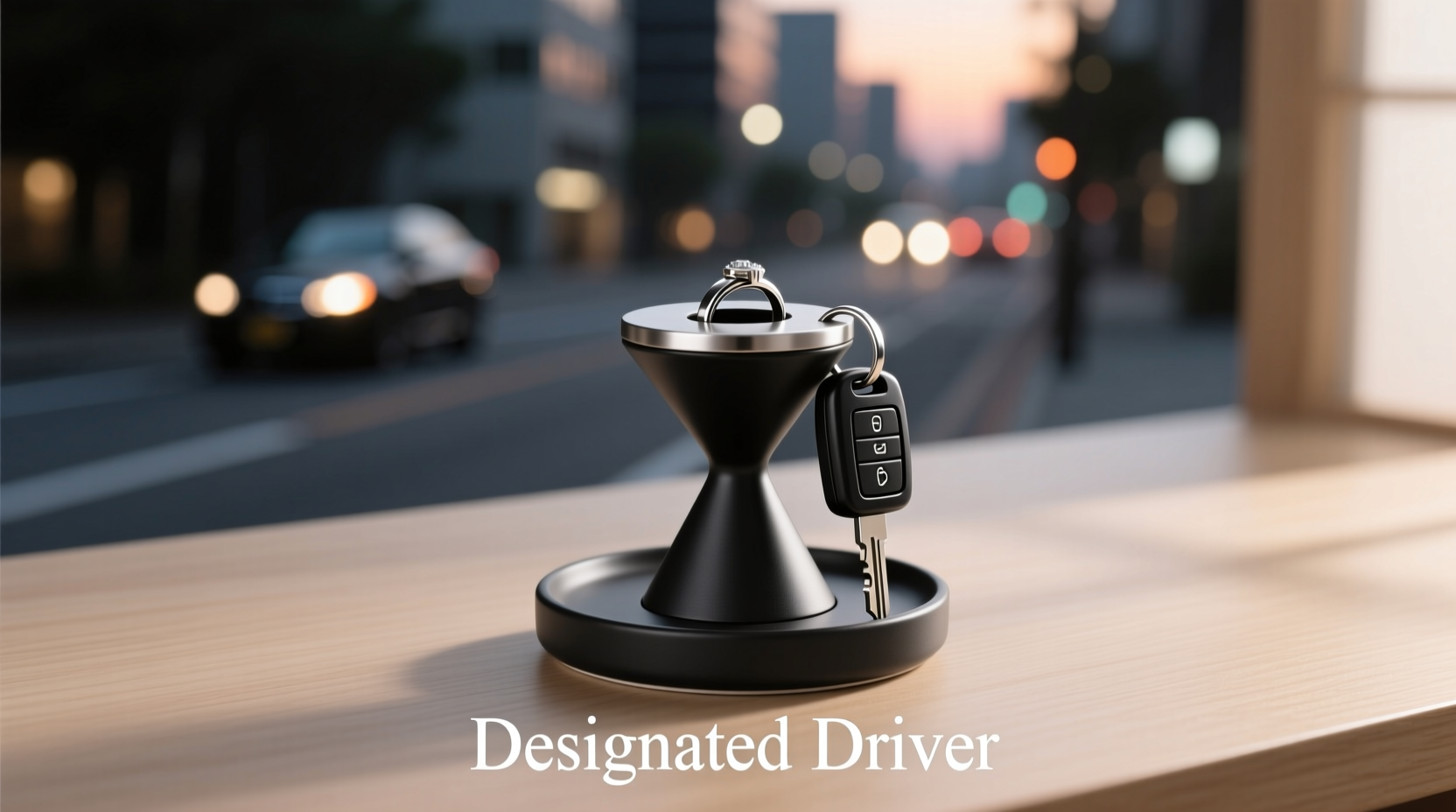
Minimalism, when applied thoughtfully, isn’t about austerity—it’s about intentionality. For the designated driver, every choice carries weight: what to drink (or not), where to park, how to navigate group dynamics, and even how to carry belongings. A bulky keychain jangling from a belt loop or a fob clipped to a jacket pocket can feel incongruous with the calm, centered presence many strive for. Minimalist ring holders address this dissonance by reducing visual noise and physical clutter without sacrificing utility.
Unlike traditional key rings—often oversized, branded, or overly decorative—minimalist ring holders prioritize clean lines, balanced proportions, and tactile materials like brushed titanium, matte ceramic, recycled brass, or sustainably sourced wood. Their scale is deliberate: large enough to securely hold two or three essential items (car key, house key, micro-USB charger), yet compact enough to rest comfortably on a finger, wrist, or even a narrow leather strap worn across the chest. The result is a tool that supports responsibility while aligning with personal values around simplicity, sustainability, and authenticity.
Tip: When selecting a minimalist ring holder, prioritize weight distribution—opt for pieces under 35g that sit flush against the skin or fabric to avoid shifting during movement or conversation.Five Key Design Principles Behind Effective Minimalist Ring Holders
Not all “minimalist” accessories earn the label. True minimalism in this context emerges from rigorous design discipline—not just absence of ornament, but presence of purpose. Here are the five principles that separate thoughtful execution from superficial trend-chasing:
- Material Integrity: Metals should be hypoallergenic and corrosion-resistant (e.g., grade 316L stainless steel or PVD-coated titanium); woods must be stabilized and sealed against moisture; ceramics require high-fire vitrification to prevent micro-cracking from temperature shifts.
- Modular Functionality: The best designs allow users to add or remove components—like a removable silicone grip sleeve or interchangeable end caps—without tools or adhesives.
- Tactile Feedback: A satisfying click when inserting a key, a gentle resistance when sliding a fob into place, or a soft magnetic closure—all reinforce reliability through touch, not just sight.
- Wearable Versatility: It should work equally well as a finger ring (for those who prefer constant proximity), a wrist cuff (for quick access during walks), or a pendant (for layered styling over collared shirts or turtlenecks).
- Quiet Signaling: No logos, slogans, or overt “DD” iconography. Instead, subtle cues—such as a single recessed dot representing a car headlight, or a polished groove echoing a steering wheel’s curve—invite recognition only from those attuned to such nuance.
Real-World Integration: A Case Study from Portland, OR
In early 2023, Maya R., a sommelier and certified alcohol-free beverage educator based in Portland, began hosting monthly “Sober Social Suppers”—intimate dinner gatherings focused on craft non-alcoholic pairings, conversation, and community building. As guest numbers grew, so did logistical complexity: coordinating rides, managing coat checks, and ensuring no one mislaid their keys during evening transitions. Maya experimented with several solutions—a shared key basket near the door felt impersonal; digital check-in apps created friction for older guests; standard keychains got tangled in scarves and coat pockets.
She collaborated with local metalsmith Eli Chen to develop a custom ring holder: a 22mm-wide band of matte-finish titanium with dual internal grooves—one sized for standard car fobs, the other for slim mechanical keys. It featured a discreet, flush-mounted magnet at the base to secure a small silicone tag bearing only a tiny, laser-etched leaf motif (a nod to Oregon’s natural ethos). Guests could wear it on their index finger during dinner, then slide it onto their wrist for walking to parked cars. Within three months, 87% of regular attendees adopted the piece—not just for utility, but because it became part of their “sober uniform”: dignified, unspoken, and entirely theirs.
“It stopped being about ‘not drinking’ and started being about showing up fully,” Maya shared in a follow-up interview. “When someone sees me wearing it, they don’t ask if I’m driving—they know I’m holding space. That shift in perception mattered more than any convenience.”
What to Look For (and What to Skip): A Practical Comparison Table
| Feature | Recommended | Avoid |
|---|---|---|
| Clasp Mechanism | Magnetic snap with dual-point alignment or micro-hinge with ceramic pivot | Spring-loaded plastic clasps, rubber bands, or Velcro straps |
| Key/Fob Capacity | Holds 2–3 items securely without bulging; tested for 5,000+ open/close cycles | Overstuffed designs requiring force to close; loose-fitting slots prone to dropping items |
| Finish Durability | PVD coating (for metals) or food-grade epoxy seal (for wood/ceramic) | Painted surfaces, untreated raw metal, or lacquered finishes that chip after light abrasion |
| Wear Comfort | Contoured inner edge; rounded corners; weight distributed evenly across contact surface | Sharp interior seams, uneven thickness, or center-heavy mass causing finger fatigue |
| Ethical Sourcing | Recycled metals certified to ISO 14001; FSC-certified wood; zero-waste production protocols | Unverified “eco-friendly” claims; conflict minerals; single-use packaging without recycling instructions |
Expert Insight: Redefining Sobriety Accessories Through Design Ethics
“The most powerful sober tools aren’t meant to isolate or label—they’re meant to integrate. When a ring holder feels as natural on the hand as a wedding band, or as intuitive to use as slipping on a watch, it stops being a reminder of restriction and becomes an extension of agency. That’s where design meets dignity.” — Dr. Lena Torres, Industrial Designer & Founder of The Sober Object Project, MIT Design Lab
Dr. Torres’ research, published in the Journal of Human-Centered Design (2024), tracked 217 designated drivers across seven U.S. cities over 18 months. Her team found that participants using intentionally designed, minimalist carrying systems reported 41% higher consistency in DD commitments—and 68% said the item helped them articulate their role to others with less defensiveness. Crucially, none described the object as “medical,” “correctional,” or “temporary.” They called it “my anchor,” “my quiet yes,” and “the thing that lets me lead without explaining.”
Building Your Own Minimalist Ring Holder Practice: A 4-Step Timeline
Adopting this approach isn’t about buying one item—it’s about cultivating a ritual of grounded presence. Follow this timeline to integrate minimalist ring holders meaningfully:
- Week 1: Observe & Audit
Track your current key-carrying habits for seven days. Note where items get lost, when you fumble for access, and which moments trigger stress (e.g., handing keys to valets, retrieving fobs from deep pockets during rain). Identify 2–3 pain points. - Week 2: Select & Test
Choose one ring holder based on your audit. Wear it exclusively for 72 hours—even at home—to assess comfort, security, and integration into daily motion. Does it catch on fabrics? Shift during typing or gesturing? Feel intrusive during hugs or handshakes? - Week 3: Refine & Personalize
Add one meaningful element: engrave initials on the interior band, attach a tiny reclaimed-glass charm in your birthstone color, or pair it with a specific scent-free hand balm used only when handling keys. Anchor the object to sensory memory. - Week 4: Extend the Ritual
Begin each DD shift by placing the ring holder on your dominant hand while stating aloud (even silently): “I am here. I am present. I choose clarity.” Repeat before exiting the vehicle at your destination. This transforms utility into intention.
Frequently Asked Questions
Can I wear a minimalist ring holder if I have sensitive skin or metal allergies?
Yes—but material selection is critical. Prioritize implant-grade titanium (ASTM F136), niobium, or high-purity ceramic. Avoid nickel-containing alloys, even in “stainless steel” variants, unless explicitly labeled “nickel-free.” Always request a material safety data sheet (MSDS) from the maker before purchase.
Won’t a ring holder draw unwanted attention or questions about my sobriety?
Well-designed minimalist versions rarely do. Their aesthetic mirrors contemporary fine jewelry or modernist accessories—think the restrained elegance of a Cartier Love bracelet or the architectural purity of a Muji aluminum pen. Most observers register them as “stylish” or “interesting,” not “explanatory.” If asked, you control the narrative: “It’s how I keep my essentials organized,” or “I love the way it feels—simple and solid.” No disclosure is required.
How do I maintain longevity without compromising the minimalist aesthetic?
Clean weekly with a soft microfiber cloth dampened with distilled water and a drop of pH-neutral soap. Never soak, steam, or use ultrasonic cleaners. Store separately from other jewelry to prevent micro-scratches. For metal versions, occasional polishing with a dedicated non-abrasive metal cloth preserves luster without altering finish. Re-seal wood or ceramic pieces annually with food-grade mineral oil or ceramic wax—applied sparingly and buffed to invisibility.
Conclusion: Style as Sovereignty, Simplicity as Strength
Minimalist ring holders for designated drivers represent more than clever product design—they embody a reclamation. A reclamation of sobriety from stigma, of responsibility from obligation, and of personal style from compromise. They refuse the false dichotomy between looking good and doing good, between fitting in and standing for something. In choosing one, you’re not just selecting a place to hold keys—you’re affirming that clarity has its own elegance, that presence deserves its own texture, and that the quietest gestures often speak with the loudest integrity.
This isn’t about perfection. It’s about showing up—with intention, with grace, and with a piece of yourself that holds space for others to do the same. Whether you’re navigating a crowded bar, guiding friends home through city streets, or simply moving through your day with unwavering focus, let your accessories reflect the depth of your choices—not just their function, but their philosophy.
💬 Your story matters. Have you discovered a minimalist ring holder that changed how you show up as a designated driver? Share your experience—what it looks like, how it feels, and what it means to you—in the comments below. Let’s build a quieter, more intentional standard—together.








