
The Negroni is a rite of passage—a drink that announces your arrival into the world of serious cocktails. Its equal-parts structure—gin, sweet vermouth, and a bitter aperitif—is deceptively simple, yet profoundly revealing. For newcomers, the third component is often the steepest learning curve. Aperol and Campari are both Italian red aperitifs, both used in Negronis, and both proudly bitter—but they occupy opposite ends of the same spectrum. One invites with citrus and herbs; the other commands attention with medicinal intensity. Choosing between them isn’t just about preference—it’s about understanding how bitterness functions in balance, how palate sensitivity evolves, and why “approachable” doesn’t mean “watered down.” This isn’t a debate over which is “better.” It’s a guided tasting of philosophy in a glass.
Origins & Identity: Why These Two Aren’t Interchangeable
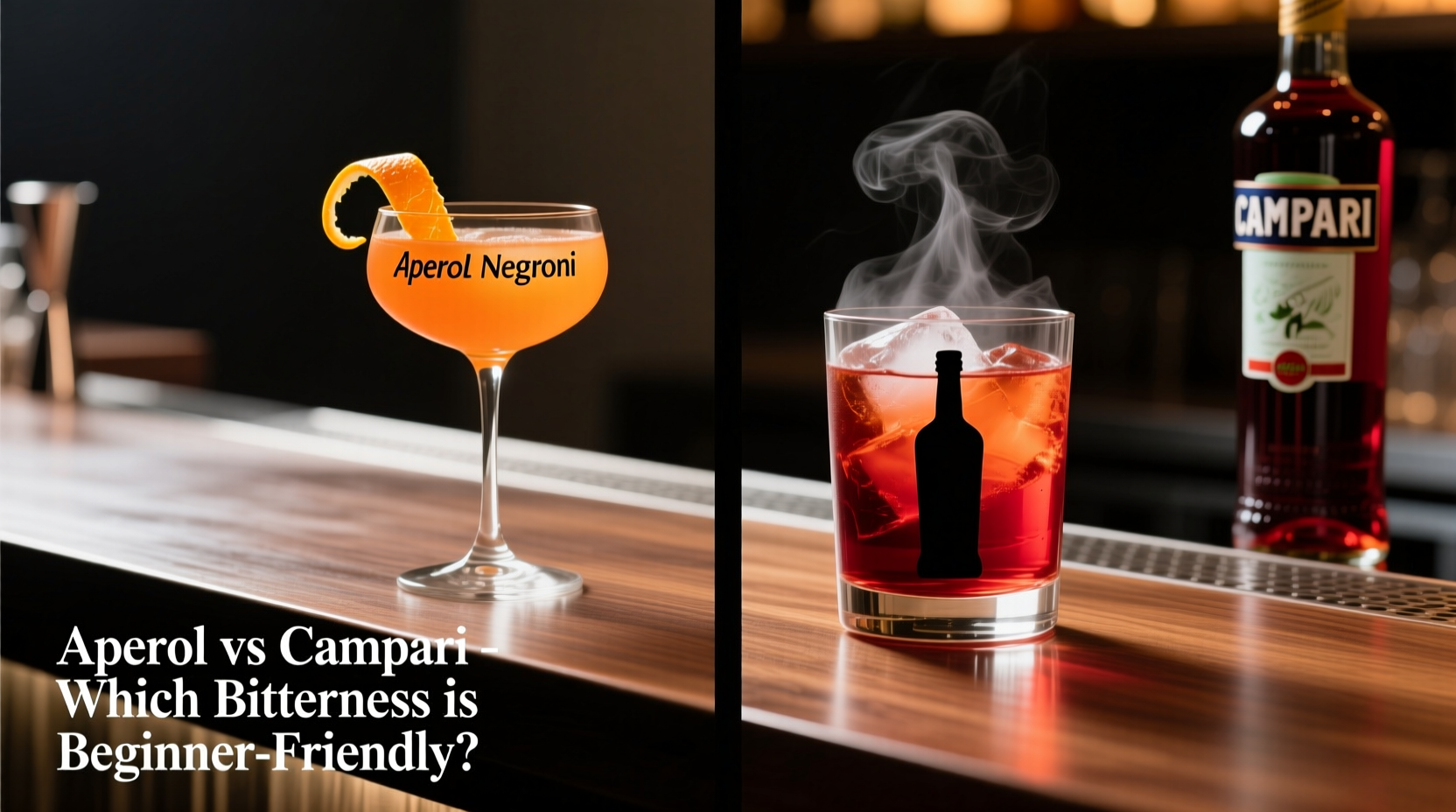
Aperol and Campari share geography and category—but little else. Campari was born in 1860 in Novara, Italy, formulated by Gaspare Campari as a proprietary blend of over 60 botanicals, including chinotto (bitter orange), rhubarb, gentian, and quinine. Its deep crimson hue comes from carmine dye (derived from cochineal insects), and its ABV sits at 28.5%. The flavor is unapologetically assertive: sharp grapefruit pith, burnt sugar, clove, and a lingering, tannic finish that coats the tongue like fine-grained sandpaper.
Aperol entered the scene in 1919—nearly six decades later—and was conceived as Campari’s gentler counterpart. Created by the Barbieri brothers in Padua, it uses fewer botanicals (around 30), emphasizes sweet orange peel and gentian root, and includes hints of rhubarb and cinchona bark—but in much lower concentrations. Its ABV is just 11%, less than half of Campari’s. Visually, it’s a translucent tangerine, not a blood-red. Its bitterness registers early but recedes quickly, giving way to bright citrus, light herbal sweetness, and a clean, almost effervescent finish—even without carbonation.
This divergence isn’t accidental. Campari was designed for seasoned palates and digestive resilience. Aperol was engineered for mass appeal—especially post-WWI Europe, where lighter, fruit-forward aperitifs were gaining traction. As cocktail historian David Wondrich notes:
“Campari is a statement. Aperol is an invitation. One says ‘this is what you must learn.’ The other says ‘let’s begin together.’ In a Negroni, that distinction changes everything—not just the taste, but the entire relationship between drinker and ritual.” — David Wondrich, James Beard Award–winning cocktail historian and author of Imbibe!
Taste Science: How Bitterness Registers on the Palate
Bitterness isn’t monolithic. It’s perceived through at least 25 different T2R (taste receptor type 2) proteins across the tongue and throat—each tuned to distinct chemical compounds. Quinine (in tonic water), caffeine, and gentian root activate overlapping but non-identical pathways. Campari’s high concentration of quinine derivatives and polyphenolic tannins triggers multiple receptors simultaneously, creating a dense, persistent signal. That’s why its bitterness feels “heavy”—it lingers because the receptors stay activated longer.
Aperol, by contrast, contains far less quinine and relies more on limonene (from orange oil) and milder sesquiterpene lactones (from gentian). These compounds produce a quicker, sharper onset—but also faster receptor recovery. Neurogastronomy research shows that low-ABV, citrus-dominant bitters like Aperol register first as sour-citrus, with bitterness arriving as a secondary note—like a soft echo rather than a shout. This perceptual sequencing makes it inherently more forgiving for beginners whose bitter receptors may still be developing sensitivity or who associate bitterness with unpleasantness (e.g., burnt food, medicine).
Crucially, the gin and sweet vermouth in a Negroni don’t merely “dilute” bitterness—they interact with it chemically. Juniper oils bind with certain terpenes in Campari, amplifying its medicinal edge. In Aperol, those same oils harmonize with orange esters, reinforcing brightness. Sweet vermouth’s caramelized sugars and vanillin mute harsh tannins in Campari but enhance Aperol’s natural fruitiness. The result? Aperol-based Negronis taste *structurally simpler*—not weaker, but more linear and intuitive.
Practical Comparison: A Side-by-Side Negroni Breakdown
| Attribute | Campari Negroni | Aperol Negroni |
|---|---|---|
| ABV (approx.) | 24–26% | 18–20% |
| Bitterness Profile | Intense, layered, medicinal, long finish (20+ sec) | Moderate, citrus-forward, quick fade (5–8 sec) |
| Key Flavor Notes | Grapefruit pith, clove, burnt sugar, dried herbs, leather | Orange zest, rhubarb candy, light anise, floral honey |
| Balance Sensitivity | High—small variations in vermouth sweetness or gin botanicals dramatically shift perception | Forgiving—works well with most gins and vermouths |
| Beginner Readiness | Low to medium—requires palate calibration; best after exposure to other bitters | High—often the first bitter aperitif newcomers enjoy neat or on ice |
Importantly, the “Aperol Spritz” phenomenon—Italy’s most exported aperitif drink—has conditioned global palates to expect Aperol as a light, social, daytime option. That cultural framing reinforces its beginner-friendly status. Campari, meanwhile, remains strongly associated with the classic Negroni, Americano, and even espresso-based drinks like the Campari Soda—contexts that emphasize its boldness, not its accessibility.
Real-World Experience: A Bar Manager’s Observation
At “The Vermouth Hour,” a Brooklyn-based aperitif bar specializing in low-ABV and pre-Prohibition cocktails, manager Lena Rossi has served over 12,000 Negronis since opening in 2019. She tracks first-time orders and follow-up preferences meticulously. Her data reveals a telling pattern:
Of the 3,427 customers who ordered their first-ever Negroni, 78% chose Aperol when given the option. Among those, 63% returned within two weeks requesting a “real” Negroni—with Campari. But crucially, only 12% of those who started with Campari came back for a second try. “It’s not that they disliked it,” Rossi explains. “They respected it. But respect isn’t enough to build habit. Aperol gives them confidence to return, ask questions, and eventually seek deeper complexity. Campari is the destination—but Aperol is the map.”
She adds a practical insight: “We never say ‘Aperol is easier.’ We say ‘Aperol highlights the gin’s citrus and the vermouth’s vanilla. Campari highlights the gin’s juniper and the vermouth’s tannins. They’re different conversations.”
Tip: If you’re new to bitter aperitifs, skip the full Negroni at first. Try Aperol on the rocks with an orange twist—or mix 1 oz Aperol + 3 oz sparkling water + orange slice. Let your palate acclimate over 2–3 sessions before committing to equal parts.Building Your Bitter Confidence: A 4-Step Progression Plan
Approachability isn’t static—it’s cultivated. Here’s how to move thoughtfully from Aperol to Campari without palate fatigue or discouragement:
- Week 1–2: Aperol Foundation
Drink Aperol neat over one large ice cube with an orange twist. Note texture (light, slightly syrupy), aroma (bright citrus), and finish (clean, short). Repeat 3x. No gin or vermouth yet—just pure ingredient awareness. - Week 3: First Aperol Negroni
Make it exactly equal parts: 1 oz Aperol, 1 oz gin (try Tanqueray or Beefeater for classic citrus-juniper balance), 1 oz sweet vermouth (Carpano Antica or Cocchi Vermouth di Torino). Stir 30 seconds with ice. Strain into a rocks glass over one large cube. Observe how the gin lifts the orange, and the vermouth rounds the edges. - Week 4: The Hybrid Bridge
Substitute half the Aperol with Campari: 0.5 oz Aperol + 0.5 oz Campari + 1 oz gin + 1 oz vermouth. Stir, strain, taste. You’ll notice Campari’s depth emerging—but softened by Aperol’s lift. This is where many discover they actually enjoy Campari’s complexity when it’s not solo. - Week 5+: Full Campari Transition
Make a classic Campari Negroni—but serve it slightly colder (stir 40 seconds) and garnish with both orange *and* grapefruit twists. The grapefruit echoes Campari’s core note, making the transition feel intentional, not confrontational.
What Beginners Often Misunderstand (And Why It Matters)
Many newcomers assume “more approachable” means “less authentic.” That’s a misconception rooted in cocktail mythology. The original Negroni—created in Florence in 1919 for Count Camillo Negroni—used Campari. But authenticity isn’t frozen in time. In the 1950s, bartenders in Venice began serving Aperol-based versions during summer months, calling them “Negroni Sbagliato” (meaning “mistaken Negroni”)—a playful nod to the substitution. Today, both are canonized: Campari for tradition and intensity, Aperol for evolution and accessibility.
Another common error is conflating low ABV with low craft. Aperol’s 11% isn’t a compromise—it’s precision engineering. Its lower alcohol allows volatile citrus oils to express fully, where Campari’s higher proof can mute top notes. Similarly, using cheap gin or cloying vermouth will undermine either version. As award-winning bartender and aperitif educator Marco Fumagalli states:
“The difference between Aperol and Campari isn’t skill level—it’s intention. Choose Aperol when you want the Negroni to be a conversation starter. Choose Campari when you want it to be the conversation itself.” — Marco Fumagalli, owner of Bar Luce, Milan, and author of The Aperitivo Code
Frequently Asked Questions
Can I use Aperol in a “real” Negroni—or is it technically incorrect?
Yes—you absolutely can, and many respected bars do. The International Bartenders Association (IBA) lists both Campari and Aperol as official variants under “Negroni.” Calling it “inauthentic” ignores decades of regional practice and modern reinterpretation. What matters is intention and balance—not dogma.
Why does my Aperol Negroni taste watery compared to Campari’s?
Likely due to dilution or temperature. Aperol’s lower ABV means it dilutes faster when stirred. Stir your Aperol Negroni for only 25–30 seconds (vs. 35–40 for Campari) and use colder, denser ice. Also verify your vermouth isn’t overly sweet—some mass-market brands add corn syrup, which clashes with Aperol’s delicate profile.
Is there a third option for ultra-beginners who find even Aperol too bitter?
Yes—Cynar. Made from artichoke leaves, it’s vegetal, earthy, and only mildly bitter (16.5% ABV). Try a Cynar Negroni (1:1:1) for a gentler, more savory entry point. Alternatively, start with a “White Negroni” using Lillet Blanc and Suze—but that’s a different category entirely.
Conclusion: Bitterness Is a Journey, Not a Threshold
Choosing Aperol over Campari in your first Negroni isn’t settling—it’s strategic. It’s honoring how human taste develops: through repetition, context, and layered exposure. Aperol doesn’t mask bitterness; it frames it in light, familiar terms—citrus, herbs, warmth—so your nervous system registers it as intriguing rather than alarming. That small shift in perception builds the neural pathways needed to later appreciate Campari’s intricate, challenging beauty.
Every great bartender, every seasoned enthusiast, every confident home mixer started somewhere. For most, that somewhere was a tangerine-hued drink on a sunlit terrace—simple, refreshing, and quietly profound in its invitation. Don’t rush past that moment. Savor it. Stir it well. Garnish it thoughtfully. Then, when the time feels right—not dictated by expectation, but by genuine curiosity—reach for the deep red bottle. You’ll taste the difference not as a gap, but as growth.
💬 Your turn: Did you start with Aperol or Campari? What made the difference for your palate? Share your first Negroni story—and what you learned—in the comments below. Let’s keep the conversation stirring.








