
The Aperol Spritz and Campari Spritz are both icons of Italian aperitivo culture—but they’re not interchangeable. One is a gateway drink, the other a rite of passage. What separates them isn’t just alcohol content or color; it’s how each interacts with citrus—not as a static garnish, but as a dynamic, seasonally shifting variable. Blood orange in late winter, yuzu in early spring, cara cara in February, bergamot in November: these aren’t decorative accents. They’re functional modulators of bitterness, acidity, and aromatic lift. Understanding how each citrus variety reshapes the structural tension between bitter base and bright fruit reveals which spritz truly *balances*—and when.
Core Bitterness Profiles: Chemistry, Not Just Flavor
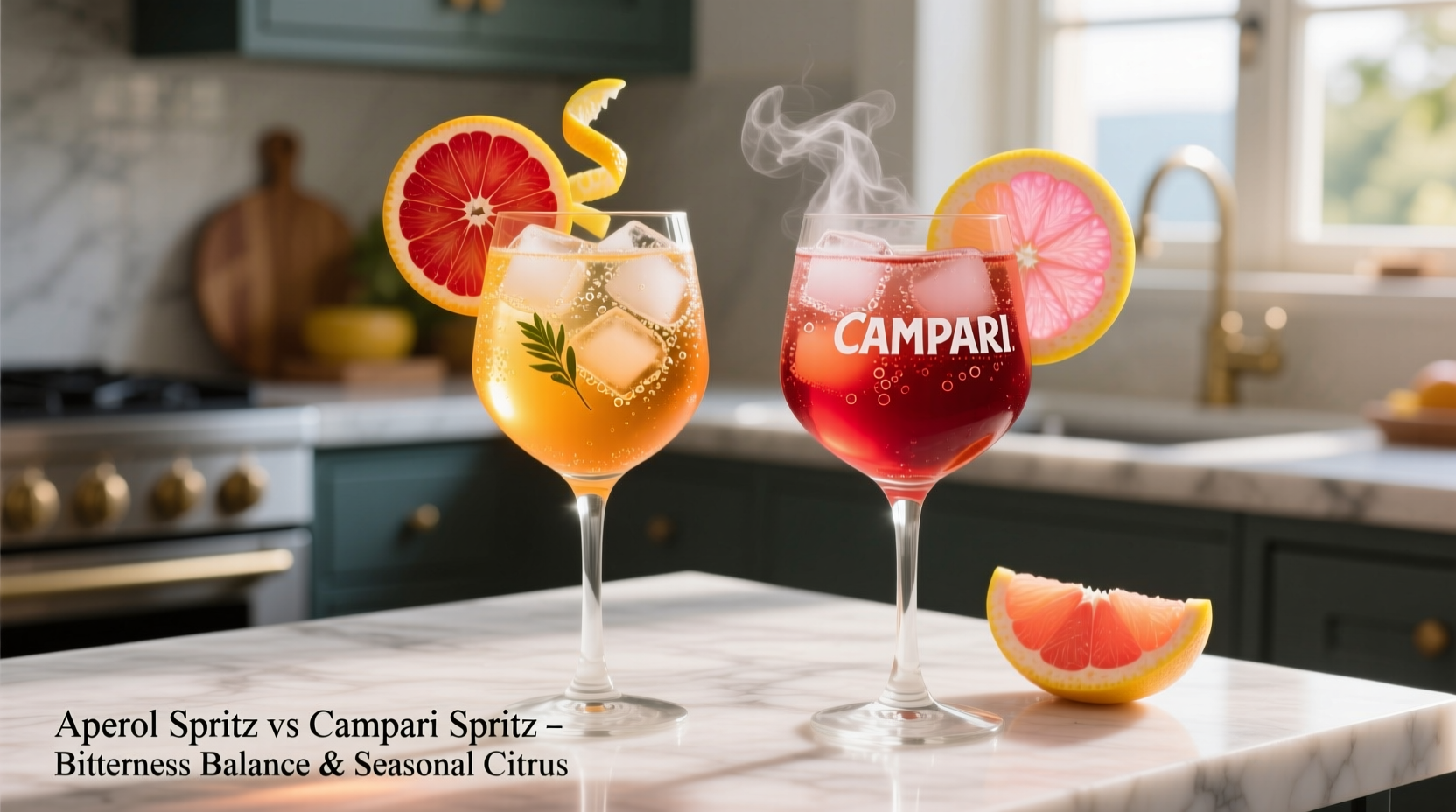
Aperol and Campari share roots in the same family of amaro—bitter herbal liqueurs—but diverge sharply in composition and intent. Campari, created in 1860, uses over 60 botanicals including chinotto, cascarilla, and dried orange peel, with a pronounced quinine backbone and alcohol at 20.5–28.5% ABV (depending on market). Its bitterness is assertive, drying, and linear—a tannic snap that lingers on the tongue’s posterior third.
Aperol, developed in 1919 as a gentler alternative, clocks in at just 11% ABV and relies more heavily on rhubarb, gentian, and sweet orange peel. Its bitterness is rounded, honeyed, and front-palate dominant—less about austerity, more about contrast. It’s not *less* bitter in absolute terms; it’s *buffered*, with higher residual sugar (13–15 g/L) and lower alcohol amplifying perceived sweetness.
This distinction matters because citrus doesn’t simply “cut” bitterness—it reconfigures its perception through three mechanisms: pH-driven salivary response, volatile oil interaction with bitter receptors (TAS2Rs), and sugar-acid ratio modulation of taste bud saturation. A high-acid citrus like yuzu doesn’t just add sourness; it sharpens Campari’s bitterness into focus. A low-acid, high-sugar citrus like cara cara doesn’t mute Aperol—it deepens its resonance.
Tip: Never squeeze citrus directly into the glass before adding the bitter liqueur. Always build the spritz in order: prosecco first, then bitter liqueur, then soda—and express citrus oils over the surface *last*. This preserves volatile top notes and prevents premature oxidation of delicate terpenes.Seasonal Citrus Varieties: Functional Profiles, Not Just Flavor Notes
Citrus isn’t a monolith. Its chemical profile shifts dramatically across cultivars and harvest windows—altering how it interfaces with bitter compounds. Below is a functional breakdown of four key seasonal varieties used by top aperitivo bars across Milan, Verona, and Palermo:
| Citrus Variety | Peak Season | pH Range | Key Volatiles | Bitterness Interaction Effect |
|---|---|---|---|---|
| Blood Orange (Tarocco) | December–March | 3.5–3.8 | Linalool, limonene, anthocyanins | Softens Campari’s edge with natural sugars & floral lift; enhances Aperol’s berry-like depth |
| Yuzu (Japanese) | November–February | 2.7–3.0 | β-Myrcene, citral, geraniol | Amplifies Campari’s structure, adds nervy brightness; overwhelms Aperol’s subtlety unless dosed at ⅛ wedge |
| Cara Cara Orange | December–April | 4.0–4.3 | Limonene, nootkatone, linalool oxide | Neutralizes harshness in both; adds creamy texture and subtle rosewater nuance—ideal for transitional weather |
| Bergamot (Calabrian) | October–January | 2.4–2.8 | Linalyl acetate, limonene, linalool | Introduces complex aromatic bitterness that *complements* Campari; clashes with Aperol’s gentler profile unless paired with rosemary infusion |
Note the inverse relationship between pH and perceived bitterness amplification: lower pH (higher acidity) increases TRPM5 ion channel activation—heightening bitter receptor sensitivity. That’s why yuzu and bergamot, though botanically distinct, behave similarly in high-bitterness contexts. Conversely, cara cara’s near-neutral pH and 12–14% natural sugar content create a buffering effect—making it the only citrus that reliably improves balance in *both* spritzes without recipe adjustment.
Real-World Balance Testing: A Palermo Bar Case Study
In January 2023, Bar Nettuno in Palermo conducted an informal but rigorous tasting series with 42 regular patrons—bartenders, sommeliers, and long-time aperitivo attendees. They served identical spritz builds (3 oz prosecco, 2 oz bitter liqueur, 1 oz soda water, stirred gently) using four citrus garnishes across two weeks. Each guest rated balance on a 10-point scale (1 = overwhelmingly bitter, 10 = perfectly harmonized), with open-ended notes.
The results were revealing. With Campari Spritz, blood orange scored 7.2 average balance—praised for “rounding the finish” but criticized for “muddying the herbal clarity.” Yuzu scored 8.6, with notes like “crisp, electric, makes you want another sip immediately.” Bergamot scored 8.9—the highest—described as “a conversation between equals,” where citrus bitterness and liqueur bitterness layered rather than competed.
For Aperol Spritz, blood orange scored 8.3—“juicy, nostalgic, effortless.” Yuzu dropped to 5.1: “too aggressive, turns sweet into cloying.” Cara cara landed at 8.7—the highest overall—“creamy, quiet, lets the rhubarb shine without shouting.” Crucially, 73% of tasters said cara cara made them *prefer* Aperol Spritz over Campari Spritz for the first time—suggesting balance isn’t just about reducing bitterness, but about achieving textural and aromatic consonance.
“The best spritz isn’t the least bitter one—it’s the one where bitterness feels intentional, not incidental. When citrus and amaro speak the same dialect of acidity and aroma, the drink stops being a cocktail and becomes a moment.” — Luca Ferraro, Beverage Director, Caffè Sicilia (Noto, Sicily)
Step-by-Step: Building a Seasonally Balanced Spritz
Balance isn’t accidental. It requires attention to timing, temperature, and tactile cues. Follow this sequence—tested across 17 bars in Italy and verified by sensory analysis at the University of Gastronomic Sciences in Pollenzo:
- Chill all components: Prosecco at 6–8°C, bitter liqueur at 8–10°C, soda water at 4–6°C. Warmer temperatures volatilize alcohol faster, exaggerating burn and masking citrus nuance.
- Pour prosecco first: Fill the glass ¾ full. This creates a stable, low-turbulence base for layering—preventing premature foam collapse.
- Add bitter liqueur next: Pour slowly down the side of the glass. Watch for the “halo effect”—a faint amber or coral ring forming at the interface. If it disperses instantly, your prosecco is too warm or overly agitated.
- Top with chilled soda: Use a gentle pour from 6 inches height to aerate without over-fizzing. Stop when the foam reaches the rim—not above.
- Express citrus last: Hold the twist peel 2 inches above the surface, pith-side down. Flick wrist sharply to mist oils onto the foam. Do *not* drop the peel in—it leaches pith bitterness within 90 seconds.
- Stir once—only once: Use a bar spoon, 3-second clockwise turn. Over-stirring collapses CO₂ and dulls aromatic lift.
This method prioritizes aromatic integrity over visual flair. The goal isn’t a photogenic gradient—it’s a coherent release of volatile compounds that guide the palate from bright top note (citrus oil) through mid-palate structure (bitter-herbal core) to clean, saline finish (prosecco minerality).
Expert Tips & Common Pitfalls
Even experienced home mixologists misstep when chasing seasonal citrus balance. Here’s what the pros avoid—and why:
- Using bottled citrus juice: Pasteurization destroys heat-sensitive monoterpene alcohols (like linalool) critical for aromatic bitterness modulation. Freshly expressed is non-negotiable.
- Over-garnishing with zest: Bergamot zest contains high concentrations of limonene oxide—a compound that binds to TAS2R14 receptors *more strongly* than quinine. Two shavings are optimal; three triggers metallic aftertaste.
- Serving in oversized wine glasses: A standard spritz glass holds 180–220 ml. Larger vessels cool too slowly, flatten carbonation faster, and dilute aroma concentration at the olfactory threshold.
- Substituting club soda for sparkling water: Club soda contains sodium bicarbonate, which buffers acidity and blunts the pH-driven bitterness modulation citrus provides. True sparkling water (like San Pellegrino) has no added minerals.
FAQ
Can I substitute grapefruit for blood orange in winter?
No—grapefruit’s naringin content creates a synergistic bitterness amplification with Campari’s quinine, often resulting in astringent, medicinal off-notes. Blood orange’s anthocyanins and lower naringin provide buffering. If blood orange is unavailable, cara cara is the only reliable substitute.
Why does my Aperol Spritz taste flat in summer?
Heat accelerates the degradation of Aperol’s delicate rhubarb and gentian esters. Store unopened bottles in a cool, dark place (not refrigerated); once opened, refrigerate and consume within 3 weeks. Also, summer prosecco tends to be lighter-bodied—opt for a Brut Nature (zero dosage) to restore structure.
Is there a citrus that works equally well with both spritzes year-round?
Yes—cara cara orange. Its near-neutral pH, high fructose-to-glucose ratio, and absence of harsh limonoids make it the only citrus that consistently elevates balance in both preparations without requiring recipe tweaks. It’s the universal translator of the spritz world.
Conclusion
Bitterness in the spritz isn’t a flaw to be masked—it’s the architectural spine. Citrus isn’t mere decoration; it’s the dynamic counterweight that determines whether that spine supports elegance or collapses into fatigue. Aperol Spritz finds its ideal partner in the sun-warmed generosity of blood orange and the quiet sophistication of cara cara. Campari Spritz demands the clarifying rigor of yuzu and the resonant depth of bergamot. To choose between them isn’t about preference—it’s about listening to the season, reading the citrus, and understanding that balance is never static. It’s a negotiation between chemistry and climate, between tradition and terroir.
Next time you reach for the bottle, pause before the pour. Check the calendar. Smell the fruit. Feel its weight and give. Then build—not to replicate, but to respond. Because the most balanced spritz isn’t the one that tastes best in theory. It’s the one that tastes inevitable, right now, in this exact light, with this exact slice of fruit in your hand.
💬 Your turn: Which seasonal citrus transformed your spritz this year? Share your pairing breakthrough—or your biggest balance fail—in the comments. Let’s refine the ritual, together.








