Building a spirits collection is more than accumulation—it’s curation. Whether you’ve amassed 20 bottles from weekend tastings or 200 from years of travel and exploration, disorganization leads to overlooked gems, inconsistent tasting experiences, and missed opportunities for education and enjoyment. Most home collections grow haphazardly: a bourbon gifted at Christmas sits beside a Japanese whisky bought on vacation, next to a bottle of mezcal that arrived in a subscription box—unlabeled, unremembered, uncatalogued. Without intention, even a thoughtful collection becomes inert inventory.
The most effective organization systems don’t just make bottles easier to find—they deepen your understanding of distillation traditions, highlight stylistic evolution across geographies, and reveal patterns in how raw materials, climate, aging, and technique shape flavor. This isn’t about aesthetics alone; it’s about building a living reference library you can taste your way through. Below are three rigorously tested frameworks—regional, flavor-based, and ABV-driven—each with distinct advantages, real-world implementation strategies, and pitfalls to avoid.
Why One-Size-Fits-All Doesn’t Work
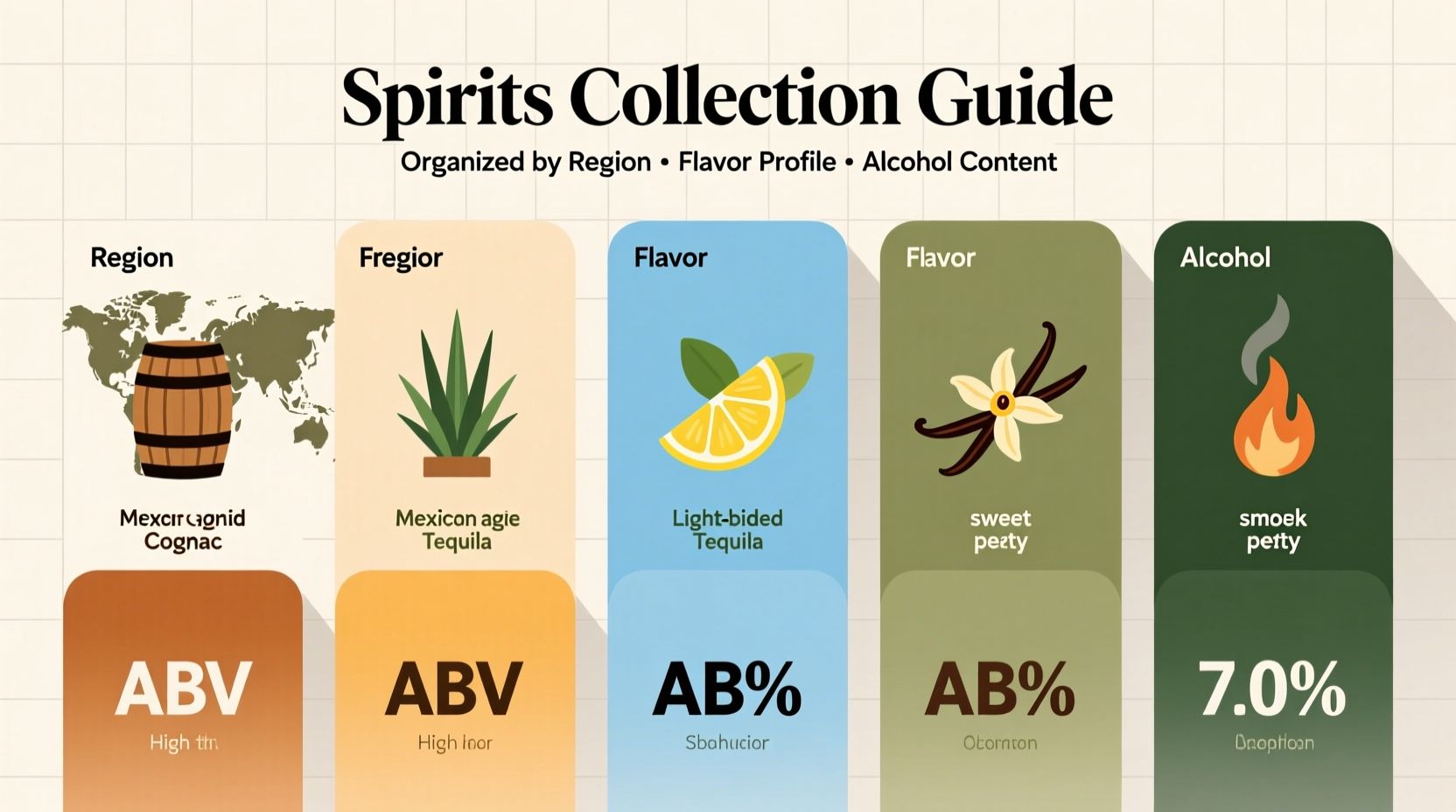
Many guides suggest alphabetical or price-based sorting. Neither reflects how spirits are made or experienced. Whisky from Islay shares more sensory DNA with peated mezcal from Oaxaca than with unpeated Lowland Scotch—even though both Scotches share a country. Likewise, a 43% ABV Jamaican rum and a 43% ABV Kentucky bourbon behave very differently in the glass due to ester intensity, barrel char, and fermentation time. Organization must serve purpose: whether that’s efficient service at a dinner party, systematic comparative tasting, or tracking personal palate development over time.
Tip: Before organizing, empty each bottle’s label information into a simple spreadsheet (brand, category, origin, age, ABV, key tasting notes, purchase date). This audit reveals gaps, redundancies, and hidden themes—and takes less than 90 minutes for a 50-bottle collection.Organizing by Region: Mapping Terroir and Tradition
Regional organization mirrors how professionals—distillers, importers, sommeliers—think about spirits. It groups expressions by shared cultural practices, legal definitions, agricultural conditions, and historical constraints. A bottle of Cognac isn’t just French brandy; it’s a product of delimited terroir, double-distillation in copper pot stills, and mandatory aging in Limousin oak. That context matters.
This system excels for collectors who value provenance and want to trace how geography shapes spirit character. It also simplifies themed tastings (“A Night of Peat: Islay, Campbeltown, and Highland”) or comparative studies (“Rye vs. Bourbon: Two American Expressions”).
Key regional categories to consider:
- Scotland: Subdivide by official regions (Campbeltown, Highland, Islay, Lowland, Speyside) — not just for geography, but for regulatory and stylistic distinctions (e.g., Islay’s mandatory peat use in many distilleries).
- Japan: Group by prefecture (Hokkaido, Kyushu, Chugoku) where local water sources, climate, and distillery philosophies diverge significantly—even within single malt categories.
- Mexico: Separate by agave species *and* state: Tequilas (Jalisco only, blue Weber agave), Mezcals (Oaxaca, Durango, Zacatecas—often espadín or wild agaves), Bacanora (Sonora), Sotol (Chihuahua, Coahuila, Durango).
- Caribbean: Distinguish by island tradition—not just “rum,” but Jamaican (high-ester, dunder pit fermentation), Martinique (AOC rhum agricole, fresh cane juice), Barbados (blended column-and-pot distillates), Guyana (Demerara, wooden stills).
- USA: Go beyond “bourbon” or “rye”: note state of production (Tennessee whiskey’s charcoal mellowing, New York’s grain-to-glass craft movement, California’s experimental wine-barrel finishes).
“Region tells you what’s legally possible—but also what’s culturally expected. When you line up four bourbons from Kentucky, Indiana, Tennessee, and New York, you’re not just tasting corn and oak—you’re tasting interpretation of a shared rulebook.” — Sarah Keltner, Master Distiller & Educator, Kentucky Craft Spirits Guild
Organizing by Flavor Profile: Building a Sensory Roadmap
Flavor-based organization prioritizes experience over origin. It answers the question: “What do I want to drink *right now*?” rather than “Where was this made?” This system shines for hospitality, seasonal rotation, or palate training. It requires honest self-assessment: Do you reach for smoky, medicinal whiskies when stressed? Crisp, citrusy gins after work? Rich, dried-fruit rums on cold evenings?
To implement this, develop a consistent 3–5 descriptor framework. Avoid vague terms like “smooth” or “bold.” Instead, anchor descriptors in objective sensory markers:
- Smoke/Peat: From faint campfire ash (Caol Ila) to medicinal iodine (Ardbeg Uigeadail)
- Fruit Spectrum: Citrus (grapefruit zest in gin), orchard (green apple in young Calvados), stone (apricot in Armagnac), tropical (pineapple in Jamaican rum)
- Spice & Herb: Black pepper (rye), anise (pastis), mint (cooling high-proof tequila), dill (some American gins)
- Earth & Umami: Wet clay (Mezcal Tobalá), soy sauce (aged shōchū), mushroom (old Cognac)
- Sweetness Level: Dry (London Dry Gin), off-dry (many PX-finished whiskies), rich (tawny port cask rums)
A practical approach is to assign each bottle two primary flavor tags (e.g., “Smoky + Earthy,” “Citrus + Herbal,” “Stone Fruit + Spicy”). Then group shelves or cabinets accordingly. Reserve one shelf for “Bridge Bottles”—expressions that cross categories (e.g., a lightly peated Japanese whisky with bright yuzu notes) to encourage exploration.
Organizing by Alcohol Content (ABV): Safety, Service, and Structure
Alcohol-by-volume is the most functional organizational axis—especially for active collections used regularly. It directly impacts serving size, glassware choice, dilution needs, and even storage stability. High-ABV spirits (55%+), particularly cask-strength whiskies and navy-strength gins, require different handling than delicate 40% bottlings. They’re also more sensitive to oxidation post-opening.
This system prevents accidental overpouring and streamlines bar setup. For example: keep all 37.5–43% bottlings (standard gins, vodkas, entry-level rums) on the lower shelf for quick access during cocktail prep. Place 46–50% expressions (most premium whiskies, aged rums) at eye level for neat sipping. Reserve the top shelf for 55%+ cask strengths, which benefit from cooler, darker conditions and should be served in smaller portions (15–20ml vs. 30ml).
| ABV Range | Typical Categories | Storage & Serving Notes |
|---|---|---|
| 37.5–43% | Standard gins, vodkas, tequilas, young rums, blended whiskies | Store upright; serve at room temp; ideal for mixing and high-volume service |
| 44–50% | Premium single malts, aged rums, reposado/anejo tequilas, small-batch bourbons | Store upright; serve neat or with minimal water; optimal balance of aroma and body |
| 51–55% | Cask strength whiskies, overproof rums (e.g., Plantation OFTD), some mezcals | Store upright in cool, dark place; serve with water or ice; oxidize faster once opened |
| 56%+ | Navy strength gins, some Japanese whiskies, rare cask finishes | Store upright, away from light/heat; serve in 15ml pours; use tulip glass to manage ethanol lift |
Real-World Implementation: A Case Study from Portland
Maya R., a Portland-based sommelier and home collector of 87 bottles, struggled with her growing collection. “I’d buy something interesting at a tasting—say, a smoked barley whisky from Tasmania—and stick it wherever there was space. Six months later, I’d forget I owned it. Or I’d grab a ‘light’ gin for a martini, only to realize it was actually a heavy, resinous London dry that overpowered the vermouth.”
She adopted a hybrid system: primary organization by region (with sub-shelves for Scotland, Japan, Mexico, Caribbean, USA), but added color-coded stickers for dominant flavor profile (blue for smoky, green for herbal, yellow for citrus, red for spice, brown for earthy) and ABV range (white = standard, silver = cask strength). She also installed adjustable shelving to separate ABV zones physically. Within three weeks, she noticed two changes: she finished bottles faster (no more forgotten “special occasion” whiskies), and her friends began requesting “the smoky Mexican shelf” or “the high-ABV tasting flight” by name. Her collection transformed from static inventory into an interactive tool for learning and sharing.
Step-by-Step: Building Your System in Under Two Hours
- Audit & Document (30 min): Remove every bottle. Record brand, category, country/state, age, ABV, and 2–3 core flavor descriptors in a spreadsheet or notebook. Note condition (seal integrity, fill level).
- Choose Your Primary Axis (10 min): Decide whether region, flavor, or ABV serves your goals best—or combine two (e.g., region first, then ABV within each section).
- Design Physical Zones (20 min): Map your storage space. Assign shelves or cabinets to categories. Label clearly. Leave 15% space for growth.
- Sort & Place (40 min): Group bottles using your chosen system. Place high-ABV or fragile bottles on stable, lower shelves. Keep frequently used items at eye level.
- Create Quick-Reference Aids (20 min): Print a one-page legend (e.g., “Red sticker = Smoky + >50% ABV”) and tape it inside your cabinet door. Add tasting notes to a small notebook kept beside your bar.
FAQ
Can I combine multiple organization systems without confusion?
Yes—strategically. Use region as your primary structure (it’s stable and educational), then add secondary identifiers: small stickers for ABV range and dominant flavor. Avoid layering more than two visual cues per bottle (e.g., sticker + handwritten tag + shelf label). Clarity trumps completeness.
What if I have limited space—like a single cabinet?
Prioritize ABV-based zoning. It’s the most functionally critical: separates service-ready bottles from those needing dilution or special glassware. Within ABV bands, use flavor descriptors to guide selection. Reserve the top shelf for high-ABV, the middle for standard, and the bottom for low-ABV or liqueurs.
Do I need to reorganize every time I add a new bottle?
No—but do a quarterly 10-minute review. Check for emerging patterns (e.g., “I’ve bought five Japanese whiskies this year—should I create a dedicated sub-section?”) or imbalances (e.g., “I have no unpeated Lowland Scotches”). Let your collection evolve intentionally, not accidentally.
Conclusion: Your Collection Is a Living Archive
Organizing spirits isn’t about imposing rigid order—it’s about creating pathways for curiosity, connection, and continuity. When you group a smoky Islay alongside a smoky mezcal, you’re not erasing their origins; you’re honoring a shared expressive language. When you isolate high-ABV bottles, you’re respecting their volatility and potency—not reducing them to numbers. And when you map flavor profiles, you’re charting your own evolving relationship with taste.
Your collection reflects your journey: the places you’ve visited, the people who’ve poured for you, the moments you’ve marked with a special pour. Treat it as both a resource and a record. Start tonight—not with a full reorganization, but with one shelf, one category, one intentional decision. Pull out three bottles you haven’t tasted in months. Compare their regions, their ABVs, their flavors side by side. Notice what surprises you. That moment of discovery—that’s the real reward.
💬 Your turn: Which system resonated most—region, flavor, or ABV? Share your organizing breakthrough (or biggest challenge) in the comments. Let’s learn from each other’s shelves.








