
For DIYers and weekend warriors, having the right tools can mean the difference between a smooth project and a frustrating mess. Two of the most common power tools found in home garages are the cordless drill and the impact driver. Both are compact, battery-powered, and capable of driving fasteners—but they’re not interchangeable. Understanding their differences is essential for choosing the right tool for your next home improvement job.
While they may look similar at first glance, these tools operate differently, deliver force in distinct ways, and excel in separate tasks. Choosing the wrong one can lead to stripped screws, damaged materials, or unnecessary effort. This guide breaks down how each tool works, where it shines, and which one truly handles typical home projects better—so you can make an informed decision without wasting time or money.
How Cordless Drills Work
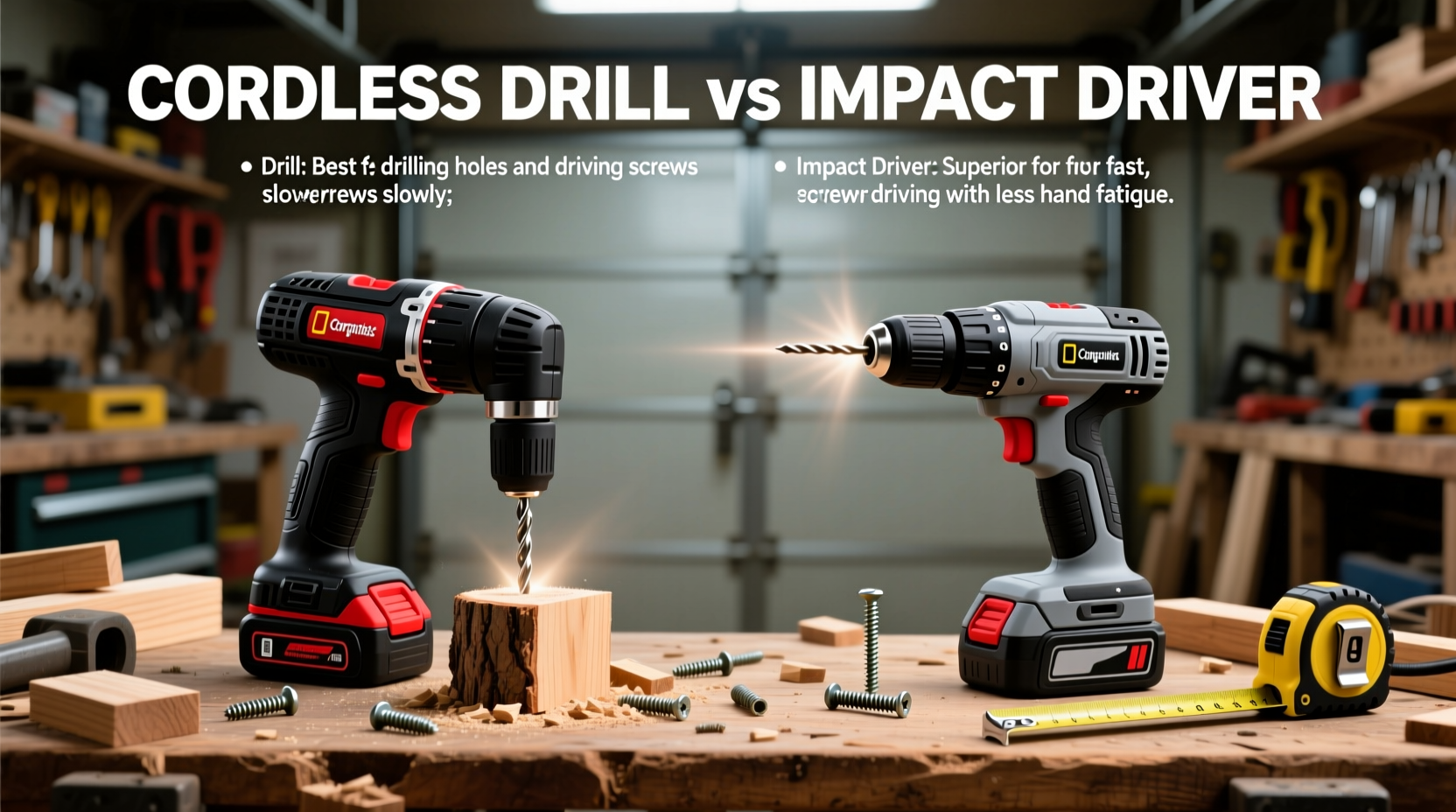
A cordless drill is a versatile, all-purpose tool designed primarily for drilling holes and driving screws. It delivers rotational force (torque) through a chuck that typically holds twist bits, screwdriver bits, or masonry bits. Most modern cordless drills feature adjustable clutch settings, allowing users to control how much torque is applied before the drill stops—this prevents overdriving screws into drywall or wood.
The key components of a cordless drill include a variable-speed trigger, forward/reverse switch, and multiple torque settings. These features make it ideal for precision work such as assembling furniture, installing shelves, or hanging cabinets. Because of its controlled output, a cordless drill offers greater finesse than raw power.
Tip: Use lower speed settings when driving screws into hardwoods to avoid splitting the material.Cordless drills typically range from 12V to 20V, with higher voltage models offering more power. However, even high-voltage drills are engineered for balance and control rather than brute strength. Their chucks usually accommodate bits up to 3/8 inch in diameter, making them suitable for most household drilling needs.
How Impact Drivers Work
An impact driver operates on a different principle. Instead of relying solely on continuous rotation, it combines rotational force with sudden bursts of concussive power—thousands of tiny hammer blows per minute. This allows it to generate significantly higher torque than a standard drill, often exceeding 1,500 in-lbs on compact models.
Impact drivers use a hex-shaped collet that accepts 1/4-inch hex shank bits directly, eliminating the need for a chuck. This design ensures minimal bit slippage under heavy load. The tool’s internal mechanism engages only when resistance builds, delivering short, powerful impacts that drive long screws or loosen stubborn fasteners with ease.
Because of this unique action, impact drivers excel in applications requiring high torque, such as securing deck screws, assembling structural timber frames, or removing rusted bolts. They're also favored by professionals working with metal framing or subflooring, where consistent, deep-driving capability is critical.
“An impact driver isn’t just a stronger drill—it’s a different beast altogether. Its pulsing action lets you drive large fasteners without straining your wrist.” — Mark Reynolds, Residential Contractor & Tool Specialist
Key Differences: Power, Precision, and Application
Understanding the functional differences between these tools helps clarify which one suits specific home projects best. Below is a detailed comparison highlighting core distinctions.
| Feature | Cordless Drill | Impact Driver |
|---|---|---|
| Torque Delivery | Constant rotational force | Rotational + concussive impacts |
| Max Torque (Typical) | 300–600 in-lbs | 1,000–1,800+ in-lbs |
| Chuck/Bit Holder | Keyless or keyed chuck (up to 3/8\") | 1/4\" hex quick-release collet |
| Speed Control | Fine-tuned via trigger and clutch | Less precise; aggressive engagement |
| Noise Level | Moderate | Loud (due to hammering sound) |
| Best For | Drilling, light fastening, precision tasks | Heavy-duty fastening, long screws, tough materials |
| Risk of Overdriving | Low (with clutch setting) | High (no clutch; requires user control) |
The data shows a clear divide: drills prioritize control and versatility, while impact drivers focus on raw driving power. Neither is universally superior—the choice depends on the nature of the task.
Real-World Home Projects: Which Tool Performs Better?
To determine which tool handles home projects better, consider common scenarios faced by homeowners.
Building a Deck or Outdoor Structure
When constructing a wooden deck, you’ll likely be driving numerous 3-inch exterior screws into pressure-treated lumber. These require substantial torque to seat flush without snapping the screw head. A cordless drill may struggle here, especially as batteries drain or wood resists. An impact driver powers through consistently, reducing fatigue and speeding up installation.
Hanging Drywall or Installing Cabinets
These tasks demand precision. You're attaching thin sheets or delicate cabinet faces where overdriving can crack surfaces or strip screw heads. A cordless drill with adjustable clutch settings gives you fine control, ensuring screws sit just below the surface without damage. Using an impact driver here risks gouging drywall or breaking hinges.
Assembling Furniture or Shelving Units
Ikea-style furniture and wall-mounted shelves involve smaller screws and pre-drilled holes. Accuracy matters more than force. A cordless drill allows gentle, steady driving—especially helpful if you're working near finished walls or fragile materials. An impact driver would be overkill and potentially destructive.
Demolition or Removing Old Fasteners
If you're tearing out old decking, removing metal brackets, or extracting rusted screws, the impact driver’s shock-driven mechanism excels. Its ability to apply sudden bursts of force helps break loose seized hardware without stripping the head—a frequent issue with standard drills.
Tip: Pair your impact driver with a Phillips #2 bit designed for high-torque applications to minimize cam-out and extend bit life.Mini Case Study: Replacing a Backyard Fence
Homeowner David L. decided to replace his warped wooden fence. He initially used his cordless drill to install new posts and rails but quickly noticed issues: screws weren’t seating fully in dense cedar, and the motor strained frequently. After switching to an impact driver, he completed the remaining sections in half the time. “It was like night and day,” he said. “The impact driver chewed through the wood cleanly. My drill just couldn’t keep up.”
However, when installing decorative trim pieces later, David switched back to the drill. “I didn’t want to blow through the thin boards,” he explained. “The drill gave me the touch I needed.”
This example illustrates a practical hybrid approach: using both tools based on the stage and material involved.
Checklist: Choosing the Right Tool for Your Project
- Use a cordless drill when:
- You’re drilling holes in wood, plastic, or light metal
- Working with small-to-medium screws (1” or less)
- Precision and depth control are important (e.g., cabinetry)
- You need versatility across multiple bit types
- Use an impact driver when:
- Driving long or lag screws (2” or longer)
- Working with tough materials like treated lumber or steel
- Installing subfloors, decking, or framing
- Removing stubborn or rusted fasteners
- Consider owning both if:
- You regularly tackle diverse home projects
- You value efficiency and reduced physical strain
- You plan to upgrade your toolkit for future renovations
Can One Tool Replace the Other?
Some manufacturers market combo kits featuring both a drill and impact driver, recognizing that each fills a unique role. While adapters exist—such as hex-to-chuck attachments that let you use drill bits in an impact driver—these compromises reduce accuracy and risk damaging the tool or bit.
Similarly, attempting to drive large construction screws with a standard drill often leads to overheating motors, worn clutches, or incomplete installations. The lack of percussive force means the tool must rely entirely on sustained torque, which drains batteries faster and increases user fatigue.
In short: no single tool does everything well. The cordless drill remains unmatched for general-purpose drilling and light fastening. The impact driver dominates in high-torque, repetitive fastening jobs. Owning both expands your capability and efficiency.
FAQ
Can I use an impact driver to drill holes?
Not effectively. Impact drivers lack the chuck system needed for most drill bits and aren't designed for smooth rotation. While some users attach drill bits via adapters, the results are inconsistent and unsafe for larger holes. Always use a cordless drill for drilling.
Is an impact driver necessary for basic home repairs?
It depends on your workload. If you mostly hang pictures, assemble furniture, or perform minor fixes, a cordless drill is sufficient. But if you frequently build decks, repair fences, or work with heavy materials, an impact driver will save time and effort.
Do impact drivers require special bits?
Yes. Standard screwdriver bits aren’t built to withstand the extreme torque and vibration of an impact driver. Use \"impact-rated\" bits, which are hardened and designed to resist shearing and wear. Regular bits may snap or degrade quickly under stress.
Final Recommendation: What Handles Home Projects Better?
For the average homeowner tackling a mix of indoor and outdoor projects, the **cordless drill** is the more essential first tool. Its versatility in drilling, light driving, and compatibility with various accessories makes it indispensable. Nearly every household project involves tasks that benefit from controlled, precise operation—something only a drill provides.
However, once your projects grow in scale or complexity—especially those involving structural woodwork, outdoor construction, or heavy fasteners—an impact driver becomes increasingly valuable. It doesn’t replace the drill but complements it by handling the physically demanding parts of the job.
Ultimately, the best answer isn’t choosing one over the other—it’s understanding when to use each. The most effective DIYers don’t debate which tool is better; they know the right tool for the task at hand.
🚀 Ready to upgrade your toolkit? Start with a quality 20V cordless drill for everyday jobs. Add an impact driver when you begin larger builds. Together, they form the backbone of a capable, efficient home workshop. Share your favorite tool tips in the comments!








