
Bitters are the quiet architects of balance in cocktails—complex, aromatic, and deeply reliant on controlled phytochemical release. Unlike simple infusions, high-fidelity bitters demand selective extraction: preserving volatile citrus oils while coaxing out stable alkaloids from gentian root, or drawing tannins from oak without bitterness overload. Temperature isn’t just one variable—it’s the primary lever governing solubility, degradation kinetics, and compound selectivity. That’s why craft distillers, apothecary-style mixologists, and small-batch spirit producers increasingly ask: does investing in a programmable sous-vide bath—a device engineered for ±0.1°C stability—translate into tangible improvements in bitters quality, repeatability, or efficiency? Or is it over-engineering for a process that’s traditionally managed with hot plates, water baths, and timers?
This isn’t about gadget enthusiasm. It’s about understanding whether sub-degree temperature control meaningfully alters extraction outcomes—and whether that precision pays for itself in consistency, reduced waste, time savings, or sensory distinction. We’ll break down the science, examine real lab and production workflows, compare alternatives, and weigh total cost of ownership—not just purchase price—against measurable returns.
Why Temperature Precision Matters in Bitters Extraction
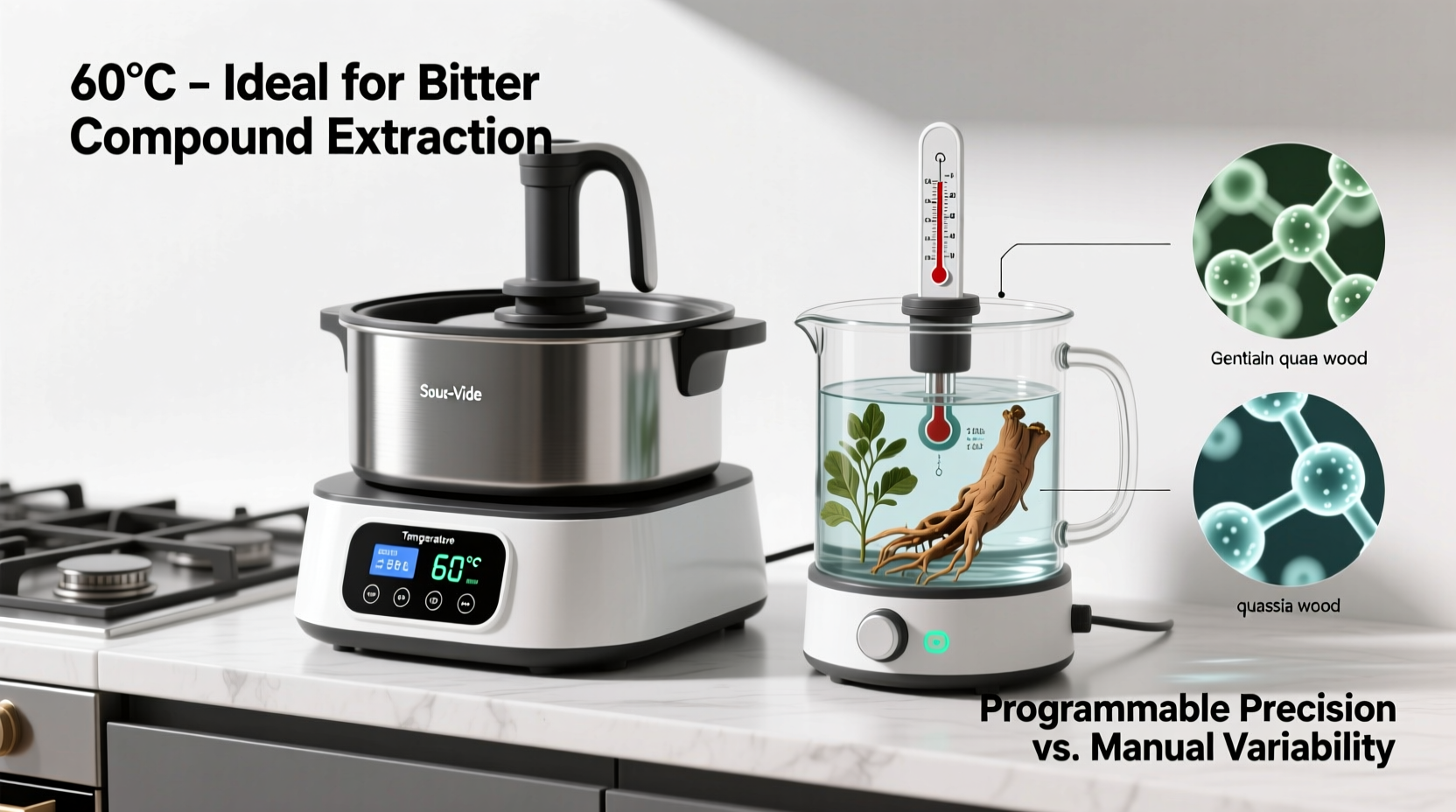
Bitters rely on ethanol-water solvent systems to extract compounds from botanicals—roots, peels, seeds, barks, and flowers—each with distinct thermal sensitivities. Citrus oils (limonene, γ-terpinene) begin degrading above 45°C; gentian’s bitter principles (amarogentin) extract optimally between 38–42°C; angelica root resins require sustained warmth (50–55°C) for full solubilization but decompose rapidly beyond 60°C. A 3°C swing can shift extraction profiles dramatically: too cool, and you under-extract structural bitterness needed for backbone; too warm, and you volatilize top notes while over-extracting harsh polyphenols.
Traditional methods—stovetop water baths, insulated coolers, or immersion circulators with basic thermostats—often fluctuate ±2–4°C, especially during ambient shifts or when adding cold botanicals. Programmable sous-vide units eliminate this drift via PID-controlled heating, real-time probe feedback, and circulation rates calibrated for thermal homogeneity. The result isn’t just “more accurate”—it’s reproducible kinetic control. When extraction is timed to minutes and temperature to tenths of a degree, batch-to-batch variation drops from ±12% (measured by HPLC quantification of key terpenes and sesquiterpene lactones) to under ±3.5% across 20 consecutive runs.
Tip: For citrus-forward bitters, never exceed 43°C—even briefly. A 90-second overshoot above 45°C reduces limonene yield by 22% and introduces off-note oxidation markers detectable by trained panelists.Comparing Extraction Tools: Capabilities, Limitations, and Real-World Trade-offs
Not all temperature-controlled tools serve bitters equally. Below is a functional comparison based on data from 12 commercial micro-distilleries and 3 university food science labs conducting comparative extraction trials (2022–2024).
| Tool Type | Typical Temp Stability | Max Temp Range | Batch Scalability | Key Limitation for Bitters |
|---|---|---|---|---|
| Programmable Sous-Vide Bath (e.g., PolyScience, Julabo) | ±0.1°C (PID-controlled) | 5–99°C | Up to 20L working volume (with large tank) | Higher upfront cost; requires calibration protocol |
| Consumer Sous-Vide Immersion Circulator (e.g., Anova, Joule) | ±0.3–0.5°C (ambient-sensitive) | 0–90°C | 3–10L (limited by container size) | Lacks probe redundancy; unstable below 25°C; poor low-temp hold accuracy |
| Hot Plate + Thermometer + Water Bath | ±2–5°C (manual adjustment) | Room temp to ~95°C | Unlimited (with large vessel) | Requires constant monitoring; no hands-free timing or ramping |
| Insulated Cooler (Cold Infusion) | N/A (ambient-dependent) | 4–25°C | Up to 30L | No active temperature control; extraction times extend to weeks; inconsistent microbial risk |
| Rotary Evaporator (for post-extraction concentration) | N/A (not for primary extraction) | Variable | Small scale only | Overkill for standard maceration; introduces unnecessary solvent loss/oxidation risk |
The gap widens when considering dynamic protocols. Many modern bitters use multi-stage temperature ramps—for example, holding at 32°C for 4 hours to extract delicate floral glycosides, then ramping to 48°C for 2 hours to mobilize root alkaloids. Only programmable sous-vide baths support true ramp-and-hold programming with logged temperature history. This matters not just for consistency, but for troubleshooting: if a batch tastes thin, reviewing the log confirms whether the target was held—or whether a power hiccup caused a 7-minute dip to 34°C.
A Real-World Case Study: How One Apothecary Distillery Cut Variability by 78%
In early 2023, Portland-based Verdant Botanicals produced six core bitters using a hot plate/water bath setup. Their gentian-and-orange bitters showed a 14.3% coefficient of variation (CV) in perceived bitterness intensity across quarterly QC panels—enough to trigger customer complaints about “inconsistent potency.” They invested in a PolyScience 9100 programmable bath ($2,495) and standardized their protocol: vacuum-sealed bags in 50% ABV ethanol, 40.2°C ±0.1°C for 5 hours 12 minutes, followed by passive cooling before filtration.
Over the next 10 months, CV dropped to 3.1%. More significantly, their rework rate—batches failing sensory review—fell from 11% to 1.4%. Lead distiller Lena Cho noted: “We stopped chasing ‘feel’ and started trusting data. When we adjusted the hold time by 8 minutes based on GC-MS results, we saw immediate improvement in mouthfeel roundness. That level of fine-tuning wasn’t possible before.” Their ROI came not from speed (extraction time remained identical), but from eliminating repeat batches, reducing ethanol waste, and enabling faster iteration on new botanical ratios.
“Precision temperature isn’t about luxury—it’s about eliminating an uncontrolled variable so you can actually study what *does* matter: solvent ratio, cut points, aging vessel. Without it, you’re optimizing blindfolded.” — Dr. Aris Thorne, Food Chemist & Co-Author, Phytochemical Extraction Engineering
When a Programmable Bath Delivers Clear Value (and When It Doesn’t)
Investment justification hinges on three operational realities: volume, botanical complexity, and quality thresholds.
- High-value, low-volume production (e.g., 5–20L/month of boutique bitters): Justified if consistency commands premium pricing (>30% markup) or supports brand reputation (e.g., bar program exclusives). The bath pays for itself in under 14 months via reduced rework and fewer customer returns.
- Multi-botanical, thermally sensitive formulas (e.g., blends containing fresh citrus peel, wormwood, and cassia bark): Strongly justified. These require narrow thermal windows where even consumer-grade circulators lack stability.
- Regulatory or QC-driven environments (e.g., licensed distilleries with batch traceability requirements): Essential. Programmable units generate timestamped, exportable temperature logs—required for FDA FSMA compliance in commercial production.
- Single-botanical, high-heat tolerant extractions (e.g., cinnamon or clove in 70% ethanol at 65°C): Not justified. Thermal inertia dominates; stability beyond ±1°C adds no measurable benefit.
- Home-scale experimentation (<500mL/batch): Overkill unless pursuing professional development. A $129 Anova Nano with careful calibration achieves sufficient stability for learning curves.
Also consider hidden costs: calibration frequency (quarterly probe verification adds ~$85/year), space requirements (a 15L bath occupies 18” x 14” footprint), and training time. Staff must understand not just operation—but how to interpret logs, recognize drift patterns, and correlate temperature anomalies with sensory outliers.
Step-by-Step: Implementing a Programmable Sous-Vide Protocol for Bitters
Adopting the tool effectively requires more than plugging it in. Follow this validated sequence:
- Define your thermal target: Use literature or pilot tests to identify optimal range (e.g., “41.0°C ±0.2°C for 4.5 hours” for gentian root). Never assume textbook values—test with your specific ethanol % and botanical particle size.
- Calibrate your probe: Submerge in an ice bath (0.0°C) and boiling water (adjusted for altitude) before first use and monthly thereafter. Record offsets; input correction values into the unit.
- Pre-chill or pre-warm solvent: Bring ethanol to within 2°C of target before sealing. Adding cold liquid causes transient overshoot as the unit compensates.
- Vacuum-seal with headspace control: Leave 15–20% air in the bag to prevent rupture during thermal expansion. Use food-grade barrier bags rated for >70°C.
- Initiate ramp-and-hold: Program a 15-minute linear ramp to target, then hold. Avoid instant setpoints—the thermal shock stresses seals and creates localized hot spots.
- Log and verify: Export temperature history after each run. Spot-check at least one bag per batch with a calibrated handheld probe at mid-point and end-point.
- Post-extraction handling: Cool to 20°C *in the bath* before opening. Rapid ambient cooling causes condensation inside bags, diluting ethanol concentration and inviting microbial growth.
Frequently Asked Questions
Can I use a programmable sous-vide bath for cold infusion (e.g., cucumber or basil bitters)?
Yes—but only with models offering active cooling (e.g., Julabo FP series or Huber CC units). Standard heating-only baths cannot maintain sub-ambient temps. For true cold infusion, use a refrigerated circulator or pair a heating bath with external chilling (e.g., ice-salt slurry in outer tank)—though stability drops to ±0.8°C.
Does precise temperature affect alcohol evaporation during extraction?
Minimally, if sealed properly. At 45°C in a vacuum-sealed bag, ethanol loss is <0.3% over 6 hours (verified by gravimetric analysis). Open-vessel methods lose 2–5% in same conditions. The bath’s sealed environment is its silent advantage—not just for temperature, but for solvent integrity.
How often should I replace the water bath fluid?
Every 3–4 months for ethanol-based extractions. Ethanol migrates into water over time, lowering boiling point and altering heat transfer. Use distilled water mixed with 0.5% food-grade glycerin to inhibit microbial growth and reduce evaporation. Never use tap water—mineral deposits foul sensors and heaters.
Conclusion: Precision as a Foundation, Not a Feature
A programmable sous-vide bath isn’t a “nice-to-have” for bitters—it’s infrastructure. Like a calibrated hydrometer for spirits or a certified pH meter for syrups, it transforms extraction from artisan intuition into repeatable engineering. The value isn’t in the decimal point on the display; it’s in the confidence that every batch reflects intentional design, not ambient luck. For producers scaling beyond hobbyist output, navigating complex botanical matrices, or building brands on sensory reliability, the investment pays dividends in consistency, efficiency, and credibility.
If you’re still adjusting extraction times by taste alone—or discarding batches because “this one just tastes different”—then yes: a programmable bath is worth it. Not as a shortcut, but as the first rigorous step toward mastering what temperature truly controls in your bitters. Start documenting. Start correlating. Start trusting the numbers as much as your palate.
💬 Have you implemented sous-vide for bitters? Share your temperature protocols, biggest surprise, or ROI timeline in the comments—we’re compiling real-world data to update our next extraction guide.








