For homeowners tackling weekend repairs, assembling furniture, or upgrading their living space, having the right power tool can mean the difference between a smooth project and a frustrating mess. Two of the most common tools found in modern DIYers’ toolboxes are the cordless drill and the impact driver. While they may look similar at first glance—both are handheld, battery-powered, and capable of driving screws—they serve different purposes and excel in distinct scenarios. Understanding their differences isn’t just about technical specs; it’s about choosing the right tool to save time, reduce effort, and get professional-quality results without unnecessary strain.
How Cordless Drills Work
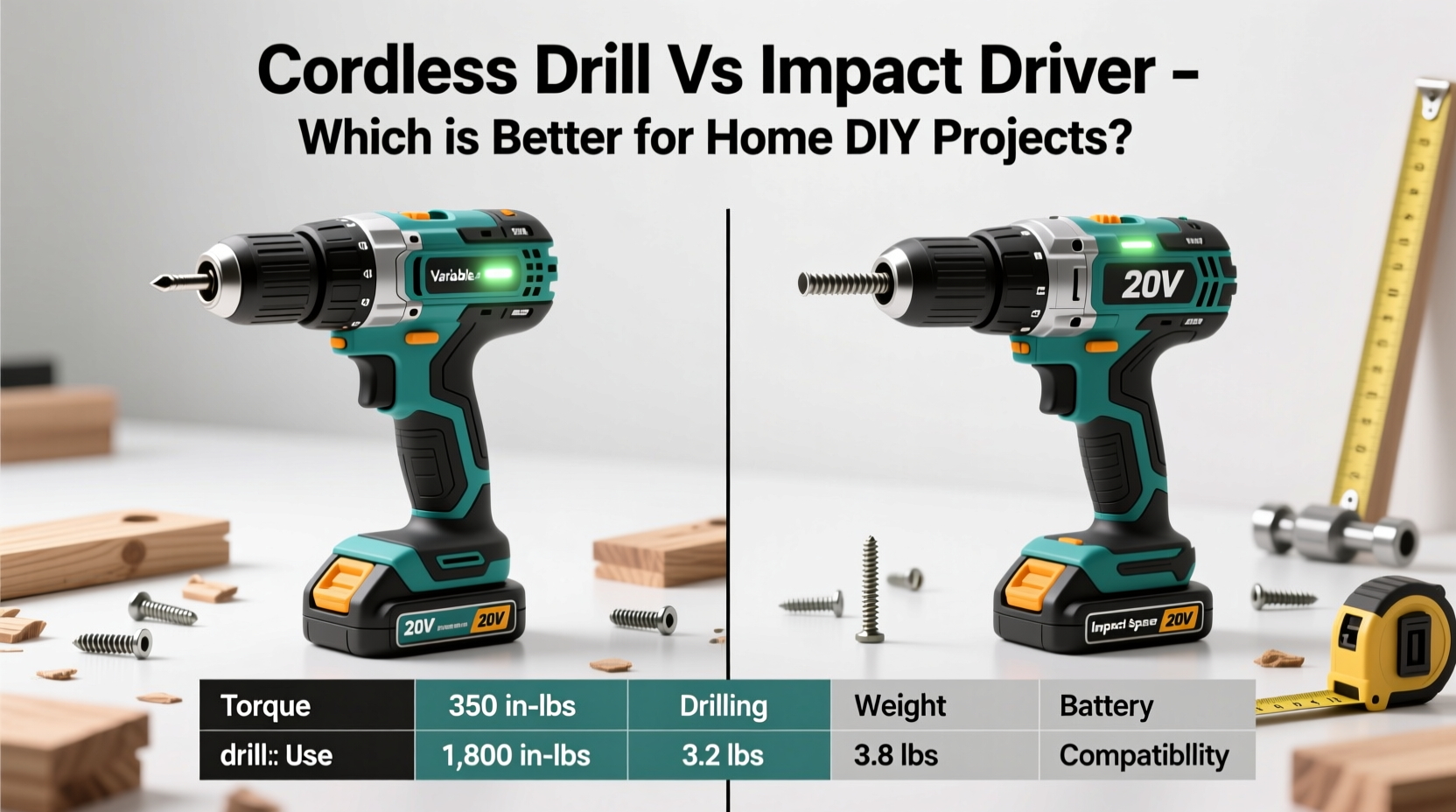
A cordless drill is a versatile power tool designed primarily for drilling holes and driving screws. It operates using a motor that delivers consistent rotational force (torque) through a chuck that holds drill bits or screwdriver bits. Most models feature variable speed triggers and adjustable torque settings, allowing users to control how fast the bit spins and how much force is applied. This makes them ideal for precision work like installing drywall anchors, hanging shelves, or drilling into wood, metal, or plastic.
The key advantage of a cordless drill lies in its adaptability. With a simple twist, you can switch from a Phillips head bit to a masonry bit and go from assembling cabinets to mounting a TV bracket on a concrete wall. Many drills also offer forward and reverse modes, clutch settings to prevent over-tightening, and built-in LED lights for visibility in tight spaces.
Tip: Use lower torque settings when working with delicate materials like MDF or softwood to avoid splitting the material.How Impact Drivers Work
An impact driver, while similar in appearance, functions quite differently. Instead of relying solely on continuous rotation, it combines rotational force with sudden bursts of concussive power—thousands of tiny “impacts” per minute—that help drive screws deeper and faster, especially in tough materials. The bit is held in place by a quick-change hex collet system, eliminating the need for a chuck and allowing for quicker bit swaps.
Impact drivers are built for high-torque applications. They shine when driving long deck screws, lag bolts, or structural fasteners into hardwood or pressure-treated lumber. Their compact size and high power-to-weight ratio make them excellent for overhead work or tight spaces where leverage is limited. However, because of their aggressive action, they’re less suited for tasks requiring finesse, such as drilling pilot holes or installing small screws into thin materials.
“An impact driver is like a sledgehammer with precision aim—it delivers massive force exactly where you need it.” — Mark Reynolds, Professional Carpenter & Tool Instructor
Key Differences Between Cordless Drills and Impact Drivers
To make an informed decision, it helps to compare these tools across several critical dimensions. Below is a detailed comparison table highlighting the main differences.
| Feature | Cordless Drill | Impact Driver |
|---|---|---|
| Primary Function | Drilling holes and driving screws | Driving high-torque fasteners |
| Torque Delivery | Constant rotation | Rotational + hammering action |
| Chuck/Bit Holder | Keyless or keyed chuck (holds round shanks) | Hex collet (accepts 1/4\" hex shank bits) |
| Torque Output | 200–500 in-lbs (typical) | 1,000–1,800+ in-lbs |
| Speed (RPM) | 500–2,000 RPM | 2,500–3,500 RPM + impacts per minute |
| Precision Control | High (with clutch settings) | Low to moderate |
| Best For | Hanging pictures, assembling furniture, light construction | Deck building, framing, heavy-duty fastening |
| Size & Weight | Slightly longer and heavier | Shorter, more compact, lighter |
Real-World Scenarios: Which Tool Fits Your Project?
Choosing between a cordless drill and an impact driver often comes down to what you're actually doing around the house. Consider this real-life example:
Mini Case Study: Building a Backyard Deck
Tom, a homeowner in Portland, decided to build a 10x12-foot wooden deck in his backyard. He already owned a cordless drill and used it to assemble the frame. But as he began attaching composite decking boards with 3-inch structural screws, he noticed the drill struggled, frequently stalling and stripping screw heads. After replacing two worn-out bits and taking breaks due to wrist fatigue, he borrowed an impact driver from his neighbor. The difference was immediate. Screws drove flush in seconds without stripping, even in dense cedar joists. The job that took him two weekends with the drill was completed in one afternoon with the impact driver.
This scenario illustrates a fundamental truth: while a cordless drill can handle light to moderate fastening, an impact driver excels when volume and resistance increase. For repetitive, high-resistance tasks, the impact driver reduces physical strain and dramatically improves efficiency.
When to Choose a Cordless Drill
- General household repairs: Fixing loose cabinet hinges, mounting curtain rods, or tightening door handles.
- Furniture assembly: Driving small screws into particleboard or pre-drilled holes.
- Drilling holes: Creating openings for electrical outlets, plumbing lines, or shelving anchors.
- Precision work: Projects where over-driving could damage materials or finishes.
If your DIY activity involves a mix of drilling and light screwdriving, a cordless drill is likely sufficient—and often more practical. Its versatility means you won’t need multiple tools for basic jobs.
When to Choose an Impact Driver
- Outdoor construction: Building decks, fences, pergolas, or sheds with long screws or lag bolts.
- Heavy-duty fastening: Securing plywood sheathing, subflooring, or timber framing.
- Repetitive tasks: Installing dozens of screws quickly without hand fatigue.
- Tough materials: Working with hardwood, treated lumber, or metal-to-wood connections.
Impact drivers are not meant to replace drills entirely but rather complement them. Their specialty is brute-force efficiency, not precision. Attempting to use one for fine woodworking or shallow hole drilling often leads to stripped screws or damaged surfaces.
Tip: Never use an impact driver with standard drill bits—only use impact-rated bits to avoid breakage.Can You Use One Tool for Everything?
Many DIYers wonder if investing in both tools is necessary. The short answer: it depends on your project frequency and complexity. For occasional use—say, once every few months—a quality cordless drill with a brushless motor and 18V battery may cover 90% of needs. Modern drills are powerful enough to handle medium-duty tasks, especially if paired with sharp, high-grade bits.
However, if you plan to take on larger renovations, outdoor builds, or want to minimize physical effort, owning both tools is ideal. Think of them as a pair: the drill for accuracy and variety, the impact driver for speed and strength. Some manufacturers even sell combo kits that include both tools, two batteries, and a charger—often at a lower price than buying separately.
Checklist: Choosing the Right Tool for Your Needs
- Assess your most common DIY tasks—do they involve drilling, light fastening, or heavy-duty driving?
- Determine whether you’ll be working with hardwood, metal, or thick lumber regularly.
- Consider how often you’ll use the tool—occasional vs. frequent use affects value.
- Check battery compatibility—if you already own tools from a brand, stick with the same platform.
- Evaluate ergonomics—compact size and weight matter for overhead or extended use.
- Look for brushless motors and lithium-ion batteries for longer runtime and durability.
Expert Recommendations and Common Misconceptions
One widespread myth is that impact drivers are “just stronger drills.” In reality, they’re engineered for a different kind of force delivery. As noted by tool engineer Linda Cho in a recent industry publication: “The impact mechanism isn’t about raw speed—it’s about overcoming static friction. That initial resistance when starting a large screw is where impact drivers truly outperform.”
Another misconception is that impact drivers are too powerful for home use. While they can easily strip screws if misused, proper technique—using the right bit, applying steady pressure, and letting the tool do the work—minimizes risks. Many models now include multiple speed and power modes, giving users more control.
FAQ: Common Questions About Cordless Drills and Impact Drivers
Can I use an impact driver to drill holes?
Generally, no. Impact drivers lack the chuck to hold standard drill bits securely and aren’t designed for precise hole placement. While some users attach hex-shank drill bits, this is unsafe and ineffective for anything beyond soft materials. Always use a cordless drill for drilling.
Do I need special bits for an impact driver?
Yes. Standard screwdriver bits can shatter under the high-impact forces. Use “impact-rated” bits made from tougher steel with reinforced tips. These are widely available and slightly more expensive but last significantly longer.
Is a higher voltage always better?
Not necessarily. While 20V max tools offer more power than 12V models, they’re also heavier and bulkier. For light indoor tasks, a 12V or 18V tool is often sufficient. Match voltage to your typical workload—don’t overbuy for underuse.
Final Verdict: Which Is Better for Home DIY Projects?
There is no universal “better” tool—only the right tool for the job. For most homeowners, a **cordless drill is the essential starting point**. It handles the majority of household tasks with flexibility and control. If your DIY ambitions grow toward structural projects, outdoor builds, or frequent carpentry, then adding an **impact driver becomes a smart upgrade** that saves time and effort.
In practice, many experienced DIYers keep both in their kit. The drill handles prep work, drilling, and delicate installations, while the impact driver takes over when power and speed matter most. Together, they form a balanced, efficient system that adapts to almost any challenge.
🚀 Ready to upgrade your toolkit? Start with a reliable cordless drill, then add an impact driver as your projects evolve. The right tools don’t just make work easier—they make better results possible. Share your favorite tool tip or ask a question in the comments below!








