Quotation marks preserve someone else’s words, but sometimes those words need clarification, correction, or integration into a new context. That’s where brackets come in. Used correctly, square brackets [ ] within quotations signal that the writer has made a minor, non-disruptive change to the original text—without misrepresenting it. Misused, they can distort meaning or confuse readers. Understanding when and how to use brackets in quotes is essential for writers, editors, students, and professionals who work with cited material.
What Are Brackets Used for in Quotations?
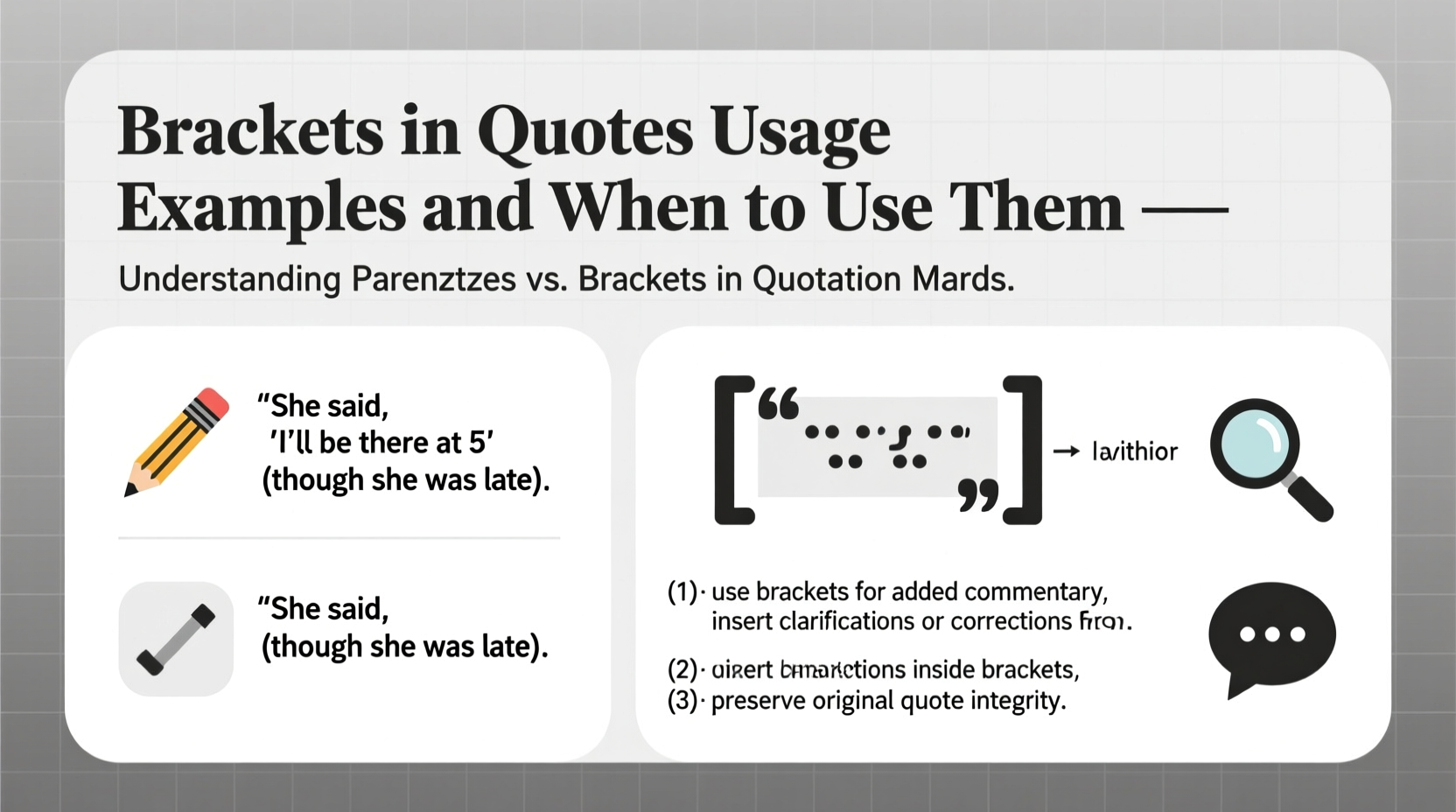
Square brackets are editorial tools used inside direct quotations to insert clarifying information, correct grammatical inconsistencies, or adapt quoted text to fit the syntax of the host sentence. Unlike parentheses, which typically add supplementary information outside the quote, brackets modify the quote itself while maintaining transparency about the alteration.
The key principle: brackets should never change the original intent of the quotation. They exist to enhance clarity—not to manipulate or mislead.
Tip: Always keep bracketed additions minimal and relevant. Overuse can make a quote appear tampered with or unreliable.Common Uses of Brackets in Quotes
Brackets serve several distinct purposes in quoted text. Below are the most frequent and accepted applications across academic, journalistic, and professional writing.
1. Adding Clarification
When a pronoun or ambiguous term appears in a quote, brackets can specify who or what is being referred to.
“She said [the CEO] would address the issue at noon.”
In the original statement, “she” might have said “he,” but without naming the subject. The bracketed addition identifies the referent without altering the speaker’s meaning.
2. Correcting Grammar or Tense
To integrate a quote smoothly into your sentence, you may need to adjust verb tense or pronouns. Brackets show these changes are editorial, not original.
“Jones stated, ‘I [was] unaware of the policy change until Tuesday.’”
Here, the past tense “was” replaces “am” to match the reporting verb “stated.” The original speaker used present tense, but the context demands past.
3. Indicating Omissions Within a Quote
While ellipses (...) denote omitted words, brackets are sometimes used to clarify that an omission was intentional and not a transcription error—especially in legal or scholarly texts.
“The report concluded that [omitted for brevity] further review is necessary.”
This usage is rare in general writing but common in formal publications where transparency about editing is critical.
4. Inserting Emphasis
If you want to emphasize part of a quote (e.g., by italicizing), you must indicate that the emphasis wasn’t in the original. Use brackets to note this.
“He claimed he had ‘no knowledge [emphasis added] of the transaction.’”
Alternatively, some style guides allow “emphasis mine” instead of “emphasis added,” though the latter is more widely accepted.
5. Translating or Explaining Foreign Terms
When quoting a foreign language, brackets can provide translations or transliterations directly within the quote.
“In her letter, she wrote, ‘Je suis fatiguée [I am tired] and cannot continue.’”
This keeps the original intact while making it accessible to readers unfamiliar with French.
Brackets vs. Parentheses: Key Differences
A common confusion arises between square brackets [ ] and parentheses ( ). While both enclose additional information, their functions differ significantly in quoted text.
| Feature | Brackets [ ] | Parentheses ( ) |
|---|---|---|
| Location | Inside direct quotations | Outside or around quotations |
| Purpose | Edit or clarify quoted text | Add commentary or citation |
| Example | “He [Dr. Lee] presented the findings.” | “He presented the findings.” (Smith, 2022) |
| Style Guide Note | APA, MLA, Chicago all permit bracketed edits | Parentheses used for references, not quote modification |
“Brackets are the ethical scaffolding of quotation—they support accuracy without compromising integrity.” — Dr. Rebecca Tan, Linguistics Professor, University of Toronto
When Not to Use Brackets
Despite their usefulness, brackets are not always appropriate. Certain uses cross the line from clarification to distortion.
- Never alter core meaning: You can’t bracket in a word that reverses the speaker’s point.
- Avoid over-correction: Don’t fix every colloquialism or informal construction unless clarity demands it.
- Don’t hide errors: If the original contains a factual mistake, don’t silently correct it with brackets. Instead, use “[sic]” to acknowledge the error.
For example, if someone says, “The data prove climate change ins’t real,” the accurate quotation is:
“The data prove climate change ins’t real [sic].”
Using brackets to correct “ins’t” to “isn’t” without noting the change would be misleading.
Step-by-Step Guide to Using Brackets Correctly
Follow this sequence when incorporating brackets into quotations:
- Select the relevant quote: Choose a passage that supports your point and stands on its own with minimal editing.
- Determine necessity: Ask whether a bracketed addition improves clarity or integration without distorting meaning.
- Insert brackets sparingly: Add only what’s needed—names, tense adjustments, or brief explanations.
- Mark emphasis if applied: If italicizing part of a quote, include ���[emphasis added]” immediately after.
- Preserve original errors: Use “[sic]” to denote mistakes; do not correct them silently.
- Review for tone and accuracy: Ensure the edited quote still reflects the source’s voice and intent.
Real-World Example: Academic Writing Scenario
In a research paper analyzing public health messaging during the pandemic, a student quotes a press briefing:
“And then we saw infection rates rise sharply in December,” said Dr. Patel.
To integrate this into a past-tense narrative, the student writes:
“Dr. Patel noted that ‘[t]hey saw infection rates rise sharply in December.’”
The bracketed “[t]” replaces “And” to avoid starting a sentence with a lowercase letter in the middle of a paragraph. The capitalization adjustment is minor and syntactically necessary, making it a valid use of brackets.
This small edit maintains readability while preserving the factual content and tone of the original statement.
Frequently Asked Questions
Can I use brackets to change a word completely?
No. Brackets should only be used for minor clarifications or grammatical adjustments. Replacing a word entirely—especially one that alters meaning—violates ethical quoting standards. If extensive rewording is needed, paraphrase instead.
Do I need to use brackets every time I change a quote?
Only if the change isn’t obvious or could be misleading. Minor capitalization fixes at the start of a sentence (like changing “and” to “[A]nd”) are often acceptable without brackets in some style guides, but including them ensures transparency. When in doubt, use brackets.
Are round brackets ever used inside quotes?
Rarely—and generally discouraged. Parentheses within quotes can confuse readers about what was originally said. If you must include parenthetical information, use square brackets to distinguish editorial content from the source’s own parentheses.
Final Checklist for Bracket Use in Quotes
- ✅ Only use square brackets [ ]—never parentheses ( )—for internal quote modifications.
- ✅ Keep additions brief and relevant.
- ✅ Use “[emphasis added]” when applying italics or bold.
- ✅ Preserve original spelling and grammar with “[sic]” when necessary.
- ✅ Avoid changing verbs or nouns that affect meaning.
- ✅ Double-check that the quote still represents the speaker’s intent.
Maintain Integrity in Every Quote
Brackets are more than punctuation—they’re a promise of honesty. When you quote someone, you carry their voice into a new context. Brackets help you adapt that voice without distorting it. Whether you're writing a news article, academic paper, or business report, precise and ethical use of brackets strengthens your credibility and respects your sources.
💬 Now that you know how to use brackets correctly, review your recent writing. Did you edit any quotes? Could brackets have made your changes clearer and more transparent? Share your experiences or questions below.








