
For trail runners, choosing the right smartwatch isn’t just about convenience—it’s about reliability, precision, and resilience. The Apple Watch Ultra 2 and the Garmin Fenix 7X represent two distinct philosophies in wearable design: one rooted in seamless integration with modern digital lifestyles, the other built for rugged endurance and outdoor mastery. While both deliver top-tier performance, their strengths cater to different types of athletes. Understanding these differences is crucial when your next run could take you through dense forests, across mountain ridges, or deep into remote terrain where every second and every meter counts.
Durability and Build: Built for the Elements
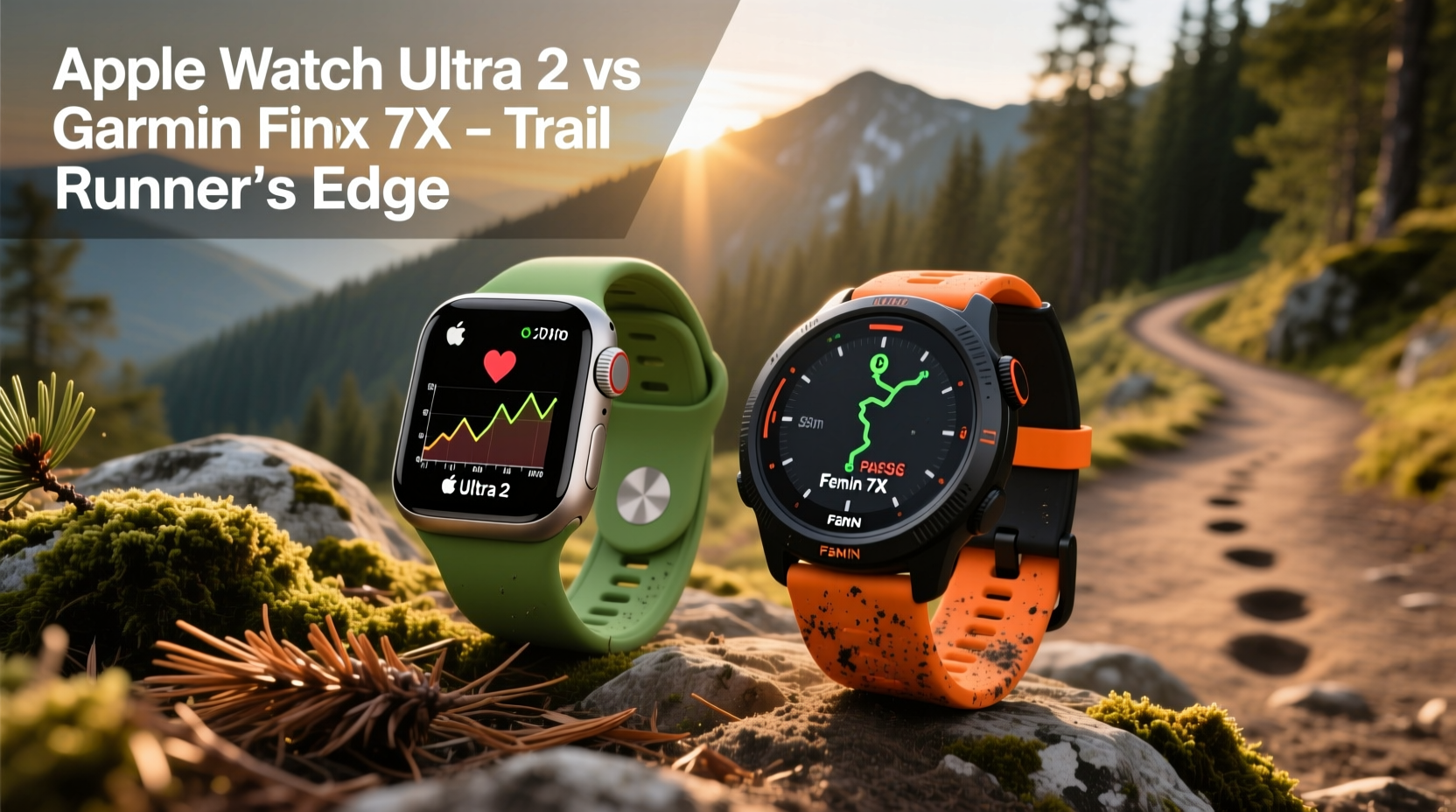
The first test any trail runner’s watch must pass is durability. Whether it’s a fall on rocky terrain, exposure to rain, or constant sweat and dust, the device must endure relentless conditions.
The Apple Watch Ultra 2 features a titanium case, sapphire crystal front, and an IP6X dust resistance rating with WR100 water resistance—meaning it can survive depths up to 100 meters. Its flat, angular design includes a prominent Action button, which can be programmed for quick access to workouts, flashlight, or dive modes. The flat edges make screen navigation intuitive but may collect more dirt during off-trail use.
In contrast, the Garmin Fenix 7X uses either titanium or fiber-reinforced polymer depending on model, with a domed sapphire lens and similar WR100 water resistance. What sets it apart is its field-tested ruggedness over years of evolution. Garmin designs its Fenix line specifically for extreme environments, and the 7X continues that legacy with reinforced antenna shielding and better shock absorption. It’s slightly bulkier than the Ultra 2, but many long-distance hikers and ultra-runners appreciate the added heft as a sign of robustness.
Tip: For technical trails with frequent scrambling or risk of impact, the Fenix 7X’s thicker bezel offers better screen protection than the Ultra 2’s edge-to-edge glass.GPS Accuracy and Navigation Features
Precise GPS tracking is non-negotiable for trail runners who rely on accurate distance, elevation gain, and route retracing. Both watches support multi-band GNSS (GPS, GLONASS, Galileo, BeiDou), significantly improving location accuracy in dense tree cover or steep canyons.
The Fenix 7X has a clear edge here due to Garmin’s decades of focus on outdoor navigation. It supports full-color topographic maps with TOPO mapping, breadcrumb trails, TracBack routing (which lets you retrace your steps automatically), and advanced waypoint marking. You can pre-load routes from platforms like Komoot or Gaia GPS and follow them turn-by-turn even without phone connectivity.
The Apple Watch Ultra 2, while capable of standalone GPS recording and supporting third-party apps like AllTrails or OnX Backcountry, lacks native offline topographical map navigation. Instead, it relies heavily on connected iPhone functionality for full route planning. When paired with an iPhone, it can display maps and directions via the Workout app, but once disconnected, navigation becomes limited to basic compass guidance and backtracking using the Compass app.
“Trail runners need confidence they won’t get lost. Garmin’s ecosystem gives real-time navigational feedback that’s hard to match—even by premium wearables.” — Daniel Ruiz, Ultrarunning Coach & Outdoor Guide
Battery Life Under Real Trail Conditions
No feature matters more mid-run than battery longevity. A dead watch halfway through a 50-mile race is worse than having no watch at all.
The Apple Watch Ultra 2 promises up to 36 hours in normal mode and 72 hours in Low Power Mode with reduced functionality. However, continuous GPS + music playback drains it faster—closer to 18–24 hours. This makes it suitable for long day hikes or marathons, but not ideal for multi-day ultras unless paired with portable charging solutions.
The Garmin Fenix 7X, especially in solar-equipped models, delivers up to 34 days in smartwatch mode and 57 hours in full GPS mode. With UltraTrac mode (reduced GPS sampling), it extends to over 100 hours. Solar charging further boosts this under direct sunlight, making it viable for unsupported multi-day adventures without needing external power.
| Metric | Apple Watch Ultra 2 | Garmin Fenix 7X |
|---|---|---|
| Smartwatch Mode | 36 hrs (up to 72 in LPM) | Up to 34 days (solar) |
| GPS Only Mode | ~24 hours | 57 hours (up to 113 with solar) |
| Multi-GNSS Mode | ~18 hours | 43 hours (up to 85 with solar) |
| Music Playback + GPS | ~12–15 hours | ~30–35 hours |
If your training involves overnight sections, alpine loops, or races exceeding marathon distance, the Fenix 7X provides peace of mind that the Ultra 2 simply can’t match.
Training Insights and Recovery Metrics
Both devices offer comprehensive health and fitness tracking, but their approaches differ fundamentally.
The Apple Watch Ultra 2 excels in seamless integration with iOS health data. It tracks heart rate variability (HRV), blood oxygen (SpO2), sleep stages, and ECG—all accessible instantly through the Health app. Its new dual-frequency GPS improves elevation accuracy, and the temperature sensor (measured from the back crystal) enables retrospective cycle tracking and potential insights into thermal stress during runs.
However, its post-run analysis remains relatively basic compared to Garmin. While Apple Fitness+ subscribers get guided coaching, there’s no built-in recovery advisor or performance condition metric that adjusts based on readiness.
The Fenix 7X goes deeper with its suite of training load analytics. It calculates Training Load Focus, evaluates cardiovascular strain, and provides a Recovery Time recommendation after intense efforts. Its Morning Report summarizes sleep quality, HRV status, and suggested workout intensity for the day. These tools are invaluable for runners periodizing training blocks or preparing for peak events.
Garmin also scores higher in sport-specific metrics: vertical oscillation, ground contact time balance, cadence alerts, and even lactate threshold estimation—all available directly on-device or via Garmin Connect.
Tip: Use the Fenix 7X’s “Race Widget” to simulate pacing strategies before key events using historical grade-adjusted pace data.Real-World Example: A 50K Trail Race Scenario
Consider Sarah, an experienced trail runner preparing for a challenging 50K race through variable terrain—forest paths, river crossings, and exposed ridgelines. She starts early morning with her watch set to multi-GNSS mode for maximum accuracy.
With the Fenix 7X, she loads a pre-planned route from her desktop using BaseCamp. During the race, the watch vibrates at each upcoming turn, displays elevation ahead, and warns her when she’s pushing above optimal heart rate zones. At mile 30, her battery reads 40% remaining—more than enough to finish. After crossing the line, her recovery advisor suggests 48 hours of light activity before resuming structured training.
If Sarah used the Apple Watch Ultra 2, she’d have excellent GPS tracking and real-time metrics synced beautifully to her iPhone. But if she didn’t carry her phone, she wouldn’t receive turn prompts unless manually checking the Compass app. Her battery would dip below 20% near the end, triggering low-power warnings. Post-race, she’d see heart rate trends and calories burned—but no automated recovery timeline.
In high-stakes, remote environments, predictability and autonomy win. The Fenix 7X proves itself as a tool designed *for* the trail; the Ultra 2, though impressive, still feels optimized *around* urban and lifestyle use cases.
Connectivity and Daily Usability
Outside of running, daily usability plays a major role in user satisfaction.
The Apple Watch Ultra 2 shines here. It supports cellular calling, messaging, Apple Pay, third-party apps (Strava, Spotify, Nike Run Club), and seamless handoff with AirPods. Notifications appear instantly, and Siri voice commands work fluidly. For runners who want one device for fitness, communication, and media, it’s unmatched in integration.
The Fenix 7X offers basic smartphone notifications, music storage (supporting offline playlists on select services), and Garmin Pay. However, its interface is menu-driven and less responsive than Apple’s touchscreen. App availability is limited, and voice assistant support is absent. It’s built to function independently—not to replace your phone.
If you value staying connected during commutes, gym sessions, or casual outings, the Ultra 2 enhances everyday life far beyond the trail. But if you prioritize minimal distraction and extended autonomy, the Fenix 7X keeps you focused on movement, not messages.
Checklist: Choosing the Right Watch for Your Needs
- Choose the Apple Watch Ultra 2 if:
- You're deeply embedded in the Apple ecosystem
- Your runs rarely exceed 4–5 hours
- You value sleek design and wrist comfort
- You want cellular, payments, and rich app support
- You train mostly on marked trails with reliable navigation cues
- Choose the Garmin Fenix 7X if:
- You run ultras, backpack, or explore off-grid
- Battery life is a top concern
- You rely on turn-by-turn navigation without a phone
- You want advanced training analytics and recovery insights
- You frequently switch between sports (climbing, swimming, skiing)
FAQ
Can the Apple Watch Ultra 2 navigate trails without a phone?
Limited capability. While it can record GPS tracks and use the Compass app to guide you back along your path, it does not support downloadable offline maps or turn-by-turn navigation without prior syncing via iPhone. Third-party apps like ViewRanger offer partial solutions, but not natively integrated.
Is the Garmin Fenix 7X too bulky for small wrists?
The 7X has a 51mm bezel and weighs approximately 87g (titanium). Some users with smaller wrists find it cumbersome, especially during fast-paced runs. Consider trying the Fenix 7S or 7 if size is a concern—though you’ll sacrifice some battery and screen real estate.
Which watch has better heart rate accuracy during trail runs?
Both use optical sensors with similar accuracy under steady conditions. However, Garmin’s Elevate v4 sensor performs slightly better during rapid elevation changes and uneven motion typical of trail running. Independent tests show Garmin maintains consistency across technical descents, whereas Apple may lag briefly during sudden spikes.
Final Verdict: Purpose Defines Performance
The Apple Watch Ultra 2 is the most advanced smartwatch ever made for active lifestyles. It blends elegance, power, and connectivity into a package that elevates daily routines and supports serious athletic effort. For weekend warriors, city-to-trail commuters, and tech-savvy runners who stay within cellular range, it’s an exceptional choice.
The Garmin Fenix 7X, however, is engineered for survival and sustained performance. It doesn’t dazzle with apps or notifications—it empowers with endurance, precision, and independence. When the trail disappears, the weather turns, and your only companion is your gear, the Fenix 7X becomes part of your survival toolkit.
Ultimately, the decision comes down to intent. Are you running trails as an extension of a connected, dynamic life? Or are you venturing into places where connection fades and self-reliance begins? One watch enhances your world. The other helps you conquer it.
🚀 Ready to choose your next adventure companion? Assess your longest runs, remotest routes, and daily habits—then pick the watch that aligns with where you’re headed, not just where you’ve been.








