
Core strength is more than just visible abs—it’s about stability, posture, injury prevention, and functional movement. Two of the most popular mind-body disciplines, Pilates and yoga, are frequently praised for building a stronger core. But when it comes to speed and effectiveness in toning, which one truly delivers faster results? The answer isn’t straightforward, as both practices offer unique advantages rooted in different philosophies and biomechanics.
While yoga emphasizes flexibility, breath, and balance through sustained postures, Pilates focuses on controlled, isolated movements designed to activate deep abdominal muscles. Understanding how each method targets the core—transverse abdominis, obliques, rectus abdominis, and pelvic floor—is key to determining which path aligns with your goals, especially if you're aiming for visible definition and improved muscular endurance in less time.
The Core Anatomy: What Are You Actually Toning?
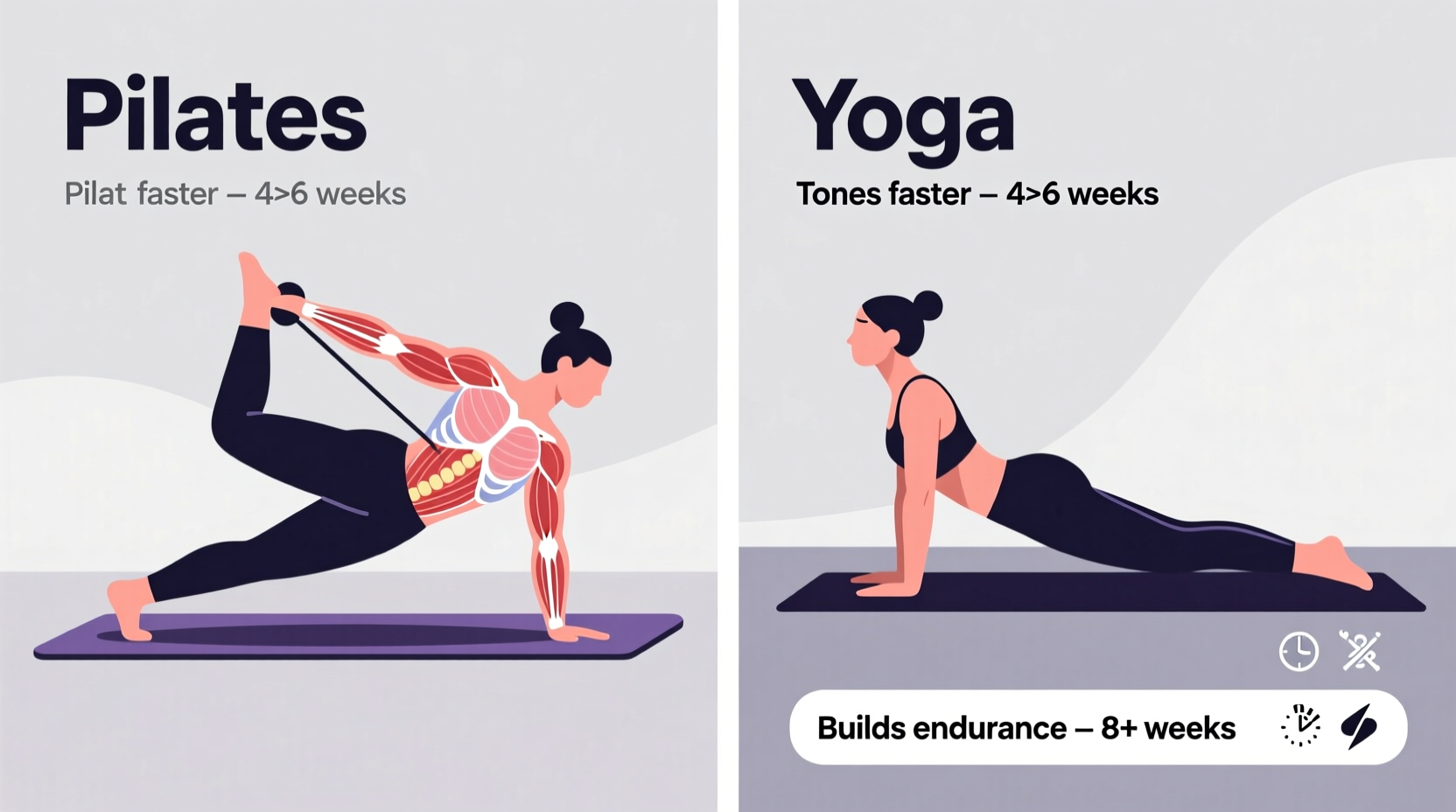
Before comparing Pilates and yoga, it's essential to understand what \"core strength\" really means. The core includes not only the front abdominal muscles but also the lower back (erector spinae), hips (glutes and hip flexors), and pelvic stabilizers. A strong core supports spinal alignment, enhances athletic performance, and reduces lower back pain.
The primary muscles involved in core toning include:
- Rectus abdominis: The \"six-pack\" muscle responsible for trunk flexion.
- Transverse abdominis: The deepest layer, acting like a natural corset for spinal support.
- Internal and external obliques: Control rotation and lateral bending.
- Erector spinae: Maintain upright posture and extend the spine.
- Pelvic floor muscles: Support internal organs and contribute to stability.
Toning refers to increasing muscle definition through a combination of resistance training and reduced body fat. Both Pilates and yoga can build endurance and neuromuscular control, but their approaches differ significantly in intensity, repetition, and focus.
Pilates: Precision-Based Core Conditioning
Invented by Joseph Pilates in the early 20th century, this system was originally developed for rehabilitation and performance enhancement. Pilates places heavy emphasis on controlled movements, proper alignment, and what practitioners call \"the powerhouse\"—a term referring to the entire center of the body from the lower ribs to the pelvis.
Mat-based and reformer Pilates exercises often isolate the core using minimal momentum. Movements like the Hundred, Roll-Up, and Teaser directly engage the rectus abdominis and transverse abdominis through repeated contractions and isometric holds.
Tip: Focus on engaging your lower abs during Pilates exercises by imagining pulling your pubic bone toward your navel—this activates the transverse abdominis more effectively.One of the reasons Pilates excels at fast core toning is its use of progressive overload. Whether using body weight or resistance from springs on a reformer, you can gradually increase difficulty. For example, progressing from single-leg stretches to double straight-leg lowers increases abdominal demand significantly.
A 2020 study published in the *Journal of Sports Science & Medicine* found that participants who practiced mat Pilates three times per week for eight weeks showed a 27% increase in core endurance compared to a control group. This suggests that consistent Pilates training leads to measurable improvements in muscular stamina and tone within two months.
Yoga: Functional Strength Through Stability and Breath
Yoga, with roots in ancient Indian philosophy, integrates physical postures (asanas), breathwork (pranayama), and meditation. While not traditionally viewed as a strength-building practice, many styles—especially Vinyasa, Ashtanga, and Power Yoga—require significant core engagement to maintain balance and transition between poses.
Poses like Plank, Boat (Navasana), Side Plank (Vasisthasana), and Crow Pose rely heavily on core stabilization. Unlike Pilates, where the focus is often on segmental control, yoga develops dynamic stability—using the core to support full-body movement and balance.
However, yoga generally uses fewer repetitions and longer holds, emphasizing endurance over hypertrophy. While this builds incredible functional strength and awareness, the rate of visible toning may be slower than with Pilates due to lower mechanical tension and volume.
“Yoga strengthens the core indirectly through integration. You’re not just isolating muscles—you’re teaching them to work together in harmony.” — Dr. Loren Fishman, MD, specialist in yoga therapy and musculoskeletal rehabilitation
That said, advanced yogis develop impressive core definition over time. A 2016 study in the *International Journal of Yoga* noted that regular practitioners demonstrated improved postural control and increased activation of deep abdominal muscles after 12 weeks. However, the changes were more subtle and focused on neuromuscular efficiency rather than rapid muscle sculpting.
Comparative Analysis: Pilates vs Yoga for Core Toning Speed
To determine which modality tones the core faster, consider these four factors: muscle activation, repetition frequency, progression potential, and overall training volume.
| Factor | Pilates | Yoga |
|---|---|---|
| Muscle Activation | High, targeted activation of deep core muscles with precise cues | Moderate to high, but more integrated across multiple muscle groups |
| Repetition & Volume | Higher number of core-specific repetitions per session | Fewer direct core exercises; focus spreads across flexibility and balance |
| Progressive Overload | Clear progression via added resistance (reformer) or complexity | Limited; progression based on pose mastery, not resistance |
| Time to Visible Toning | Noticeable changes in 6–8 weeks with consistent practice | Visible results typically emerge after 10–12+ weeks |
| Best For | Rapid core definition, postural correction, rehab | Functional strength, mind-body connection, holistic fitness |
This comparison shows that Pilates generally provides faster toning results due to its higher specificity, repetition count, and structured progression. If your primary goal is to see defined abs and feel tighter core engagement in daily activities within a few weeks, Pilates has the edge.
Real-World Example: A 6-Week Transformation
Sarah, a 34-year-old office worker, wanted to strengthen her core after experiencing chronic lower back discomfort. She committed to two routines: first, six weeks of daily 30-minute beginner yoga sessions focusing on Sun Salutations and core-centric poses. She noticed improved flexibility and slight tightening but no dramatic visual change.
She then switched to a structured Pilates program—three 45-minute mat classes per week, emphasizing the Hundred, Criss-Cross, and Saw variations. By week five, she could perform advanced progressions with control, and her clothes fit more snugly around the waist. At week six, her trainer measured a 1.5-inch reduction in waist circumference and a noticeable improvement in abdominal definition.
Sarah’s experience reflects a common trend: while yoga builds foundational strength and awareness, Pilates accelerates visible toning due to its targeted, repetitive nature.
Maximizing Results: A Hybrid Approach
For optimal core development, combining both practices can yield superior long-term results. Use Pilates for focused toning and muscle isolation, and complement it with yoga to enhance flexibility, breath coordination, and full-body integration.
Tip: Alternate days—Pilates on Monday, Wednesday, Friday; yoga on Tuesday and Thursday. This prevents overuse while promoting recovery and mobility.Here’s a sample weekly plan for fast core toning:
- Monday: 45-minute mat Pilates (focus on roll-ups, scissors, teaser)
- Tuesday: 30-minute Vinyasa flow (emphasize Plank, Chaturanga, Boat Pose)
- Wednesday: Reformer Pilates or intermediate mat class
- Thursday: Rest or gentle restorative yoga with breathwork
- Friday: Advanced Pilates circuit targeting obliques and lower abs
- Saturday: Active recovery—walking or light stretching
- Sunday: Mindful yoga session focusing on alignment and core engagement in standing balances
This balanced approach leverages the strengths of both systems: Pilates for speed and definition, yoga for sustainability and joint health.
FAQ: Common Questions About Pilates, Yoga, and Core Development
Can I get a six-pack just from Pilates or yoga?
Visible abs depend on both muscle development and low body fat percentage. While Pilates builds the abdominal muscles effectively, achieving a six-pack also requires dietary attention to reduce visceral and subcutaneous fat. Yoga contributes less directly to hypertrophy but supports overall wellness, which aids in sustainable fat loss.
Is Pilates better than crunches for core strength?
Yes. Unlike traditional crunches, which primarily target the superficial rectus abdominis and can strain the neck and spine, Pilates engages the entire core—including the deep stabilizing muscles—with controlled, safe movements. It promotes balanced strength without compromising spinal health.
How soon will I feel stronger in my core?
Most people report improved core engagement and stability within 2–3 weeks of consistent practice (3x per week). Visible toning typically appears between 6 and 10 weeks, depending on frequency, diet, and starting fitness level.
Action Plan: How to Start Building a Stronger Core Now
If your goal is faster core toning, follow this step-by-step guide to get started immediately:
- Assess your current routine: Are you doing any core work now? Identify gaps in frequency or technique.
- Choose your primary method: Pick Pilates if you want faster definition; choose yoga if you prioritize balance and mindfulness alongside strength.
- Commit to consistency: Schedule at least three sessions per week, each lasting 30–45 minutes.
- Focus on form: Watch instructional videos or take a beginner class to learn proper engagement cues (e.g., “navel to spine” for transverse activation).
- Track progress: Take photos, measure waist circumference, or note improvements in plank hold time every two weeks.
- Add variety: After four weeks, introduce new challenges—try a reformer class, attend a Power Yoga workshop, or incorporate props like resistance bands.
Conclusion: Choose Based on Goals, Then Commit
When comparing Pilates vs yoga for core strength, Pilates emerges as the faster route to visible toning. Its precision-based methodology, emphasis on repetition, and capacity for progressive overload make it ideal for those seeking defined, stronger abs in a shorter timeframe. Yoga, while powerful for functional strength and mental clarity, tends to produce more gradual changes in muscle definition.
Ultimately, the best choice depends on your personal goals. Want quicker results and targeted sculpting? Start with Pilates. Seeking a holistic practice that builds strength alongside flexibility and calm? Yoga may be your match. For the fastest, most sustainable transformation, combine both—let Pilates shape your core, and let yoga integrate that strength into every movement you make.
🚀 Ready to transform your core? Begin with one Pilates session this week and notice the difference in how your body feels. Share your journey in the comments below—we’d love to hear what works for you!








