Parrots are among the most vocal and cognitively advanced birds in the animal kingdom. Their ability to imitate sounds—ranging from human speech to household appliances—is both fascinating and sometimes puzzling. If you’ve ever been startled by a sudden \"beep-beep-beep\" coming from your parrot, only to realize it’s perfectly mimicking the microwave, you’re not alone. This behavior isn’t random or malfunctioning; it’s rooted in biology, psychology, and environmental cues. Understanding why your parrot replicates such sounds offers insight into their intelligence, emotional needs, and how they interpret the world around them.
The Science Behind Parrot Mimicry
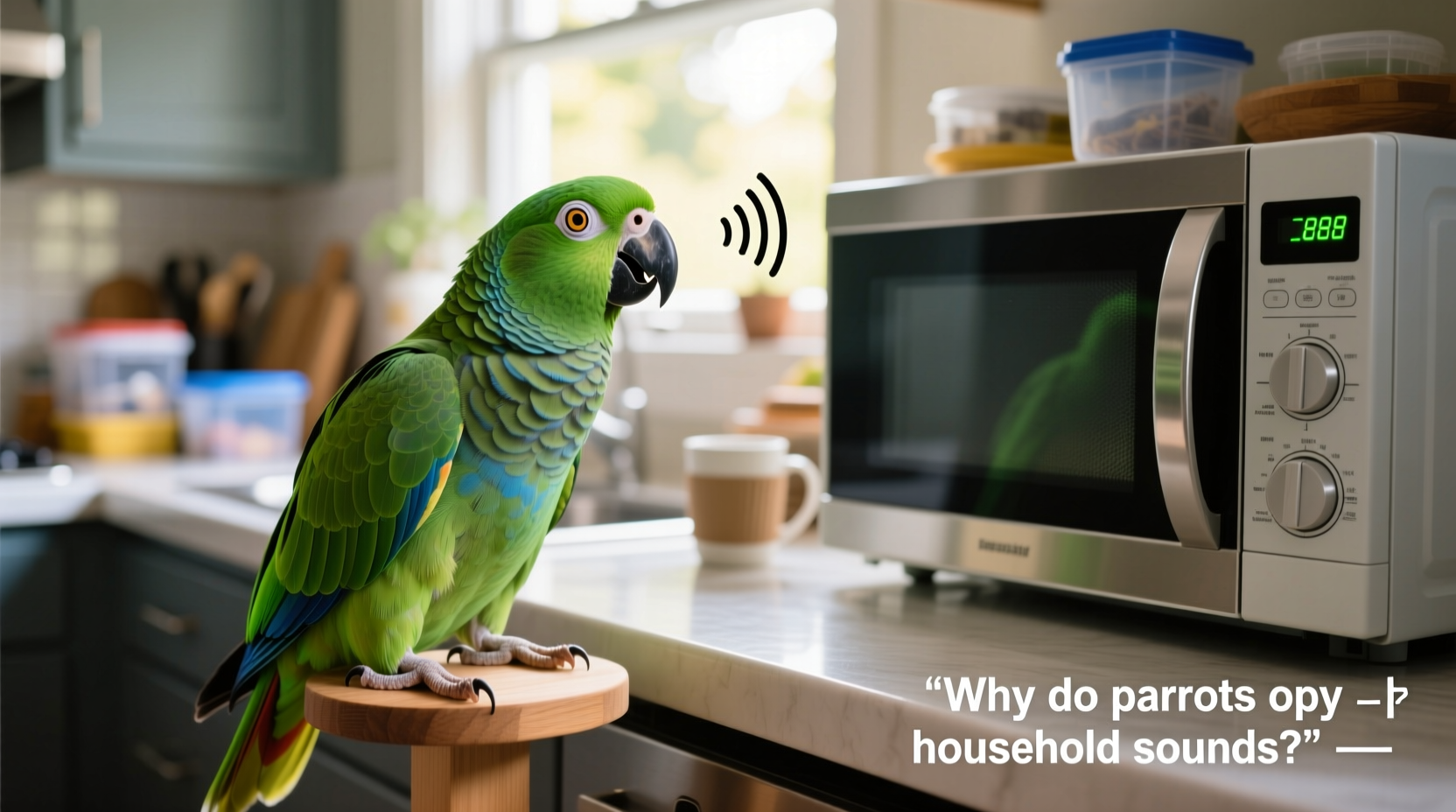
Parrots don’t just repeat sounds—they learn them. Unlike many animals that produce instinctive calls, parrots possess a rare neurological trait: vocal learning. This means they can hear a sound, process it, and reproduce it with remarkable accuracy. In the wild, this skill helps young parrots integrate into flocks by matching the contact calls of their group. In captivity, however, the flock includes humans—and all the mechanical noises that come with modern living.
Studies have shown that parrots use mimicry as a form of social bonding. When a parrot repeats the microwave beep, it may be attempting to participate in its environment, much like a child repeating a phrase they hear often. The brain structures involved—the song system nuclei—are highly developed in species like African Greys, Amazons, and Cockatoos, making them especially adept at picking up repetitive, high-pitched tones like appliance beeps.
“Parrots are auditory sponges. They absorb sounds not because they understand the function, but because those sounds are part of their social landscape.” — Dr. Irene Pepperberg, Avian Cognition Researcher, Harvard University
Why the Microwave Beep Specifically?
Not all household sounds captivate parrots equally. The microwave beep stands out for several reasons:
- Repetition: Microwaves emit the same sharp tone multiple times daily, reinforcing the sound in the bird’s memory.
- Pitch and Clarity: The high-frequency beep falls within the optimal hearing range for most parrots (1–4 kHz), making it easy to detect and reproduce.
- Association with Activity: The beep often precedes feeding time, human movement, or attention—key events in a parrot’s routine.
- Sudden Onset: The abrupt start of the beep grabs attention, increasing the likelihood of imitation.
In essence, the microwave beep is predictable, noticeable, and tied to meaningful moments. To a parrot, it’s not just noise—it’s a signal embedded in the rhythm of daily life.
Tip: If your parrot frequently mimics appliance sounds, observe when they do it. Are they seeking attention? Bored? Or simply practicing a learned behavior?What This Behavior Reveals About Your Parrot’s Mind
Mimicking the microwave beep isn’t merely a party trick—it reflects deeper cognitive processes. Parrots categorize sounds based on context and consequence. A bird that beeps after the actual microwave might be testing cause and effect, or even attempting communication.
For example, if every time the microwave beeps, someone walks into the kitchen, the parrot may begin using the same sound to summon people. This demonstrates associative learning: the bird connects the sound with an outcome and uses it strategically. Some owners report their parrots beeping when hungry, suggesting the sound has become a conditioned cue for food-related activity.
This level of behavioral flexibility is rare in the animal kingdom. It indicates that your parrot isn’t just imitating—it’s interpreting. They’re mapping out patterns in their environment and using sound as a tool to navigate social interactions.
Mini Case Study: Charlie the Amazon Parrot
Charlie, a double-yellow-headed Amazon, lived with a family in Portland who used the microwave several times a day, mostly for reheating meals. Over six months, Charlie began reproducing the four-tone sequence with near-perfect pitch. What surprised the owners was timing: Charlie didn’t just mimic the beep—he started doing it when he wanted attention.
One evening, while the family watched TV, Charlie emitted the microwave sound. When no one responded, he repeated it louder. Finally, the youngest daughter walked into the kitchen, only to find the microwave untouched. She returned to the living room laughing, “Charlie’s calling us!” From then on, the family recognized the “fake beep” as Charlie’s way of saying, “I want to be included.”
This case illustrates how parrots assign functional meaning to sounds beyond their original purpose. For Charlie, the beep evolved from mimicry into a communicative signal.
Environmental Influences on Sound Imitation
A parrot’s surroundings play a crucial role in shaping its vocal repertoire. Birds kept in quiet homes with minimal auditory stimulation tend to develop smaller sound libraries. Conversely, those in active households pick up everything from doorbells to phone ringtones.
The presence of electronic beeps—microwaves, timers, alarms, washing machines—creates a sonic environment rich in short, repetitive signals. These are ideal for mimicry because they’re consistent and easy to break down into components. Parrots often master these before full sentences.
Additionally, loneliness or lack of interaction can drive increased vocalization. A parrot left alone for long periods may mimic familiar sounds to self-soothe or create a sense of connection. In this context, the microwave beep becomes a comfort sound—a reminder of human activity and routine.
| SOUND TYPE | WHY PARROTS COPY IT | Likelihood of Repetition |
|---|---|---|
| Microwave beep | High frequency, repeated daily, linked to feeding | ★★★★★ |
| Doorbell | Sudden, triggers human response | ★★★★☆ |
| Phone ringtone | Attention-grabbing, variable melodies | ★★★★☆ |
| Human speech | Strong social reinforcement | ★★★★★ |
| Television jingle | Musical, repetitive, emotionally charged | ★★★☆☆ |
How to Respond: Encouragement vs. Management
While mimicking the microwave beep is natural, unchecked repetition can become disruptive. The key is not to suppress the behavior entirely, but to guide it constructively. Parrots need mental engagement, and vocalization is one of their primary outlets.
Instead of discouraging mimicry, redirect it. Teach your parrot to associate certain sounds with specific rewards. For instance, if they beep, respond positively only when it’s not excessive. Use clicker training to reinforce desirable behaviors like quiet sitting or speaking on command.
Step-by-Step Guide: Managing Excessive Beeping
- Observe Triggers: Note when and why your parrot mimics the beep. Is it during idle time? Before meals?
- Introduce Alternatives: Play recorded bird calls or gentle music to diversify their auditory environment.
- Train a Cue: Use a word like “quiet” followed by a treat when the bird stops vocalizing.
- Enrich the Environment: Add puzzle toys, foraging boxes, or rotating perches to reduce boredom.
- Limit Exposure: If possible, mute appliance sounds or use models with softer alerts.
- Reinforce Quiet Time: Reward calm behavior with attention or treats, so silence becomes rewarding too.
Checklist: Supporting Healthy Vocal Development
- ✅ Spend 30+ minutes of direct interaction daily
- ✅ Rotate toys weekly to prevent boredom
- ✅ Provide foraging opportunities (hidden treats in shredded paper or puzzles)
- ✅ Limit exposure to harsh or loud mechanical sounds
- ✅ Use positive reinforcement for desired vocalizations
- ✅ Record your parrot’s sounds to track progress and identify patterns
- ✅ Consult an avian behaviorist if vocalizations become obsessive or aggressive
FAQ: Common Questions About Parrot Mimicry
Is it normal for my parrot to mimic appliance sounds?
Yes, it’s completely normal. Parrots mimic any frequent, distinct sound in their environment. Appliance beeps are common due to their clarity and repetition. As long as the behavior isn’t compulsive or accompanied by stress signs (pacing, feather damage), it’s a sign of a mentally active bird.
Can I stop my parrot from mimicking the microwave?
You can reduce the frequency, but not eliminate it entirely once learned. Instead of suppression, focus on enrichment and redirection. Replace the beep with more interactive sounds or words you’d prefer them to say. Remember, mimicry is a healthy expression of intelligence.
Does mimicking mean my parrot understands the sound?
Not necessarily. Parrots often mimic without understanding the meaning, though they may learn associations over time. For example, they might link the beep with food arrival and use it to request a meal. True comprehension varies by individual and species, with African Greys showing the highest levels of semantic understanding.
Conclusion: Embracing Your Parrot’s Unique Voice
Your parrot’s imitation of the microwave beep is more than a quirky habit—it’s a window into their mind. It shows they’re listening, learning, and trying to engage with the world you share. Rather than viewing it as a nuisance, consider it a testament to their adaptability and emotional depth.
By understanding the reasons behind this behavior, you can foster a richer relationship with your bird. Encourage healthy vocalization, provide mental stimulation, and celebrate the unique ways your parrot expresses itself. After all, every beep, whistle, or word is a form of connection—one that bridges species and deepens companionship.
💬 Have a story about your parrot mimicking household sounds? Share your experience in the comments and help fellow bird owners appreciate the clever minds of their feathered companions!








