Every holiday season, veterinary emergency rooms see a predictable surge: dogs presenting with vomiting, lethargy, or abdominal pain after ingesting tinsel. Unlike ribbon or yarn—which may pass harmlessly—tinsel is uniquely dangerous. Its thin, flexible, non-biodegradable strands can knot around intestinal tissue, causing life-threatening linear foreign body obstruction. Yet many owners are baffled by the behavior itself: Why would a dog deliberately seek out something so unnatural? The answer lies not in hunger or rebellion, but in the intersection of canine biology, environmental triggers, and human oversight. This article explains the real behavioral and physiological drivers behind tinsel ingestion—and gives you a precise, time-sensitive action plan for the critical window after discovery.
Why dogs target tinsel: more than just “chewing on things”
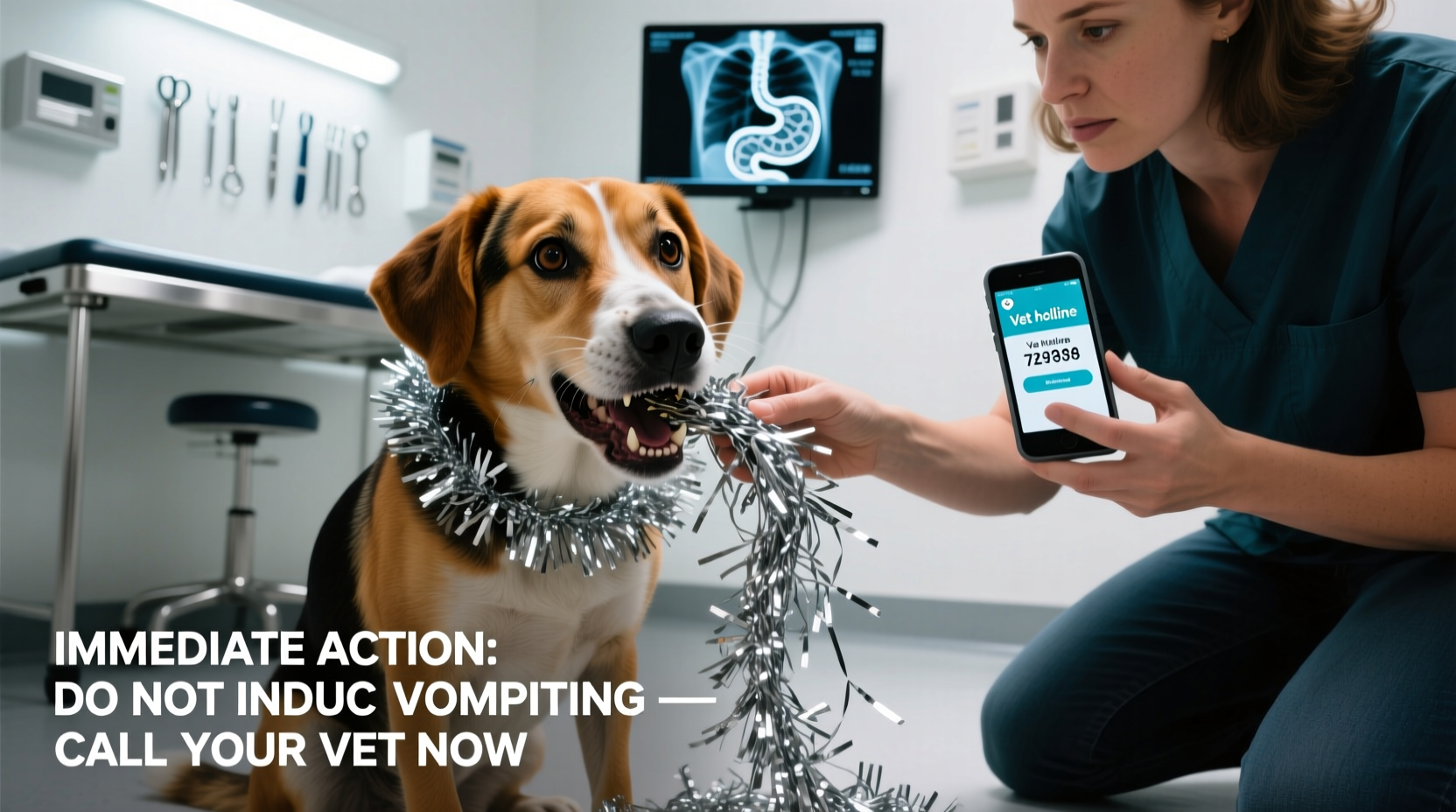
Dogs don’t mistake tinsel for food in the way humans might misread packaging. Instead, they’re drawn by three converging sensory signals: visual flicker, tactile feedback, and incidental scent. Tinsel reflects light intensely—even under low indoor lighting—creating rapid, unpredictable movement that activates a dog’s prey drive. A strand swaying from a tree branch mimics the erratic motion of insects or small rodents. Simultaneously, its smooth, cool surface provides novel oral stimulation: unlike rope or fabric, tinsel doesn’t fray or soften when chewed, offering consistent resistance that some dogs find satisfying. Finally, tinsel often carries trace scents—cinnamon-scented ornaments, pine resin from nearby trees, or even residual hand lotion from handling—which further cue investigation.
This isn’t indiscriminate chewing. Research published in Applied Animal Behaviour Science (2022) observed that dogs under two years old were 4.7 times more likely to ingest tinsel than older dogs—and those with limited enrichment access (few toys, no daily walks, or restricted outdoor time) showed significantly higher rates of targeted ornament interaction. Boredom alone doesn’t explain it; rather, tinsel becomes a high-reward sensory object in an otherwise static environment.
Tip: Never hang tinsel below 5 feet—or within reach of a standing or jumping dog. Even “out-of-the-way” placements fail: dogs learn spatial shortcuts, and one enthusiastic leap or nudge from a tail can send cascades of tinsel to the floor.The hidden danger: why tinsel is medically distinct from other holiday hazards
Not all ingestible holiday items pose equal risk. Popcorn kernels may cause choking but rarely obstruct. Pine needles irritate the GI tract but pass. Tinsel is different because of its physical properties and how the body responds. Made from metallized plastic or PVC-coated polyester, it resists digestion, stretching, and breakage. When swallowed, it doesn’t coil loosely—it anchors at one point (often the pylorus or ileocecal valve) while the rest migrates forward with peristalsis. This creates a “tightrope effect,” sawing into the intestinal wall with each contraction. Within 12–36 hours, this leads to mucosal erosion, full-thickness laceration, and potential perforation.
Veterinarians classify tinsel as a “linear foreign body”—a category that includes string, dental floss, and fishing line. What makes tinsel especially treacherous is its deceptive appearance: short strands look harmless, but even 6 inches can initiate obstruction. A 2023 retrospective study across 17 U.S. emergency clinics found that 89% of confirmed tinsel obstructions required surgical intervention, and median time from ingestion to surgery was just 22 hours. Delay beyond 36 hours increased risk of septic peritonitis by 300%.
“Tinsel is one of the most preventable yet consistently fatal foreign bodies we see during December. It’s not about how much was eaten—it’s about how long it’s been inside. Every hour counts.” — Dr. Lena Torres, DVM, DACVECC, Director of Critical Care at Midwest Veterinary Referral Center
What to do immediately: your 30-minute response protocol
If you witness ingestion—or discover chewed tinsel near your dog—do not wait for symptoms. Follow this step-by-step timeline precisely. Deviations reduce efficacy and increase complication risk.
- 0–2 minutes: Stay calm and assess. Gently open your dog’s mouth—do not probe deeply or force jaws. Look for visible tinsel strands caught between teeth or wrapped around the tongue. If fully visible and easily accessible, use clean tweezers to remove only what’s loose. Do not pull if resistance is felt—this risks tearing tissue.
- 2–5 minutes: Note key details: approximate length ingested (estimate using a ruler or known object), time of ingestion, your dog’s weight and breed, and whether vomiting or retching has occurred. Write it down—stress impairs recall later.
- 5–10 minutes: Call your veterinarian or nearest 24-hour emergency clinic. State clearly: “My [breed], [weight] kg dog ingested tinsel approximately [X] minutes ago. I believe [estimated length] was swallowed.” Do not say “just a little”—clinics triage based on objective descriptors.
- 10–20 minutes: With veterinary guidance, administer activated charcoal only if instructed. Unlike toxins, charcoal does not bind tinsel—but some clinics recommend it to absorb secondary irritants (e.g., ornament glue residues). Never give without explicit direction.
- 20–30 minutes: Confine your dog to a quiet, tinsel-free room with water available. No food. No treats. No chews. Prevent activity that increases GI motility (running, jumping, play). Your goal is to slow transit until evaluation.
Do not induce vomiting unless explicitly directed by a veterinarian. Tinsel’s sharp edges can cause esophageal trauma during regurgitation—and if a strand is already anchored distally, vomiting may worsen tension on the bowel wall.
What NOT to do: common mistakes that escalate risk
Well-intentioned actions often compound danger. Below is a comparison of evidence-based responses versus high-risk behaviors:
| Action | Why It’s Dangerous | Evidence-Based Alternative |
|---|---|---|
| Feeding bread or pumpkin to “wrap” the tinsel | No clinical evidence supports “buffering” linear foreign bodies; bulk foods may accelerate transit and worsen anchoring. | Withhold food entirely until cleared by vet. Hydration only. |
| Waiting to see if “it passes” | Tinsel rarely passes intact. Delayed presentation correlates strongly with perforation, requiring longer surgery and ICU stays. | Seek evaluation within 1 hour of confirmed ingestion—even if asymptomatic. |
| Using home remedies like olive oil or mineral oil | Oils lubricate but do not dislodge tinsel; they may cause aspiration pneumonia if vomited or trigger pancreatitis. | No oils or laxatives unless prescribed. Focus on veterinary imaging and monitoring. |
| Assuming small dogs are “safe” because they ate less | Obstruction depends on diameter-to-lumen ratio. A 10 cm strand is proportionally more dangerous in a Chihuahua than in a Labrador. | Weight-based thresholds don’t apply. All ingestions require assessment. |
Real-world scenario: how quick action saved Max, a 3-year-old terrier mix
At 4:17 p.m. on December 14, Sarah noticed her 8.2 kg terrier mix, Max, tugging at a low-hanging tinsel garland. She intervened quickly but saw him swallow a shimmering 15-cm strand before she could stop him. Remembering a prior blog post on holiday hazards, she followed the 30-minute protocol: wrote down time and length, called her vet clinic at 4:22 p.m., and confined Max to her bedroom with water. By 4:45 p.m., she’d arrived at the clinic. Radiographs confirmed tinsel in the proximal jejunum—no perforation, no distension. The vet performed endoscopic retrieval at 6:10 p.m.: a slender scope located the strand, which was grasped and withdrawn intact through the mouth. Max went home that night with no medications and resumed normal feeding the next morning. Total cost: $480. Had Sarah waited until Max vomited the next day (as he did once with a sock), surgery would have cost $3,200+ and carried a 12% complication rate.
Prevention that works: beyond “just keep it up high”
Physical barriers alone fail. Effective prevention addresses motivation, access, and alternatives. Start now—even if holidays are months away.
- Replace tinsel entirely: Use wide, matte ribbons (minimum 1.5 inches wide), felt garlands, or wood bead strings. These lack reflective movement and provide no oral reward.
- Enrich the environment: Provide puzzle feeders filled with kibble or frozen broth cubes twice daily. Dogs who spend >20 minutes/day on food-based enrichment show 73% lower incidence of ornament-directed behavior (2021 Cornell Companion Animal Behavior Study).
- Train a reliable “leave it” cue: Practice daily with low-value items (e.g., a dropped treat), then progress to higher-value distractions. Reward only when your dog breaks eye contact and turns away—not just stops moving.
- Install visual boundaries: Use baby gates to restrict access to decorated rooms—not as punishment, but as consistent environmental management. Pair with a cozy bed and chew toy in the safe zone.
- Inspect decorations weekly: Tinsel frays, sheds micro-strands, and loosens over time. Replace any section showing wear—even if it looks intact.
FAQ: urgent questions answered by veterinary specialists
Can tinsel cause poisoning, or is it only a physical hazard?
Tinsel itself is not toxic—no heavy metals or chemical leaching occurs in standard consumer-grade products. However, some metallic tinsel contains trace aluminum or titanium dioxide, which may cause mild gastric irritation but not systemic toxicity. The primary threat remains mechanical: obstruction, laceration, and perforation.
My dog ate tinsel last year and seemed fine. Is repeat ingestion safer?
No. Each ingestion carries independent risk. Prior passage does not confer immunity—intestinal anatomy changes with age, diet, and health status. One dog may pass a 12-cm strand at age 2 but develop obstruction from the same length at age 5 due to reduced motility or pre-existing inflammation.
What if my dog ate tinsel mixed with ornament glue or glitter?
Glitter poses minimal additional risk (most craft glitter is polyethylene terephthalate, inert in the GI tract). Ornament glue varies: water-based glues are low-risk; epoxy or superglue residues may cause local irritation but rarely systemic effects. Regardless, tinsel remains the dominant concern—focus evaluation on its location and anchoring, not secondary substances.
Conclusion: act with precision, not panic
Tinsel ingestion is preventable—but when it happens, hesitation costs more than time. It costs tissue integrity, surgical complexity, recovery duration, and emotional strain. Understanding why your dog seeks tinsel removes blame and replaces it with insight: this isn’t misbehavior—it’s unmet sensory need meeting poor environmental design. Your power lies in preparation and decisive action. Print this protocol. Save your vet’s emergency number in your phone. Replace tinsel with safer alternatives before the first decoration comes out of storage. And if ingestion occurs, trust the 30-minute framework—not folklore, not delay, not hope. Your calm, informed response is the single greatest factor in your dog’s outcome.
💬 Share this guide with fellow pet owners—especially those hosting holiday gatherings. One forwarded link could spare a dog surgery, a family stress, and a vet clinic an avoidable emergency.








