Cats are enigmatic creatures. Their sudden bursts of energy, silent observation, and seemingly inexplicable behaviors often leave owners puzzled. One such behavior—your cat staring intently at a blank wall in the middle of the night—is both common and unsettling. While it may appear eerie or even concerning, this action is usually rooted in natural feline instincts, sensory perception, or minor environmental triggers. Understanding why your cat engages in this behavior can ease anxiety and help you determine whether it’s normal or a sign of an underlying issue.
Unlike humans, cats operate on crepuscular rhythms—most active during dawn and dusk—but many also exhibit nocturnal tendencies. This means their peak alertness often coincides with times when their human companions are asleep. During these quiet hours, subtle sounds, air movements, or even light shifts can capture a cat’s attention. When that focus locks onto a wall, it’s rarely about the wall itself—but rather what lies beyond, within, or just outside its surface.
Understanding Feline Sensory Perception
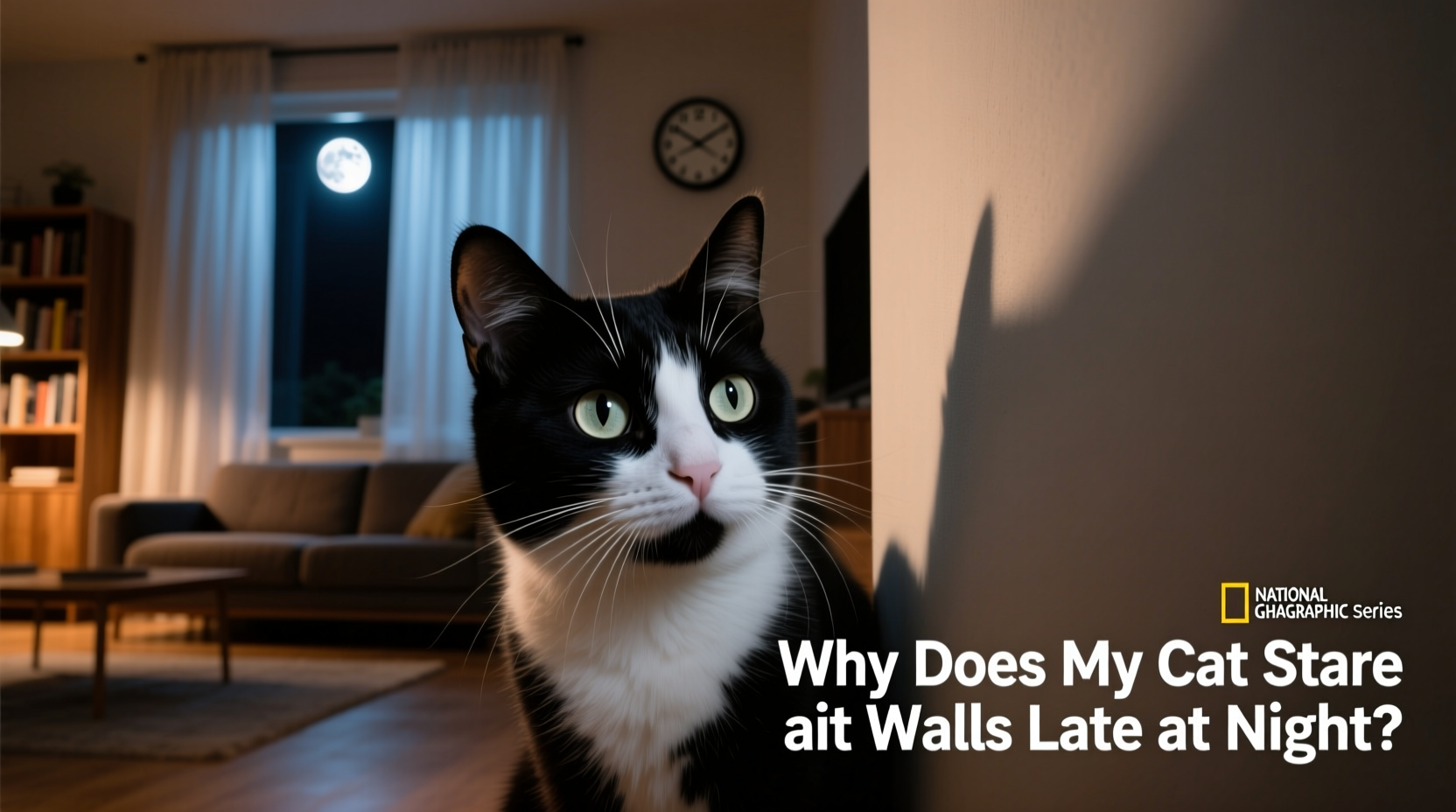
Cats possess senses far more acute than our own. Their hearing, vision, and olfactory capabilities allow them to detect stimuli that go unnoticed by humans. This heightened awareness explains why a cat might fixate on something that appears completely inert to us.
- Hearing: Cats can hear frequencies up to 64 kHz—well above the range of human hearing. They may detect the faint scurrying of insects inside walls, dripping pipes, or even electrical humming from outlets.
- Vision: In low-light conditions, cats see significantly better than humans due to a higher concentration of rod cells in their retinas. Subtle shadows, dust motes, or reflections from moonlight could appear as moving objects to a cat.
- Whiskers and Air Currents: A cat’s whiskers are sensitive to minute changes in airflow. If there's a draft behind a wall or near a vent, your cat may sense movement and investigate visually.
What looks like aimless staring may actually be intense surveillance. Your cat isn’t hallucinating—it’s responding to real sensory input, even if we can't perceive it.
Tip: Use a flashlight at night to check for tiny cracks, insect trails, or drafts near where your cat stares—these could explain the fixation.Common Reasons Cats Stare at Walls at Night
While some causes are benign and instinct-driven, others may hint at deeper issues. Here are the most frequent explanations:
1. Hunting Instincts Triggered by Invisible Prey
Cats are hardwired to stalk and pounce. Even well-fed domestic cats retain strong predatory drives. If your cat hears mice, spiders, or insects moving inside walls or along baseboards, they may lock onto the spot, tracking the unseen creature. The stillness before a potential pounce often manifests as prolonged staring.
2. Shadows and Light Reflections
Nighttime lighting—especially from streetlights, digital clocks, or passing car headlights—can cast flickering shadows or create glimmers on walls. To a cat with motion-sensitive vision, these shifting patterns resemble prey-like movement.
3. Residual Scent or Sound Memory
Cats have excellent memory for locations associated with past events. If a mouse once scratched inside the wall or a bird flew past the window, your cat may return to the same spot, expecting a repeat occurrence.
4. Cognitive Dysfunction in Older Cats
In senior cats (typically over 10 years), staring into space or at walls can be a symptom of feline cognitive dysfunction syndrome (CDS), similar to dementia in humans. Other signs include disorientation, nighttime vocalization, and altered sleep patterns.
5. Seizures or Neurological Issues
In rare cases, wall-staring may be linked to partial (focal) seizures. These episodes involve brief periods of unresponsiveness, twitching, or repetitive blinking while the cat remains upright. If staring is accompanied by muscle rigidity, drooling, or loss of balance, consult a veterinarian immediately.
“Cats don’t stare without reason. Either they’re detecting something we can’t, or there’s a physiological explanation worth investigating.” — Dr. Lena Torres, Veterinary Behaviorist
When to Be Concerned: Red Flags to Watch For
Occasional wall-gazing, especially during active hours, is typically harmless. However, certain behaviors suggest the need for veterinary evaluation. The following table outlines key differences between normal and concerning staring behavior:
| Normal Behavior | Potentially Problematic Behavior |
|---|---|
| Stares briefly (under 30 seconds) | Stares for several minutes without blinking |
| Responds when called | Ignores surroundings and vocal cues |
| Eyes follow actual movement (e.g., shadow) | Eyes fixed, pupils dilated abnormally |
| Resumes normal activity afterward | Appears disoriented or wobbly after episode |
| Occurs occasionally | Happens multiple times per night or daily |
If your cat exhibits three or more red flags from the “Problematic” column, schedule a vet visit. Diagnostic tests such as blood work, neurological exams, or MRI scans may be necessary to rule out medical conditions.
Step-by-Step Guide: What to Do If Your Cat Stares at Walls
Rather than reacting with alarm, follow this logical sequence to assess and address the behavior:
- Observe silently: Note duration, frequency, time of day, and any accompanying actions (vocalizing, pawing, twitching).
- Check the environment: Look for drafts, pests, flickering lights, or electronic devices emitting high-pitched sounds.
- Rule out pests: Inspect baseboards, listen for scratching, and consider pest control if rodents or insects are suspected.
- Monitor other behaviors: Track changes in appetite, grooming, litter box use, or interaction levels.
- Consult your vet: Share your observations and request a full physical and neurological exam, especially if your cat is older or shows additional symptoms.
This methodical approach helps distinguish between instinctive behavior and potential health concerns.
Mini Case Study: Bella the Wall-Watcher
Bella, a 7-year-old tabby, began staring at the living room wall every night around 2 a.m. Her owner, Mark, initially dismissed it as quirky behavior. But when Bella started meowing loudly during these episodes and seemed unable to respond when called, he grew concerned.
After ruling out pests and checking for drafts, Mark recorded a video of one episode. The footage showed Bella’s eyes darting rapidly, her body rigid, and her tail twitching—despite no visible stimulus on the wall. A veterinary neurologist reviewed the clip and diagnosed Bella with mild focal seizures. With anti-seizure medication, the episodes stopped entirely within two weeks.
Bella’s case illustrates how subtle signs can escalate if ignored—and why documentation is crucial when seeking professional help.
Tip: Record a short video of your cat’s staring episodes to show your vet. It provides invaluable insight into the nature of the behavior.Preventive Measures and Environmental Enrichment
Even if your cat’s wall-staring has a benign cause, reducing unnecessary stimulation at night can minimize stress and prevent obsessive fixation. Consider the following checklist to improve your cat’s nighttime experience:
- ✅ Provide interactive toys before bedtime to burn excess energy.
- ✅ Install blackout curtains to reduce external light disturbances.
- ✅ Use white noise machines to mask high-frequency household sounds.
- ✅ Rotate toys weekly to maintain mental engagement.
- ✅ Create elevated perches near windows for daytime bird-watching (reducing nighttime curiosity).
- ✅ Avoid feeding right before bed; instead, use timed feeders to simulate hunting patterns.
Environmental enrichment plays a vital role in preventing boredom-related behaviors. A mentally stimulated cat is less likely to develop compulsive habits—even if those habits involve staring at drywall.
Frequently Asked Questions
Is it normal for cats to stare at walls?
Yes, occasional staring is normal, especially at night when cats are more alert. As long as the behavior is brief and your cat responds normally afterward, it’s likely due to sensory detection or instinctual scanning.
Can cats see ghosts or spirits?
There is no scientific evidence that cats see supernatural entities. However, their superior senses may pick up on stimuli we cannot perceive—such as ultrasonic sounds, infrared heat patterns, or vibrations—which might fuel myths about \"seeing ghosts.\"
Should I stop my cat from staring at walls?
Interfering is not recommended unless the behavior is excessive or disruptive. Gently calling your cat’s name may redirect attention, but forcing interaction could increase anxiety. Focus instead on identifying and addressing root causes.
Conclusion: Decoding the Gaze
Your cat’s midnight wall-staring is rarely a sign of something sinister. More often, it reflects the intricate way felines interact with their world—attuned to subtleties invisible to us. Whether driven by instinct, environment, or, in rare cases, health issues, this behavior invites deeper understanding rather than fear.
By observing calmly, eliminating common triggers, and knowing when to seek professional advice, you can ensure your cat remains healthy, engaged, and secure. Remember: curiosity isn’t just part of your cat’s personality—it’s a survival trait honed over millennia.
💬 Have a story about your cat’s mysterious nighttime behavior? Share your experience in the comments below—your insight could help another pet owner decode the silent language of cats.








