It’s a familiar scene: someone cooing at their dog, “Did you miss Mommy today?” or telling their cat, “You’re such a dramatic little drama queen.” Despite knowing their pets can’t respond in words, people routinely speak to them with full emotional investment, as though they’re having a real conversation. This behavior isn’t just whimsical—it’s deeply rooted in human psychology, neuroscience, and the biology of attachment. The act of talking to pets goes far beyond cute anecdotes; it plays a crucial role in strengthening the bond between humans and animals, often triggering measurable changes in both parties’ brains and behaviors.
Scientists have found that these seemingly one-sided conversations are actually rich social interactions. They reflect our innate need for connection and reveal how we anthropomorphize animals not out of ignorance, but as a natural extension of empathy and caregiving instincts. What may appear as silly pet-parent babble is, in fact, a window into the powerful emotional architecture that underpins human-animal relationships.
The Psychology Behind Pet-Directed Speech
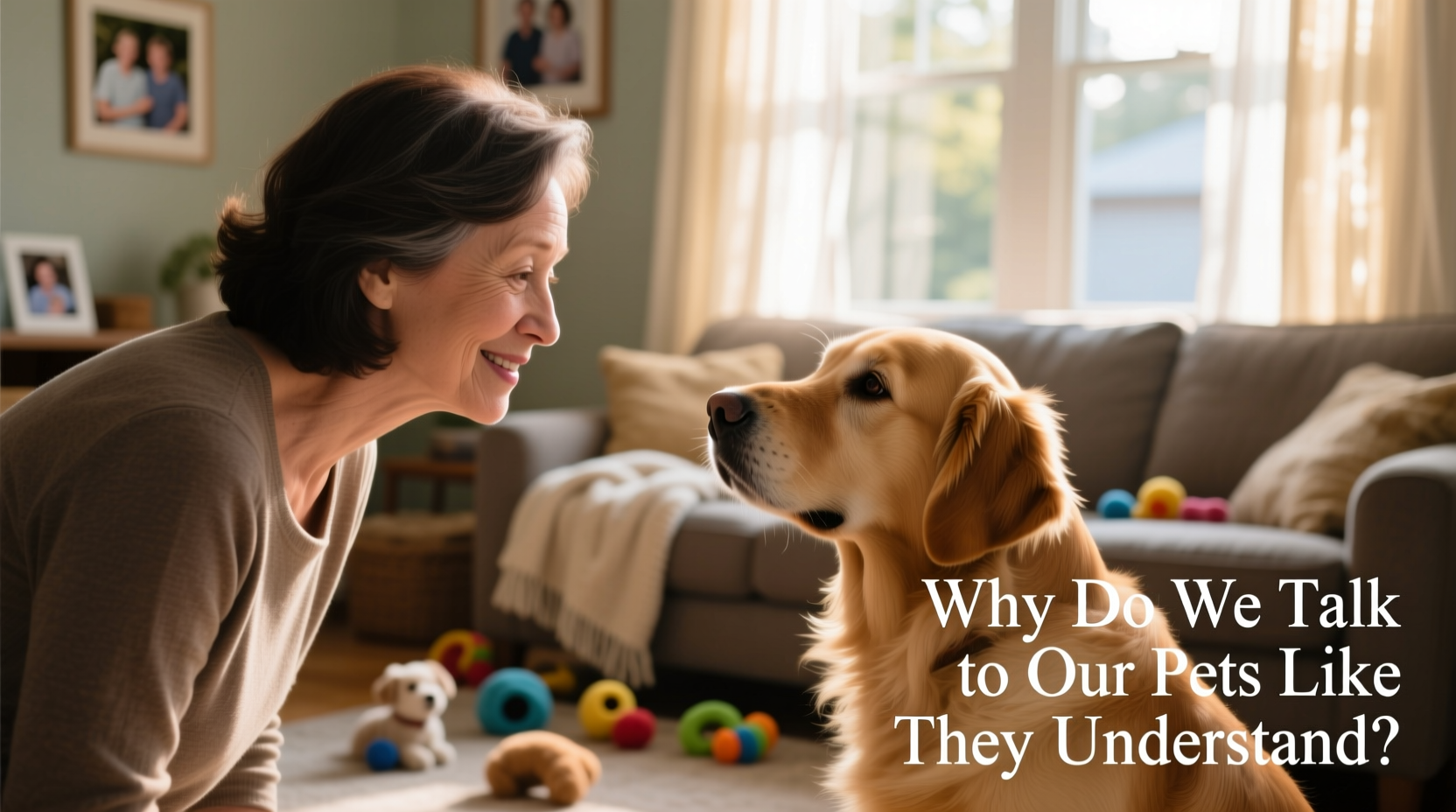
Just as parents use “baby talk” with infants—characterized by higher pitch, exaggerated intonation, and simplified vocabulary—many people instinctively shift into a similar tone when speaking to pets. This form of communication, known as pet-directed speech (PDS), mirrors infant-directed speech (IDS), which research shows helps babies tune into language patterns and fosters emotional bonding.
A 2017 study published in *Animal Cognition* demonstrated that dogs pay more attention to PDS than to normal adult speech, especially when the speaker uses emotionally expressive tones. While cats may seem less responsive, anecdotal evidence and behavioral observations suggest they also recognize and react to vocal cues tied to affection, commands, or distress.
This linguistic adaptation isn’t about expecting verbal replies. Instead, it serves as an emotional conduit. When humans raise their voices slightly, soften their tone, or repeat phrases like “Who’s a good boy?”, they’re signaling safety, warmth, and positive intent—cues that animals pick up through tone, rhythm, and body language.
Tip: Use consistent phrases paired with positive reinforcement—your pet may not understand every word, but they’ll associate your voice with comfort and reward.Neurochemical Bonds: Oxytocin and the “Love Hormone” Loop
The foundation of the human-pet bond lies in neurochemistry. One key player is oxytocin, often dubbed the “love hormone” or “bonding hormone.” Released during physical touch, eye contact, and nurturing behaviors, oxytocin reinforces social attachments across species.
In a groundbreaking 2009 Japanese study, researchers observed that when dog owners gazed into their dogs’ eyes, both parties experienced a significant rise in oxytocin levels—mirroring the hormonal exchange seen between mothers and infants. Remarkably, this cross-species oxytocin loop did not occur as strongly with wolves, even those raised by humans, suggesting that domestication has fine-tuned dogs to participate in human emotional signaling.
Talking to pets—especially in gentle, affectionate tones—can trigger this same neurochemical cascade. Verbal interaction, particularly when combined with petting or shared activities, signals care and attention, prompting oxytocin release in both owner and animal. Over time, this creates a feedback loop where each interaction deepens trust and attachment.
“Oxytocin doesn’t discriminate based on species. It responds to emotional connection—and talking to your pet is a powerful way to cultivate that.” — Dr. Paul Zak, Neuroeconomist and Oxytocin Researcher
Anthropomorphism: Why We Attribute Understanding to Pets
Humans are wired to interpret behavior through a social lens. We naturally assign intentions, emotions, and thoughts to others—even non-humans. This tendency, called anthropomorphism, isn’t necessarily flawed; it’s a cognitive shortcut that helps us navigate complex social environments.
When a dog tilts its head upon hearing a question, many owners interpret it as curiosity or comprehension. A cat sitting beside someone who’s crying might be seen as offering comfort. These interpretations aren’t delusions—they’re empathetic projections grounded in observable behaviors. And while pets don’t process language the way humans do, they *do* perceive emotional context.
Dogs, for example, can distinguish between different emotional tones in human voices and associate specific words with actions (e.g., “walk,” “treat,” “no”). MRI studies show that canine brains respond to praise similarly to food rewards, indicating that verbal affection has intrinsic value to them.
Thus, when people say, “He knows exactly what I’m saying,” they’re not claiming their pet speaks English. They’re expressing a truth on a deeper level: their pet understands *them*—their moods, routines, and emotional rhythms—through years of shared experience.
How Anthropomorphism Strengthens Caregiving
- Promotes attentiveness: Owners who believe their pets have feelings are more likely to notice subtle behavioral changes, leading to better health monitoring.
- Encourages consistency: Viewing a pet as a thinking, feeling being supports structured routines, training, and long-term commitment.
- Fosters empathy: Assigning emotional depth to animals reduces neglect and increases willingness to invest time and resources in their well-being.
Bonding Through Routine Communication: A Case Study
Sarah, a nurse from Portland, adopted Luna, a mixed-breed rescue dog, after a period of personal burnout. Initially distant and anxious, Luna would flinch at sudden movements and avoid eye contact. Sarah began talking to her constantly—not just commands, but narration: “I’m making dinner,” “That thunder was loud, huh?” and “You did great on our walk today.”
She didn’t expect Luna to reply, but over weeks, she noticed shifts. Luna started meeting her at the door, initiating eye contact, and responding more readily to cues. During night shifts, Sarah recorded short voice messages playing on a smart speaker. Though skeptical, she found Luna remained calmer on those nights.
Her veterinarian noted that Luna’s stress markers had decreased significantly. “You’re not just caring for her—you’re including her in your world,” the vet said. “That kind of verbal inclusion builds security.”
Sarah’s experience illustrates how consistent, emotionally attuned communication—even without linguistic reciprocity—can rebuild trust and deepen connection, especially in animals with trauma histories.
Do’s and Don’ts of Talking to Your Pet
| Do’s | Don’ts |
|---|---|
| Use a warm, consistent tone for reassurance and bonding. | Avoid shouting or harsh tones unless correcting dangerous behavior. |
| Pair words with actions (e.g., “treat” + giving a treat) to build associations. | Don’t overuse commands without follow-through, which causes confusion. |
| Engage in daily “check-ins”—narrating your day or asking how they are. | Don’t assume silence means disinterest; some pets prefer low-stimulation environments. |
| Observe body language to ensure your pet is receptive to interaction. | Avoid forcing interaction if your pet walks away or shows signs of stress. |
Step-by-Step Guide to Deepening Your Bond Through Communication
- Start with presence: Spend quiet time near your pet without demands. Speak softly about what you’re doing—reading, cooking, etc.—to normalize your voice as a background of safety.
- Incorporate name and cue training: Use their name positively and pair simple words (“sit,” “come”) with treats and touch to create positive verbal associations.
- Respond to their sounds: If your cat meows or dog whines, acknowledge it verbally: “I hear you, you want out?” This validates their attempt to communicate.
- Practice mutual gaze: Sit quietly and make soft eye contact. In dogs, this can stimulate oxytocin release. Reward calm engagement with praise.
- Reflect emotions: If your pet seems anxious, say, “It’s okay, I’m here,” in a soothing tone. Your voice becomes a tool for emotional regulation.
- Record progress: Note behavioral changes over time. Are they coming to you more? Responding faster? Seeming more relaxed? These are signs the bond is growing.
FAQ: Common Questions About Pet Communication
Can pets really understand human language?
Not in the grammatical sense, but many pets—especially dogs—can learn to associate hundreds of words with objects, actions, or outcomes. Border Collies like Chaser have demonstrated vocabularies exceeding 1,000 words. More importantly, pets excel at reading tone, facial expressions, and body language, which carry more meaning than words alone.
Is it bad to treat my pet like a person?
Only if it leads to inappropriate expectations or boundaries. Treating your pet with empathy and respect is beneficial. However, denying their species-specific needs—like preventing a cat from scratching or a dog from sniffing on walks—in favor of human norms can cause stress. Balance emotional connection with understanding their nature.
Why do I feel guilty when I leave my pet alone?
This reflects the strength of your attachment. Because you talk to and interact with your pet as a social partner, your brain registers their absence similarly to missing a family member. This is normal and underscores the depth of the bond. Providing enrichment (toys, music, cameras) can ease both your guilt and their solitude.
Conclusion: The Power of Voice in Human-Animal Connection
Talking to pets as if they understand everything isn’t childish or irrational—it’s a profound expression of love and connection. Science confirms that these verbal exchanges do more than fill silence; they activate ancient neural pathways designed for caregiving, trust, and emotional synchrony. Whether it’s praising a dog for sitting, comforting a cat during a storm, or simply narrating your morning routine, each word contributes to a shared emotional world.
The beauty of this bond lies in its asymmetry: humans speak, pets listen in their own way, and both benefit. For the owner, it offers companionship and emotional release. For the animal, it provides predictability, affection, and a sense of belonging. In a world where loneliness is rising, this silent-yet-vocal relationship stands as a testament to the versatility of love.
💬 How do you talk to your pet? Share your stories and phrases in the comments—your experience might help others deepen their own bonds.








