Dog owners have long observed a peculiar ritual: their pets often spin in circles—sometimes multiple times—before settling down to defecate. While it may seem like random or even comical behavior, scientists suggest there’s more beneath the surface. Recent research has linked this spinning to Earth's magnetic field, offering a fascinating glimpse into how animals interact with natural forces in ways humans barely understand. This article explores the science behind why dogs spin before pooping, focusing on the magnetic alignment theory, supporting studies, and what this reveals about canine sensory perception.
The Canine Poop Spin: More Than Just Habit?
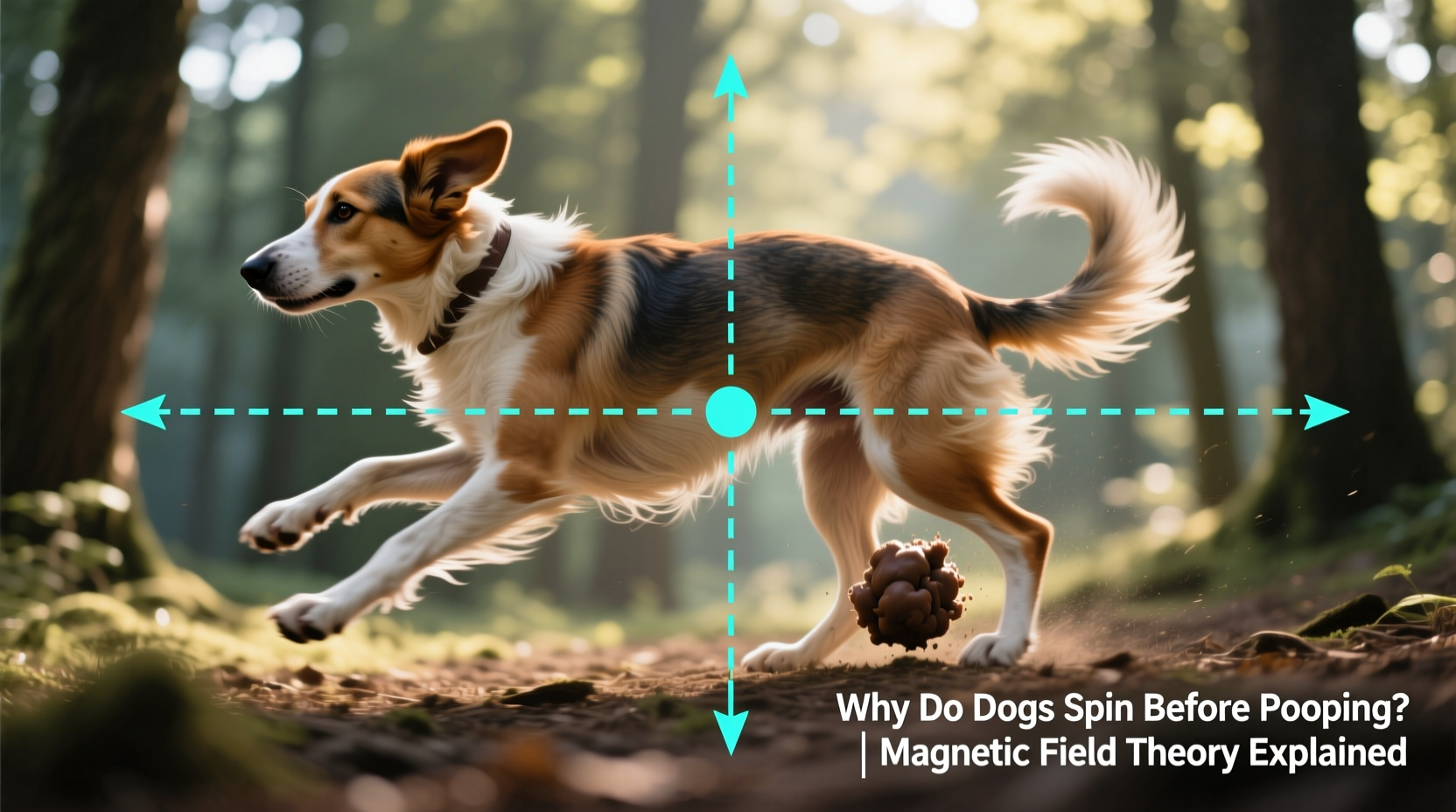
For years, dog spinning before elimination was dismissed as instinctive grooming behavior or an attempt to flatten grass. But in 2013, a groundbreaking study published in Frontiers in Zoology shifted the conversation entirely. Researchers from the Czech University of Life Sciences and the University of Duisburg-Essen conducted a two-year observational study involving 70 dogs across 37 breeds. They recorded over 1,893 defecations and 5,582 urinations under varying environmental conditions.
What they discovered was astonishing: when the Earth’s magnetic field was stable, dogs consistently aligned themselves along the north-south axis before pooping. The spinning motion appeared to be part of a process to orient their bodies correctly. However, during periods of magnetic instability—such as solar flares or geomagnetic storms—this preference disappeared, and dogs showed no consistent directional alignment.
“Dogs are not only sensitive to the Earth’s magnetic field, but they also use it for spatial orientation during excretion.” — Dr. Vlastimil Hart, lead author of the 2013 study
This finding suggests that dogs possess a form of magnetoreception—a biological ability to detect magnetic fields—similar to migratory birds, sea turtles, and some rodents. While the exact mechanism remains unknown, scientists hypothesize that iron-rich minerals in canine tissues or specialized cells in the nervous system may act as internal compasses.
How Magnetic Alignment Works in Animals
Magnetoreception is not uncommon in the animal kingdom. Birds use it to navigate thousands of miles during migration. Bees align their dances relative to magnetic fields. Even cows and deer tend to graze facing north or south, as satellite imagery has shown. But among domesticated animals, evidence of deliberate magnetic alignment during routine behaviors is rare—making the dog poop study particularly significant.
The theory goes that by aligning themselves along the north-southern axis, dogs may be optimizing their body position for neurological or physiological efficiency. Some researchers speculate that this orientation reduces interference from background electromagnetic noise, allowing for clearer neural signaling during vulnerable moments like defecation.
Tip: If you're observing your dog’s behavior for patterns, try noting the time of day and weather conditions—these can influence magnetic field stability.Why Spinning? The Role of Orientation Behavior
The spinning motion itself likely serves as a calibration phase. Just as a sailor checks compass direction before setting course, dogs may be using rotational movement to sense subtle cues from the environment. This could involve input from the vestibular system (inner ear balance), proprioception (body awareness), and possibly even cryptochrome proteins in the eyes—molecules believed to play a role in light-dependent magnetoreception.
Interestingly, the number of spins varies between individuals. Some dogs make a single smooth turn; others pivot back and forth several times. This variation might reflect differences in sensitivity, breed tendencies, or environmental distractions. For example, urban dogs surrounded by concrete and electromagnetic interference may exhibit less consistent alignment than rural dogs.
Factors That Influence Spinning Behavior
- Magnetic Field Stability: Dogs show strongest north-south alignment during calm geomagnetic conditions.
- Time of Day: Activity peaks in early morning and late afternoon correlate with lower atmospheric disturbance.
- Terrain: Open fields allow better orientation than cluttered spaces.
- Breed and Size: Larger breeds may require more turns due to momentum and spatial awareness limitations.
- Health: Older dogs or those with vestibular disease may struggle to spin effectively.
Scientific Skepticism and Ongoing Research
While the 2013 study sparked widespread interest, it also drew skepticism. Critics pointed out that correlation does not imply causation, and that other factors—such as wind direction, sunlight, or human presence—were not fully controlled. Subsequent attempts to replicate the findings have yielded mixed results, partly due to challenges in measuring real-time magnetic fluctuations and controlling for confounding variables.
Nonetheless, follow-up studies have reinforced the possibility of canine magnetoreception. A 2020 study using GPS tracking found that hunting dogs preferentially returned to their owners along magnetic field lines, suggesting navigational reliance on geomagnetism. Another experiment demonstrated changes in brainwave activity in dogs exposed to artificial magnetic fields, indicating neurological responsiveness.
The lack of a definitive anatomical structure for magnetoreception in dogs keeps the debate open. Unlike birds, which have magnetite in their beaks, or fish with electroreceptors, mammals—including humans—have no clearly identified magnetic sensor. Yet behavioral evidence continues to accumulate, pointing toward a subconscious, hardwired response rather than conscious decision-making.
Mini Case Study: Observing Max, the Border Collie
Emma R., a dog trainer in Vermont, began documenting her Border Collie Max’s bathroom habits after reading about the magnetic alignment theory. Over six weeks, she recorded his defecation direction using a handheld compass and cross-referenced data with NOAA’s geomagnetic activity reports.
She found that on days with low K-index values (indicating stable magnetic conditions), Max aligned north-south 78% of the time. On high-disturbance days—such as during a minor solar flare—he showed no preference, often facing east-west or spinning erratically. Emma noted that Max also took longer to settle on unstable days, sometimes aborting the attempt altogether.
“It made me realize how attuned dogs are to invisible forces,” Emma said. “We think we control their walks, but in many ways, they’re responding to signals we can’t perceive.”
Practical Implications for Dog Owners
Understanding this behavior doesn’t just satisfy curiosity—it can improve pet care. Recognizing that dogs need time and space to orient themselves can reduce stress during walks. Rushing a dog to “hurry up” may interfere with their natural process, potentially leading to incomplete elimination or anxiety-related issues.
Checklist: Supporting Your Dog’s Natural Elimination Routine
- Allow at least 2–3 minutes for your dog to explore and orient at each stop.
- Avoid pulling on the leash during the spinning phase—let them move freely.
- Choose walking routes with minimal electromagnetic interference (e.g., avoid power lines).
- Observe patterns: note if your dog prefers certain directions or becomes restless on stormy days.
- Be patient during geomagnetically active periods—they may need extra time.
Do’s and Don’ts When Observing Poop Spins
| Do | Don't |
|---|---|
| Give your dog space to move naturally | Pull the leash tightly during alignment |
| Walk during quieter geomagnetic hours (early morning) | Expect consistency every single time |
| Use a compass app to track directional trends | Assume spinning means something is wrong |
| Monitor changes in behavior over time | Ignore sudden reluctance to defecate |
Frequently Asked Questions
Is spinning before pooping normal for all dogs?
Yes, most dogs exhibit some form of circling or sniffing before elimination. The extent and precision of spinning vary by individual, breed, and environment. It’s considered a normal part of marking and positioning behavior.
Can health problems cause excessive spinning?
Potentially. While occasional spinning is typical, obsessive turning, difficulty squatting, or vocalizing during elimination may indicate pain, neurological issues, or spinal problems. Consult a veterinarian if you notice new or worsening behaviors.
Do dogs align magnetically when peeing too?
The original study found weaker but still present alignment during urination, especially in male dogs who lift their legs. Female dogs showed less directional consistency, possibly due to different postures and social signaling priorities.
Step-by-Step: How to Observe Magnetic Alignment in Your Dog
If you're curious whether your dog follows the north-south rule, here’s how to conduct a simple observation:
- Prepare Tools: Download a free compass app on your smartphone and check the current K-index via a geomagnetic forecast website.
- Choose Calm Conditions: Pick a day with low solar activity (K-index below 4) and minimal wind.
- Go for a Walk: Visit an open area like a park or field where your dog can roam freely on a long leash.
- Record Direction: When your dog begins to spin, quietly note the final body orientation using the compass. Face the same direction as your dog’s spine for accuracy.
- Repeat Over Time: Collect data from at least 10 separate events to identify patterns.
- Analyze Results: Tally how many times alignment was within 20 degrees of north-south. Compare with days of high magnetic disturbance.
This informal experiment won’t prove scientific theories, but it can deepen your appreciation for your dog’s hidden sensitivities.
Conclusion: Tuning Into Nature’s Hidden Signals
The mystery of why dogs spin before pooping opens a window into the complex relationship between animals and Earth’s natural systems. Far from being mere habit, this behavior may reflect an ancient survival mechanism—one that allows dogs to stay grounded, both literally and metaphorically, in a world filled with invisible forces.
As science continues to unravel the secrets of animal magnetoreception, pet owners have a unique opportunity to observe and respect these subtle instincts. By giving dogs the time and space they need to align, we honor their evolutionary heritage and strengthen our bond with them.
💬 Have you noticed your dog spinning before pooping? Does it seem directional? Share your observations in the comments—your experience could contribute to citizen science and help deepen our understanding of canine behavior.








