Birdsong is one of nature’s most familiar sounds—especially in the early hours. If you’ve ever woken up just before sunrise to a symphony of chirps, tweets, and trills, you’ve experienced the dawn chorus. Yet, as evening falls and darkness sets in, that same neighborhood often falls silent. Why do birds sing so vigorously in the morning but remain largely quiet at night? The answer lies in a combination of evolutionary biology, environmental conditions, social behavior, and survival strategy.
Birds don’t chirp randomly. Each call serves a purpose—whether it's defending territory, attracting mates, warning of predators, or coordinating with flock members. Understanding when and why these vocalizations occur reveals much about avian life cycles and their adaptation to the rhythms of day and night.
The Science Behind the Dawn Chorus
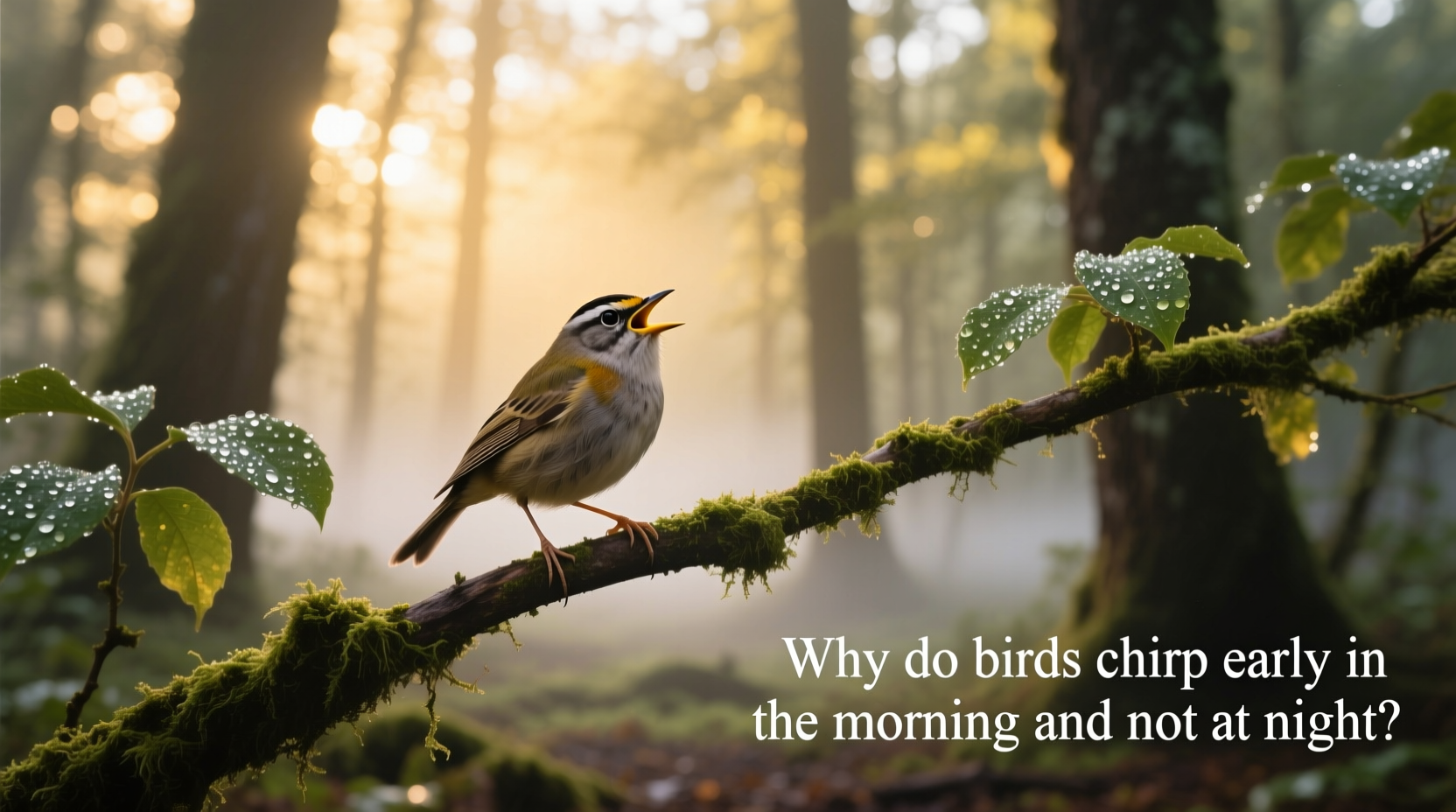
The period just before and after sunrise is known as the “dawn chorus,” a peak time for bird vocalization. This phenomenon isn’t limited to a few species; across continents, dozens of bird types—from robins and blackbirds to warblers and thrushes—participate in this daily ritual.
One key reason birds favor morning singing is sound transmission. Early in the day, the atmosphere tends to be cooler and more stable. With less wind and thermal turbulence, sound travels farther and clearer. A male bird’s song can carry over greater distances, increasing its effectiveness in communicating with rivals and potential mates.
Additionally, light levels at dawn are just sufficient for birds to see but still too dim for efficient foraging. Instead of searching for food in near-darkness, many species use this window to assert dominance and reproductive fitness through song. As ornithologist Dr. Sarah Langston explains:
“Dawn is a strategic time for birds. They’re announcing, ‘I survived the night, I’m strong, and this territory is mine.’ It’s both a mating display and a territorial broadcast.” — Dr. Sarah Langston, Behavioral Ornithologist, Cornell Lab of Ornithology
Biological Rhythms: How Circadian Clocks Influence Birdsong
Birds, like humans, operate on circadian rhythms—internal biological clocks synchronized with the 24-hour cycle of light and dark. These rhythms regulate sleep, feeding, hormone production, and, crucially, vocal activity.
In most songbirds, the brain’s hypothalamus controls these rhythms, responding to changes in daylight. As light increases before sunrise, hormonal shifts trigger heightened neural activity in brain regions associated with singing, such as the HVC (high vocal center). Testosterone and corticosterone levels also rise during breeding season, further stimulating vocal performance.
This internal timing ensures that birds are primed to sing at optimal times. Singing too late into the night would disrupt rest, while singing too early may not align with peak audience availability—other birds listening in.
Tip: If you're recording bird calls, aim for 30 minutes before sunrise—the peak clarity and diversity of songs occur during this window.Why Birds Don’t Chirp at Night
While some birds do make noises after dark—owls hoot, nightjars call, and corncrakes rasp—most diurnal species fall silent once night arrives. There are several compelling reasons for this behavioral shift.
1. Energy Conservation
Singing requires energy. Producing complex songs involves coordinated muscle control, breath regulation, and neurological effort. After a full day of foraging, flying, and evading predators, birds need to conserve energy for rest and recovery. Vocalizing at night would waste calories better spent on maintenance and repair.
2. Limited Auditory Advantage
Unlike dawn, nighttime air is often more turbulent due to temperature inversions and wind patterns. Sound doesn’t travel as predictably, reducing the effectiveness of long-distance communication. Moreover, fewer birds are active to hear the messages, making singing inefficient.
3. Predation Risk
Noise attracts attention—not just from mates and rivals, but from nocturnal predators like owls, raccoons, and snakes. Remaining quiet reduces the chance of being detected while roosting. A single misplaced chirp could reveal a bird’s location to a hunter relying on acute hearing.
4. Lack of Visual Cues
Many bird signals are multimodal—combining sound with visual displays like feather fluffing or wing flicking. At night, these cues are lost. Without the ability to see responses, singing becomes a one-way interaction with uncertain outcomes.
Exceptions to the Rule: Nocturnal and Crepuscular Species
Not all birds follow the diurnal pattern. Some species have evolved to be active at night or during twilight hours, and their vocal behaviors reflect this adaptation.
- Owls: Use low-frequency hoots to communicate across long distances in darkness.
- Nightjars: Produce repetitive churring calls during courtship flights at dusk and night.
- Cuckoos: In certain regions, cuckoos call frequently at night during breeding season.
- Corncrakes and Sora Rails: Marsh-dwelling birds that call primarily after dark.
Even typically diurnal birds may call at night under specific circumstances—such as artificial lighting, stress, or disorientation. Urban environments with streetlights can trick birds into thinking it’s dawn, prompting premature or nighttime singing. Studies show that robins in well-lit cities begin singing up to two hours earlier than their rural counterparts.
“In urban areas, light pollution is disrupting natural bird behavior. We’re seeing extended singing periods, including at night, which may impact breeding success and energy budgets.” — Dr. Rajiv Mehta, Urban Ecology Researcher, University of Bristol
Functions of Morning Birdsong: More Than Just Noise
Morning chirping isn’t merely habitual—it serves multiple critical functions in avian society.
1. Territory Defense
A male bird’s song acts as an acoustic fence. By singing loudly and consistently at dawn, he signals occupancy and discourages rivals from encroaching. Neighboring males often engage in counter-singing, creating a dynamic exchange that reinforces boundaries without physical confrontation.
2. Mate Attraction
Females evaluate potential mates based on song complexity, duration, and frequency. A robust dawn performance demonstrates vitality, good health, and genetic quality. Longer, more intricate songs are correlated with higher reproductive success in species like the great tit and song sparrow.
3. Pair Bonding
In mated pairs, duetting at dawn strengthens social bonds. For example, California towhees and some tropical species sing coordinated phrases that reinforce pair cohesion and synchronize daily activities.
4. Flock Coordination
For social species like starlings or finches, morning calls help regroup individuals after nocturnal dispersal. Contact calls ensure group members know each other’s locations before setting out to feed.
Step-by-Step: How Birds Prepare for the Dawn Chorus
Birds don’t simply wake up and start singing. Their preparation begins the previous evening and unfolds in a precise sequence:
- Evening Roosting: Birds settle into safe, sheltered spots to minimize predation risk.
- Metabolic Slowdown: Heart rate and respiration decrease during sleep, conserving energy.
- Dawn Hormonal Surge: As light increases, melatonin drops and corticosterone rises, activating the vocal centers.
- Pre-Song Warm-Up: Some birds emit soft subsongs or practice phrases before launching into full performance.
- Peak Singing Window: From 30 minutes before to 90 minutes after sunrise, singing intensity peaks.
- Transition to Foraging: Once territories are declared and mates alerted, birds shift focus to feeding.
Checklist: What Influences Bird Singing Patterns?
Understanding bird vocal behavior involves considering multiple factors. Use this checklist to assess what might affect chirping in your area:
- ✅ Time of Year: Breeding season (spring/summer) brings increased singing.
- ✅ Light Levels: Artificial lighting can advance or extend singing.
- ✅ Species Present: Identify whether local birds are diurnal, nocturnal, or crepuscular.
- ✅ Weather Conditions: Calm, cool mornings enhance sound transmission.
- ✅ Habitat Type: Forests, open fields, and urban areas each support different vocal strategies.
- ✅ Predator Presence: High predation pressure may suppress daytime or nighttime calls.
- ✅ Urbanization: Noise and light pollution alter natural singing schedules.
Mini Case Study: The Robin’s Urban Adaptation
In Sheffield, UK, researchers studied European robins (Erithacus rubecula) in both city parks and rural woodlands. They found that urban robins began singing an average of 87 minutes earlier than rural ones—some even sang throughout the night under bright streetlights.
The study concluded that artificial illumination was the primary driver of this shift. While early singing helped urban males establish territory in noisy environments, it came at a cost: reduced sleep and elevated stress markers. Over time, this could affect immune function and longevity.
This case illustrates how human activity indirectly shapes bird behavior—even something as natural as the dawn chorus can be disrupted by modern infrastructure.
Do’s and Don’ts of Observing Morning Birdsong
| Do’s | Don’ts |
|---|---|
| Arrive quietly and stay still to avoid startling birds | Play recorded bird calls excessively—it can provoke stress or aggression |
| Use binoculars to observe without approaching nests | Touch or handle nesting materials or chicks |
| Keep a journal to track species and singing times | Litter or leave equipment behind |
| Support habitat conservation efforts locally | Encourage feeding practices that attract invasive species |
| Report unusual nighttime singing to local wildlife groups | Assume all night calls are from common species—some rare birds are nocturnal |
Frequently Asked Questions
Why do birds start chirping so early, sometimes before sunrise?
Birds begin singing before sunrise because atmospheric conditions are ideal for sound travel, and they have limited ability to forage in low light. Singing during this window maximizes the impact of their message while minimizing competition from daytime noise.
Are there birds that only sing at night?
Yes. Several species are strictly nocturnal singers, including barn owls, whip-poor-wills, and the Eurasian nightjar. These birds rely on darkness for hunting and use vocalizations to navigate social interactions when diurnal competitors are inactive.
Can birds sing too much in the morning?
While frequent singing is normal during breeding season, excessive vocalization can indicate stress—especially in urban areas with high noise or light pollution. Prolonged singing may lead to fatigue, reduced feeding time, and lower reproductive success.
Conclusion: Listening with Purpose
The morning chirps of birds are far more than background noise—they’re a sophisticated language shaped by millions of years of evolution. From asserting territory to wooing mates, every note carries meaning. Understanding why birds sing in the morning and rest at night deepens our appreciation of their lives and the delicate balance they maintain with their environment.
Next time you wake to the dawn chorus, take a moment to listen closely. You’re not just hearing birds—you’re witnessing a complex, coordinated performance of survival and connection. And if you live in an area affected by light pollution, consider supporting local efforts to reduce unnecessary outdoor lighting. Small actions can help preserve the natural rhythms that birds—and ecosystems—depend on.
💬 What’s the earliest you’ve heard birds chirp? Share your experience or record a local dawn chorus and contribute to citizen science projects like eBird or Xeno-Canto!








