Modern interior design prioritizes intentionality—clean lines, curated textures, and functional elegance. When it comes to holiday styling, the base of the Christmas tree is no longer an afterthought. It’s a deliberate design moment: the visual anchor where floor meets foliage, where utility meets aesthetic cohesion. Yet many homeowners hesitate between two dominant options—the tree collar and the tree skirt—and default to whichever feels more familiar. That hesitation isn’t about preference; it’s about misalignment. A tree collar isn’t just a “modern alternative” to a skirt. It’s a distinct design system with its own spatial logic, material language, and maintenance profile. Likewise, a well-chosen tree skirt isn’t nostalgic clutter—it can be a sculptural, textural, or even sustainable statement piece in a minimalist or Scandinavian-inspired room. This article cuts through seasonal marketing noise to evaluate both options on terms that matter to today’s interior-conscious homeowner: visual integration, spatial efficiency, safety compliance, long-term versatility, and real-world usability across apartment living, open-plan spaces, and multi-functional rooms.
What Exactly Defines a Tree Collar—and Why It’s Not Just a “Skirt Alternative”
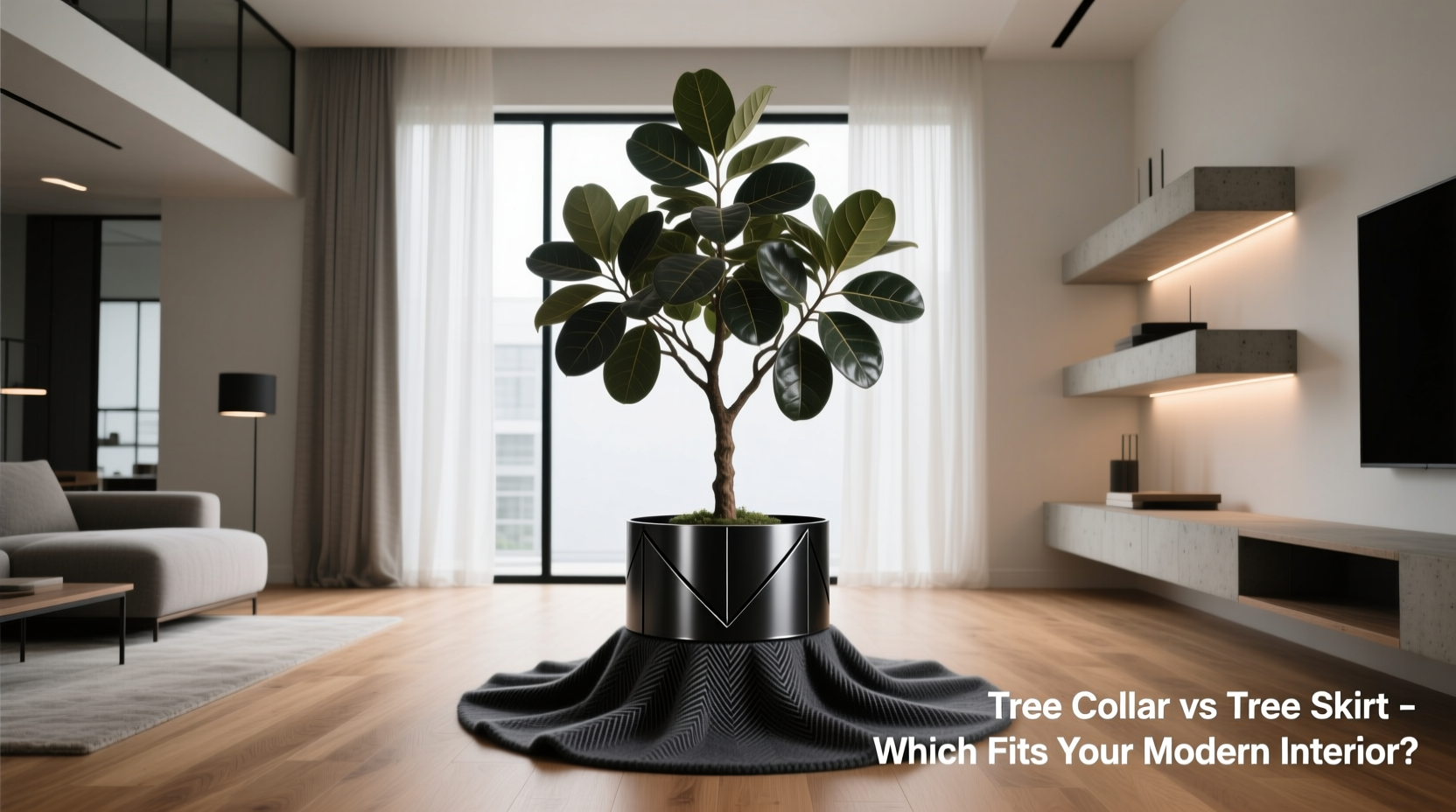
A tree collar is a rigid or semi-rigid cylindrical sleeve designed to encircle the trunk of a Christmas tree, sitting directly over the stand. Its primary function is concealment—not of gifts (though it can hold them), but of the mechanical infrastructure: the water reservoir, screws, plastic base, and visible hardware. Most collars are constructed from metal (brass, matte black steel, brushed nickel), woven rattan, felted wool, or molded composite materials. Their height typically ranges from 10 to 16 inches, and their diameter is engineered to fit snugly around standard tree stands without compressing branches. Unlike skirts, collars do not drape or pool on the floor; they terminate cleanly at the base, maintaining vertical continuity with the tree’s silhouette.
This structural precision is what makes collars uniquely suited to modern interiors. In a space defined by architectural restraint—think floating shelves, recessed lighting, and monochromatic palettes—a collar acts as a deliberate punctuation mark. It reinforces the tree’s presence as a vertical object rather than a grounded installation. Interior designer Lena Torres, whose work appears in Architectural Digest’s “Minimalist Holiday” feature, puts it plainly: “A collar doesn’t compete with your rug or furniture layout. It respects the floor plane instead of violating it. That’s not minimalism—it’s spatial intelligence.”
Tree Skirts: Beyond Nostalgia—When Fabric Still Earns Its Place
A tree skirt is a flat, circular textile (or occasionally rigid) covering placed beneath the tree to conceal the stand and create a decorative “base layer.” Traditional versions use velvet, burlap, lace, or embroidered cotton—but contemporary iterations now include handwoven jute, upcycled denim, felted merino, and even laser-cut acrylic with integrated LED strips. Skirts vary widely in diameter (48–72 inches is common) and fall style (flat, ruffled, tiered, or pleated). Their strength lies in texture, softness, and adaptability: they soften hard flooring, absorb sound, and provide a generous surface for gift placement without requiring precise alignment.
Crucially, skirts remain relevant—not outdated—when selected with intention. In biophilic or organic-modern spaces (characterized by natural wood tones, stone accents, and tactile layering), a textured wool skirt adds warmth that a metal collar cannot replicate. In homes with young children or pets, a plush, low-profile skirt offers safer footing than a raised metal rim. And unlike collars, most high-quality skirts fold compactly and store flat—making them ideal for urban dwellers with limited closet space.
Tip: Measure your tree stand��s outer diameter *before* buying either option. Many collars require exact sizing—especially metal ones—to avoid gaps or instability. Skirts need at least 12 inches of clearance beyond the stand’s edge to drape naturally.Side-by-Side Comparison: Function, Form, and Real-World Fit
| Feature | Tree Collar | Tree Skirt |
|---|---|---|
| Aesthetic Integration | Strong vertical emphasis; enhances clean lines and architectural cohesion. Ideal for industrial, mid-century, and Japandi interiors. | Horizontal emphasis; adds softness and texture. Excels in organic-modern, cottage-core, and layered Scandinavian spaces. |
| Floor Compatibility | Works flawlessly on hardwood, tile, and low-pile rugs. Can catch on high-pile carpet edges if not seated carefully. | Adapts seamlessly to all floor types—including thick rugs, uneven tiles, and radiant-heated floors—without lifting or warping. |
| Safety & Accessibility | No tripping hazard; stable base. However, exposed metal edges may pose pinch risks for toddlers. Not recommended near open flames or candles. | Low-profile and flexible. Natural fiber skirts (wool, cotton) meet Class A fire retardancy standards when treated. Avoid synthetic blends near heat sources. |
| Storage & Longevity | Rigid collars require dedicated vertical storage (e.g., behind a door or in a closet shelf). Metal and composite versions last 10+ years with minimal care. | Folds flat or rolls easily. High-quality natural-fiber skirts retain shape and color for 5–8 years if stored away from light and moisture. |
| Gift Placement | Offers narrow, upright storage zone—ideal for small, stacked presents. Not suited for oversized or irregularly shaped items. | Provides wide, accessible surface area. Allows for creative stacking, staggered heights, and wrapping variety without visual crowding. |
A Real Example: How One Brooklyn Apartment Solved Its “Tree Base Dilemma”
Maya Chen, a graphic designer and co-owner of a 650-square-foot Williamsburg loft, faced a classic modern-interior challenge: her 7-foot Nordmann fir stood in the center of an open-plan living-dining-kitchen zone. The original tree skirt—velvet, 60-inch diameter—kept sliding under her dining chairs and snagged on the leg of her Eames lounge. Gifts piled haphazardly, disrupting sightlines and making the space feel visually “heavy.” She switched to a matte-black powder-coated steel collar (14 inches tall, 18-inch inner diameter) paired with a minimalist white ceramic planter base hidden beneath it.
The change was immediate and functional. The collar’s crisp silhouette aligned with her blackened-steel shelving and matte-black light fixtures. With no fabric to shift or bunch, vacuuming became effortless—and her Roomba navigated freely around the tree base for the first time. More unexpectedly, the collar created a subtle “halo effect”: the negative space between its top edge and the lowest branches drew attention upward, reinforcing the tree’s verticality in a space where ceiling height was already a design priority. “It didn’t make the tree smaller,” Maya notes. “It made the room feel taller.”
Practical Decision Framework: Which Option Fits *Your* Space?
- Evaluate your floor plan. If your tree sits in a high-traffic path, near seating, or adjacent to sliding doors—prioritize stability and low profile. A collar wins unless you choose a flat-weave, non-fraying skirt.
- Assess your dominant materials. If your space features exposed steel, concrete, blackened wood, or monochrome ceramics, a collar will harmonize. If your palette centers on linen, oak, stone, and undyed wool, a thoughtfully textured skirt will deepen cohesion.
- Consider daily routines. Do you vacuum daily? Have pets who dig or chew? A collar eliminates fabric temptation and simplifies cleaning. Do you rearrange furniture seasonally? A skirt moves with less friction than repositioning a rigid collar.
- Factor in gift logistics. Hosting large gatherings? A skirt provides flexible real estate. Gifting mostly small, uniform items (books, candles, jewelry)? A collar’s structured zone keeps presentation tight and intentional.
- Review your storage reality. No closet depth? No vertical shelf space? Choose a skirt. Have a dedicated holiday bin with rigid dividers? A collar will stay pristine year after year.
“The best tree base isn’t the most beautiful one—it’s the one that disappears into your routine while elevating your design language.” — Javier Mendez, Founder of Studio Linea, award-winning residential interior practice specializing in adaptive holiday design
FAQ: Clarifying Common Misconceptions
Can I use a tree collar with a real (cut) tree that needs watering?
Yes—but only if the collar is explicitly designed for water access. Look for models with removable bottom plates, discreet side ports, or a split-seam construction that allows the collar to open and close around the stand. Never force a rigid collar onto a stand with a protruding water spout or overflow valve.
Are tree skirts fire hazards in modern homes?
Not inherently—but material matters. Untreated cotton, linen, or burlap is highly flammable. Opt for skirts labeled “flame-resistant” or “Class A fire-rated” (the highest standard for decorative textiles). Avoid polyester blends near mantels, fireplaces, or candle arrangements. Natural fibers like wool have inherent flame resistance and self-extinguish when ignited.
Do tree collars work with artificial trees that have bulky, integrated stands?
Most do—if you measure correctly. Many artificial trees use oversized, octagonal, or tripod-style stands. Check the collar’s compatibility chart before purchasing. Some premium collars (e.g., those from Terrain or West Elm) offer adjustable inner diameters or modular panels specifically for complex stands.
Design-Forward Recommendations for Each Style
- For collars: Prioritize matte finishes over high-gloss—matte absorbs ambient light and avoids visual competition with metallic decor. Brass collars pair beautifully with warm-toned woods and terracotta; matte black suits cooler palettes with graphite, slate, and pale oak.
- For skirts: Avoid busy prints in minimalist spaces. Instead, choose tonal texture—like a charcoal herringbone wool or oatmeal bouclé. For sustainability, look for GOTS-certified organic cotton or OEKO-TEX®-verified wool. Hand-stitched hems signal durability and heirloom potential.
- Hybrid approach: In transitional spaces (e.g., a sunroom with both tile and area rugs), consider a slim, low-profile collar (under 10 inches) topped with a small, circular accent rug or woven mat—blending structure and softness without visual overload.
Conclusion: Choose Intention Over Tradition
“Which one works better?” isn’t a question of superiority—it’s a question of alignment. A tree collar excels where clarity, control, and architectural harmony define the space. A tree skirt thrives where warmth, tactility, and human-centered flexibility are non-negotiable. Neither is inherently “more modern.” What makes either choice truly contemporary is how deliberately it serves your space, your habits, and your values—not the calendar. In an era where every square foot carries meaning, the tree base is never neutral. It’s a quiet declaration of how you live: whether you value precision or softness, structure or spontaneity, permanence or adaptability. So measure twice. Consider your floor, your furniture, your family’s rhythm—and choose the option that doesn’t just hide the stand, but honors the entire composition.
💬 Your turn: Did you switch from skirt to collar—or vice versa—after redesigning your space? Share your real-life experience, measurements, and material choices in the comments. Let’s build a practical, crowd-sourced guide for next season’s intentional holiday styling.








