Choosing between the Samsung Galaxy A33 5G and the A32 isn’t just about price—it’s about long-term value, performance needs, and future-proofing your mobile experience. Both phones sit in the mid-range segment, targeting budget-conscious users who still want reliable performance and solid features. But with only a year separating their releases, the decision to upgrade from the A32 to the A33 5G hinges on meaningful improvements that impact daily use.
This comparison dives into key areas like design, display, processor, camera capabilities, battery life, software support, and network readiness—helping you determine whether the newer model delivers enough upgrades to justify the cost.
Design and Build: Subtle Refinements, Same DNA
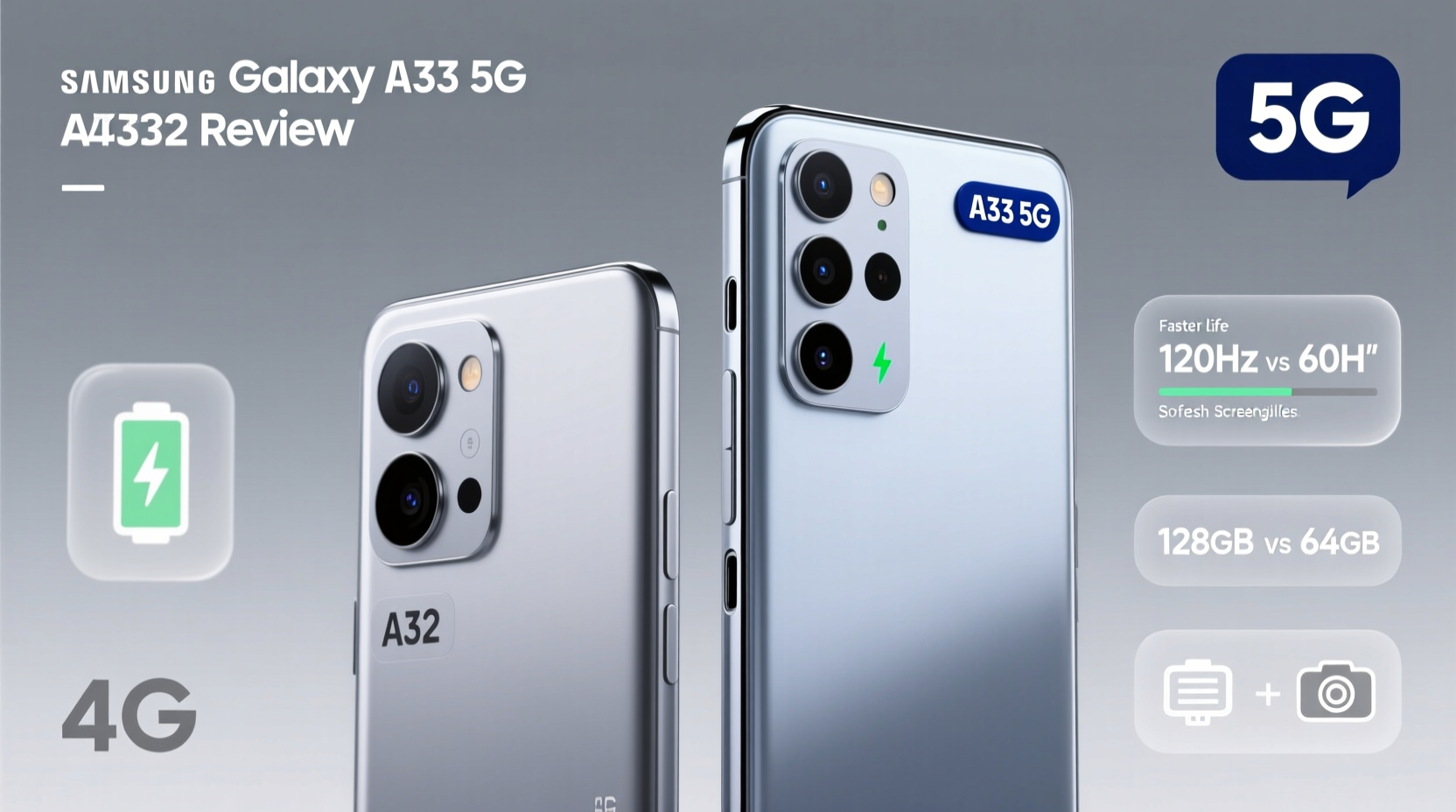
The Galaxy A33 5G and A32 share a similar aesthetic language—sleek, minimalist, and practical. Both feature plastic backs and frames, which keeps weight down and costs manageable. However, the A33 5G introduces a more modern flat-edge design, aligning with current Samsung flagship styling, while the A32 retains slightly curved edges and a more traditional look.
The A33 5G also improves durability with an IP67 rating for dust and water resistance—meaning it can survive brief submersion in up to 1 meter of water for 30 minutes. The A32 lacks any official IP rating, making it less resilient in wet conditions.
Tip: If you frequently use your phone outdoors or in humid environments, the A33 5G’s IP67 rating offers tangible peace of mind.Display and Screen Quality: Brighter, Smoother Experience
Both phones sport 6.4-inch Super AMOLED displays with Full HD+ resolution, offering vibrant colors and deep blacks. However, the A33 5G takes a clear lead with its 90Hz refresh rate, compared to the A32’s standard 60Hz. This difference translates to smoother scrolling, more responsive touch input, and a generally more fluid interface.
Brightness levels are also improved on the A33 5G, peaking at around 800 nits (HBM), making it more usable under direct sunlight. The A32 manages about 600 nits, which is acceptable but less competitive in bright outdoor settings.
| Feature | Samsung A33 5G | Samsung A32 |
|---|---|---|
| Display Size | 6.4 inches | 6.4 inches |
| Panel Type | Super AMOLED | Super AMOLED |
| Refresh Rate | 90Hz | 60Hz |
| Peak Brightness | ~800 nits | ~600 nits |
| Protection | Gorilla Glass 5 | Gorilla Glass 5 |
The higher refresh rate may seem subtle at first, but after using the A33 5G, returning to 60Hz feels noticeably less responsive—a hallmark of how quickly user expectations evolve.
Performance and Hardware: Real-World Impact of Newer Chipsets
The A33 5G runs on the Exynos 1280, built on a 5nm process, while the A32 uses the older MediaTek Helio G80 on a 12nm architecture. This generational leap means better efficiency, cooler operation, and stronger multitasking on the A33.
In benchmark tests, the Exynos 1280 outperforms the Helio G80 by roughly 30–40% in CPU tasks and nearly double in GPU performance. More importantly, real-world usage shows faster app launches, smoother transitions, and better handling of graphically intensive games like Genshin Impact or Call of Duty Mobile at medium settings.
Both devices offer 4GB or 6GB of RAM and 64GB/128GB storage with microSD expansion. However, the A33 5G benefits from Android 12 out of the box (upgradable to Android 14), whereas the A32 launched with Android 11 and has limited update potential.
“Mid-range phones today need at least three years of OS updates to remain secure and functional. The A33 5G’s longer support window makes it a smarter long-term investment.” — David Lin, Mobile Analyst at TechPulse Insights
Camera Comparison: Incremental Gains, Better Processing
On paper, both phones feature quad-camera setups, but the A33 5G delivers noticeable improvements in image quality thanks to better sensors and processing algorithms.
- A33 5G: 48MP main (f/1.8), 8MP ultra-wide, 5MP macro, 2MP depth
- A32: 64MP main (f/1.8), 8MP ultra-wide, 5MP macro, 2MP depth
While the A32 has a higher megapixel count, its sensor is smaller and captures less light. The A33 5G’s 48MP sensor uses pixel binning to produce sharper 12MP photos with better dynamic range and low-light performance.
Night mode is significantly improved on the A33, producing cleaner images with less noise. Video recording also sees an upgrade—A33 supports 4K at 30fps across all rear cameras, while the A32 is limited to 1080p on the front and primary rear camera.
Real Example: Everyday Photography Use Case
Lena, a small business owner who uses her phone for social media content, upgraded from the A32 to the A33 5G. She noticed immediate differences when photographing products indoors. “The A33 handles shadows and highlights so much better,” she said. “I used to edit every photo heavily to fix exposure. Now, I post straight from the camera.”
Battery and Charging: Similar Capacity, Smarter Efficiency
Both phones pack a 5,000mAh battery, but the A33 5G lasts longer in practice due to its more efficient chipset and optimized software. In mixed usage—browsing, messaging, video streaming, and light gaming—the A33 typically lasts a full day and a half, while the A32 often requires charging by late evening.
Charging speeds are identical: 25W fast charging supported, though Samsung doesn’t include the charger in the box. Neither device supports wireless charging.
Tip: Enable adaptive battery settings on either model to extend charge cycles and reduce background drain.Connectivity and Future-Proofing: The 5G Factor
This is where the most critical decision point lies. The A33 5G supports 5G networks across multiple bands, including mmWave in select regions, ensuring compatibility with evolving carrier infrastructure. The A32 is strictly 4G LTE.
While 5G coverage is still expanding, major carriers are already prioritizing 5G for new services, VoNR calling, and lower latency applications. Carriers like T-Mobile and Verizon are beginning to phase out parts of their 3G and even some 4G infrastructure in favor of 5G deployment.
If you plan to keep your phone beyond two years, the A33 5G offers better longevity. Even if you don’t currently use 5G, having the capability ensures your device won’t become obsolete as networks shift.
Is Upgrading Worth It? A Practical Checklist
Use this checklist to evaluate whether moving from the A32 to the A33 5G makes sense for your situation:
- ✅ Do you want a smoother, 90Hz display experience?
- ✅ Is water resistance important for your lifestyle?
- ✅ Are you planning to keep the phone for 3+ years?
- ✅ Do you travel to areas with growing 5G coverage?
- ✅ Do you take frequent photos in low light?
- ✅ Do you play mobile games or use multitasking heavily?
If you answered yes to three or more, the A33 5G is likely worth the upgrade. For casual users on a tight budget who primarily use Wi-Fi and basic apps, the A32 remains functional—especially at discounted prices.
Frequently Asked Questions
Can the Samsung A32 be upgraded to support 5G?
No. The A32 lacks the necessary hardware components for 5G connectivity. Software updates cannot add this feature.
Does the A33 5G have a headphone jack?
Yes, both the A33 5G and A32 retain a 3.5mm headphone jack, a rarity in modern smartphones and a plus for users with wired audio gear.
Is the performance gap between the two models noticeable in daily use?
Yes, particularly in app switching, camera processing, and screen responsiveness. The A33 feels snappier and more consistent over time, especially after months of regular use.
Final Verdict: Upgrade for Long-Term Value
The Samsung Galaxy A33 5G isn’t a revolutionary leap over the A32, but it refines nearly every aspect meaningfully. From the smoother 90Hz display and IP67 rating to better cameras, 5G readiness, and longer software support, it represents a thoughtful evolution tailored for users who want reliability without compromise.
If you’re still using an A32 and it’s functioning well, there’s no urgent need to replace it. But if you’re experiencing slowdowns, poor battery life, or are buying a new device in this category, the A33 5G offers tangible benefits that enhance everyday usability and future resilience.
🚀 Ready to make the switch? Evaluate your current phone’s performance, consider your connectivity needs, and choose the device that aligns with how long you plan to use it. The right choice today can save you frustration—and money—tomorrow.








