Choosing between the iPhone 6s Plus and the iPhone 8 isn’t just about nostalgia or budget—it’s a decision that balances screen size, performance, longevity, and user experience. The iPhone 6s Plus offers a larger 5.5-inch display, while the iPhone 8 brings modern internals, better efficiency, and wireless charging. For users clinging to the 6s Plus for its screen real estate, the question remains: is that extra space enough to justify staying on an older platform?
As both models are now outside Apple’s active support window, software updates and app compatibility are becoming increasingly limited. Yet many still rely on these devices daily. Understanding the trade-offs helps determine whether upgrading to the iPhone 8—or holding onto the 6s Plus—is the smarter move.
Design and Display: Size vs. Modern Build
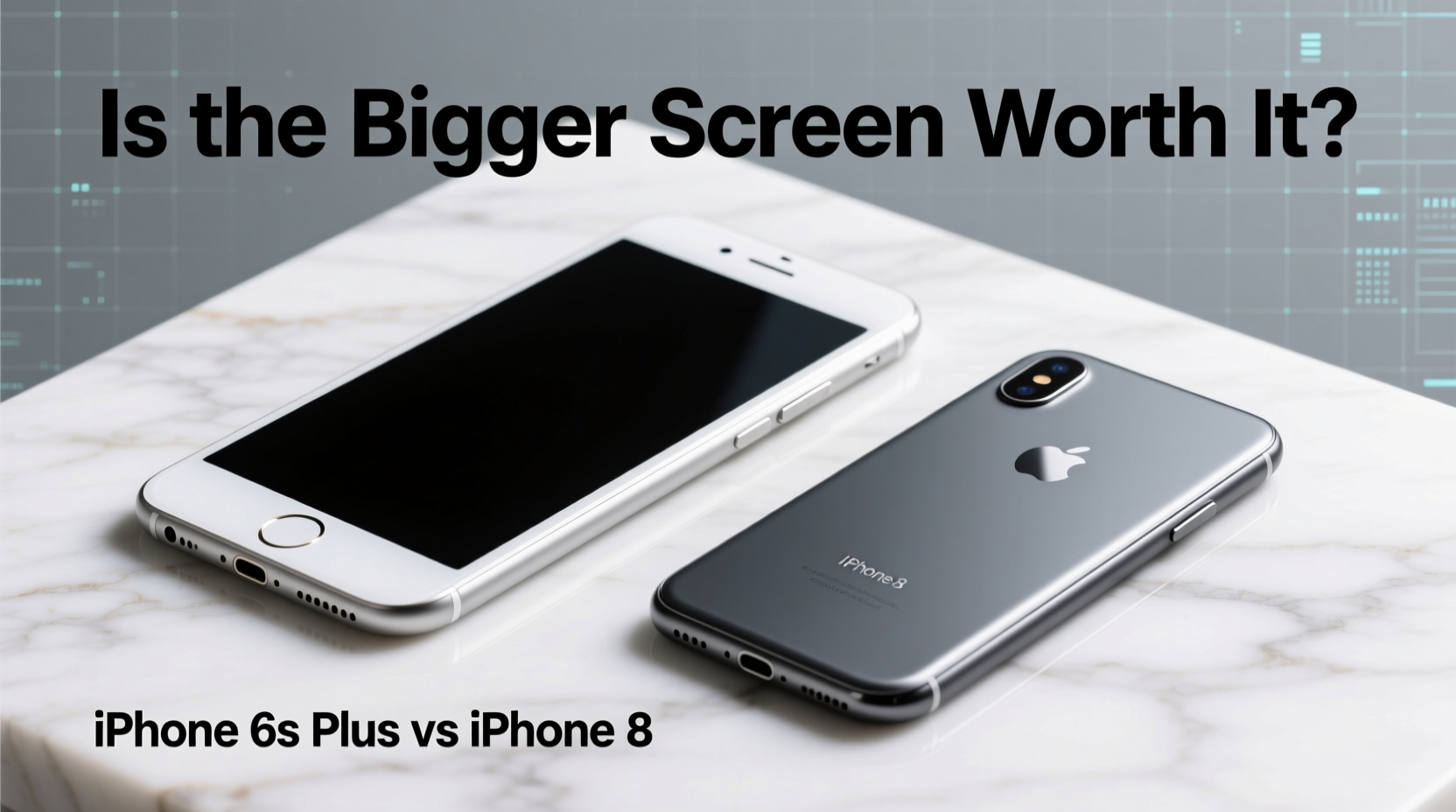
The most immediate difference between the two phones lies in their design philosophy. The iPhone 6s Plus features a classic aluminum body with large bezels and a home button embedded in a wide front face. Its 5.5-inch LCD screen delivers sharp visuals at 1920x1080 resolution, making it ideal for media consumption, multitasking, and reading.
In contrast, the iPhone 8 opts for a more compact 4.7-inch Retina HD display. While smaller, it benefits from True Tone technology, improved color accuracy, and higher brightness levels. More importantly, the iPhone 8 introduces a glass back—a first since the iPhone 4—enabling wireless charging and a more premium feel despite similar dimensions to the iPhone 6s Plus.
Tip: If you frequently watch videos or read on your phone, the 6s Plus’s larger screen may enhance comfort—but consider using zoomed display modes on the iPhone 8 for better reachability.Screen Comparison at a Glance
| Feature | iPhone 6s Plus | iPhone 8 |
|---|---|---|
| Display Size | 5.5 inches | 4.7 inches |
| Resolution | 1920 x 1080 | 1334 x 750 |
| PPI (Pixels per Inch) | 401 | 326 |
| Display Technology | LCD | LCD with True Tone |
| Front Panel | Aluminum frame, large bezels | Narrower bezels, glass back |
While the 6s Plus wins on sheer screen size, the iPhone 8 compensates with superior color management and ambient light adaptation. Users accustomed to phablet-sized devices might find the jump down to 4.7 inches restrictive, but iOS’s dynamic text scaling and accessibility features can help bridge the gap.
Performance and Longevity: A Clear Winner Emerges
Beneath the surface, the differences become stark. The iPhone 6s Plus runs on the A9 chip with 2GB of RAM—impressive in 2015, but now struggling with demanding apps and multitasking. By comparison, the iPhone 8 packs the A11 Bionic chip and 2GB of RAM, delivering up to 70% faster CPU performance and a dedicated neural engine for machine learning tasks.
This performance leap translates directly into real-world usage. Apps launch quicker, animations remain smooth even after extended use, and background processes handle better. More crucially, the A11 chip ensures longer software support; although neither device receives official iOS updates beyond iOS 15, the iPhone 8 handles newer app versions and web standards more reliably.
“Even two generations apart, Apple’s silicon improvements are exponential. The A11 wasn’t just faster—it laid groundwork for AR, AI, and advanced photography.” — David Lin, Mobile Hardware Analyst
For users who rely on productivity tools, social media, or gaming, the iPhone 8 provides a noticeably smoother experience. The 6s Plus, while still functional, shows signs of aging under load—especially when switching between multiple apps or streaming high-bitrate content.
Camera Capabilities: Evolution in Every Shot
Photography is another area where the iPhone 8 pulls ahead decisively. Both phones feature 12MP rear cameras, but the iPhone 8 includes optical image stabilization (OIS), a feature absent on the 6s Plus. OIS reduces blur in low-light conditions and improves video stability, resulting in sharper images and smoother footage.
The front-facing camera also sees improvement. The iPhone 8 upgrades to a 7MP FaceTime HD camera with better low-light performance and autofocus, making selfies and video calls significantly clearer than the 5MP shooter on the 6s Plus.
- iPhone 6s Plus Camera: 12MP rear, no OIS, 5MP front
- iPhone 8 Camera: 12MP rear with OIS, 7MP front, Portrait mode via software (with limitations)
In practical terms, this means the iPhone 8 captures brighter night shots, more consistent exposures, and better detail in fast-moving scenes. While the 6s Plus holds up well in daylight, it falters in dim environments where the iPhone 8 maintains clarity and color balance.
Real-World Example: Sarah's Upgrade Dilemma
Sarah, a freelance writer, had used her iPhone 6s Plus since 2016. She loved the large screen for reading manuscripts and taking notes. However, by 2023, she noticed frequent app crashes, sluggish Safari performance, and difficulty uploading photos due to processing delays. After testing an iPhone 8 at a friend’s house, she was surprised by how much snappier everything felt—even though the screen was smaller.
She adjusted quickly by enabling “Zoomed” display mode and using split-screen browsing in Safari. Within weeks, she realized the performance gains far outweighed the minor inconvenience of reduced screen size. Her battery lasted longer per charge cycle, and photo uploads became instant. For her workflow, the upgrade was transformative.
Charging, Battery, and Future-Proofing
The iPhone 8 supports Qi wireless charging—a convenience the 6s Plus lacks entirely. This small feature adds flexibility, especially for users with wireless charging pads at work or in cars. Additionally, the iPhone 8 generally offers comparable battery life despite the smaller physical size, thanks to the more efficient A11 chip.
Battery degradation affects both models equally over time, but replacement services are widely available and affordable. Still, future-proofing matters: the iPhone 8 is more likely to run emerging web technologies, progressive web apps, and cloud-based tools effectively in the coming years.
Tip: Enable Low Power Mode and reduce auto-brightness to extend usable battery life on either device.Checklist: Should You Stick With the iPhone 6s Plus or Upgrade?
- Are you experiencing frequent app crashes or slow loading times? → Consider upgrading.
- Do you value a larger screen for reading, watching videos, or note-taking? → 6s Plus has an edge.
- Is wireless charging or better camera quality important to you? → iPhone 8 wins.
- Do you plan to keep the phone for another 1–2 years? → iPhone 8 offers better longevity.
- Are you on a tight budget and already own a working 6s Plus? → Extending its life may be acceptable short-term.
Frequently Asked Questions
Can the iPhone 6s Plus still run modern apps?
Yes, but with limitations. Many newer apps require iOS 14 or later, which the 6s Plus supports (up to iOS 15). However, performance degrades with resource-heavy apps like TikTok, Instagram Reels, or mobile games. Expect longer load times and occasional crashes.
Is the iPhone 8 waterproof?
The iPhone 8 has an IP67 rating, meaning it can survive submersion in up to 1 meter of water for 30 minutes. The iPhone 6s Plus has no official water resistance rating, making it more vulnerable to spills and moisture damage.
Does screen size affect usability more than performance?
It depends on usage. Media consumers and readers benefit from larger screens, but power users prioritize responsiveness. With iOS optimizations like Dynamic Type and Reachability, the iPhone 8 mitigates some size drawbacks while offering superior overall performance.
Conclusion: Balancing Screen Size and Sustainable Performance
The iPhone 6s Plus remains a capable device for basic tasks, and its large screen continues to appeal to those who value readability and media immersion. However, the iPhone 8 represents a meaningful technological leap—not only in processor speed and camera quality but in long-term usability.
If you're holding onto the 6s Plus solely for its screen size, consider whether that advantage outweighs slower performance, lack of wireless charging, and declining app compatibility. For most users, the answer leans toward upgrading. The iPhone 8 delivers a more responsive, reliable, and future-ready experience—even if it means adjusting to a slightly smaller display.
🚀 Ready to make the switch? Evaluate your daily usage, test both devices if possible, and choose the one that supports your lifestyle—not just your preferences. Share your experience below and help others decide!








