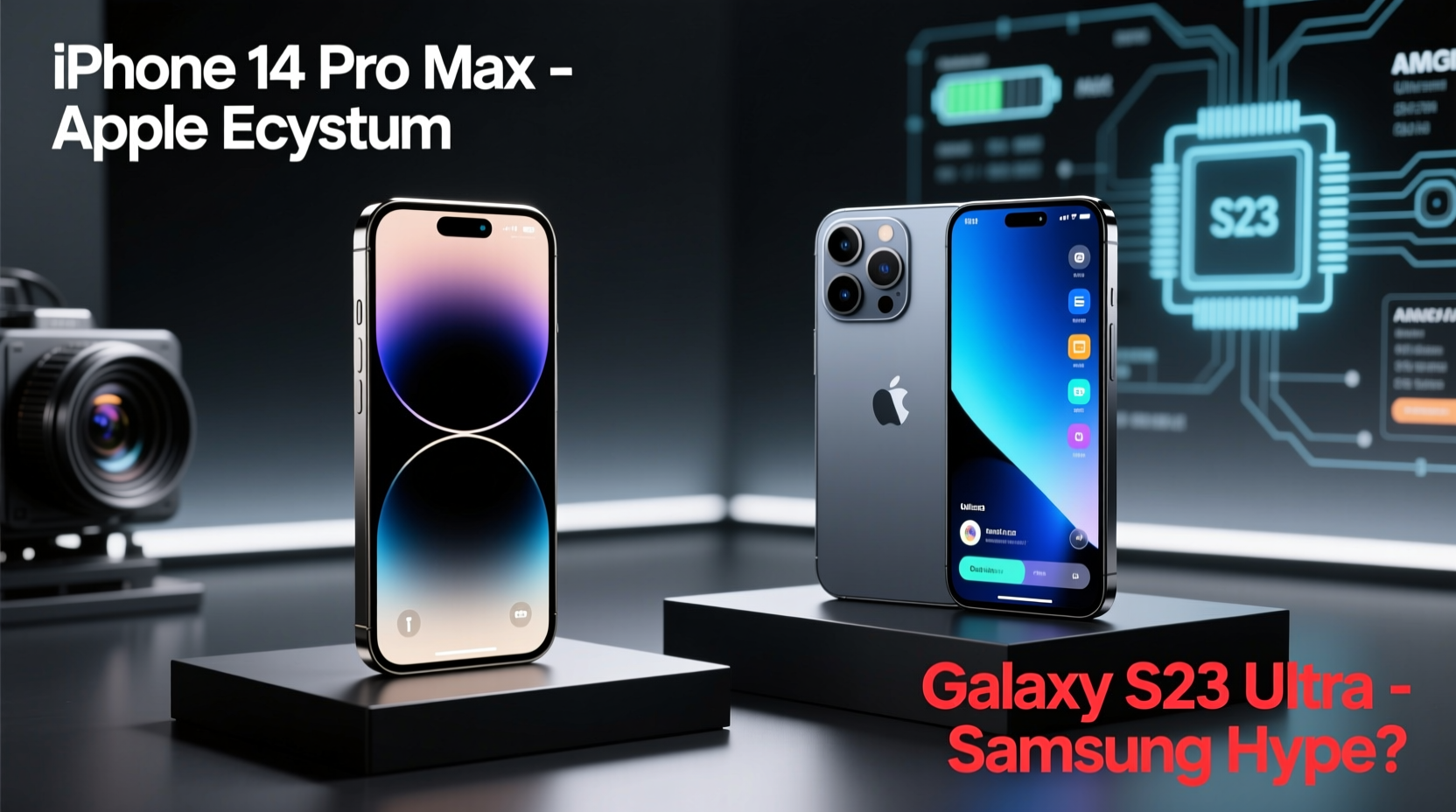
Choosing between the iPhone 14 Pro Max and the Galaxy S23 Ultra isn’t just about brand loyalty—it’s about deciding which device aligns best with how you live, work, and create. Apple and Samsung continue to push boundaries in their respective ecosystems, but the differences go beyond specs. This comparison dives into real-world performance, ecosystem integration, camera quality, longevity, and user experience to answer a growing question: Is Samsung’s flagship dominance overhyped, or is it time to consider switching from Apple?
Design and Build: Premium Feel, Different Philosophies
The iPhone 14 Pro Max embraces Apple’s minimalist design language—flat edges, surgical-grade stainless steel frame, and Ceramic Shield front cover. It feels dense and premium, though its 240g weight can become noticeable during extended use. The Dynamic Island, replacing the notch, adds functionality by integrating notifications and live activities, making it more than just a design tweak.
In contrast, the Galaxy S23 Ultra opts for a bolder aesthetic with sharper corners, a titanium-reinforced aluminum frame, and Gorilla Glass Victus 2 on both sides. At 234g, it’s slightly lighter despite housing a larger 6.8-inch display. Its flat screen and boxy profile appeal to users who prefer precision and productivity, especially with the integrated S Pen—a feature absent from any iPhone.
Tip: If you value stylus input for notes, sketches, or precise control, the S23 Ultra’s built-in S Pen gives it an edge no iPhone can match.Display and Performance: Brightness vs. Efficiency
Both phones feature top-tier displays, but they serve different purposes. The S23 Ultra’s 6.8-inch QHD+ Dynamic AMOLED 2X panel runs at up to 1750 nits peak brightness and supports a variable 1–120Hz refresh rate. It’s ideal for media consumption, outdoor visibility, and creative tasks requiring color accuracy.
The iPhone 14 Pro Max uses a 6.7-inch Super Retina XDR OLED with ProMotion (10–120Hz adaptive refresh). While slightly smaller, it excels in color calibration and power efficiency thanks to Apple’s custom silicon. True Tone and Always-On Display (introduced in iOS 16.1) enhance usability without draining the battery excessively.
Under the hood, Apple’s A16 Bionic chip remains one of the most efficient and powerful mobile processors ever made. In raw CPU tasks, it outperforms the Snapdragon 8 Gen 2 (used in the S23 Ultra) in single-core benchmarks. However, Samsung’s device handles sustained workloads—like gaming or video editing—better due to superior thermal management and larger cooling systems.
“While Apple leads in peak performance per watt, Samsung has closed the gap in real-world multitasking and thermal endurance.” — David Chen, Mobile Hardware Analyst at TechPulse Insights
Camera Comparison: Versatility vs. Consistency
This is where preferences truly diverge. The iPhone 14 Pro Max delivers reliable, true-to-life photos across all lenses. Its 48MP main sensor captures exceptional detail in daylight, while computational photography ensures balanced HDR and natural skin tones. Low-light performance is excellent, and the new Photonic Engine improves mid-range lighting significantly.
The S23 Ultra takes a different approach: extreme zoom capability. With a 200MP main sensor, 10x optical zoom, and 100x digital zoom, it dominates in telephoto reach. Its AI-powered processing enhances distant subjects better than any competitor. For landscape photographers or wildlife enthusiasts, this flexibility is unmatched.
However, some critics argue that Samsung’s aggressive sharpening and saturation can make images look artificial. Apple, by contrast, prioritizes consistency and color science that matches professional workflows.
| Feature | iPhone 14 Pro Max | Galaxy S23 Ultra |
|---|---|---|
| Main Sensor | 48MP (f/1.78) | 200MP (f/1.7) |
| Telephoto Zoom | 3x optical | 10x optical, 3x periscope |
| Ultra-Wide | 12MP (f/2.2) | 12MP (f/2.2) |
| Video Recording | 4K Dolby Vision HDR | 8K@30fps, HDR10+ |
| Low-Light Performance | Excellent (Photonic Engine) | Very Good (Nightography) |
Real Example: Travel Photographer’s Dilemma
Consider Maya, a travel content creator who shoots daily vlogs and stills across Southeast Asia. On her trip to Bali, she tested both devices. The S23 Ultra allowed her to capture temple carvings from a distance without disturbing ceremonies. But when editing footage later, she found the iPhone’s Log video encoding easier to grade in Final Cut Pro. Ultimately, she kept the iPhone as her primary rig because of seamless iCloud syncing and editing workflow—despite admiring the S23 Ultra’s zoom prowess.
Battery Life and Charging: Endurance Meets Ecosystem
The S23 Ultra packs a 5000mAh battery and consistently lasts 12–14 hours under heavy mixed use. Fast charging (45W) brings it from 0 to 50% in under 20 minutes, though the charger is sold separately. Wireless and reverse wireless charging add convenience.
The iPhone 14 Pro Max, with its 4323mAh battery, achieves similar endurance—around 11–13 hours—thanks to the A16’s efficiency. However, charging tops out at 20W wired (slower), and MagSafe introduces new accessories but doesn’t drastically improve speed. Where Apple wins is ecosystem-level optimization: Background app refresh, location services, and notification grouping are finely tuned to preserve battery over days of moderate use.
Tip: If fast recharge is critical, the S23 Ultra offers quicker recovery. But if you rely on consistent day-to-day battery behavior, iOS optimization may feel more predictable.Ecosystem and Longevity: Lock-In vs. Flexibility
Staying with the iPhone makes sense if you own other Apple products. Handoff, AirDrop, iMessage, FaceTime, and iCloud sync operate seamlessly. Upgrades are straightforward, and iOS updates are guaranteed for five years—longer than most Android OEMs.
Samsung offers robust software support too—four generations of Android OS upgrades and five years of security patches—but fragmentation across carriers and regions can delay updates. Still, the S23 Ultra integrates well with Windows PCs via Link to Windows, and DeX mode transforms it into a desktop-like interface, appealing to professionals.
Switching from iOS to Android requires relearning gestures, app alternatives (e.g., iMessage → RCS/WhatsApp), and accepting less uniform backup solutions. However, Samsung provides excellent migration tools through Smart Switch, minimizing friction.
Checklist: Should You Switch from iPhone to S23 Ultra?
- ✅ Need a stylus for drawing, note-taking, or precise editing?
- ✅ Want superior zoom for photography?
- ✅ Prefer faster charging and broader file system access?
- ✅ Use Windows or non-Apple laptops regularly?
- ✅ Open to using alternative messaging apps instead of iMessage?
If you answered “yes” to three or more, the S23 Ultra deserves serious consideration.
Frequently Asked Questions
Can the Galaxy S23 Ultra replace my iPad and laptop?
Not fully, but DeX mode allows desktop-style multitasking when connected to a monitor. With the S Pen and keyboard, it handles email, documents, and light design work effectively. For full productivity, however, a dedicated computer is still recommended.
Does the iPhone 14 Pro Max have better video quality than the S23 Ultra?
Yes, especially for creators. The iPhone records in Dolby Vision HDR by default, offering richer dynamic range and smoother grading in post-production. The S23 Ultra supports 8K but lacks Apple’s end-to-end video optimization from capture to playback.
Which phone will last longer in terms of software updates?
Both offer strong commitments. iPhones typically receive updates for 5–6 years. Samsung now promises 5 years of OS and security updates for the S23 series, matching Apple’s timeline—making longevity a tie.
Conclusion: Hype or Reality?
The hype around the Galaxy S23 Ultra isn’t unfounded. It’s a powerhouse built for productivity, creativity, and high-performance photography. Its S Pen, zoom capabilities, and fast charging deliver tangible advantages over the iPhone 14 Pro Max in specific scenarios.
But Apple’s strength lies in cohesion. If your life revolves around MacBooks, AirPods, and iCloud, switching disrupts a deeply optimized ecosystem. The iPhone offers unparalleled reliability, video excellence, and long-term support with minimal learning curve.
Ultimately, the choice depends not on specs alone, but on how you use your phone. For tinkerers, multitaskers, and those needing a mini workstation, the S23 Ultra delivers. For those valuing simplicity, consistency, and seamless integration, sticking with Apple remains the smarter move.
💬 Still torn between the two? Try borrowing both from a friend or visiting a store to test them side-by-side. Real-world feel often trumps spec sheets. Share your experience below—your insight could help someone else decide.








