Many households now feature a dedicated home bar—a stylish, functional space for relaxation and socializing. But for dogs, it’s also a sensory minefield: the scent of spilled wine, the clink of glassware, the lingering aroma of spirits, and the irresistible allure of unattended snacks or dropped treats. When a dog repeatedly invades this zone—nudging bottles, nosing open cabinets, or lingering near low shelves—it’s not mischief; it’s natural curiosity meeting unstructured boundaries. Traditional corrections (“No!” “Get out!”) often backfire, creating anxiety or confusion. The more effective, humane, and lasting solution lies in positive cue training: teaching your dog *what to do instead*, reinforcing calm presence elsewhere, and making the bar area itself predictably uninteresting—not forbidden, but irrelevant.
This approach aligns with modern canine behavior science. Dogs don’t understand abstract concepts like “off-limits” unless those boundaries are paired with consistent, rewarding alternatives. Positive cue training builds trust, sharpens focus, and strengthens impulse control—all while preserving your dog’s confidence and your shared peace of mind.
Why “Avoidance” Is a Misleading Goal—and What to Aim For Instead
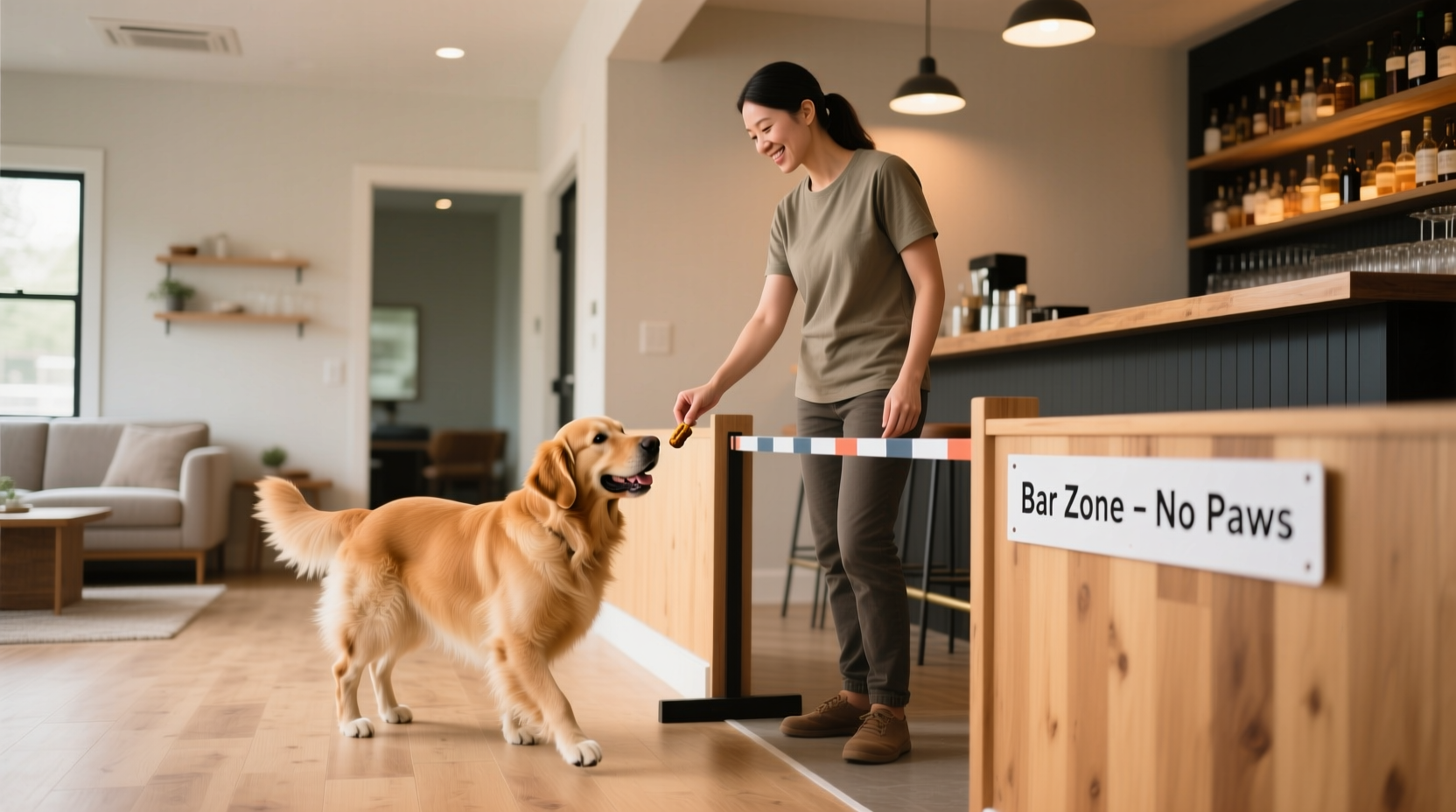
“Training your dog to avoid the bar area” sounds straightforward—but avoidance implies suppression, not understanding. A dog who backs away only because they’ve been startled or corrected may retreat when you’re watching, then return the moment you turn your back. Worse, repeated negative associations (a sharp voice, a startling noise, or even unintentional body language that reads as threatening) can make the bar area a source of low-grade stress—even if the dog never enters it.
What works reliably is contextual choice: helping your dog learn that staying calmly in their designated spot near the bar yields better outcomes than investigating the counter. This isn’t about fear or obedience—it’s about clear communication and reinforced preference.
Dr. Sarah Wilson, certified applied animal behaviorist and co-author of Every Dog Has a Plan, explains: “Dogs don’t generalize well from ‘don’t do X’ to ‘do Y instead.’ If we want reliable, joyful compliance, we must teach the replacement behavior explicitly—and reward it more generously than the default action.”
Step-by-Step Positive Cue Training Protocol (4-Week Progression)
This method assumes your dog already knows basic cues like “sit,” “stay,” and “come.” If not, begin with those first. All sessions should be brief (3–5 minutes), upbeat, and conducted when your dog is calm—not right after walks or meals. Use high-value treats (small pieces of cooked chicken, freeze-dried liver, or commercial training treats) exclusively for bar-area work.
- Week 1: Establish the “Bar Zone” as Neutral Ground
Do not yet restrict access. Instead, walk your dog past the bar several times daily while casually dropping a treat on the floor *just outside* the bar perimeter (e.g., 3 feet away). Say nothing—just toss, step away, and ignore. Repeat 5x/day. Goal: decouple the bar from excitement or tension; associate proximity with relaxed, automatic reward. - Week 2: Anchor the “Go to Mat” Cue Near the Bar
Place a small, distinct mat (e.g., a rubber yoga mat or textured rug) 4 feet from the bar entrance. Practice “go to mat” in neutral rooms until your dog reliably trots there and lies down. Then, practice at the bar location—toss a treat onto the mat, say “mat,” and reward the moment all four paws land. Gradually increase duration (from 2 seconds to 20 seconds) using a quiet “yes” marker and treat. Never lure *into* the bar zone—only *onto the mat beside it.* - Week 3: Introduce Controlled Distraction & Reward Timing
With your dog on the mat, simulate bar activity: open a cabinet door, pour water into a glass, or shake a cocktail shaker—*without looking at your dog*. If they remain on the mat, mark (“yes”) and deliver a treat *at the mat*. If they stand or look toward the bar, quietly pause the activity, wait 2 seconds, and re-cue “mat.” No correction—just reset. Do 3 short sessions/day. Success = 80% stays during mild activity. - Week 4: Add Real-World Cues & Fade Lures
Now incorporate everyday bar use. Before pouring a drink, say “mat” and point to the mat. Reward generously for immediate response. If your dog hesitates, gently guide them *to the mat* (not away from the bar)—then reward. Phase out pointing by Week 4’s end. Introduce a new verbal cue for the bar’s “off-limits” boundary: “bar zone” said calmly as you step *just inside* the threshold. Your dog doesn’t need to respond—but hearing it consistently while you’re in the space reinforces the context.
Do’s and Don’ts: Setting Up for Long-Term Success
Environmental design matters as much as training. A well-structured space reduces temptation and supports your dog’s ability to make good choices. Use this table to audit your setup:
| Action | Do | Don’t |
|---|---|---|
| Bar Surface Access | Install child-safety latches on lower cabinets; keep countertops fully cleared *before* training begins. | Rely solely on verbal “no” to prevent counter-surfing—dogs rarely generalize across locations. |
| Treat Management | Store human snacks and dog treats in sealed containers *outside* the bar area—never on open shelves. | Leave fruit bowls, nut dishes, or candy jars within nose-height reach—even if “just for tonight.” |
| Mat Placement | Choose a non-slip, visually distinct mat placed where your dog has full view of the room—never tucked behind furniture. | Use a throw pillow or blanket that blends in; dogs struggle to identify ambiguous targets. |
| Consistency | All household members use the same cue (“mat”), same reward timing, and same mat location—no exceptions. | Let one person “relax the rules” on weekends—this erodes reliability faster than any single mistake. |
Real Example: Maya, a 3-Year-Old Rescue Terrier Mix, and Her Home Gin Bar
Maya’s owners installed a sleek, open-shelved gin bar in their living room. Within days, she was standing on her hind legs, nudging bottles with her nose, and licking condensation off glasses. Correction attempts escalated—shouting, blocking her path, even spraying bitter apple spray on the shelf edge. Maya stopped approaching the shelf—but began whining and pacing nearby, tail low, ears back.
They paused corrections and began the positive cue protocol. They chose a bright blue rubber mat placed 3.5 feet left of the bar, directly in Maya’s line of sight from her favorite sofa. In Week 1, they dropped tiny bits of roast beef near the mat while scrolling on phones—no interaction. By Day 4, Maya would trot to the mat unprompted when she heard the cabinet door creak. In Week 2, they added “mat” as a cue—and rewarded her for lying down, even for 3 seconds, while they filled a shaker with ice. By Week 3, Maya stayed on the mat through full cocktail prep, eyes soft, tail thumping gently. Her owners now say “mat” once before pouring wine, and she settles in 2 seconds—then receives a chew toy *on the mat* while they enjoy their drink. The bar is no longer a battleground. It’s simply part of the background—where Maya chooses calm over curiosity, every time.
Essential Tools & Environmental Tweaks You’ll Need
You don’t need special gear—but thoughtful tools accelerate success. Here’s what makes a measurable difference:
- A dedicated, non-slip training mat: 24\" x 36\" minimum, with texture (rubber dots or woven fibers) so your dog feels grounded—not a flat towel or rug that slides.
- Two-tier treat system: High-value treats (freeze-dried liver) for active training; lower-value chews (bully sticks, dental chews) for passive reinforcement *while you’re at the bar*. This teaches sustained calm—not just quick compliance.
- Cabinet safety hardware: Magnetic child locks (like those from Munchkin or Safety 1st) that require two hands to open—eliminating accidental access without visual clutter.
- A “bar zone” visual cue: A subtle floor tape line (3M ScotchBlue painter’s tape in navy or charcoal) marking the boundary. Not for your dog to see—but for *you* to remember where the respectful distance begins.
- Odor management: Wipe spills immediately with vinegar-water (1:1) to neutralize residual sugar and alcohol scents that trigger investigation. Avoid citrus-based cleaners—many dogs find them aversive and may avoid the entire area.
“The most powerful cue isn’t spoken—it’s the environment itself. When a dog learns that ‘the space near the bar’ reliably predicts ‘my mat, my chew, my person’s calm attention,’ they stop asking permission to enter—and start choosing comfort instead.” — Dr. Lena Torres, DVM, Veterinary Behavior Specialist, UC Davis School of Veterinary Medicine
FAQ: Addressing Common Concerns
What if my dog is food-motivated but ignores treats near the bar?
This signals over-arousal—not defiance. Pause training for 3 days. During that time, feed all meals *on the mat*, far from the bar. Then restart Week 1 with higher-value treats (e.g., slivers of cheese or hot dog) and shorter sessions (90 seconds max). Never force proximity—step back 6 feet, then gradually close the distance over multiple days.
Can I use a crate instead of a mat?
Only if your dog already loves their crate and enters willingly *without pressure*. Crates should never be used as punishment zones or forced confinement near tempting areas. A mat teaches voluntary choice; a crate teaches containment. For long-term bar-area harmony, choice-based training is more sustainable and less stressful.
How long until this becomes automatic?
Most dogs show reliable response within 18–22 days of consistent practice (5 minutes, 3x/day). Full fluency—where your dog self-selects the mat during spontaneous bar use—typically takes 5–7 weeks. Patience pays: dogs trained this way maintain reliability for years, not weeks.
Conclusion: Building Trust, One Calm Choice at a Time
Training your dog to avoid the home bar area isn’t about enforcing a rule—it’s about cultivating mutual respect. It’s recognizing that your dog’s nose knows more than your words can convey, and meeting that instinct with clarity, kindness, and consistency. When you replace correction with cue, avoidance with choice, and tension with trust, you’re not just protecting your bar—you’re deepening your bond. You’re teaching your dog that the best things in life aren’t behind closed doors or on high shelves—they’re right beside you, on a blue mat, in a moment of shared calm.
Start today—not with a command, but with a treat dropped just outside the bar’s edge. Watch your dog’s head tilt, their tail lift, their body soften. That’s the first sign they’re beginning to understand: this space isn’t off-limits. It’s simply not where the good things happen. And that, more than any barrier or boundary, is the foundation of true harmony.
💬 Have you trained your dog to respect a specific zone in your home? Share your cue, your biggest win, or your “aha” moment in the comments—we’re building a community of calm, confident cohabitation.








