Estimating a puppy’s age is often essential for responsible care—whether you’ve adopted a rescue, found a stray, or simply want to understand your pet’s developmental stage. While dental development is a common benchmark, it has limitations, especially in mixed-breed puppies or those with unknown backgrounds. Relying solely on teeth can lead to inaccurate assumptions. A more holistic approach considers multiple factors including size, coat changes, eye clarity, behavior, and skeletal development. By combining these indicators, caregivers and veterinarians can form a far more accurate picture of a puppy’s true age.
Physical Development: Size and Proportion Clues
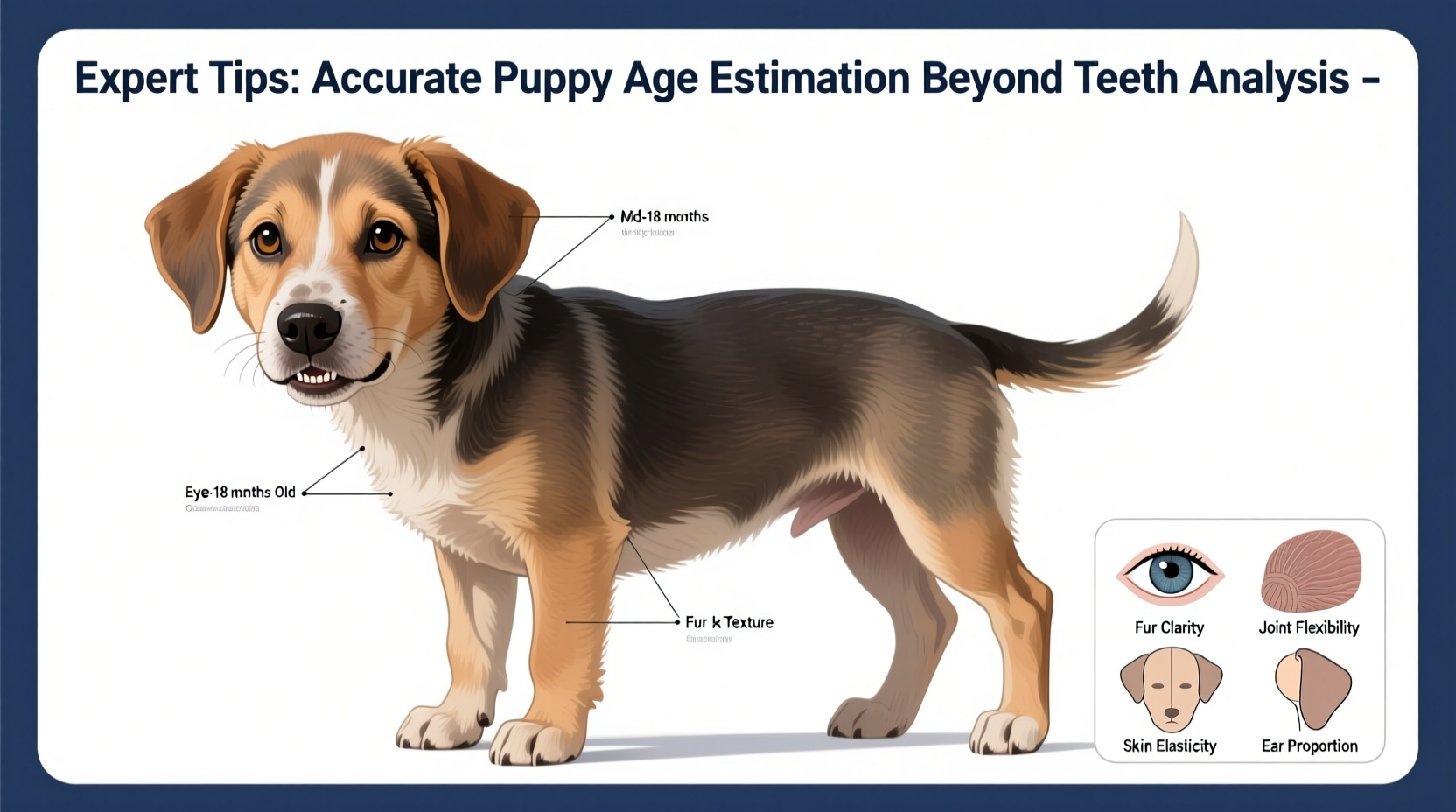
A puppy’s growth isn’t linear—it follows predictable phases based on breed size. Small breeds mature faster than large or giant breeds, which continue growing well into their second year. Observing body proportions offers insight into developmental milestones.
For example, most puppies are about half their adult weight by 4 months if they’re small or medium breeds. Larger breeds reach this point closer to 6 months. By 6–8 weeks, puppies typically double their birth weight. Monitoring weekly growth patterns—even without precise records—can help narrow the age range.
Tip: Compare your puppy’s current weight to average breed-specific growth charts. Even if the breed is unknown, general size category (small, medium, large) provides useful context.Limb length relative to body size also matters. Young puppies have disproportionately short legs and round bellies. As they approach 12–16 weeks, limbs begin to elongate, giving them a lanky appearance typical of adolescence. This “gangly phase” usually peaks between 4 and 7 months.
Coat and Eye Changes as Age Indicators
A puppy’s coat undergoes several transitions during early life. Most are born with a soft, downy puppy coat that begins shedding between 12 and 16 weeks. The timing varies slightly by breed, but the emergence of a coarser, denser adult coat is a reliable sign that the puppy is entering mid-to-late juvenile stages.
Observe texture and shedding patterns. If you notice active shedding and new guard hairs emerging, the puppy is likely at least 3 months old. Conversely, a uniformly soft, fluffy coat with no undercoat suggests an age under 10 weeks.
Eyes offer another clue. Newborn puppies open their eyes around 10–14 days after birth. Initially, their eyes appear cloudy or bluish due to incomplete iris pigmentation. Over the next few weeks, the color gradually deepens and stabilizes. Permanent eye color typically sets in by 8–12 weeks. If a puppy still has light blue or grayish eyes, especially with a hazy sheen, it’s likely under 8 weeks old.
“Eye clarity and coat transition are subtle but powerful markers. A clear-eyed puppy with a maturing coat is past the neonatal stage and gaining independence.” — Dr. Lena Torres, Veterinary Behaviorist
Behavioral Milestones and Social Development
Puppies progress through distinct behavioral phases that align closely with age. These stages reflect neurological and emotional development and can be used alongside physical traits to refine age estimates.
From birth to 3 weeks, puppies are primarily focused on feeding and basic motor skills. Between 3 and 5 weeks, they begin exploring, playing tentatively, and responding to sounds. By 6 weeks, most puppies engage in active play, show curiosity, and begin learning social boundaries from littermates.
If your puppy confidently approaches people, plays with toys, and shows fear responses to loud noises, it’s likely at least 6–8 weeks old. Puppies younger than 5 weeks rarely walk steadily or interact socially beyond immediate needs.
| Age Range | Key Behavioral Traits |
|---|---|
| 0–3 weeks | Limited mobility, sleeps most of the time, relies entirely on mother |
| 3–5 weeks | Begins crawling, then walking; starts vocalizing; reacts to sound |
| 6–8 weeks | Plays actively, eats solid food, responds to name, shows fear reflexes |
| 9–12 weeks | Highly curious, learns commands, may show separation anxiety |
| 13–16 weeks | Teething peak, increased chewing, begins testing boundaries |
Step-by-Step Guide: Estimating Puppy Age Without Teeth
Follow this systematic process to assess your puppy’s age using non-dental clues:
- Assess mobility: Can the puppy walk steadily? If wobbly or unable to stand, age is likely under 3 weeks.
- Check eye clarity: Are the eyes fully open and clear? Cloudiness suggests under 4 weeks.
- Observe coat type: Is it soft and fluffy or transitioning to coarse? Change begins at ~12 weeks.
- Evaluate social behavior: Does the puppy seek interaction or hide? Active engagement points to 6+ weeks.
- Monitor eating habits: Is the puppy eating solid food independently? Weaning typically completes by 7–8 weeks.
- Measure size progression: Estimate growth trajectory using breed-size averages if possible.
- Note coordination: Tripping or clumsy movements suggest under 5 weeks; smooth gait indicates older.
Real-World Example: Assessing a Rescue Puppy
In spring 2023, a rescue group in Colorado took in a small mixed-breed puppy found near a rural trail. The team had no information about its birth date. The puppy walked steadily, played with foster kittens, ate kibble, and had mostly clear brown eyes—though one retained a faint blue tint at the rim. Its coat was soft but beginning to thicken along the back.
Using behavioral cues—confident exploration, response to voice, playful biting—they ruled out under 6 weeks. Eye pigmentation suggested it hadn’t yet reached 12 weeks. Coat transition was just starting, pointing to early adolescence. Based on size (2.8 lbs), it was consistent with a small breed at approximately 8–9 weeks old.
The vet concurred, estimating 8.5 weeks based on overall development. The puppy received appropriate vaccinations for that window and began training shortly after. Accurate age estimation ensured proper nutrition, socialization timing, and medical care.
Common Mistakes and What to Avoid
- Mistaking small size for young age: Toy breeds remain tiny for months. Always consider potential breed influence.
- Over-relying on weight alone: Malnourished puppies may be older but underweight. Combine with behavior and development.
- Ignoring environmental context: A fearful puppy may act younger than it is due to trauma, not age.
- Assuming all puppies develop at the same rate: Genetics, health, and prenatal conditions affect growth speed.
“Age estimation isn’t an exact science, but cross-referencing multiple signs dramatically improves accuracy—especially when teeth are missing or damaged.” — Dr. Rajiv Mehta, Shelter Medicine Specialist
Quick Checklist: Signs by Age Bracket
Use this checklist to quickly evaluate key indicators:
- Under 3 weeks: Eyes closed or just opened, cannot walk, purely dependent on milk.
- 3–5 weeks: Eyes open and cloudy, crawls then walks, begins vocalizing, sleeps frequently.
- 6–8 weeks: Walks well, eats some solids, plays briefly, responds to sounds and names.
- 9–12 weeks: Clear eye color, sheds puppy coat, highly curious, learns quickly.
- 13–16 weeks: Adult coat emerging, increased chewing, tests rules, grows rapidly.
Frequently Asked Questions
Can I estimate age if the puppy is malnourished?
Yes, but with caution. Malnutrition can delay both physical and behavioral milestones. Focus on developmental capabilities—like walking or social response—rather than size. A vet exam is crucial in such cases to rule out stunted growth.
What if the puppy has no baby teeth?
Teeth can be lost due to injury or disease. In such cases, rely more heavily on eye clarity, coat changes, and behavior. A veterinarian may use X-rays to check growth plate closure in bones, which correlates with age.
Do mixed-breed puppies develop differently?
They can, depending on genetic mix. However, broad developmental timelines (e.g., eye opening, weaning, coat change) remain consistent across breeds. Use size category (small, medium, large) as a guide for growth pace.
Final Thoughts and Next Steps
Accurately estimating a puppy’s age goes far beyond examining teeth. By observing physical traits like coat texture and eye clarity, understanding behavioral milestones, and considering size progression, you gain a multidimensional view of your puppy’s development. These insights ensure timely vaccinations, appropriate nutrition, effective training, and proper socialization—all critical to raising a healthy, well-adjusted dog.
🚀 Take action today: Record your puppy’s behaviors, take weekly photos, and consult your vet with your observations. Sharing detailed notes helps professionals provide better guidance and confirms your age estimates with medical insight.








